THE BRIDE – Hildur Guðnadóttir
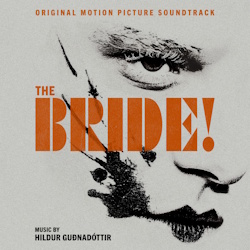 Original Review by Jonathan Broxton
An ambitious, audacious, controversial, and polarizing film from actress-turned-director Maggie Gyllenhaal, The Bride is a genre-bending combination of classic Gothic horror and old Hollywood gangster movies. Very loosely – and I do mean very loosely – based on both the 1818 novel Frankenstein by Mary Shelley and the 1935 film The Bride of Frankenstein directed by James Whale, it stars Christian Bale as the monster from the original novel who has, after a century of wandering, found himself in Chicago in 1936 and is now simply calling himself Frank. With the help of scientist Dr. Cornelia Euphronious (Annette Bening), Frank successfully reanimates the corpse of gangster’s moll Ida (Jessie Buckley), who was recently killed by the mob after unwittingly revealing the criminal activities of crime boss Lupino while possessed by the ghost of Mary Shelley. Frank convinces Ida – who has lost her memory – that she is his wife, but when the pair go on a crime spree, they are forced to go on the run with the police in hot pursuit. Just go with it.
The film has an excellent supporting cast, including Penélope Cruz, Maggie’s brother Jake Gyllenhaal as matinee idol Ronnie Reed, and Maggie’s husband Peter Sarsgaard as the lead detective, and it looks wonderful from a design point of view. However, mainstream reviews have not been kind, with critics calling it everything from “the cinematic equivalent of a mad scientist’s experiment” to “a hot mess,” “a crushing disappointment,” and “an intellectual joyride without the joy.”
The score for The Bride is by the everything-winning Icelandic composer Hildur Guðnadóttir, who was actually a fairly late replacement for Gyllenhaal’s original choice, Jonny Greenwood, who dropped out for reasons still to be fully explained. I have been very open about the fact that, for the most part, I have found very little of Guðnadóttir’s music to be of cinematic value. I’m not going to revisit my reviews of Joker, Tár, A Haunting in Venice, or Chernobyl here, as my writing is readily available for all to read, both on this website and elsewhere. So, with that in mind, I am now writing what is perhaps one of the most surprising things I have written in quite some time: I thought this score was excellent, and for me it’s easily the best of Guðnadóttir’s career to date.
 Last year Guðnadóttir wrote the music for Hedda, which reimagined the Ibsen play Hedda Gabler and shifted it from 19th-century Norway to 1950s Britain. For that film, Guðnadóttir wrote a mostly jazz- and percussion-driven score that captured the sound of British jazz, combined with orchestral elements in the experimental style of composer Cornelius Cardew. The score for The Bride feels very much like a continuation of that approach and is a broad, bold, sometimes raucous work that blends her familiar cello-based orchestral minimalism with a healthy dose of electronica, rock guitars, and drums.
The resulting work is really quite superb; the orchestral writing feels authentic and is rich and engaging, although at times the more introverted and understated cello writing gives off a different emotional tone that appropriately addresses the inherent tragedy at the heart of Ida’s story. Meanwhile, the rock guitars give the whole bloody affair a deliberate punk/grunge edge that effectively captures the anarchic chaos that Frank and Ida leave in their wake.
Cues like the opening “The Fall,” “Aren’t You Curious,” and the rollicking “Gotta Get Out of Here” fully embrace the punk rock mentality with a wild, thrashing, violently destructive sound that grabs you by the lapels and doesn’t let go. Some might find this sound ear-splittingly aggressive and obnoxious, but as a fan of 1980s rock and punk, I have always found it quite thrilling, and that is very much the case here as well. Renowned guitarists Amedeo Pace (of Blonde Redhead) and Lee Ranaldo (of Sonic Youth) are among the notable performers, working alongside Hildur’s brother Tóti Guðnason.
On the other side of the coin, the more strongly orchestral passages – heard in cues like “Reinvigoration,” the four statements of the traditionally beautiful “Love Theme,” and the excellent “The Fountain” – feature full orchestrations, a rich and varied sound palette, and properly developed thematic material with a clear sense of drama and classical romance, albeit one that is occasionally undercut by crunching electronic distortions in the mix. There is also a curious playfulness bordering on innocence in some of the light pizzicato textures that Guðnadóttir employs, which perfectly captures Ida’s confusion as she awakens to her new life. By the fourth iteration, “Someone Oughta Cut Your Fucking Tongue Out,” however, the emotional weight of the cello writing is palpable, seething with barely suppressed anger.
“Ida Rather Been Called Something Else” uses choppy, thrusting cello rhythms and more anguished string writing beneath the main theme to drive the music toward something far more dramatic; the church organ interlude in the middle gives the cue an unexpected religioso tone that I appreciated. There is a coolly detached atmosphere to the combination of strings and restrained guitars in “Wiles Talks/Obliterated” that reminds me of the work Elliot Goldenthal was doing on scores like Heat in the 1990s. A strong sense of tragic romance permeates “Til Death Do Us Part,” which rises to powerful heights in its finale. These ideas carry through the penultimate pair, “Just The Bride” and “I Would Prefer Not To,” before the conclusive “Til the End of Time” brings the score to a soaring close steeped in rich Gothic romanticism.
As much of the film takes place in nightclubs and jazz halls in New York and Chicago, the soundtrack also features a number of period songs performed in-character by Jake Gyllenhaal as Ronnie Reed, a popular Hollywood matinee idol and singer who is idolized by Frank. The songs are standards written by George Gershwin, Ira Gershwin, Irving Berlin, Mack Gordon, Billy Rose, and others, and Gyllenhaal acquits himself reasonably well, although his vocal limitations are apparent. There is also a version of the Marlene Dietrich classic “Falling in Love Again” performed in character by Jessie Buckley with a slightly unhinged energy, as well as a boisterous orchestral rendition of “Puttin’ on the Ritz,” which serves as a clear in-joke for fans of Mel Brooks, Gene Wilder, and Peter Boyle.
There are also three original songs written by Karin Dreijer and Peder Mannerfelt of the Swedish electropop band Fever Ray; “Wrong Flower (Cinematic),” “The Lake (Cinematic),” and “Wanna Sip” are all offbeat, theatrically melodramatic, and spikily idiosyncratic. I enjoyed them in much the same way that I enjoy artists like Kate Bush, early Cyndi Lauper, Björk, or Siouxsie Sioux – your mileage may vary.
Overall, as I said, I personally think that The Bride is the best score of Guðnadóttir’s career to date, by a considerable margin. My past criticisms of her work have largely centered on a perceived lack of dramatic narrative, emotional depth, and stylistic variety; combined with the fact that her music has often not aligned with my personal tastes, this has perhaps made me seem overly critical of her work. But here’s the thing – I go into every new Guðnadóttir score with high hopes. I want the music to be great. I want what she writes to move me, excite me, and take me on a cinematic journey that reflects the full range of great storytelling. And, with this score, she has done exactly that. Guðnadóttir has said she wanted the wedding march for The Bride to be “monstrous and intimate, punk and classical, romantic and roaring, all at once, a sonic rollercoaster,” and that ambition has very much been realized.
Buy the Bride soundtrack from the Movie Music UK Store
Track Listing:
- The Fall (1:57)
- I’ve Got a Feeling I’m Falling (written by Thomas Waller, Harry Link, and Billy Rose, performed by Jake Gyllenhaal feat. Vince Giordano and the Nighthawks) (3:16)
- Aren’t You Curious? (1:36)
- Reinvigoration (1:25)
- Love Theme #1/You Have an Amazing Vocabulary (1:04)
- Cooking Breakfast for the One I Love (written by Billy Rose and Henry Tobias, performed by Jake Gyllenhaal feat. Vince Giordano and the Nighthawks) (3:15)
- Wrong Flower (Cinematic) (written by Karin Dreijer and Peder Mannerfelt, performed by Fever Ray) (4:35)
- The Lake (Cinematic) (written by Karin Dreijer and Peder Mannerfelt, performed by Fever Ray) (4:26)
- Things Are Looking Up (written by George Gershwin and Ira Gershwin, performed by Jake Gyllenhaal) (3:08)
- Wanna Sip (written by Karin Dreijer and Peder Mannerfelt, performed by Fever Ray) (3:29)
- Gotta Get Out of Here (0:58)
- Love Theme #2/I Don’t Know Where I Live (1:25)
- Knock, Knock (1:19)
- Falling in Love Again (Can’t Help It) (written by Frederick Hollander and Sammy Lerner, performed by Jessie Buckley) (0:41)
- The Fountain (1:42)
- Love Theme #3/I Can’t Remember My Name (1:30)
- Puttin’ on the Ritz (written by Irving Berlin, performed by The Bride Orchestra) (2:29)
- Brain Attack (2:03)
- Love Theme #4/Someone Oughta Cut Your Fucking Tongue Out (1:20)
- Ida Rather Been Called Something Else (4:04)
- Wiles Talks/Obliterated (4:39)
- My Sin (written by Ray Henderson, B. G. DeSylva, and Lew Brown, performed by Jake Gyllenhaal feat. Vince Giordano and the Nighthawks) (4:23)
- ‘Til Death Do Us Part (1:51)
- Just The Bride (1:17)
- I Would Prefer Not To (2:01)
- ‘Til the End of Time (2:51)
- I Have to Have You (written by Leo Robin and Richard A. Whiting, performed by Jake Gyllenhaal feat. Vince Giordano and the Nighthawks) (3:04)
- Ain’tcha (written by Max Rich and Mack Gordon, performed by Jake Gyllenhaal feat. Vince Giordano and the Nighthawks) (3:01)
WaterTower Music (2026)
Running Time: 68 minutes 52 seconds
Music composed by Hildur Guðnadóttir. Conducted by Lucas Richman. Orchestrations by Jeff Atmajian and Daniel Brown. Additional music by Philip Klein. Recorded and mixed by Derik Lee, Neal Shaw and Alex Vengeur. Edited by Joseph S. DeBeasi, Jason Ruder and Katrina Schiller. Album produced by Hildur Guðnadóttir.

Shop at the Movie Music UK Store

Member of the

 MOVIE MUSIC UK