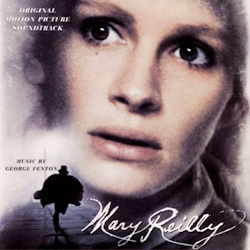
MARY REILLY – George Fenton
 THROWBACK THIRTY
Original Review byJonathan Broxton
In the mid-1990s there were a series of big-budget Hollywood films which adapted classics of the horror genre to the big screen, with the most famous being Bram Stoker’s Dracula in 1992 and Mary Shelley’s Frankenstein in 1994. One of the films which is now somewhat forgotten is this one: Mary Reilly, an adaptation of a 1990 novel by Valerie Martin, which was itself inspired by Robert Louis Stevenson’s 1886 novella Strange Case of Dr Jekyll and Mr Hyde. The twist here is that this story is told from the point of view of Henry Jekyll’s housemaid, the Mary of the title, who falls in love with her master, but then makes an enemy in the form of Jekyll’s “assistant,” Edward Hyde. The film stars Julia Roberts as Mary, John Malkovich as Jekyll and Hyde, and has an excellent idiosyncratic supporting cast that includes Michael Sheen, Glenn Close, and Michael Gambon, plus British TV stalwarts like George Cole of Minder and Kathy Staff of Last of the Summer Wine. It was written by Christopher Hampton and directed by Stephen Frears, who had previously worked together on Dangerous Liaisons in 1988.
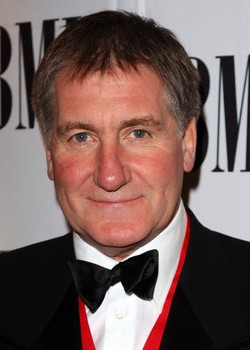
The score for Mary Reilly was by the great George Fenton, and was his 10th collaboration with director Frears following the aforementioned Dangerous Liaisons, Hero in 1992, and earlier BBC TV movies like Afternoon Off, Bloody Kids, Walter, and Saigon: Year of the Cat. Fenton wrote the score right in the middle of his mainstream Hollywood A-List career, when he was scoring three or four major studio films a year – comedies, dramas, thrillers, and more. Horror was a genre that Fenton didn’t tackle too often, although he had had early success there in 1984 with his score for The Company of Wolves; furthermore, two years previously, he had his score for Neil Jordan’s Interview With the Vampire rejected by the studio after poor test screenings. Fenton eventually re-worked portions of the unused material into a concert suite called Le Vampire, but interestingly some of the stylistics of that rejected score appear to have made it into Mary Reilly too. There are no direct thematic or melodic quotes from one to the other, but the overall ‘vibe’ of the score, with its prominent use of solo violins and gloomy classical atmosphere, is very much the same.
 The score is heavily gothic, brooding, and romantic, with a distinct melancholy feeling that captures the emotional devastation of the story and the heartrending depth of the doomed relationship between Mary and Jekyll. It is written for the London Symphony Orchestra with significant emphasis on emotional violin solos contrasted against larger symphonic arrangements. In terms of tone and mood it has haunting, despairing, dolefully beautiful sound, perfectly matching the Victorian setting with its austere production design amid shadowy, fog-covered London streets. There are stylistic echoes of Bernard Herrmann’s music for similar films, again mostly through the use of prominent strings, which gives the whole thing an intentional Golden Age sound that is very appealing.
The film’s elegant but mysterious and slightly foreboding main theme is introduced in the opening credits cue “The House of Henry Jekyll,” perfectly capturing the mood of the entire film. Fenton’s habit of contrasting a pair of violins against a larger string orchestra is very much in evidence here, much as it was in the score for The Company of Wolves, and it cleverly speaks both to the duality of Jekyll and Hyde and to the very different relationships that Mary has with the two sides of the doctor’s personality. The theme is present in a lot of the rest of the score, receiving a notably prominent performance in “The Story of the Scars,” a tender and intimate scene between Mary and Jekyll where she hesitantly shares her childhood trauma with her kind employer.
A darker, more dramatic motif for Mr. Hyde is introduced in “The Birth of Hyde,” bold brassy textures emerging out of a bank of curious, exploratory strings with great vigor and animalistic power, and then in the subsequent “The Announcement” Fenton moves the motif back over to the strings as Hyde is officially announced as Jekyll’s ‘assistant’ and his malevolent presence becomes more prominent.
More dissonant and traditionally horrific textures compete with the mournful elegance of the score’s general sound in cues like “Mary’s Errand,” “It Comes In Like the Tide” and especially the tumultuous, revelatory “Mary Meets Hyde”. The former cue underscores the shocking scene where Mary delivers a letter from Jekyll to the madam of a brothel, only to discover the aftermath of a bloody massacre there, caused by Hyde. The latter cue underscores the scene where Jekyll is forced to reveal his secret to Mary after she discovers Hyde in his bed; that, as a cure for depression, Jekyll injects himself with a serum that transforms him into Hyde, who later injects the “antidote” to resume being Jekyll. There is a clever passage towards the end of the cue where Fenton plays both the main theme and the brutal Hyde motif in counterpoint, further exploring the contrast at the heart of the story.
There’s some fantastic, dramatic interplay between solo piano and bold, striking solo violins in the superb “The Shopping Trip,” and then again in the emotionally poignant “Haffinger’s,” wherein Jekyll’s butler Poole secretly visits a chemist to try to find a permanent cure for his master’s split personality problem. “The Transformation” then underscores the shocking final scene in which Mary – having been attacked and almost killed by a deranged Hyde – actually witnesses Hyde transform back into Jekyll, after which he dies in her arms, having mixed his ‘antidote’ with poison. Fenton lays the drama on thickly here, huge banks of strings intertwined with bold, brassy clusters and rolling percussion. It’s just superb. The score then concludes with a beautiful final statement of the main theme in the “Mary Reilly (End Credits)” as she leaves the Jekyll household for good and walks away into the mist, and an uncertain future.
Fans of George Fenton’s darker and more serious scores – especially the aforementioned Company of Wolves – will find Mary Reilly to be an engaging listen. The main theme for Mary and Jekyll is a standout, a mournfully elegant piece of Gothic romance which, although never quite reaches the heights of things like In Love and War or Dangerous Beauty or Anna and the King, nevertheless remains one of his most memorable creations of the 1990s. Furthermore, his explorations of the dual nature of the Jekyll and Hyde characters, as well as the more brutal part of Hyde’s personality, allow the score to adopt some varied characteristics, which increases the scope and depth of the work as a whole.
Buy the Mary Reilly soundtrack from theMovie Music UK Store
Track Listing:
- The House of Henry Jekyll (Opening Credits) (5:15)
- The Birth of Hyde (2:11)
- The Announcement (1:43)
- The Story of the Scars (3:54)
- Mary’s Errand (2:15)
- Mrs Farraday’s (2:34)
- It Comes In Like the Tide (3:37)
- Mary Meets Hyde (3:55)
- The Shopping Trip (2:44)
- Butler’s Night Off (1:58)
- Haffinger’s (5:31)
- The Transformation (6:44)
- Mary Reilly (End Credits) (3:05)
Running Time: 45 minutes 27 seconds
Sony Classical SK-62259 (1996)
Music composed and conducted by George Fenton. Performed by the London Symphony Orchestra. Orchestrations by Jeff Atmajian and Geoffrey Alexander. Recorded and mixed by Keith Grant. Edited by Peter Mew. Album produced by George Fenton and Eliza Thompson.

Shop at the Movie Music UK Store

Member of the

 MOVIE MUSIC UK