SEND HELP – Danny Elfman
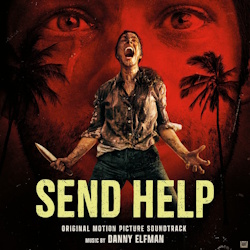 Original Review by Jonathan Broxton
It’s probably a universal experience that everyone has dealt with at some point in their lives: a terrible boss. Maybe they are a micromanager. Maybe they take credit for others’ work. Maybe they are just jerks – misogynistic, sexist, or simply bullies who revel in public humiliation, criticizing or mocking employees in front of others. In Send Help, star Rachel McAdams has to put up with all these things and more from her boss, played by Dylan O’Brien, before she is able to get revenge in the most surprising – and violent – of ways. McAdams plays Linda Liddle, a corporate strategist who is constantly belittled by her male colleagues and denied the professional respect she believes she deserves. When a company plane crashes on the way to an international business trip, she and her smug, chauvinistic boss Bradley Preston are the only survivors, washing ashore on a desert island. Stranded together, their uneasy alliance soon turns into a disturbing battle of wills in which Linda’s survival instincts begin to blur into something far darker.
The film initially presents itself as a straightforward survival thriller about two people stranded on a remote island after a catastrophic plane crash, but before long the story – written by Damian Shannon and Mark Swift of Freddy vs. Jason fame – quickly shifts gears and becomes something more mischievous and provocative: a darkly comic psychological horror story about misogyny, power, and revenge. It’s a fun, bloody romp which is, unfortunately, let down by a cop-out ending that rips off Triangle of Sadness and undermines all the points Linda was trying to make throughout the film, and arguably makes her worse than Bradley by turning her into everything she said she hated. But… you know… it’s a first-quarter movie. I had fun with it regardless.
 The score for Send Help is by Danny Elfman, Sam Raimi’s longtime musical collaborator, and was recorded in Sydney, Australia, with conductors Pete Anthony and the great Christopher Gordon. This is Elfman and Raimi’s eighth film together, their first since Doctor Strange in the Multiverse of Madness in 2022, and although the two famously clashed during the making of Spider-Man 2 (which resulted in Christopher Young scoring Spider-Man 3, as well as other concurrent projects), their more recent reunions have proven fruitful, and Send Help finds Elfman working comfortably in the strange tonal territory where he has always excelled.
Elfman’s score is unmistakably his own – quirky, theatrical, and full of sly musical jokes – and at its heart is a beautiful main theme associated with Linda, first heard in the opening cue “Linda at Home.” The melody is introduced as a delicate and haunting wordless vocal lullaby performed by Holly Sedillos, clearly inspired by Krzysztof Komeda’s famous theme for Rosemary’s Baby, and is often accompanied by gentle woodwinds and light percussion. The music conveys innocence and vulnerability while subtly hinting at Linda’s traumas and possible psychoses bubbling just beneath the surface. It is an elegant and immediately memorable idea, easily one of Elfman’s most distinctive themes in recent years.
Linda’s theme is present throughout much of the score, and to his credit Elfman subtly alters it so that it conveys different emotional shades with each new iteration, reflecting Linda’s evolving role in the narrative. It captures Linda’s heartbreak and sense of humiliation in the melancholy piano version heard in “Linda Shamed.” Later, in “Building Shelter,” the more full-bodied orchestral arrangement lends the music a sense of determination and forward motion that is really quite impressive. Elsewhere, in cues such as the tranquil “The Waterfall,” the unsettling “Hiking Together,” and “Cuddle Cave,” the theme fragments into smaller pieces, often hidden inside complex orchestrations or distorted into darker – but still identifiably Elfmanesque – shapes, full of the small compositional touches and instrumental colors that have defined his sound for almost four decades. As the character’s morality becomes increasingly ambiguous, the music mirrors that transformation, so much so that by the time the finale rolls around her theme has become quite menacing.
Beyond the central theme, the score is filled with stylistic touches that longtime Elfman listeners will instantly recognize. There are echoes of Bernard Herrmann in the tense orchestral writing of “Underwater,” while cues such as the sickly-sounding “Waiting to Die,” the thrillingly bombastic “Poison Raft,” and the gloriously gruesome “Castration” layer eerie electronic and metallic textures against more of Sedillos’s lovely vocal tones to create a sense of unsettling psychological dread. Conversely, I also like the idyllic sound of “Alone,” which reminds me a little of Basil Poledouris’s score for The Blue Lagoon. Elsewhere, Elfman indulges his darker sense of humor, notably during the oddly playful pair comprising “Toilet Wine” and “Getting Along,” which combine light woodwinds and guitars with unexpectedly sinister harmonies, creating a tone that is whimsical yet faintly grotesque.
One or two energetic action sequences also give Elfman an opportunity to unleash some muscular orchestral writing. Tracks like the vicious “The Hunt,” the full-blooded dissonance and synthetic howling of “Linda’s Nightmare,” the cacophonous “Diamond Ring,” and the wildly furious “Jungle Fight” feature pounding percussion and aggressive stabbing brass, some of which recalls the composer’s more explosive work on films such as Planet of the Apes. It’s especially impressive when Elfman injects Linda’s theme into the action material too, notably the thunderous variant during the last minute of “Jungle Fight,” in which Elfman bolsters the motif with clattering drums and screeching strings.
The album’s final stretch provides a particularly satisfying conclusion. “Strategy and Planning” begins as a seemingly sincere cue for piano and strings, offering an unexpectedly emotional reflection on the character’s journey, before being suddenly upended by an outburst of string-based violence in the cue’s final moments. “Saving Yourself” follows with a gently ironic flute-led variation of the main theme, complete with the composer’s signature wordless “la-la” vocals à la Edward Scissorhands and Batman. Finally, the “End Credits” deliver a lively rock-infused arrangement of Linda’s theme that transforms it into something approaching triumphant before resolving it in a darker, more reflective passage. A short bonus track offers yet another relaxed variation of the melody, bringing the album to a fitting close.
It’s interesting that Send Help’s core message is about female empowerment and how, when pushed far enough, a woman may violently react to aggressive and unwanted male behavior, especially considering the recent #MeToo-related legal battles in Elfman’s own life. Perhaps this was his way of addressing that a little, or making a statement about his personal feelings on the matter. Who knows? Whatever the case may be, from a musical point of view, Send Help is a hoot. There is enough of Elfman’s signature sound in the score to satisfy long-time fans, and enough new material to ensure it still sounds impressively fresh.
Buy the Send Help soundtrack from the Movie Music UK Store
Track Listing:
- Linda at Home (2:00)
- Linda Shamed (1:00)
- Underwater (1:05)
- Alone (1:47)
- Building Shelter (1:26)
- Waiting to Die (3:06)
- The Hunt (2:17)
- The Waterfall (1:31)
- Hiking Together (2:33)
- Toilet Wine (1:24)
- Cuddle Cave (0:57)
- Getting Along (2:01)
- Poison Raft (2:27)
- Castration (2:42)
- Sick Day (1:37)
- Linda’s Nightmare (2:05)
- Diamond Ring (1:31)
- Jungle Fight (3:50)
- Home Invasion (3:08)
- Strategy and Planning (3:12)
- Saving Yourself (1:15)
- End Credits (3:05)
- Bonus Track (1:59)
Hollywood Records (2026)
Running Time: 47 minutes 58 seconds
Music composed by Danny Elfman. Conducted by Pete Anthony and Christopher Gordon. Performed by the Sydney Scoring Orchestra. Orchestrations by Steve Bartek, Dave Slonaker, Edward Trybek, Sean Barrett, Benjamin Hoff, and Jamie Thierman. Special vocal performances by Holly Sedillos. Recorded and mixed by Noah Scot Snyder and Dennis Sands. Edited by Bill Abbott and Denise Okamoto. Album produced by Danny Elfman.

Shop at the Movie Music UK Store

Member of the

 MOVIE MUSIC UK