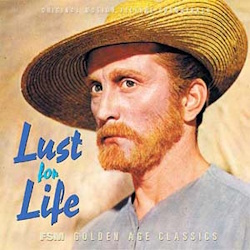
LUST FOR LIFE – Miklós Rózsa
 GREATEST SCORES OF THE TWENTIETH CENTURY
Original Review by Craig Lysy
In 1946 MGM purchased the film rights to Irving Stone’s 1934 biographical novel Lust for Life, about the tumultuous life of Dutch painter Vincent van Gogh. The contract required production within ten years or ownership would revert to Stone, but the project languished until 1954, when actor Kirk Douglas purchased the rights with the intention of starring in and producing a film adaptation. Director Vincente Minnelli also sought to make a film about Van Gogh, which had long been a passion project of his. Eventually, all parties joined in common cause and the film proceeded to production by MGM, with John Houseman in charge and a $3.23 million budget. Minnelli was tasked with directing, and Kirk Douglas would star in the lead role of painter Vincent van Gogh. Joining him would be Anthony Quinn as Paul Gauguin and James Donald as Theo van Gogh.
The film takes place circa 1873 and explores the tortured life of the legendary Dutch painter Vincent van Gogh, one of the greatest artists of the Post-Impressionist school. The young Vincent had aspirations of becoming a minister, but was deemed unsuitable by the church due to his social activism. He finds a woman whom he desperately loves, yet she rejects him as he has no job to support her. He by chance takes up painting with the financial support of his brother Theo. They move to Paris, where Vincent is exposed to the Impressionist painters of the day. However, discord with Theo leads to Vincent moving to the south of France, where he becomes friends with painter Paul Gauguin. Yet once again Vincent’s obsessive and volatile personality frays their friendship, leading to him cutting off his ear and then signing himself into an insane asylum. With the aid of Theo, he is released, returns to painting, only to be driven mad one day by crows that plague him while painting in a cornfield. Tragically, he shoots himself and dies a few days later, ending his tortured life. The film was a commercial failure for MGM, losing $2.1 million. Critical reception was mixed, with the film earning praise for its production values, but being criticized for its unexciting narrative. Nevertheless, it earned four Academy Award nominations, including Best Actor, Best Adapted Screenplay, and Best Art Direction, winning one for Best Supporting Actor.
Director Vincente Minnelli had collaborated with Miklós Rózsa on two prior films, “Madame Bovary” (1949) and “The Story of Three Loves” (1953), and believed that he was the composer best suited to score the film. Rózsa was ecstatic to take on the assignment as he would draw inspiration from an artist whom he loved. He understood that his challenge in scoring the film would be two-fold; he would have to speak to the beauty and vivid colors of Van Gogh’s art, as well as the natural beauty, which provided him inspiration. But most importantly, he understood that Van Gogh was a tortured soul, plagued by self-doubt, at war within himself, as well as with those around him. In his autobiography Rózsa relates:
“The music he (van Gogh) knew would have been that of the ’80s – Wagner, Liszt, César Franck – but I felt that mid-19th-century romanticism had little in common with his work. Somehow, I had to evolve a suitable style in terms of my own music. It had to be somewhat impressionistic, somewhat pointillistic, somewhat post-romantic and brightly, even startlingly colorful, much like his paintings”.
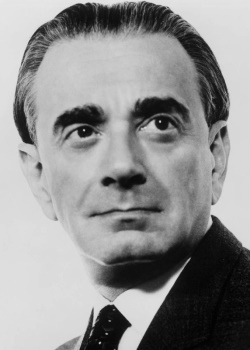 For his soundscape Rózsa composed eight primary themes, including four for Vincent, and two motifs. Rózsa understood that a multifaceted approach was required for Vincent, as he had to create a musical portrait that spoke to his intense creative fervor, but also his inner desolation. The first is the Yearning Theme, which offers one of the finest in Rózsa’s canon, and in his autobiography he states: “The ascending motif and theme, which develops from it, mirror van Gogh’s inner yearnings, and eternal search for the infinite and unreachable”.
It expresses Vincent’s eternal, restless search for the infinite and the unreachable. It is introduced during the opening credit titles and acts as a leitmotif for his longing, dissatisfaction, and his intense, desperate need to paint the beauty he saw. This theme often represents his emotional instability and inner torment. Juxtaposed is the Achievement Theme. This theme is kindred in that it is developed from the second half of the first theme. This melody highlights the moments of fulfillment, contentment, and joy Vincent found while painting outdoors, immersed in nature. It contrasts with his agony by showcasing the splendor of his artistic creation, specifically in scenes involving his work and passion. This theme reappears in a transfigured, more somber form in the final scenes of the film. Lastly, there is Vincent’s Madness Theme, which speaks to the instability and deterioration of his psyche, offering a haunting, twisted, jarring, and dissonant narrative beset by horn outbursts and weeping strings that convey his profound desolation. The fourth theme associated with Vincent is the Impressionism Theme. It is, in reality, Rózsa’s effort to translate the Impressionist painting style into music, drawing inspiration from Debussy, to evoke a sense of light and space. It often accompanies scenes of painting en plein air, capturing the vibrant, sun-drenched landscapes of Arles, functioning less as a traditional melodic composition and more as an atmospheric, textured backdrop, using orchestral colors — ranging from horn bursts to flute whispers — to match the changing mood of the scenes. It is often paired with the Achievement Theme for moments of contentment or “Light and Color” moments in the film, highlighting the brief periods of joy and achievement Van Gogh found with his act of creation.
Theo’s Theme supports Vincent’s younger brother, the most important figure in Vincent’s life. Theo was loving, nurturing, protective, and devoted, but also long-suffering, serving as Vincent’s emotional anchor and financial supporter. As such, Rózsa conceived music, which is calm, thus providing emotional counterpoint to the chaotic, tormented, and tumultuous themes surrounding Vincent’s mental health and creative struggles. Theo’s Theme is typically played by a solo cello, giving it a warm, intimate, and deeply emotional tone that contrasts with the heavier orchestral textures elsewhere. Kindred to Theo’s Theme is the intimate Brothers’ Theme, which speaks to their close filial bond, emoting with a warm, soothing, and comforting string borne expression. Christine’s Theme speaks to this woman of the streets, who lived with Vincent for two years. She brought a brief respite from his tumultuous life with an interlude of domestic tranquility, which offered a fleeting sense of fulfillment, and haven. Her theme is tender, warm, and wistful, and Rózsa expresses it intimately with cello, kindred strings, adorned with oboe, clarinet, and harp. For Paul Gauguin’s Theme, Rózsa understood that he needed to juxtapose him from Van Gogh’s turbulent music. Gauguin has a more calculated, abstract, and intellectual approach to life; as such, his theme is offered in a more controlled, confident, assertive, and sophisticated style, highlighting his role as a dispassionate, cynical yet admired artist.
Roulin’s Theme supports the affable postman Roulin, who is a warm-hearted and loyal friend to Vincent. The theme is characterized by its friendly, jovial, and slightly pompous nature, which Rózsa expresses by a solo bassoon comico. The Mine Theme arises when Van Gogh works among the poor miners. Rózsa conceived a dramatic and atmospheric piece designed to reflect the harsh, dark environment of the coal mines, which uses a brooding, and intense orchestral texture to convey the oppressive atmosphere of the mine, but also to express Van Gogh’s emotional immersion in it. To that end, the music is bleak, solemn, and claustrophobic, borne by grim horns and low-register strings. The Laborers’ Theme is associated with peasant laborers and the working poor. Rózsa offers a rugged, earthy, folk-like, and somber tone that contrasts with the more lush, impressionistic themes of his paintings. There are two motifs, the Crow Motif, which empowers the frenetic avian storm that plagued Vincent. Rózsa propels the swarming attack by creating a horrific fluttering sound using trilling woodwind descents, which intensify, buffet, and finally rattle Vincent’s psyche. The Baby Motif speaks to Vincent’s bonding with Christine’s daughter, offering a tender, child-like innocence with woodwinds delicato.
Cues coded (*) contain music not found on the album. “Prelude” offers a brilliant, and well-conceived score highlight. A stepped ascent by fanfare drammatico declarations and surging strings support the display of the MGM Lion logo. At 0:21 we flow into a grand exposition of Vincent’s Yearning Theme, which expresses his eternal, restless search for the infinite and the unreachable. The theme unfolds against the opening credits, set against a backdrop of his paintings. Rózsa masterfully expresses Vincent’s yearning with repeating, declarative strings, countered with contrapuntal horn statements. We feel a restlessness as the music never resolves, suggesting that what Vincent seeks is unattainable. At 0:52 frustration borne of unrealized striving gains potency, ascending on a crescendo appassionato, which fails to culminate and resolve, instead resuming the theme’s unfulfillment. We flow into the film proper as the four pastors of the “Belgian Committee: Messengers of the Faith” meet to decide whether to grant Vincent Evangelical rights. His application is curtly dismissed, citing that he is, unqualified. After the committee departs, one pastor calls him back and is moved by his fervent and passionate pleading to not abandon him, but instead use him. He tasks him with the most difficult ministry available, ministering to the coal miners of the Borinage province of Belgium, home of the most miserable people on earth. He says, if you are truthful in your desire to help the unfortunate, then this is where you should go.
“The Borinage” reveals a camera panning across the destitute, coal-processing and mining region of Borinage, which is cloaked in a dark pall of coal dust as the restlessness of Vincent’s Yearning Theme supports. In an unscored scene, Vincent offers a sermon, which is tone deaf in that he preaches to accept with humility their circumstances, as this is the path to God. A miner walks out, and when the sermon concludes, people depart with the same misery and hopelessness they bore when they arrived. Vincent chases after the man who left and asks what he did wrong. The miner says you offer pious bilge and although well-intentioned, you do not understand their lot. When Vincent begs to help him understand, the miner says, be here at 4 a.m. and I’ll take you to where we live out our lives, 2,000 feet below. “The Mine” reveals Vincent and the miner descending by a lift into the bowels of the coal mine. Rózsa introduces his Mine Theme, a brooding textural piece, which speaks to the claustrophobic, dark, and oppressive atmosphere of the coal mine. Yet I also discern that it emotes on a personal level, expressing Vincent’s emotional reaction to the mine. After working a shift, Vincent returns to his apartment and we segue at 1:22 into “The Evangelist” atop a vibrant, and determined rendering of Vincent’s Yearning Theme as we see him joining people in their homes, where he comforts and finally begins bonding with them.
“Disaster” offers a very well-conceived and executed cue where Rózsa masterfully enhances this terrible scene in every way. It reveals Vincent spending the day on the coal mounds extracting coal rocks from the ground coal. A dire and desperate Mine Theme erupts when the mine horn sounds three blasts, which means a cave- in. The theme propels the women with dread and urgency, who rush en masse to the mine to see if their husbands have survived. The musical narrative becomes torturous as Vincent witnesses the dead piling up, including the miner guide and a small boy. We close at 1:03 on a diminuendo of heartache and despair as Vincent begins the painful task of comforting the families who lost their husband and father. “Theo” reveals the ministers of the “Messengers of Faith” arriving for inspection. They admonish Vincent for living in poor quarters, sleeping on straw, for not wearing clean clothes, and for not being an upstanding member of the clergy. They decry his social activism, and for degrading the image and dignity of the clergy. This unleashes a tirade and scathing barrage attacking their false piety, and biblical hypocrisy of mouthing what Jesus preached, but not living it through personal action. Music enters with fury as they flee as he curses them like a madman with righteous anger. Later, Theo van Gogh arrives in Borinage in search of his brother. The townsfolk direct him and he arrives and finds Vincent living in a shack, in squalor, laying on a straw bed exhausted. Rózsa introduces Theo’s Theme, borne by woodwinds teneri, draped with harp tresses. It emotes with a calm, and warm, intimacy, which speaks of his loving concern for Vincent’s welfare. He tells Vincent that he is saddened that he has estranged himself, and asks why. Vincent responds that he still seeks their shared boyhood dreams to be someone, and work and bring something to the world. When Theo asks, “Do you think this is the answer?” Vincent wavers, frets that he is in a cage of shame, from failure, alone and plagued by fear and self-doubt.
“Brotherly Love” offers a testament to Rózsa’s gift for enhancing the emotional depth and poignancy of a scene. Theo moves closer and opens his heart, reminding Vincent that he loves him, values him, and needs his friendship in his life. He asks Vincent to come home and live with him until he can find his way. Rózsa supports the intimacy of the brother-to-brother moment with a warm, soothing, and comforting string-borne Brother’s Theme, which joins and entwines with a contrapuntal Vincent’s Yearning Theme for a profoundly moving intimate musical narrative. “Home” offers another score highlight. It reveals Theo receiving a letter from Vincent, who is staying in the family’s country home in Etten. Theo’s mind narrates the letter in which Vincent expresses contentment, happiness in his surroundings, and a renewed sense of purpose in painting. During this narration, a montage of scenes reveals Vincent painting in several beautiful natural outdoor settings. Rózsa supports this with Theo’s Theme expressed with warmth, tenderness, and gentility, in the form of a pastorale of sumptuous beauty.
“Summertime” reveals Theo’s Theme supporting him as he reads another letter from Vincent, who expresses optimism and happiness at his ever-improving artistic technique. At 0:24 a bubbling Vincent’s Theme full of joie de vivre supports as cousin Kay and her son Jan join for a summer visit. Vincent is happy, and takes Kay and Jan on a picnic, with Rózsa supporting with idyllic happiness. Yet this changes as Vincent begins to talk about his loneliness, and need for love, children, and a family. The music sours and we segue at 2:46 into “Refusal,” where he grabs her, passionately professes his love and then forcibly kisses her, pleading with her to marry him. She, with disgust, rejects him, tears herself free, and flees in terror with her son Jan. Rózsa supports Vincent’s transformation into a crazed madman with his Yearning Theme, which mutates into a corrupted, dark, obsessive, and terror-evoking form. The synergy achieved with Kirk Douglas’ acting is extraordinary and frightening. The scene was edited shorter, so the tormented ostinato from 3:16 to 3:43 died with it.
(*) “Pain!” reveals Vincent so obsessed with Kay that he barges into his father’s house and demands to speak to her. She fled the dinner table when she heard him barge past the maid. His mother leaves and he and his father talk. It goes poorly as he admonishes Vincent for being unable to support himself, let alone a wife. He adds that Kay does not love him and to take the rejection like a man. Vincent says he suffers in his love, and his father tells him to man it up and quit whining. With that Vincent says I’ll show you how I suffer and places his hand over a candle flame, saying he will not remove it until Kay is brought to him. Rózsa introduces his Madness Theme, a corrupted variant of the Yearning Theme which speaks to the instability and deterioration of his psyche, as the flame sears his palm, offering a haunting, twisted, jarring, and dissonant narrative beset by horn outbursts, shrill strings and a repeating horrific four-note ostinato. His father is appalled, yells stop, and Vincent pulls back his seared hand. We flow painfully into “Persistence” as his father discloses that Kay never wants to see him again, as she finds you, disgusting. Horns of agony, and writhing strings of anguish speak to his devastation, desolation, and despair as he departs, his psyche shattered by the intensity of Kay’s rejection. At 0:45 a grim three-note ostinato of hopelessness supports Vincent standing on a bridge and gazing into the blackened water below.
“Concertina Waltz” reveals Vincent walking into Dirk’s Tavern carried by a soft concertina melody wafting from inside. He sits, as the concertina’s strain takes him home. In “Sien” Vincent orders a brandy, and then befriends a middle-aged prostitute Christine who is drunk, and relates the misery of her life. He offers her his brandy, his sympathy and then some money as her employer delayed paying her until tomorrow. In return she examines his burnt hand and says she will clean and dress the wound, but at her house. He hesitates, but relents when she asks if he is ashamed to be seen with her. Her theme enters on clarinet tenero and a retinue of strings, with the soft and caring melody carrying their walk to her home. At 0:21 Theo’s Theme joins as we hear in Vincent’s mind him speak of her in a letter to Theo. He relates that this was a woman far from young, far from pretty, but that she was good to me, and kind. He says that they talked about her life, her troubles, her poverty, her health and her loneliness. Later at 0:43 a more optimistic Christine’s Theme rejoins as he holds her and speaks of everyone’s need for love, with interplay of Theo’s Theme draped with harp adornment. The next day in an unscored scene Vincent visits his cousin Anton Mauve, a successful painter. He asks for his critique and guidance, after he reviews his portfolio of drawings. He agrees to mentor him, and gifts him a box of watercolors and oils, plaster busts, and some money, saying that to progress as an artist, you must learn and master the technique of painting in color.
“Contentment” reveals Vincent enjoying a contented life of domestic fulfillment living with Christine. Rózsa supports with Christine’s clarinet-borne Theme voicing this contentment with a wonderful exposition, blossoming at 0:39 with lush, lyrical strings. At 0:47 the Baby Motif is introduced with tenderness, by child-like woodwinds as Vincent bonds with Christine’s little girl. At 1:02 Theo’s warm theme joins as Vincent writes a letter and we hear in his mind, him expressing his happiness and bliss in his domestic life with Christine and her daughter. At 1:24, as he expresses his love for her daughter and picks her up, the Baby Theme reprises with all its tenderness and sweetness. At 1:32 we segue into “Plein Air” carried by a breezy Christine’s Theme as we see Vincent painting her at a sandy beach awash with waves. Christine is cold and weary from modeling for his latest painting and storms off in frustration at 1:40 carried by an aggrieved Vincent’s Theme which surges on a torturous crescendo as his canvas blows away while he runs to retrieve her. We close grimly with a coda of Vincent’s Theme, which presages conflict.
“Outburst” was dialed out of the film as the director decided to let the dialogue’s intense vitriol carry the scene. Christine is haranguing Vincent that nothing he paints sells, that they are always short of food, and that she is tired of being hungry. When she ridicules him for being a painter unable to sell his paintings, he erupts in anger, empowered by a ferocious declaration of his Yearning Theme. At 0:17 we segue into “Farewell”, a score highlight of heartache and anguish. Vincent receives a letter asking him to come home as his father has had a stroke. As he packs, Christine returns carried by her clarinet-borne theme, which is rendered with sad resignation. She is unable to say what must be said, and so remains silent. At the train station as he prepares to board, she says that she is moving back in with her mother as he cannot support them. He is deeply wounded, although he gains some solace when she says that he was the only man that ever loved her and the baby and that she will be forever thankful. He kisses the baby, and then hastily boards the train already in motion. Rózsa supports the pathos of the scene with heart-breaking interplay of Christine’s Theme, and a devastating reprise of a mortally wounded Vincent’s Yearning Theme. The confluence of acting and music is profoundly moving.
“The Artist” opens with a warm Theo’s Theme and idyllic musical narrative, as we see Vincent returning to his roots — the verdant Dutch countryside. At 0:32 we are bathed in solemn religiosity as Vincent walks past a congregation departing a church, and we hear some women mocking his disheveled clothes. At 0:49 a hopeful musical narrative empowered by Vincent’s Theme supports a montage of him painting the common folk performing hard work in the fields and factory shops. At 1:44 we close with the rugged, earthy, folk-like, and somber woodwind-borne Laborer’s Theme as we see peasant laborers and the working poor struggling to make a living. One day his sister Willemien visits and informs him that his mother and the family are weary of friends criticizing his dress and behavior. He agrees to relieve the family of his burden, and disgrace and informs her he is moving in with Theo in Paris. “Impressionism” offers the Impressionism Theme, as a spritely, effervescent musical narrative of wonderment. Vincent is joyously awestruck at a gallery, which displays paintings of the new, unconventional school of Impressionism, which has caused an uproar of indignation and ridicule in the gallery patrons, and art world.
“Light and Color” offers a gorgeous score highlight. We open with a warm and welcoming Theo’s Theme as Vincent moves in with Theo, who says he will have to make a Parisian of him. Vincent is like an inquisitive schoolboy and so Theo promises to take him to meet the new, Impressionist painters as he needs to understand this new emerging style of painting. At 0:37 Rózsa again offers his vibrant, colorful and Debussian Impressionism Theme, which supports a montage of Vincent meeting the great Impressionist painters of the day, who give him insight into what their style expresses; Pissarro, says that he translates the power of light into the language of paint, taking in the totality of what you see, not the individual components, and Seurat, who uses science to precisely select the spectrum of colors he will use to paint. In an unscored scene the stress of living with Vincent causes Theo to admonish him for his behavior, selfishness, and boorish behavior with his friends and guests. He reassures Vincent of his talent, but says further development is needed, and to gain exposure and make money, he should take his paintings to the gallery dealers.
“Noble Savage” reveals Vincent having a chance meeting with painter Paul Gauguin at a gallery where he was bringing paintings to sell. The men bond after Paul defends Vincent’s style to other painters in the room. The two men leave, relax by a stream and decide to escape Paris for the verdant French countryside, where they can paint, uninhibited. Rózsa supports the intimate moment with Paul’s Theme, which is well-conceived in that it juxtaposes Vincent’s mercurial, volatile and turbulent theme. Paul has a more calculating, abstract, intellectual, and ruthless approach to life; as such his theme is offered in a more controlled, confident, assertive, and sophisticated style, highlighting his role as a cynical, yet admired artist. It is reserved, string-borne with flute adornment, the first three notes rising, followed by a descent, and operating in a narrow expressive zone. “Belief” reveals Theo arriving home with his boss and discovering a clean apartment with a note. Vincent apologizes for being a burden, disrupting his life, and is forever thankful for your kindness. He says he heads south to Arles in Provence to paint freely under open skies. Theo’s boss says good riddance and he and Theo quarrel over his art. When asked how much support is enough, we see Theo come to his defense as a very devoted brother who loves Vincent despite his flaws and tormented mind. The two men mend their discord after Theo is comforted by his boss, who says perhaps Vincent needs Arles to at last find himself. Rózsa supports with Theo’s Theme expressing his devotion and brotherly love for Vincent. At 1:46 we see Vincent arriving at Arles carried by a pensive statement of his Yearning Theme.
“Orchards” offers a beautiful and glorious score highlight. Vincent rents a flat and when he wakes up, he opens the shutters and Rózsa offers Vincent’s Achievement Theme as the camera pans the gorgeous countryside. We are graced by a pastorale with the Impressionist Theme, which blossoms with joy and a sense of wonderment. Vincent is ecstatic and inspired by the beauty of Provence with its blooming orchards, flowers, delightful streams, alight in refulgent sunlight under stunning azure skies. At 0:24 the beauty of the countryside shifts onto Vincent’s canvases and we close at 1:00 with a quote of Theo’s Theme, a musical affirmation that Theo’s faith in Vincent was justified. In an unscored scene, a quarrel with the landlord over unpaid rent, and paintings overflowing onto the landing lead to Vincent relocating. In “Postman Roulin” Vincent struggles leaving the apartment house and drops his many paintings. Roulin, the postman, turns and Rózsa introduces his theme; a friendly, jovial, and slightly pompous piece, expressed with a solo bassoon comici. The jovial man assists Vincent and the two men bond in friendship. At 0:29 we segue into “Artesiana” as they walk through town supported by a medley of traditional French folk tunes.
“The Yellow House” reveals Roulin offering to assist him in securing new lodging, with the caveat that he does the talking. He artfully secures the apartment for Vincent and music enters with Theo’s Theme rendered as a pastorale as Vincent writes to him about his new flat, and how he used most of his stipend to furnish it. At 0:11 a syncopated, buffoonish Roulin’s Theme, propelled playfully by bassoon comici, supports his arrival with chairs and a table. At 0:30 comes a sumptuous Vincent’s Achievement Theme as we see Vincent settling in and contented with his new apartment. At 0:51 we flow into “Summer” carried by a rapturous exposition of his Achievement Theme rendered with the Impressionism Theme as a pastorale, replete with fluttering woodwinds as his mind speaks of the vibrant colors that the sun-drenched countryside offers him; old gold, bronze, copper, lemon yellow, sulfur yellow, and greenish yellow. These colors flow onto his canvasses. Yet slowly, the music begins to darken as we see him consumed by his desire to paint, as he descends into obsession. At 2:51 we segue into “Mistral” as the lash of autumnal mistral winds sweeping the Rhone Valley buffet Vincent’s shutters. Rózsa sows an agitato with anxiety empowered by skin-crawling nervous strings and flutter-tongue flutes, which unsettle us. At 3:29 Vincent seeks refuge in drink at a pub, which Rózsa supports classically with chromatic piano. However, repeating descents by contrapuntal strings support Vincent’s anxiety that he is becoming consumed by his passion. The music darkens and gains an increasing frenzy swept by swirling disturbances as we see him crazed, painting at night in a hat on which candles burn, as he says he is unable to satisfy his need to paint.
Roulin arrives at the pub in the morning to deliver mail and finds Vincent passed out. He gives him a letter from Theo, and money falls out. The landlord demands thirteen francs, Roulin gives him ten and says, shut up. He then escorts Vincent out. As they walk Vincent informs him that his brother is getting married. Roulin says, a happy day then and to wish him well for him. Vincent agrees, but we see he is disturbed and goes to his apartment. Theo reads Vincent’s letter with his fiancée Johanna, and frets to find a lasting way to assist him, and says if he could only sell one of his paintings. He then remembers Gauguin and wonders if he could assist as he and Vincent bonded in Paris. He decides to solicit him going to Arles, understanding that he will have to pay off his debts. “Reunion” reveals Paul arriving in Arles and is carried by his theme. At 0:30 Paul arrives at Vincent’s apartment, and Vincent’s Achievement Theme blossoms with ecstasy as he runs to him joyously and hugs him. He shows him to a bedroom he prepared, and Paul examines three beautiful flower vase portraits, which Vincent said he painted to honor him. He takes Paul downstairs for stew, and as he prepares it, Paul is awestruck by a sea of paintings, of exceptional beauty. Paul smells and declines the stew, and then insists on bringing order to the chaos of Vincent’s apartment. Later that night after dinner, Paul creates a plan to manage finances so they do not starve at the end of each month. At 1:05 Paul’s Theme is joined by Vincent’s Achievement Theme for a wonderful exposition as the two reacquaint.
“Bliss” reveals Theo’s Theme supporting Vincent writing to him of how happy he feels now that Paul has joined him. Yet at 0:15 we flow into “Argument” empowered by the Madness Theme as conflict arises over Paul’s rational, non-emotional approach to painting, and Vincent’s passionate approach. Paul concedes to Vincent’s frustration at being cooped up and painting indoors, and tries to paint outdoors. The unrelenting mistral winds cause Paul to snap, unable to paint in such windy conditions. An argument ensues, Vincent says if you are so unhappy, leave, to which Paul replies, I would, had I the money. “Conflict” reveals Vincent later returning to the apartment. He sheepishly tries to communicate, saying Theo’s money had arrived, but Paul ignores him. Rózsa scores the scene from Paul’s perspective, using a grim rendering of his theme, which becomes more and more distressed as Paul tries to make amends, but instead makes matters worse. When Paul yells, I know what it is to be poor, but I never had a brother to support me. This causes Vincent to snap, and he throws a glass at Paul, which shatters on the wall. We flow into “Loneliness” atop a raging Paul’s Theme as he says he is leaving, throws Vincent who is blocking the door away, and says he will be back in the morning for his belongings. At 0:30, after Paul slams the door, a dissonant Vincent’s Theme dissociates and transforms into an eerie Madness Theme**.**
“Madness” offers a score highlight, which offers a testament to Rózsa’s genius. It reveals Paul walking through town**;** he hears running footsteps. Music enters with a grotesque, dissonant and tormented Yearning Theme as Paul turns to discover Vincent chasing him with a shaving blade. He is stunned, readies himself, only to have Vincent turn away in pain and depart carried by a diminuendo of agony. At 0:27 the eerie Madness Theme arises as Vincent looks up and stares at a street lamp. A grotesque E-flat clarinet supports imagery from his paintings, which display horrific, distorted figures. He stumbles into his room and a tumultuous psychic storm surges from within, unleashing a horrific crescendo torturato, which crests as he slices off his left ear, and then dissipates in agony. As good as Douglas’ acting was, it was Rózsa’s musical conception and execution that delivered the horror of the scene. Paul returns, and the police question him. He said Vincent has lost his mind and he left after they argued. The doctor declares the wound self-inflicted, and Paul is allowed to collect his things and depart.
“Crisis” reveals people gathered outside Vincent’s apartment. Roulin tries to disperse them, to no avail. A tormented Vincent wakes and hears the crowd. A man climbs up the drainspout and bangs on the shutter, which brings Vincent to the window. The crowd mocks him and the Madness Theme rises up for a horrific iteration as Vincent screams to leave him alone, to no avail. Theo visits Vincent at the hospital and invites him to return to live with him and Johanna in Paris. Vincent refuses, saying that he needs to heal himself in his own way. He advises Theo that he has self-committed to an asylum, and will write him when he is better. “Asylum” reveals Roulin seeing Vincent off on a train supported by a pathetic Yearning Theme, full of despair. As he and Theo ride in a carriage to the asylum at Saint-Rémy-de-Provence, a forlorn bass clarinet plays over a grim bass sustain. In an unscored scene, Dr. Peyron, medical director of the asylum, advises Theo in a letter that his assessment has determined that Vincent will require extended observation and treatment.
“Inertia” reveals Dr. Peyron’s medical progress note, which states that although Vincent’s progress is satisfactory, he continues to suffer from a state of chronic inertia. Rózsa supports this with the bass clarinet leading a melancholy exposition of his Yearning Theme. A new medical progress note by Dr. Peyron informs us that his condition is fair, non-violent, and that he will accommodate Vincent’s request that they return his personal effects, including his painting supplies, to his room. At 1:30 Vincent caresses his painting supplies, and his Yearning Theme arises anew like the phoenix on a crescendo gioioso as he walks to the window and gazes upon the verdant countryside bathed in wondrous golden sunshine. At 1:47 we flow into “Reaper,” soaring on the Achievement Theme as we behold a new montage of landscape paintings. Later, in his room a contented Achievement Theme plays as a nun comments that his latest painting is beautiful. She asks why there is a mower, whether it is imaginary, as I see no one outside in the field. He answers that it is a figure of death. She is taken aback, and says, “It doesn’t seem a sad death.” To which Vincent replies, “It’s not, sister. It happens in the bright daylight, the sun flooding everything in a light of pure gold.” A new progress note by Dr. Peyron informs us that Vincent’s painting is beneficial, and perhaps necessary for his recovery. The Achievement Theme flows with felicity and gentility, as we see a new opus of paintings. However, a dark, portentous undercurrent led by alto flute joins at 2:57 as Dr. Peyron warns that they must closely observe him to ensure Vincent does not return to a manic-obsessive state. The alto flute continues to lurk in the musical narrative. At 3:47 we blossom on the Achievement Theme as the camera pans one of Van Gogh’s greatest paintings, “Starry Night,” which he painted in June 1889. The painting depicts his view from the east-facing window of his asylum room at Saint-Rémy-de-Provence, just before sunrise. At 3:55 we segue with harsh discordance into “Seizure,” which reveals Vincent suffering a seizure empowered by a grotesque and writhing Madness Theme. In an unscored scene, Dr. Peyron dictates a discharge note, where he accommodates Vincent’s request to be discharged, so he may return to Paris.
“False Hopes” reveals Vincent’s reunion with Theo and Johanna, which Rózsa supports with a crescendo felice and joyous interplay of Vincent’s and Theo’s Themes. Woven within the narrative is an undercurrent of trepidation that joins at 0:24 as Vincent looks at his nephew with Johanna, leaving a ponderous Theo in the main room. Vincent becomes light-headed, and a loving Theo’s Theme supports as he is taken to a chair to rest, while Johanna fetches some coffee. Later, Theo informs Vincent that he sold his first painting to a painter, Anna Bock for 400 francs. Vincent is amazed and as he looks around the apartment, he sees he has swamped Theo and Johanna with his paintings. They review the lodging arrangements Theo has made for Vincent, staying in the countryside of Auvers-sur-Oise at the country home of Dr. Gachet. “Blind Leading the Blind” reveals Vincent having wine with Dr. Gachet who counsels Vincent to not fret over the seizures, but instead give them no mind, and go forth and paint boldly and joyously. Music enters portentously with repeating fragments of the Madness Theme as Vincent relates to Theo in a letter, that he is not hopeful as when you have the blind leading the blind, you end up in the ditch. A new montage of painting unfolds empowered by a more sedate Vincent’s Theme, within which is woven repeating fragments of the Madness Theme. The theme repeatedly strives to gain wing, yet is weighted down, unable to break free from the lurking threat of madness. At 1:20, Rózsa interpolates a solemn declaration of the Quo Vadis Domine Theme as we behold a painting of the Church of Auvers, which is followed by a quote of the festive folk song Arlesiana as we see the “Town Hall at Auvers” painting.
“Carrousel” reveals Vincent walking through a celebratory Auvers town square, where kids ride a carrousel, which Rózsa supports with source carrousel music. (*) “Vincent’s Agony” reveals the town band taking up “La Marseillaise” as Vincent unloads his painter’s backpack at a café. He sits down distraught and begins to sob as couples begin dancing in the square to a polka. Vincent covers his ears, clearly in agony and the festive sounds and band become muted. He then gets up, with crazed eyes, and departs. “Last Strokes” reveals Vincent trying to paint a landscape only to be suddenly beset by a swarm of squawking crows. Rózsa supports the avian storm with trilling woodwind descents, which intensify, buffet, and finally rattle Vincent. At 0:25 a crescendo frenetico commences empowered by a horrific synergy of the Crow Motif and the Madness Theme as Vincent’s psyche snaps and he begins adding crow figures to his painting. As the crescendo escalates with him repeating “It’s impossible,” so too does his adding of crow figures, until he gives up, and just covers the sky with black paint. A man on a cart rides by and hears his mad rambling. At 0:51 we segue into “Suicide” atop repeated dire four-note declarations of the Yearning Theme entwined with the Madness Theme. The musical narrative slowly shifts to a molto tragico exposition of his theme as he drops his paint palette, brush, and walks away from his easel dazed. On a tree branch he writes a note: “I am desperate, I can foresee absolutely nothing, I see no way out.”
He then pulls out a pistol from his jacket pocket. We flow seamlessly into “Journey’s End,” which opens with a dire death chord as the cart driver hears a single gunshot. We shift to Vincent’s deathbed at Theo’s house where the brothers’ themes interplay in a sad string-borne musical narrative, shifting to woodwinds as they chat. A vacant gaze comes over Vincent, he utters, Theo, I would like to go home, and then he passes. At 1:41 Theo lowers his head onto Vincent’s chest, weeps, and utters “my poor, poor brother,” supported by his theme rendered as a lament. At 1:50 we flow into “Finale” softly atop the Achievement Theme, where we see a backdrop of Van Gogh’s famous “Wheatfield with a Reaper” painting, supported by narration:
Sister: “It doesn’t seem a sad death.”
Vincent: “It’s not sister. It happens in the bright daylight, the sun flooding everything in a light of pure gold.”
At 2:06 the camera slowly pulls back to reveal a wall with many of Van Gogh’s famous paintings, empowered by the Achievement Theme rendered as a crescendo trionfante, which culminates gloriously with “The End”. “Apotheosis” supports the Cast Credits and offers an impassioned reprise of the Yearning Theme, which culminates in a glorious flourish.
I commend Lukas Kendall for this exceptional restoration and premiere release of Miklós Rózsa’s masterpiece, “Lust for Life.” The technical team’s digital mixing and mastering of the original three-track magnetic film masters was exemplary, achieving excellent audio quality. Vincent had a mercurial personality that was ebullient and passionate, soaring with ecstasy when he was inspired by nature to create another masterpiece. Yet he was also impulsive, obsessive, and plagued by self-doubt, which led to tumult, and torturous descents into a dark, crucible of pain, despair, and desolation. Rózsa masterfully captured this fractious psychic dichotomy with Vincent’s Yearning Theme, juxtaposed, yet interlinked to his joyous Achievement Theme. Also masterful was how Vincent’s madness, whether lurking, or erupting, was evoked by Rózsa, creating a truly horrific synergy with Kirk Douglas’ outstanding acting performance. In the realm of Van Gogh’s art, Rózsa clearly utilized his music to act as a non-melodic, tonal interpretation for the scenes featuring Van Gogh painting, or displays of his paintings. In a sense, he embraced Debussy’s renowned impressionism, by focusing on mood, atmosphere, and color over strict formal structure, in a sense, treating Vincent’s paintings musically as tone poems of color. Folks, this score serves as yet another testament to Rózsa’s mastery of films with psychological narratives. Indeed, for me, Rózsa excelled with both the agony, and the ecstasy of Vincent’s tumultuous and tortured life, creating a score, which is beautiful, poignant, and profoundly moving. I highly recommend you purchase this fine album, and take in the film to bear witness to the power of music to enhance a film.
For those of you unfamiliar with the score, I have embedded a YouTube link to a wonderful fifteen-minute suite: https://www.youtube.com/watch?v=c6VX166ph_U
Buy the Lust for Life soundtrack from the Movie Music UK Store
Track Listing:
- Prelude (1:34)
- The Borinage (0:25)
- The Mine/The Evangelist (2:16)
- Disaster (1:24)
- Theo (1:20)
- Brotherly Love (1:28)
- Home (1:15)
- Summertime/Refusal (3:40)
- Persistence (1:02)
- Sien (1:13)
- Contentment/Plein Air (2:08)
- Outburst/Farewell (2:43)
- The Artist (2:05)
- Impression (0:38)
- Light and Color (1:04)
- Noble Savage (0:58)
- Belief (2:17)
- Orchards (1:12)
- Postman Roulin/Artesiana (1:56)
- The Yellow House/Summer/Mistral (4:25)
- Reunion (2:24)
- Bliss/Argument (0:31)
- Conflict (2:04)
- Loneliness (0:42)
- Madness (1:55)
- Crisis (0:44)
- Asylum (0:51)
- Inertia/Reaper/Seizure (4:24)
- False Hopes (1:01)
- Blind Leading the Blind (1:44)
- Last Strokes/Suicide (1:33)
- Journey’s End/Finale (2:37)
- Apotheosis (1:28)
- Summertime/Refusal (Film Version) (3:00) BONUS
- Sien (Film Version) (1:13) BONUS
- Concertina Waltz (0:15) BONUS
- Romance Piano (1:49) BONUS
- Carrousel (Source Music) (1:45) BONUS
- Journey’s End/Finale (Alternate) (2:28) BONUS
Film Score Monthly FSM Vol. 5 No. 1 (1956/2002)
Running Time: 67 minutes 31 seconds
Music composed and conducted by Miklós Rózsa. Orchestrations by Eugene Zador. Recorded and mixed by XXXX. Score produced by Miklós Rózsa. Album produced by Lukas Kendall.

Shop at the Movie Music UK Store

Member of the

 MOVIE MUSIC UK