SOLO MIO – Joy Ngiaw
 Original Review by Jonathan Broxton
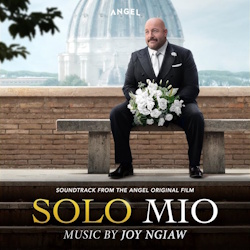
Considering that I finished my 2025 review schedule with a score by Joy Ngiaw, it’s perhaps only fitting that I start 2026 with one too. I said in my review of WondLa that ‘somebody needs to give Joy Ngiaw a Star War to score,’ and while I still absolutely stand by that sentiment, that hasn’t actually happened, and what has happened instead is that she has been given a lovely, sunny, romantic comedy drama to work on instead. Solo Mio was made by five of the eight filmmaking Kinnane brothers from Rhode Island – directors Chuck Kinnane and Dan Kinnane, writers John Kinnane and Patrick Kinnane, and editor Pete Kinnane – and it is the latest in several ventures involving actor and comedian Kevin James. In this film, James plays Matt Taylor, whose life is upended when he is ditched at the altar by his fiancée Heather in the middle of his dream wedding in Rome. Despite being crushed and heartbroken by the end of his relationship, Matt is convinced by his friends to take his honeymoon anyway – a tour around the most romantic locations in Italy that becomes an adventure he never expected.
As I mentioned in my WondLa review, Joy Ngiaw was born in Malaysia in 1994, raised in China, moved to the United States to attend Berklee College of Music in Boston, and then moved to Los Angeles in 2016 to work in film. She started out assisting composers like Jeff Russo, Leo Birenberg, and Zach Robinson on some of their TV work, and then started scoring short films and TV episodes of her own in 2018, before getting her big break on WondLa in 2021. That score was a magnificent, bold, adventurous, classic orchestral score full of old-fashioned Hollywood symphonic bombast, but now that it’s over Ngiaw is being given a chance to showcase another aspect of her musical personality, and for Solo Mio that aspect is Italianate romance.
 For this score, Ngiaw drew deeply from classic Italian folk traditions and the romantic film music idiom, taking inspiration from masters such as Nino Rota and Ennio Morricone. Recorded with a live 50-piece orchestra in Budapest, the music features prominent mandolin and guitar solos, plus vocals, that lend its sweeping lyrical themes and playful rhythmic textures an unmistakable regional character. Shifting effortlessly between light comedy, tender romance, and moments of genuine emotional pathos, the score remains consistently warm, melodic, vibrant, and optimistic throughout.
The album is a brisk, easy listen at just a hair over 20 minutes, but it leaves such a positive impression that once it’s finished you just want to start over again. The tinkle of the mandolins at the beginning of “Left at the Altar” quickly gives way to an upbeat, festive celebration of joy and romance, which is clearly intended to be a representation of the wedding Matt is supposed to have before it all goes sour in the final few moments. Matt’s subsequent sadness is captured perfectly by the bittersweet piano writing and breathy vocals (performed by Ngiaw herself) in “Wish You Were Here,” by the tender strings in “Perdere,” and then by the gorgeous orchestral sweep at the conclusion of “I Want You to Be Happy”.
Running through all of this is a recurring melodic idea associated with Matt, which receives a notably beautiful reprise in “Cheer Up, You’re in Rome,” and a slightly more robust but melancholy performance in “Wasn’t Meant to Be.” There is a wonderful sense of mischief and playfulness to the jazz of “Dinner Table Bet,” which then carries over into “Lunch With Gia,” a new thematic idea for the unexpected romantic relationship that develops between Matt and a pretty café owner. Both Matt’s theme and the love theme for Matt and Gia continue to be prominent throughout “Go See Italy” and “Goodbye Kiss,” all of which are awash in more of the lovely writing for mandolin, guitars, and orchestra.
After a moment of moody introspection in the ghostly, synth-led “Alone Again”, Matt gets his happy ending in the enchanting “Night Walk,” which builds up to an especially gorgeous statement of the love theme for Matt and Gia, before concluding with the title track “Solo Mio,” which reprises the celebratory sound heard in the opening cue, but this time ends on a satisfying high.
Scores like Solo Mio are refreshing palate cleansers, and are especially welcome in the wake of the seriousness and sometimes quite difficult music that accompanies heavy end-of-year dramas and Oscar contenders. There is nothing difficult about this music; it is simple, straightforward, and uncomplicated, but done with love, care, and attention, and no small amount of flair. This is the film music equivalent of a fresh bowl of pasta with pomodoro and Parmigiano Reggiano, a hunk of focaccia with olive oil, and a glass of Chianti, enjoyed on the terracotta terrace of a villa, with the sun-kissed hills and vineyards of Tuscany rolling away to the horizon. Bellissimo.
Buy the Solo Mio soundtrack from the Movie Music UK Store
Track Listing:
- Left at the Altar (2:45)
- Wish You Were Here (0:43)
- Perdere (1:30)
- I Want You To Be Happy (2:20)
- Cheer Up, You’re In Rome (1:01)
- Wasn’t Meant To Be (1:22)
- Dinner Table Bet (1:14)
- Lunch With Gia (1:47)
- Don’t Leave (1:04)
- Go See Italy (1:08)
- Goodbye Kiss (0:57)
- Couch Argument (1:15)
- Alone Again (0:48)
- Night Walk (2:10)
- Solo Mio (1:27)
Filmtrax/Atlantic Screen Music (2026)
Running Time: 21 minutes 31 seconds
Music composed by Joy Ngiaw. Conducted by Péter Illényi. Performed by the Budapest Scoring Orchestra. Orchestrations by Max Fourmy, Gregory Jamrok, Abraham Libbos and Joe Zimmerman. Featured musical soloists Garrett Podgorski and Hal Rosenfeld. Special vocal performances by Joy Ngiaw. Recorded and mixed by Frank Wolf. Edited by Jacopo Manzo. Album produced by Joy Ngiaw.

Shop at the Movie Music UK Store

Member of the

 MOVIE MUSIC UK