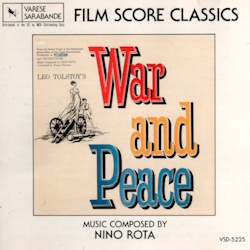
WAR AND PEACE – Nino Rota
 GREATEST SCORES OF THE TWENTIETH CENTURY
Original Review by Craig Lysy
A film based on Leo Tolstoy’s epic 1869 novel War and Peace first surfaced in 1941 with aspirations by renown British producer Alexander Korda, but the project could not move into production because the Soviet Ministry of Culture would not cooperate. It would take thirteen more years for ambitious producer Dino De Laurentis to finally get the project off the ground. He would personally manage production using his own production company with a massive $6.0 million budget. Condensing the massive 1,225-page novel into a cogent screenplay for a 2.5 – 3.5-hour film was daunting with it going through several incarnations at the hands of eight writers, including director King Vidor. A stellar cast was assembled, including Audrey Hepburn as Natasha Rostova, Henry Fonda as Count Pierre Bezukhov, Mel Ferrer as Prince Andrei Bolkonsky, and Herbert Lom as Napoleon Bonaparte.
The film is set in Russia, circa 1812 C.E. The French Emperor Napoleon Bonaparte initiates his war of conquest by attacking Russia, the last remaining continental European power not under his dominion. The film explores the impact of the war on Russians Count Nikolai Rostov and his family, Prince Andrei Bolkonsky and Count Pierre Bezukhov on the battlefield as well as their personal lives. The film was a smashing commercial success earning a profit of $9.45 million. Critics for the most part praised the film’s production values, but were critical of how extensive the film truncated and deviated from the novel, as well as Henry Fonda at 50 years of age being cast as Andrei who was in his mid-twenties. Nevertheless the film went on to earn three Academy Award nominations for Best Director, Best Cinematography and Best Costume Design.
With production being managed by Italian Dino De Laurentis, Nino Rota, a stalwart of the Italian film industry, was offered the job of scoring the film. Rota understood both the opportunity the film’s massive tapestry presented as well as the challenges its expansive narrative posed. He decided to score the film by embracing the grand pageantry of “Old Hollywood”. As such he fashioned his music to incorporate both Western European, Gypsy, and Russian cultural idioms. Given the war setting, Rota also understood that the military battles would require martial drums, marches, fanfares, as well as kinetic battle music with interplay of the opposing French and Russian identities. Lastly, there were the entwined personal narratives of Prince Andrei Bolkonsky, Count Nikolai Rostov, Count Pierre Bezukhov, Helene Kuragin, Anatole Kuragin, and Natasha Rostova. Rota related;
“In composing the background music for “War and Peace” I followed the two concepts of the story as they develop in Tolstoy’s novel, constantly alternating, or overlapping and flowing together, thus giving a certain rhythm to the entire narrative and establishing its musical structure. These two concepts, already so clearly expressed in the title and of course reflected in the film, are illustrated on the one hand by the motives of the private lives, the relationship between the protagonists, their individual feelings and experiences; motives that somewhat broadly may be named “peace motives”, or “personal motives.” On the other hand, they are illustrated by the motives of public life, or history with its great feats of arms, of reality as objectively told in historic documents; these we may call the “war motives” or “environmental motives.” This distinction, clearly present in the book and in the film with the alternate succession or converging of the two themes, was the first and fundamental basis for the work of the musician.”
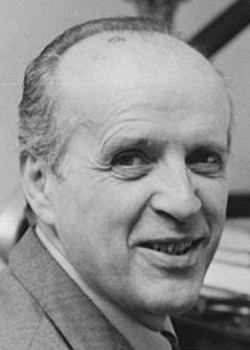 For his soundscape, Rota composed several personal, transpersonal and settings themes. Foremost is theme for Natasha, which offers one of Rota’s finest inspirations, a gorgeous valzer elegante. Natasha’s personal narrative experiences a myriad of challenges, some very painful, which ultimately transform her from a naïve girl, into a mature woman. Rota speaks to these musically by rendering her captivating waltz in a multiplicity of guises; yearning, sweepingly romantic, melancholic, tragic, and joyous. Pierre’s Theme is well-conceived and specifically crafted to represent the inner life of Pierre Bezukhov, an introspective, intellectual, and idealistic young man, who is good-natured, socially awkward, and somewhat naïve. Throughout the film he is searching spiritually for meaning and purpose in life. His tender Schumannesque theme first introduced on piano, thereafter is borne by strings and woodwinds, and evokes a sense of longing, with an undercurrent of melancholia. Profoundly moving is how his theme in the finale transforms into a beautiful, and hopeful iteration, which speaks to his new life with Natasha.
Andrei’s Theme supports a man torn between his rigid upbringing, filial loyalty, and commitment to duty, and search for spiritual peace. His theme is deeply melancholic, sentimental, and wistful, often highlighted by poignant strings and woodwinds, which imbue it with a hymn-like religiosity that reflects his spiritual journey. In war, his theme takes on the mantle of nobility and heroism. Tragically, only when he is on his deathbed does the theme shed its innate sadness, liberated by the power of his forgiveness, and love for Natasha. Anatole was a charismatic, impulsive, reckless, and amoral rake. Rota speaks to this with a theme that offers a traditional Gypsy energy that is festive, ornamental, and which embraces rubato, frivolity and excitement. When he seduces Natasha his theme transforms into a sweeping romanticism, but it is in the final analysis, only a veneer. Helene’s Theme is more textural than melodic. It speaks to her as a cold, selfish, vain and duplicitous gold-digger who deeply wounds Pierre. Rota supports her with woodwinds; however, they emote with a twisted, dissonant and ultimately grotesque manner when Pierre at last realizes her true nature.
The “Sleigh Ride Song” is quintessentially Russian, and serves as a leitmotif for the Rostov family. It is colorful, lively, spirited, often features the bright, jingling sound of sleigh bells, and exudes the welcoming warmth of the Rostov home. I believe Rota sought to imbue a “Schubertian” atmosphere in the early part of the film for the Grand Ball, and so composed and interpolated a number of dances to ensure his score provided the requisite cultural sensibilities; including; Natasha’s Waltz, a gorgeous Polonaise, Chopin’s “Grande Valse Brillante”, a Scottish “Écossaise”, which was a popular social dance imported from Scotland that became a staple of court balls in Tsarist Russia during the early 19th century. Lastly, Rota interpolated two Russian folk songs and a waltz; “In the Field Stood a Birch Tree”, which symbolizes the beauty of spring, Aram Khachaturian’s sumptuously romantic “Masquerade Waltz, the melancholic, yearning romantic ballad “The Rose of Novgorod”, and Serge Prokofiev’s vibrant and exciting music from the 4th movement “Troika”, from his “Lieutenant Kijé Suite” (1934), Opus 60.
For War Themes, Rota composed the War Fanfare, which offers a dire and oppressive four-note declaration used to empower the film’s narrative shifting to war. It is pervasive in the film, empowering the Battle of Austerlitz, and often joined synergistically with the French and Russian identities. For Emperor Napoleon I, and by extension his Grand Armée, Rota offered a rhythmic melody empowered by a martial drum roll embedded with phrasing for Le Marseillaise. When used to empower the legendary charges of the French cavalry, it becomes charging and ferocious. For the Tsar Alexander I, and by extension the Russian army, Rota joined the traditional “God Save The Tsar” anthem with one of the score’s greatest and most inspirational themes. He astutely empowered the sacred ‘Defense of Holy Mother Russia” by composing a grand, yet solemn marcia slava buttressed with a stirring hymn-like ascension, enriched with contrapuntal chorus religioso. A secondary Russian March is introduced when the camera moves from the marching soldiers to the windows of the Rostov Palace. A classic marcia eroica, which reprises in the film during scenes of Russian victories.
Cue coded (*) contain music not found on the album. (*) “Logo” opens with syncopated thrusting strings strikes, crowned with horns dramatico, which support the Paramount Pictures logo. “Prelude” offers a magnificent score highlight, a suite where Rota provides a sweeping, majestic calls to arms, with intimate romantic interludes, thus speaking to the grand tale about to unfold, and its effects on the lives of the main characters. Horns dramatico resound to declare the War Motif, which flows into the French Theme, crowned at 0:15 with a quote of Le Marseillaise. The flow of the opening credits unfolds against a background of paintings featuring Tsar Alexander I defending Holy Mother Russia and Emperor Napoleon I leading his grand armée. At 0:21 the Russian Theme, draped in religioso auras is declared, empowered gloriously by mixed chorus. At 1:12 Anatole‘s Theme joins, offering festive gypsy energy, which embraces rubato, frivolity and excitement. At 1:33 field drum rolls reprise the menace of the French Theme. At 1:44 we flow gracefully into Natasha’s Theme rendered as a valzer elegante, which concludes the opening credits. 2:10 “Dawn of the 19th Century” opens darkly with a sinister rendering of the French Theme as commentary informs us of a force moving across Europe. We see a relief map of Europe with France draped in a shadow, which expands outward bringing most of Europe under Napoleon’s domain. Only England guarded by the English Channel and her fleet, and Russia, which believed itself safe being 1,000 miles from Paris remain free. At 2:40 we shift to the streets of Moscow where crowds cheer a parade of resplendently uniformed imperial calvary, and infantry men empowered by a grand marcia eroica.
Against the rhythmic foot falls of the soldiers marching, Pierre and Count Rostov watch but disagree regarding their views of Napoleon. Natasha joins and marvels at the spectacle, declaring her wish that she was a man so she could join. She then begins crying, telling Pierre all these handsome young men going off to die. Natasha’s brother Nicholas Rostov arrives with cousin Sonya to bid farewell to the family as he soon deploys to Austria. “The Orgy” reveals Pierre at a wild, drunken celebration at the Dolokhov estate where a festive party unfolds, empowered by Anatole’s Gypsy Theme as men dance the Prisiadki. His friends Fedor Dolokhov and Anatole Kuragin are hosts, and notorious rakes. Fedor decides to engage in a bottom-up wager with Anatole; that he can drink a whole bottle of rum while poised on a third story window sill, and not fall to his death. He succeeds and collects with bravado. Prince Andrei arrives and advises Pierre that his father, Count Bezukhov summons him to his death bed. (*) “Death Bed” reveals Pierre entering the bedroom and witnessing a Russian Orthodox priest chanting as he performs the Orthodox Rite of Unction on the Count. He is called as his father wishes to kiss him goodbye. He is greeted with a welcoming smile, which elicits Pierre to weep as he kisses his hand. He receives a gift box and departs. Andrei opens the box and at Pierre’s request, reads a letter addressed to him. The count petitions the Tsar to honor his dying wish to make Pierre, his legitimate son, and the next Count Bezukhov, sole heir to all his estates.
(*) “A Chance Encounter” reveals Pierre traveling by carriage back to Moscow with Prince Vasily Kuragin and his daughter Helene, who have injected themselves into his life, covetous of his new wealth and status. He encounters Andrei at a river ferry crossing, happily reacquaints, and meets his pregnant wife Lise who will be joining his sister Mary and residing at his family’s country estate. When Andrei asks if he intends to marry Helene, Pierre deflects, saying he is unsure. Men’s chorus sing the Russian folk song “In the Field Stood a Birch Tree” to support. “Andrei Leaving For The War” reveals Andrei and his father formal, but very emotional farewell. Music enters dramatically atop the dire War Fanfare declaration as Andrei turns and departs. At 0:10 we segue into “Pierre and Natasha” where we see Pierre calling on her. She discloses that she values her independence, and if she ever agrees to marriage she will view it as a failure, like a general surrendering his sword. We see Pierre loves her, but finds her unattainable. As he helps her on her horse to depart, he drops a bombshell – he intends to marry Helene. She fights to maintain her composure, smiles, and wishes him well, however Rota informs us of her true feelings with a sad rendering of Andrei’s Theme. The music from 0:34 – 1:52 features a sad romanza borne by Andre’s theme, that brightens at 0:57. I surmise that it ended up on the editing room floor. At 1:53 the cue resumes and reveals a courier riding up to Russian headquarters empowered by the Russian Imperial Anthem “God Save The Tsar. He brings an urgent message for General Kutusov, is referred to Andrei, who greets him and orders that the message be disclosed to him. He informs him that the French forces departed for new positions yet to be identified. Inside the war counsel, Kunetsov and the general staff are already informed, and Kutuzov makes the fateful decision to not change plans.
“The Battle of Austerlitz” is dominated by passages from the Le Marseillaise, the “March of the Parade”, and the “Napoleonic March”, however we suffer a supreme disappointment as Rota’s music from 0:00 – 1:11 was dialed out of the film. It offered inspired interplay of the War and French and Russian Themes as General Kutusov orders a regrouping after the French break through his left flank. Music enters with trumpet declarations of Le Marseilles at 1:12 as Kutusov sees a route unfolding. In a desperate gamble, he orders Andrei to rouse the men from retreat, to a charge. Andrei charges forth valiantly bearing the battle flag, and a diminuendo takes us into the battle aftermath as we see Andrei fallen with the flag supported by a tragic statement of his theme. Napoleon arrives, commends this heroic death, but when Andrei stirs to life, he orders him transferred to his bivouac to receive treatment by his personal physician. Sadly, music after 1:27 was also dialed out of the film. It offered a grand heroic fanfare homage, that I believe was intended for the Napoleon scene. (*) “Pierre and Helene” reveals him waking and a disagreement unfolding, where she employs her feminine wiles in an effort to get what she wants. He wants to return to the country estate to attend to its repair, as well as the school and the local hospital. We see she is only a gold digger who cares nothing about Pierre, but only herself. She proposes they separate for the winter, saying that she dislikes the country, and instead wants to attend the many gala balls, which means she will have to buy many new shoes and dresses. At this point a light turns on in Pierre as he sees her true nature. She sees that she has gone too far, earned his displeasure, and tries to makeup, but he turns a cold shoulder and departs. Rota offers a dissonant woodwind borne musical narrative, which I believe speaks to Helene’s ignominy and Pierre’s disillusionment.
(*) “Nicholas Returns” reveals Count Rostov and his youngest son Petya watch the return of Russia’s defeated army through the upstairs window. A celebratory rendering of the Rostov Sleigh Ride Theme swells and carries Nicholas’ return home as Natasha, Petya and father all run down the stairs jubilantly and hug him. When mama comes down, strings tenero carry his run to her welcoming arms. Lastly, tender strings romantico support Nicholas’ kiss of Sonya. (*) “Andrei Returns” reveals his return home. He returns limping from his leg wound and unlike Nicholas’ happy return, his is draped in sadness, his theme filled with dread and uncertainty as Lise suffers in childbirth. We descend musically into tragedy borne by his theme as he discovers he has a son, and Lise has died. He collapses next to her bed sobbing, full of regret for not providing her sufficient love and comfort. We close with tearful thankfulness as papa welcomes his beloved son.
“Moment Musical” reveals Nicholas and Vasili in the lobby during an opera intermission. They see a flirtatious Helene pursued by a lustful Fedor. An intervening scene reveals Pierre receiving a letter disclosing that his wife’s shameful infidelity with Fedor is well known. The dissonant, woodwind borne Helene’s Theme supports the scene. (*) “The Duel” offers a second intervening scene, which reveals Pierre at a party with friends, which include Fedor. Adding insult to injury, Fedor offers a toast to all the beautiful married women – and their lovers. When Pierre begins reading a letter regarding General Kutusov, Fedor grabs it out of his hands and says I want it. Pierre stands, glares, and tosses his drink in Fedor’s face punctuated with dire dissonant strings. We shift outside where ten paces are marked by swords as Fedor and Pierre examine their dueling pistols. They begin walking three paces to the sword markers, and Pierre trips and accidentally discharges his pistol that results in a mortal wound, which causes Fedor to fall to the ground in pain. He tells Pierre to cover himself, but he refuses. Fedor shoots, misses and falls unconscious. Rota supports with the dissonant and corrupted theme for Helene, which becomes truly grotesque as Pierre throws down his pistol and departs. Later we find Pierre being harangued by Helene for making her the laughing stock in Moscow. They quarrel, their marital dysfunction revealed, and agree to separate. When she demands a fortune, he picks up a table as smashes it on the floor, and yells get out, which causes her to flee. Rota punctuates this with a grotesque coda of their theme.
(*) “Pierre’s Discontent” offers a third intervening scene, which reveals his rage and discontent with Moscow culture, and his desire to return to a simple life in the country. He admits that he never loved Helene and regrets shooting his friend Fedor. Count Rostov decides that the best remedy is for Pierre to join him and the family for a country retreat. He summons the family and declares the good news and everyone is ecstatic. Prior to the Count’s announcement, the scene is supported by Natasha, who is in another room, playing her tender and gentile theme on the piano, with its melody wafting throughout the house. (*) “Troika Ride” reveals the Rostovs, Pierre and Vasili racing in two troikas over a snowbound countryside. Vasili begins singing a troika traveling song, with Rota interpolating Serge Prokofiev’s vibrant and exciting music of the 4th movement “Troika” from “Lieutenant Kijé Suite” (1934), Opus 60. There is great merriment as Vasili and Nicholas jump off and run to the other troika. Returning to cue 5 at 4:02, we segue months later to spring in “The Hunt” where we see Andrei riding alone in the countryside. Hunting horns resound as he sees a hunting party in the valley below. Pierre rides up and invites him to join, which he does, reluctantly. The galloping motif takes them back and hunting horns declare the hunt resumes. At 4:36 the dogs gain the scent and begin running with the horse riders following, propelled by an exuberant musical narrative.
(*) “Andrei’s Despair” reveals Pierre exhorting Andrei to reengage life and start living again as it is wrong to live in isolation like a hermit. Music enters as Andrei relates that there are only two things wrong in life; remorse and illness. He says he has recovered from both. When Pierre asks why he has been remorseful, he says he was too late. That he let Lise die feeling unloved and uncomforted, as he was too busy and selfish seeking glory in battle. Andrei is pathetic figure, and Rota supports under the dialogue with a Pathetique. (*) “The Ball” reveals the Rostovs ascending a grand staircase to join a gala ball. A promenade regale supports their ascent. As they enter the ball room, we see resplendently dressed couples dancing as Rota graces us with an original Polonaise. Natasha is nervous until Andrei greets her and asks her to dance. She shyly accepts and we flow into “War and Peace”, a score highlight, where Rota graces us with and extended exposition of Natasha’s Waltz, rendered sumptuously with classic elegance. Afterwards they chat and we discern a mutual attraction, but the moment is lost when a young man interrupts, and asks her to dance. They take to the floor and Rota supports with another original dance, an ecossaise. The next day Andrei asks for his father’s permission to marry Natasha. He is indignant as they are not of their class. He says wait a year, go on the peace mission to witness Tsar Alexander and Napoleon sign a peace treaty. He adds that if after a year he is still in love, he will not oppose the marriage. Here we return to cue 5, at 1:34 “Andrei and Natasha” where we are graced by Natasha’s String borne theme as she joins Andrei. He declares his undying love for her, and she upon being asked, admits that she also loves him. The melody is taken up by oboe delicato as they share a kiss. He asks her for a delay of one year as she is so young. She accepts and they join in a kissing embrace, awaiting his return for the peace mission
In two unscored scenes, narration reveals Napoleon I meeting with Alexander I on June 13, 1807 in Tilst, Prussia, for the purpose of discussing a treaty of peace. We shift to the Bolkonsky estate where Count Roskov and his daughter Natasha wait to present themselves to Andrei’s father, Prince Bolkonsky. His daughter Mary, who seems uncomfortable, greets them instead, saying that her father is ill. With that Prince Bolkonsky barges in, dressed in pajamas. He is curt, declares he was not advised of the visit, is not prepared to receive them, and hates that he is stuck here in Moscow. He turns, departs, and slams the door. Count Rostov is aggrieved and says they will depart. Mary calls to Natasha declaring that she is pleased that Andrei has found happiness and someone to love, but Natasha is curt, saying that this is now, inconvenient. In (*) “Anatole Kuragin” the Count decides that the best way to get over this is to go to the opera with Natasha and Sonya. Anatole Kuragin, Helene’s debauched brother happens to lock eyes with Natasha and lusts for her. He then signals his sister in the adjoining box to arrange an introduction, which she does bay asking Count Rostov to allow Natasha to join her for Act II. After some chit chat, Anatole arrives and is introduced. He shamelessly attempts to seduce her, inviting her to attend an evening at his sister’s estate, and then departs.
Regretfully, most of “Anatole and Natasha” seems attached to deleted scenes; 1:08 – 3:44. The cue offers some of the score’s most passionate and festive passages. It opens passionately with Rota by adapting the “Masquerade Waltz” by Aram Khachaturyan for a new Love Theme as Anatole corners Natasha in a room and seduces her. She resists, but ultimately surrenders to his passionate kissing embrace as the scene goes to black. At 0:21 we shift atop this new Love Theme carried by woodwinds, shifting to solo violin romantico as Sonya enters Natasha’s bedroom. She finds her asleep with a note written by Anatole professing his undying love and desire to marry. They quarrel over her engagement to Andrei, but there is no reasoning with Natasha who declares she is finally in love and will willingly become Anatole’s slave. She orders Sonya out after she threatens to expose this to Father. For the rest of the cue, at 1:08 the Love Theme shifts to celeste and then to piano, before swelling for a grand presentation at 1:35. Festive gypsy music follows, followed by a return of the Love Theme by balalaika and violin. We conclude at 2:58 with a reprise of the festive gypsy music. In an unscored scene Anatole prepares to elope despite Fedor warning him that he is already married to that girl in Poland, and if he is caught, it means, death. The lust driven Anatole cares not and departs, intent on getting his prize. Sonya and Pierre conspire to stop Natasha with Sonya locking her in her room, and Pierre confronting Anatole when he arrives. With the threat of exposing his bigomy, Anatole relents and drives away. Pierre confronts Natasha, and her trust in his sincerity shatters her illusion when he informs her that Anatole is Moscow’s most notorious womanizer, and that he is already married. She runs crying to her room with Sonya and slams the door.
(*) “Pierre Visits Natasha” reveals Pierre visiting an ailing Natasha. A sad passage by strings and woodwinds support as Sonya advises that Andrei returns all her letters and that Moscow is rife with gossip due to her imbroglio with Anatole. He finds her weeping and begs him to intercede with Andrei, saying she is truly sorry. She berates herself, saying she is now forever unworthy of love, but is stunned when Pierre on bended knee declares that she is indeed worthy, and if he was not constrained, he would propose. She is overwhelmed by this declaration, and her theme borne by strings tristi carries both her and Pierre’s departure. As Pierre looks at a comet, the troika departs empowered by grand fanfare. (*) “Onward to Moscow!” reveals Colonel Andrei Boklonsky delivering a letter from Tsar Alexander I to Napoleon I, expressing his sincere desire to maintain the peace treaty, and not begin another war. Napoleon presses Boklonsky on the sincerity of the letter, which he affirms. Napoleon declares that he will answer the Tsar soon, and dismisses Boklonsky. After his departure, Napoleon announces to his general staff that he will answer the Tsar’s letter, in Moscow! Rota crowns the announcement of war with a powerful and dramatic declaration of the War Fanfare. A grim and horrific musical narrative of destruction supports narration revealing Napoleon’s invasion of Russia on 12 June 1812 with his grand armée of 200,000 men. Russia fights back with a scorched earth policy; burning all their crops, storehouses, and slaughtering animals they could not take. In Moscow General Kutusov fights off demands to stand and fight, arguing that would lead to defeat and subjugation.
(*) “A Growing Anger” reveals news of Smolensk falling with the Russian army retreating and refusing to engage. The people are fearful and take to the streets demanding action, including firing Kutusov. Rota supports with a Russian folk song sung by men’s chorus and tolling church bells. Pierre walks past the crowd and joins a church service where the priest enjoins God to support the Tsar and defense of Holy Mother Russia. After the service, Pierre informs the Rostov family that he is departing to join the army as the Tsar intends to make a stand at Borodino. He accepts the Count’s dinner invitation to see him off, and then takes a stroll with Natasha. A gentle, strolling rendering of her theme plays under the conversation in which she inquires about Andrei. She is told that he never mentions her, and that his father died. She then begs him to come home safely. (*) “Pierre Finds Andrei” reveals Pierre’s journey to the front lines, his arrival supported by a dour Russian Theme. He is taken to Colonel Boklonsky and they reacquaint with a sad, and portentous musical narrative softly playing under the dialogue. Andrei says that he will not be magnanimous and forgive Natasha, and then confides to Pierre that he believes that he will die tomorrow. He then goes on a tirade raging against war, how the French caused the death of his father and loss of their home, and how he hopes to kill them all. Russian men’s chorus close the scene as the two hug and Andrei departs saying “Goodbye, whether we meet again or not”.
(*) “The Battle of Borodino” reveals Napoleon dictating a letter of exhortation and French Pride to be read to the troops prior to battle. Bugles resound as Napoleon exits his command tent and mounts a horse. Pierre secures a position on a hilltop overlooking the battle as bugles militare unleash the armies below as canons thunder. As French infantry men march across a massive field, bugling fanfare supports. Pierre joins the hilltop artillery position, which unleash Hell on the French army marching towards them empowered by a relentless field drums cadence. The captain of artillery orders, hold your fire, as the Russian troops on the flanks prepare a crossfire ambush. The French reach 50 yards and the Russian artillery captain opens fire. A withering gun and canon barrage decimates the French and forces a retreat. Napoleon is angry, and orders a full cavalry charge. “The Charge Of The Cavalry And The Wounded” reveals the French cavalry unleashed by a choir of bugle declarations. They charge ferociously en masse, propelled by churning strings furioso and a horn declared Le Marseilles. They drive forward through the retreating French infantry, who turn and follow. The Russian artillery open fire and the Russian Theme now contests with the French Theme, yet it is fleeting and soon overwhelmed as the French overrun the artillery positions and route the Russians. We descend into an eerie diminuendo as Pierre picks up a mortally wounded officer and follows his request to be taken to the medical tents. When Pierre arrives, he sees a sea of wounded and bloodied dying men. Mournful woodwinds emote a musical commentary after the doctor advises Pierre that he is too late as the man is dead. A grieving, molto tragico Pierre’s Theme joins as he gently lays the man down and stumbles out of camp, devastated. We close darkly at 3:57 as Pierre’s admiration of Napoleon is turned to hatred as he curses him and damns him to Hell.
In a meeting of the general staff, General Kutsukov fights off discord in his ranks, arguing that if they attack Napoleon tomorrow, they lose both the army, and Moscow. As such he orders a retreat to preserve the army, which will allow the gravely weakened Napoleon to march into Moscow, a city that will provide him no comfort, food, or supplies. “Exodus from Moscow” reveals tolling church bells of doom as Muscovites make a desperate effort to evacuate before the French troops enter the city. We see the Rostovs loading their furniture, art work, and personal belongings. As Natasha collects her dresses, a ghostly rendering of her theme emerges, eventually coming to the forefront led by solo oboe, and flowing into a valzer romantico as she hugs the dress in which she first met Andre. But the memory is fleeting, as it sours, and dissipates as she drops the dress and walks away leaving it. She goes to the window and sees a sea of carts transporting the wounded of Borodino. Sonya rushes out with a jug of water to quench the thirst of the many walking wounded soldiers as dozens of wounded men gaze with longing eyes at Natasha. An eerie musical narrative of tension borne by an ever-shifting ostinato unfolds. At 1:47 strings tristi join as Sonya discovers a mortally wounded Andre in a carriage. Natasha pleads with her father to abandon the furniture and instead transport the wounded men to safety. He agrees and as they finally depart, the eerie motif supports. The streets are filled with desperate people all fleeing as church bells toll and portend the city’s doom. Natasha sees Pierre, calls to him and he comes. He refuses to join, saying he must stay to do something, which must be done. He kisses her hand, asks her to remember him, and departs. The eerie motif and Andre’s Theme interplay as Sonya breaks down and finally discloses to Natasha that Andre is wounded and traveling with them. She is beside herself, and we end on a diminuendo of uncertainty.
(*) “Napoleon Enters Moscow” reveals French troops entering the city empowered by declarations of the War Fanfare and Le Marseilles. In the Tsar’s palace he commands his generals to bring for the Russian representatives to formally surrender the city. He is advised that the government has fled, the citizens have fled, and that half the city is on fire. Napoleon is outraged, furious at this egregious insult, and threatens retribution. Outside the city, the Rostov family, soldiers, and peasants all grieve as they see in the distance a burning Moscow lighting up the night sky. In (*) “Rose of Novgorod”, as the Rostov family huddles in a room, a man sings the melancholic, romantic ballad “Rose of Novgorod”. The song elicits Natasha to leave and search for Andre. She finds him suffering with delirium and kneels at his bedside. She takes his hand supported by the song melody. He wakes, sees her and says, he loves her. She apologizes for everything, and he says, he loves her more. They kiss and the scene goes to black. (*) “Moscow Aflame” reveals French cavalry riding through the empty streets of Moscow amidst burning buildings. The tension motif supports as we see Pierre emerge from the shadows after a patrol passes. He enters the burned-out house and flees upstairs as a French infantry patrol marches down the street empowered by field drums militare. The march darkens as he sees Napoleon below leading a column of men. He pulls a revolver from his jacket, and takes aim, empowered by a dissonant crescendo di orrore. Yet, he cannot pull the trigger, and relents after Napoleon orders all the burning buildings extinguished. As he uncocks the pistol, a sad, and pathetic statement of his theme supports.
As Pierre wanders the streets, he comes across French soldiers preparing to rape a woman. He comes to her defense, but is overwhelmed, and taken prisoner. In a town square he stands in line as a firing squad executes rounds of prisoners, with each round empowered by a drum roll of death. Pierre and the rest are sent to prison, as the captain says only incendiaries are to be shot. “Winter And The Remembrance Of Andrei” reveals her keeping a bedside vigil at a monastery, Russian Orthodox chanting wafts in the background. Andrei is tender and affectionate and again confesses his undying love. Later, tolling bells support the arrival of Count Rostov and his family, along with Andrei’ sister Mary, and his son Kolya. After Mary, Kolya and Andrei reacquaint the chanting rises and become more prominent as his life wavers and he passes. Rota expresses Andrei’s tragic love for Natasha and his resignation to death with a poignant, orchestral piece. (*) “Napoleon’s Rage” reveals him raging against the fact that the city continues to burn, that they are running out of food, that General Kutusov has sent no emissaries to affirm his surrender. He declares to his generals that his army is decaying, and that if they do not restore order and discipline, they will all be fired and replaced. This threat is punctuated by dark chords, and then a weak and beleaguered statement of le Marseilles, which presages, defeat.
In (*) “Vindication” we shift to General Kutusov who says; “Time and patience. Patience and Time”. He adds that the Grand Armée is wounded, but queries; is it mortally wounded? A courier arrives with news that the French are preparing to leave Moscow. He reads the dispatch and a solemn, and thankful choral statement of “God Save The Tsar” supports. He falls to his knees, and with reverence prays to God, thanking him for hearing our prayers. The scene shifts to the streets of Moscow where we see the French army departing with Russian women collaborators, which Pierre likens to lice that cling to conquerors. We shift back to General Kutusov who again overrules his generals who want to attack. He said our fall rains, harsh winter, the desolate land, and a two-thousand-mile march will destroy the French army. We will instead nip at its tail to keep it moving and let nature take its course. “Napoleon’s Retreat” offers a powerful score highlight where Rota masterfully offers a synergistic musical narrative, which supports the horrible attrition of the Grand Armée as it marches ever westwards toward home. Suffering with them are Pierre and his friend Platon who remain prisoners. Rota offers interplay of a dour War Theme and beleaguered Le Marseilles, that with each subsequent scene, weakens, becomes more dissonant, and descends into despair as we see the troops weakening and being overcome from lack of food, and by the elements. Relentless, driving autumn rains and foot deep mud results in the abandoning more and more canons and equipment as they cannot move and/or the horses die from lack of food. At 2:28 trilling woodwinds and string vortices evoke the horrible snows and driving winds of Russia’s implacable winter, joined by a repeating, descending eight-note ostinato of woe. Soldiers too weak to travel, are shot. At 2:49 diminuendo of futility, leads to a resumption of the War Theme, shorn of all its force, and vitality, as it slowly descends unto death. The extended film scene is longer than the 3:59 minute album cue. As the army snakes across the snow bound countryside, stabbing strings join with wordless Russian chorus to empower a trail of woe. The will to carry on is challenged by snow bound hills as the men and horses lack strength to move carts, canons and equipment up and over them. The War Theme transforms into a marcia della morte joined by a wordless Russian choral lament join as men fall to their deaths. In my judgement, it is not the acting or cinematography, which brings home the travails and tribulations of the destruction of the Grand Armée, but Rota’s brilliantly conceived and executed music.
Petya, against his father’s command, has run away and joined the army, serving under the command of Colonel Anatole Kuragin. (*) “Petya’s Kindness” reveals him bringing his dinner to a young French cadet who sits outside by a fire shivering under guard outside. He gives him a last meal as Anatole has ordered his execution. A musical narrative by soft, woodwinds teneri offering the Rostov Theme support his act of kindness. The next day in (*) “The Death of Petya” reveals Anatole leading a cavalry attack for personal glory against French stragglers in clear violation of orders. He takes Petya, who is spoiling for his first fight with him. Tragically Petya is killed by a rifle shot during the battle. As Pierre grieves while Petya’s grave is dug, Anatole comes, apologizes, and the two reconcile. A mournful rendering of Pierre’s Theme supports the scene. The moment is interrupted by drums of death as Anatole orders all prisoners shot. Anatole informs Pierre that Petya did not follow orders, thinking his sword, was a toy. The firing squad resounds with cries of death, with Anatole declaring to Pierre that he never takes prisoners. A dire War Theme punctuates Anatole’s declaration. (*) “Neman Bridge” reveals the French army leaving Russia by crossing a narrow boat bridge over the Neman River. Kutusov positions canons on nearby hills and troops assemble for battle. Rota slowly stokes tension using the repeating and descending eight-note Tension Motif, with interplay of a distressed Le Marseilles. The Russian artillery finds its mark, and destroys the central section of the bridge, trapping half the French army. Rota unleashes a frenzy as the men all surge trying to cross before it’s too late. Napoleon watches with dismay, and the orders fallen French Flags burned with Le Marseilles supporting as a lament. Napoleon then departs in his throne sled supported by a molto tragico musical narrative, which offers the last sign, and the last voices of the collapse of the Grande Armée and the end of his ambition.
“The Homecoming at Moscow” reveals General Kutusov congratulating his men for the defense of Holy Mother Russia. They cheer and Rota crowns victory with a triumphant declaration of “God Save The Tsar”. At 0:14 we shift back to Moscow, with Count Rostov and his family returning to their burnt-out manor. A melancholic Natasha’s Theme supports their viewing of the burnt out, open to air main floor, at 0:45 the theme becomes wistful as they recall the happier times of their life before the war. Natasha remains optimistic and she and Sonya discover the north wing, which houses the family’s bedrooms remains intact. At 1:59 Natasha’s Theme resumes its dance like form as we hear in her mind conversations from happier times. At 2:26 her theme shifts to strings romantico as she sees the silhouette of a man in the main doorway. Pierre walks into the light, and she rushes into his arms carried by yearning strings romantico. It is a tearful and joyous moment, and she thanks him for his perseverance and resilience, like our house, which forever stands. At 2:48 they walk hand in hand to the garden and we swell slowly with hope for brighter days ahead on the Russian Theme rendered as a crescendo grandiose, replete with refulgent chimes as narrative script by Tolstoy reads;
“The most difficult thing – but an essential one – is to love life, to love it even while one suffers, because life is all. Life is God, and to love life, means to love God.”
The audio quality of the recording was serviceable with a noticeable limitation to its dynamic range. I would hope that in the near future, a re-recording of the full score with 21st century audio quality be realized. Nino Rota is best known for his amazing collaborations with Federico Fellini, composing music which one could characterize as whimsical, circus-like, dream-like, buffoonish, and surreal. However, with this assignment, Rota composed with a traditional, Golden Age, Old Hollywood sensibility. He understood that he needed to capture both the intimacy of Tolstoy’s characters and the epic scale of the Napoleonic wars. To that end, Rota infused his soundscape with melodic richness, sumptuous orchestration, and sweeping, forthright, and unabashed emotional expression utilizing a massive orchestra to blend Russian folk influences, patriotic anthems, and poignant melodies to define the film’s contrasting themes of love and destruction. Regretfully, I believe that too much of his music was either dialed out, or ended up on the editing room floor. Qualitatively, I believe Rota captured the essence of each character right down to their sinews, repeatedly achieving a profoundly moving cinematic confluence. Whether it be the sumptuous romanticism of Natasha’s waltz, the vibrant, unbridled reckless gypsy energy of Anatole’s Theme, or pathos of Pierre’s Theme, Rota breathed the air of life into each of them. That said, I also believe his compositions in regards to the royal pomp, militarism, patriotism and battles, masterfully empowered and propelled the destructiveness of war, and the inevitable descent into tragedy. Folks, I believe this score to be a masterpiece and highly recommend you purchase the album, and take up the film on a streaming service.
For those of you unfamiliar with the score, I have embedded a YouTube link to a 10-minute suite: https://www.youtube.com/watch?v=Vf8T2JVXeL0&list=RDVf8T2JVXeL0&start_radio=1
Buy the War and Peace soundtrack from the Movie Music UK Store
Track Listing:
- Prelude (4:42)
- The Orgy (1:50)
- Andrei Leaving For The War – Pierre and Natasha (2:33)
- The Battle of Austerlitz (3:31)
- Moment Musical – Andrei and Natasha – The Hunt (5:31)
- War and Peace (Natasha’s Waltz) (1:59)
- Anatole and Natasha (3:44)
- Winter and The Remembrance of Andrei (4:03)
- The Charge of the Cavalry and the Wounded (4:10)
- Exodus From Moscow (3:15)
- Napoleon’s Retreat (3:59)
- The Homecoming at Moscow (4:15)
Varese Sarabande VSD-5225 (1956/1989)
Running Time: 43 minutes 32 seconds
Music composed by Nino Rota. Conducted by Franco Ferrara. Performed by the Rome Symphony Orchestra. Orchestrations by XXXX. Recorded and mixed by XXXX. Score produced by Nino Rota. Album produced by Richard Kraft and Tom Null.

Shop at the Movie Music UK Store

Member of the

 MOVIE MUSIC UK