THE EMPEROR WALTZ – Victor Young
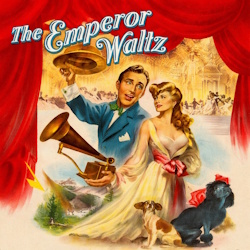 GREATEST SCORES OF THE TWENTIETH CENTURY
Original Review by Craig Lysy
In the late 1940s Billy Wilder was Paramount Pictures premier director, and Bing Crosby was the studio’s leading star. Wilder had always wanted to do a musical with Crosby, and found a story, which drew from an actual historical event, which eventually became this film: The Emperor Waltz. Valdemar Poulsen was a Danish inventor who demonstrated his magnetic recording device to Emperor Franz Joseph I of the Austro-Hungarian Empire, in an audacious effort to secure financing for his invention. Charles Brackett was assigned production with a $3.8 million budget, Wilder would direct and Brackett and Wilder would write the screenplay. Bing Cosby would star as Virgil Smith, joined by Joan Fontaine as Countess Johanna Augusta Franziska, with Richard Haydn as Emperor Franz Josef, Roland Culver as Baron Holenia, and Sig Ruman as Dr. Zwieback.
In the waning years of the of the 19th century, Virgil Smith seeks to market his American invention, the gramophone, to Europeans. He masterminds an audacious plan to impress Emperor Franz Josef I of the Austro-Hungarian Empire and seek his support and endorsement in selling his gramophone. Complications arise when a dual romance unfolds between Virgil and Countess Johanna Augusta Franziska von Stoltzenberg, and his white fox terrier dog Buttons and her black poodle Scheherazade. In both cases rigid class barriers seem to create insurmountable impediments, however, in the end we again see the power of love’s capacity to overcome all obstacles. The film was not commercially, successful, losing about $600,00. Critical reception was mixed but the film received two Academy Award Nominations, one for Best Costume Design, and one for Best Music Scoring of a Musical Picture.
 Victor Young was assigned the project as he was Paramount Pictures stalwart composer, was a song writer at heart, who had frequently collaborated with Bing Cosby, conducting his Decca recordings. I believe that upon viewing the film that Young chose to score the film which balanced original underscores with adaptations of classical European motifs to match the film’s Austrian setting. He interpolated adaptations of Johann Strauss II’s “The Emperor Waltz”, which Johnny Burke updated with new lyrics for Bing Crosby to perform. Also, true to Young’s signature style, he infused his score with understated beauty, which achieved a seamless confluence with the film’s narrative, prioritizing heart and melody over technical showmanship.
Young’s orchestral arrangements dominate the score’s sound, employing sweeping string sections, graceful waltz rhythms, and buoyant horn accents to evoke a sense of elegance and playfulness. When joined with Bing Crosby’s signature smooth baritone vocals the music provides a warm, intimate confluence that enhances the material’s romantic and lighthearted tone. For his soundscape, Young utilized transpersonal, personal, and setting themes. He chose to utilize Johann Strauss II’s “The Emperor Waltz” (1889) as idee fixe, which empowers, and permeates the entire film. The waltz, a classic of the Viennese School, brought the necessary elegance and opulence of the imperial court to life. I believe Young also understood that he would need to adapt other song melodies to create both leitmotifs, as well as bridges between the Crosby’s discreet song vignettes to ensure a cohesive and unifying musical narrative. For the Alpine setting, the song “Friendly Mountains” based on Austrian yodel songs, with lyrics by Johnny Burke served as the theme for the breath-taking alpine vistas where much of the film was set. It offered an idyllic wonderment, which found confluence with the stunning panoramas. Also, yodeling was used to provide an authentic Alpine musical culture. Yodeling is a form of singing which involves repeated and rapid changes of pitch between a low-pitch chest register and the high-pitch head register or falsetto.
For personal themes, Young used for our hero Virgil Smith, “Whistler and His Dog” (1905) by Arthur Pryor as his personal theme. The tune, often presented in whistling form, was happy-go-lucky, playful, and comedic, and offered the contrast needed to juxtapose this American salesman from the stuffy Austrian aristocratic society. For the Love Theme between Virgil and Johanna, Young interpolated the melody from the yearning romantic ballad “I Kiss Your Hand, Madame” (1928) by Ralph Erwin, lyrics by Sam Lewis and Joe Young. It is introduced in song form and sung by Crosby when he becomes amorous and makes his first move on Johanna. For Emperor Franz Josef Hapsburg I, Young utilized the stately national anthem of the Austro-Hungarian Empire “Gott erhalte Franz den Kaiser” (1797) by Joseph Haydn. Lastly, Young incorporated various classical and folk-inspired pieces to provide the requisite cultural sensibilities suitable for the Hapsburg-era setting, including; “The Kiss in Your Eyes” from the operetta “Der Opernhall” by Richard Heuberger, lyrics by Johnny Burke, “Get Yourself a Phonograph” by Jimmy Van Heusen, lyrics by Johnny Burke, “Santa Lucia” (1849) by Tedoro Cottrau, and the William Tell Overture” (1829) by Gioachino Rossini.
There is no bona fide commercial release of the score. As such I will use scene descriptors with film time indices for musical reference. 00:00 “Main Title” offers a score highlight. A drum roll supports the Paramount Pictures logo, joined by ascending strings dramtico. We flow into the opening credits set against a gold linen background adorned with a diamond broach of the House of Hapsburg double-headed eagle. Young supports with a grand adaptation of the Main Theme, the Emperor Waltz by Johann Strauss II. We conclude the credits with fanfare regale declarations, which support the producer and director credits. 01:13 “Virgil Arrives at the Palace” we flow into narrative script carried gracefully by the Emperor Waltz. It informs us that forty years ago, Emperor Francis Joseph I of Austria was giving a winter clam bake at the palace. We see Virgil sneaking towards the palace stealthily. He climbs vines up to a second-floor balcony, breaks a window and enters on a balcony overlooking the massive dance floor filled with resplendently dressed couples dancing to a grand exposition of the Emperor Waltz. After shedding his coat, he descends the grand staircase, catching the eyes of some patrons for being in a mere suit. Countess Johanna also sees him, approaches, and tells him to go. He refuses, saying they have to speak of the times when she loved him. She calls him a swine, yet accepts his grasp and take to the dance floor. He sweeps her across the floor and into an adjoining corridor as two matrons gossip over her vulgar tryst with a low born American traveling salesman that has rocked Vienna. They recall the day he first showed up in Vienna with his black box, and we flash back.
06:34 “Virgil Arrives at the Palace” reveals him walking through the palace gardens carrying a large suitcase, and accompanied by his spotted dog Buttons. He carried by his whistling theme rendered as a pleasant, strolling musical narrative. He introduces himself with false credentials to the attendant and tinny, faux horns regale usher in a comic passage, which support his escort to a seat in a room of dignitaries. Horns regale support their incredulous gazes on him. The Countess Johanna Augusta Franziska von Stoltzenberg and her prized black poodle Scheherazade also are waiting and the two dogs exchange barks. She quarrels with her father, whose profligacy and gambling has squandered the family fortune. He asserts that they have been summoned as the emperor wishes to arrange a marriage, which she dismisses. At 08:46 a solemn “Gott erhalte Franz den Kaiser” supports the departure of the Austrian ministers. The herald announces the next audience and Countess Johanna and her father enter carried by “Gott erhalte Franz den Kaiser”, which ends with a diminuendo. The emperor does indeed propose a union, but it is not for Johanna, but instead between his and the countess’ dog at his hunting retreat in the Tyrols.
Outside, Buttons accidentally knocks over Virgil’s box. It begins ticking, Virgil opens it up and we see a gramophone spinning, but the people believe it to be a bomb and move away on a panic. It does not help when he says the emperor is going to get a bang out of this. When he adds at 13:19 “This Is Going To Kill Him” the guard pulls the alarm cord and a blaring, crescendo of alarm surges as the place guard is mobilized. An aggrieved “Gott erhalte Franz den Kaiser” joins to support the evacuation of the emperor. A menacing “Gott erhalte Franz den Kaiser” supports the arrival of the guards, who confiscate and remove the box as Virgil is arrested. The theme propels the guard’s run to the garden fountain with Virgil in hot pursuit. The guard tosses it in the fountain, and then Virgil goes through a tedious explanation, and demonstration, that this is a gramophone, not a bomb. 16:02 “The Emperor Waits” reveals him walking inwards, then outwards along a spiral floor decoration in the holding room. A playful, child-like rendering of “Gott erhalte Franz den Kaiser” supports. His attendant says all clear, and he returns to finalize the dog mating next Tuesday. Returning outside, Chamberlain orders Virgil to go, but he is adamant, insisting that the emperor will approve and support his invention. 19:17 “Buttons Meets Scheherazade” offers a playful, albeit silly musical narrative as Buttons and Scheherazade get into a snarling fight when Buttons greets her. They ride away, Virgil finds Button bleeding, and secures the countess’ address from the Chamberlain. Horns maestro support his departure, and Young sow tension, which carries him to the estate. Slapstick comedy joins as he impatiently pulls out the doorbell on the second ring. He is admitted, and he and the countess share grievances, and pedigrees of their respective dogs. Then she asserts class privilege regard the two of them, and by extension, their dogs. He says really, steps forward and kisses her. We see she is conflicted and speechless as he turns and makes a whistling departure.
24:20 “Virgil Goes to Tyrol” reveals a brief return to the present, where the matrons relate that the salesman shamelessly followed the countess and emperor to the Tyrol as all Americans think about is money. The Main Theme waltz supports, but as we shift back to the Tyrols, Young interpolates the song melody rom Friendly Mountains”. As the camera pans the majestic Tyrolian Alps, Young graces us with an idyllic rendering of the song melody empowered by warm French horns, which mimic a yodeling call. Virgil joins singing the melody as a vocalise, before shifting to lyrics. Virgil begins yodeling and is answered by a mother and her daughters. He continues his trek whistling and men transporting hay join by yodeling. He continues to walk and resumes singing. A mixed chorus of yodelers join, and Virgil chips in. A couple begins to dance, and a playful danza felice supports their merriment. He smiles, and then he and Button resume their trek.
Answered by a final yodel by a soprano. Virgil arrives at the entrance of the emperor’s castle, guarded by two soldiers. He is stopped, advised that there are no visitors allowed. We shift at 30:46 “The Countess Arrives” as we see the emperor’s automobile bringing the baron, countess and Scheherazade to the castle. Young supports with a spritely travel motif. The car over heats and the “Friendly Mountains” theme supports while they wait for the driver to fetch water. They hear a beautiful baritone yodel, turn, and see Virgil and Button approaching. A frenetic musical narrative unfolds as the two dogs bolt, and begin to fight, as each owner runs to them. They separate the dogs, and a playful coda concludes the reunion. The baron departs with the dog, and Virgil and Johanna reacquaint. He advises of his scheme to present his invention to the emperor tomorrow while he is hunting. She tells him to leave, he says he will not, and they part ways, with the scene ending with two local men offering a yodeling greeting, which Virgil answers. The Friendly Mountain Theme carries Virgil’s departure and a transition to Johanna’s bed chamber. Her father arrives, and she breaks the bad news; the veterinarian says that Scheherazade has had a nervous breakdown. They meet with Dr. Zwieback, a veterinarian who says to cure her, she must confront the source of her fear – the dog Button.
38:49 “Johanna Seeks Out Virgil” reveals her ride into the village with Scheherazade carried by a horn rendered Friendly Mountain Theme. There are three Fiddle Inns; Green, Broken, and Golden, and she selects Golden when she sees a maid whistling Virgil’s Theme. A spritely tune carries her upstairs as she goes in and confronts Virgil in his room. She demands that he stay until such time that Scheherazade can confront Button to overcome her fears. He agrees, and coaxes her to say thank you. She steps out to retrieve Scheherazade while Virgil coaches Button to make nice with Scheherazade. The dogs are reunited but she is resistant, so Virgil coaches Button to give her a kiss. It works and Bing begins singing the love ballad “I Kiss Your Hand, Madame”. We see the dogs laying together and being affectionate, as the guards bring in a piano. Virgil begins the second verse, but slowly his attention shifts from the dogs to Johanna.
He becomes amorous, kissing her cheek, and she accepts as he adds that their affection will help the dogs. Outside the room, the two guards grab violins and join the song melody in accompaniment. The maid becomes enraptured and begins a balletic dance. A sliding motif brings the driver down the banister, and then he begins ballet dancing to the song melody. The hotel desk clerk matron then joins, adding comedy as she falls. She is helped up, and the three join in a danza felice as he shifts partners to and from the two women. At 48:22 we shift back upstairs as Virgil resumes his serenade with a reprise of the first stanza, which concludes in a kissing embrace. She is overcome, thanks him, and departs in a haze carried by the song melody. He calls her back to retrieve her dog, and musical concern turns into comedy as they find the two laying together under the bed. Johanna and her dog depart with ethereal happiness and wonderment as Virgil counts his blessings at have Johanna cancel his deportation.
50:36 “The Emperor Hunting” reveals the emperor on his daily hunt set against the majestic alpine backdrop, and empowered by hunting fanfare. A playful musical narrative empowered by the Friendly Mountain Theme joins as we see Virgil sneaking about. As the emperor and his entourage walk, they are supported by “Gott erhalte Franz den Kaiser”. The melody shifts again to the Love Theme as we see the dreamy eyed Johanna lost in love’s intoxication, oblivious to her companions. She starts humming the song melody. She snaps out of it, apologizes to her companions as the Hunting Fanfare resounds to empower their walk. The playful Friendly Mountain Theme supports Virgil closing in undetected. He unpacks his gramophone and we shift to the emperor being caried by “Gott erhalte Franz den Kaiser”. They stop and the emperor sees his prized stag through binoculars. He steadies his rifle, prepares to shoot, and the stag bolts as Virgil’s gramophone blares a marcia militare. The emperor is enraged that the stag again escapes him. Johanna sees Virgil, goes to him, and shuts down the record, saying it has enraged the emperor. They sit down, and he again is amorous and serenades her humming their Love Theme. The moment ends when she hears her friends calling for her. He begs her to stay, yet she departs so as to keep his presence a secret.
57:36 “Perhaps It Is Love?” reveals Johanna restlessly sleeping as we hear Virgil singing in her mind. She wakes and finds Scheherazade also restless, and dreamy of her Buttons. She coaxes her back to her bed and the Emperor Waltz plays as she says that tomorrow you will be the most important dog in Austria. She tries to forget Virgil, but his voice again sings their Love Song and we see that she truly does love him. She walks to and opens her window and confides to Scheherazade that perhaps it is love? 1:00:10 “Scheherazade Is Missing!” reveals the emperor and Baron watching Johanna and others play lawn tennis. Young supports with a spritely musical narrative. At 1:01:14 the music darkens as Dr. Zwieback arrives and informs the Baron that Scheherazade escaped from the imperial kennels. He sends the doctor away, and then informs Johanna of the problem. 1:02:10 “The Pursuit” reveals a charging flight musical narrative propelling Scheherazade’s run past the castle guard post. Soon the Baron and Johanna follows in his car propelled by a zany William Tell Overture, and we bear witness to a comedic flight and pursuit folly. They arrive at the Golden Fiddle Hotel, and Johanna rushes up to Virgil’s room, and a playful musical narrative unfolds. She is frantic to find Scheherazade and asks where Buttons is? Virgil takes her to his window and points to an island in the lake, informing her that Buttons was agitated in love and needed to calm down. They are stunned when they see Scheherazade swimming out to the island. She drags Virgil out and says they have to save her and as they run out of the hotel the zany William Tell Overture resumes. They reach the dock and Virgil paddles them over singing the Neapolitan song “Santa Lucia”, which the boatmen of Napoli singsas they take couples on a romantic journey. A playful musical narrative bubbling with joy unites the two dogs, and supports the arrival of Virgil and Johanna.
1:06:10 “Johanna Is In Love” reveals that they are happy to find their dogs safe. After drying her off, Johanna asks, what is that music? Virgil says that during the day the village makes fiddles, but in the evening, they play them. The whole town becomes a massive string orchestra, and they begin to play the romantic ballad “The Kiss in Your Eyes”. The ballad wafts over to the island and Virgil joins, adding his baritone vocal and sings to Johanna to convince her that true love can bridge their social divide. She becomes uncomfortable and asks him to stop singing. He does but the instrumental version continues as he inquires, why. She asks if he thinks he can woo her with his voice, he says he can, and so she challenges him, saying sing it now. She is clearly moved, says stop it! And the instrumental version resumes as he comes to her. He takes her into a kissing embrace, which she welcomes. She recalls her tall and handsome husband who she lost, and finally allows herself to love as she kisses him again.
1:1:13 “Love Contentment” takes us back to the ball and the gossiping matrons supported by the Emperor Waltz. They speak of Johanna’s repeated trysts at the island on the lake with the American. We flashback to the island, and see him laying with his head on Johanna’s lap whistling his theme. He asks her for another kiss, which she happily accommodates. They talk about very different visions of their future; her back in the States and she, here with her family. It is all very pleasant, and Young supports with a tender rendering of the Love Theme, which plays under the dialogue. He then shifts and asks her to get him an audience with the emperor so he can pitch his gramophone. She tries to dissuade him saying the emperor is not open to such things, and he counters, just get me in and I will take care of the rest. She acquiesces and the Love Theme concludes as they kiss. 1:14:23 “Virgil Arrives at the Palace” reveals a car bringing Virgil and Button to the castle carried by his theme rendered as a comic-playful traveling motif. Inside Johanna and her father talk past each other as she relates her love for Virgil and he dismisses him as a charlatan. Faux fanfare regale support Virgil’s arrival at the castle entrance, and a comic-playful reprise of his theme carries them in. Their Love Theme supports Johanna welcoming him and escorting him to the emperor’s bed chamber door. Johanna knocks as the emperor is inhaling vapors for his cough. He answers come in, and Virgil and Button enter with his gramophone.
“I Have a Proposition” reveals cordial introductions after which the emperor does not beat around the bush as he asks directly, if Virgil is here for Johanna? He answers yes, says that they are in love, and that he intends to marry her, and then take her back to New Jersey to live in the family home with his mother. The conversation turns to his invention and the emperor makes him a shrewd proposition; he will endorse his gramophone, on condition that he gives up his plans to marry Johanna. In the next room, Johanna argues with her father, with her professing she loves him, and he replying with condescension, that he is a common American, not even a member of a wealthy old money family. Returning to the emperor, he begins to sow doubt in Virgil’s mind, saying how she will miss the gala balls, the opening of opera season, her friends, as she washes dishes at your home. He asks; “Are you enough for her earning a weekly salary of $22.50 with a 4% commission?” Music enters at 1:23:20 as Virgil begins his demonstration with the Love Theme rendered as a valzer romantico. Johanna is ecstatic as Virgil joins them. Slowly, the waltz sours when Johanna’s joy dissipates as he callously informs her that he was only using her to gain access to the emperor, saying that Americans will do anything for a buck, and that he will be sending her a dozen roses in gratitude. He then whistles his theme, which entwines with a dejected Love Theme to support his departure. She is devastated, feels used, while her father admonishes her for her naivete.
1:26:51 “Return to The Ball” atop the Emperor Waltz as we see a vibrant dance floor full of couples. The matrons express satisfaction that Johanna came to her wits and is now engaged to the Marquis de Fuentes. They express incredulity as to why the American has returned to plague Johanna. We shift to an adjoining room where Virgil pleads for Johanna to allow love sick Buttons to say goodbye to Scheherazade. She is coldly indifferent and refuses. Here father arrives as Virgil hides in the shadows, and informs her that Scheherazade is delivering puppies and that she needs to attend. She departs with her father and the emperor. Button joins Virgil, but then runs off with Virgil in pursuit. The Emperor Waltz wafts through the courtyard and then the stables as the emperor, baron and Johanna arrive. She goes in with Dr. Zweiback, while the emperor and baron remain outside discussing names for the black puppies. Buttons arrives outside the window of the birthing stall and is joined by Virgil. The doctor and Johanna are shocked when the three puppies turn out to be white with brown spots. The doctor, baron and Johanna all conspire to lie, and inform the emperor that all three puppies died. The emperor is dejected, and proceeds to the ball. The baron remains, and orders the doctor to kill and bury the three puppies. The doctor places the puppies in a net basin, plugs the sink, and turns on the faucet to drown them as Virgil and Button enter the stables. He discovers the puppies, fights off the doctor and attendant, and rescues them. Virgil then runs away with the doctor and attendent in hot pursuit.
1:37:17 “All’s Well, That Ends Well” reveals the court herald announcing the arrival of the emperor, supported by the orchestra offering a majestic declaration of the Austro-Hungarian national anthem “Gott erhalte Franz den Kaiser”. Virgil burst in and is apprehended. The emperor allows him to speak and he rails against murdering these puppies, asking if it is because they are not pure enough? The emperor asks what these are, and Virgil says Scheherazade’s puppies. The emperor asks that he bring them up the stairs to him, and the baron explains that he did not want to shock the emperor. Virgil then discloses that he will not give them up like he was forced to give up Johanna. The emperor is fascinated by the puppies, and admits to Johanna that he did indeed ask Virgil to give her up as he felt there was only a one in a million chance that she would be happy. She counters, one in a million is better than none. The emperor accepts Virgil’s terms; he gets Johanna, Scheherazade, and two puppies, and the emperor gets the runt, who has endeared himself to him. Johanna and Virgil depart happily, and the baron is dismissed by the emperor with the caveat that they will meet later. One of the corpulent matrons asks the baron how she looks now, and he says ravishingly, and then takes her to the dance floor as the Emperor Waltz resumes. We conclude with Virgil singing lyrics written for the waltz by Van Heusen and Johnny Burke to Johanna as they dance. We close the film with a grand reprise of the waltz, which ends in a flourish for “The End”
Well, yet another Victor Young score nominated for an Academy Award that has no commercial release. In my judgement Young approached the scoring of this musical in much the same manner successfully used by Alfred Newman, Adolph Deutsch and Ray Heindorf, namely using adaptations of the musical’s songs, popular folk songs, and classical works to create character leitmotifs, that seamlessly bind the music and songs into a cogent and unified musical narrative. I offer; the use of Johann Strauss II’s “The Emperor Waltz” to support Vienna, “City of Music”, and its aristocracy, the use of the song “Friendly Mountains” based on Austrian yodel songs for the breath-taking alpine vistas, yodeling to provide an authentic Alpine musical culture, adapting the happy-go-lucky, playful, and comedic “Whistler and His Dog” as Virgil’s Theme, the transformation of the romantic ballad “I Kiss Your Hand, Madame” into a Love Theme, fostering regality, and pomp using the stately national anthem of the Austro-Hungarian Empire “Gott erhalte Franz den Kaiser” as the Emperor’s Theme, the use of the Neapolitan gondola song “Santa Lucia” for rowing to the island, and lastly, using the deliciously zany William Tell Overture” to propel the madcap flee and pursuit escapades. Folks, Young’s adaptations and usage of these songs and melodies fit the film’s narrative like a glove, keeping its story light, comedic, and romantic, while fueling its forward momentum. I believe he succeeded on all counts because like the director, he assured his music did not take the story too seriously. This is a fun and enjoyable score best experienced while streaming the film, which I recommend.
For those of you unfamiliar with the score, I have embedded a YouTube link to Bing Crosby singing the Love Theme joined with the Emperor Waltz Main Theme: https://www.youtube.com/watch?v=gP-K2fzpK0k&list=RDgP-K2fzpK0k&index=1
Track Listing:
- NOT AVAILABLE
Music composed and conducted by Victor Young. Orchestrations by Victor Young. Recorded and mixed by XXXX. Score produced by Victor Young.

Shop at the Movie Music UK Store

Member of the

 MOVIE MUSIC UK