FLYING TIGERS – Victor Young
 GREATEST SCORES OF THE TWENTIETH CENTURY
Original Review by Craig Lysy
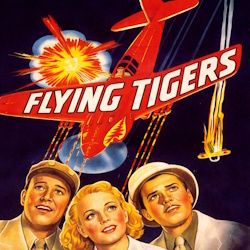
By 1942 the United States was fully engaged in WWII and Republic Pictures management decided making a propaganda film to support the war effort would be both patriotic, and profitable. They decided to tell the tale of the American Volunteer Group (AVG), American civilian pilots who shipped out to China for the purpose of flying American P-40F fighter aircraft to aid Chinese allies fighting Japanese aggression. Edmund Grainger was placed in charge of production with a $900,000 budget, David Miller would direct, and Kenneth Gamet and Barry Trivers would write the screenplay. A fine cast was assembled, with John Wayne starring as Captain Jim Gordon, joined by John Carroll as “Woody” Jason, Anna Lee as Brooke Elliot, Paul Kelly as “Hap” Davis, Gordon Jones as “Alabama” Smith, Edmund MacDonsald as Blackie Bales and Mae Clarke as Verna Bales.
The story is set in western China circa 1941 and follows the fortunes of several members of the “Flying Tigers” squadrons, which were manned by American pilots and aided our Nationalist Chinese allies in fighting the Japanese. Captain Jim Gordon commands the squadron, but squadron cohesion is ruptured when his old friend Woody Jason joins. He is an egotist, and rogue who fights only for himself and personal gain. His violation of procedures and policies leads to the loss of a valuable P-40 fighter, and the death of a two team mates. He makes matters worse by making a move on Jim’s girlfriend Brooke. Yet in the end, Woody redeems himself on a suicide mission where he destroys a vital Japanese bridge and then crashes his plane into a massive supply train. The film broke all box office records for Republic Pictures earning a profit of $600,000, and was one of the top grossing movies of the year. Critical reception was mixed, however, the film received three Academy Award Nominations for Best Sound Recording, Best Special Effects, and Best Music Scoring for a Dramatic Picture.
Though on contract with Paramount, Victor Young was loaned out to Republic Pictures for the scoring assignment. Upon watching what was in essence, a propaganda film, I believe he chose to imbue his score with the requisite patriotism. He used energetic fanfares, to propel and empower the aerial dogfights, offering a testament to the heroism of the American (AVG) pilots. I believe he also saw opportunity to juxtapose the romance between Jim and Brooke with the high-stakes aerial combat. I also believe Young understood he needed to create three cultural identities for the Chinese, Japanese and Americans. Lastly, I also believe Young realized that he would have to emotionally guide audience emotions, evoking heroism and courage during the thrilling suicide mission sequence.
 For his soundscape, Young composed four themes. Jim’s Theme serves as his personal identity, but also that of the Flying Tigers under his command. It offers classic American bravado with a “gung-ho”, trumpet led fanfare, which propels the squadron into battle and empowers it during aerial combat. The Love Theme for Jim and Brooke offers classic Hollywood, Golden Age sensibilities. It features a string borne romanza and is expressed with tenderness and an undercurrent of yearning. I also sense restraint as current circumstances do not lend themselves well to deepening their relationship. Indeed, throughout the film Young never allows the theme to culminate. For the Chinese and Japanese identities, Young shifted to the pentatonic scale, which I believe was well-conceived and executed. Many East Asian cultures developed the scale independently, often based on early instruments like bamboo flutes. The lack of half-steps (semitones) ensures no clashing notes, creating a uniquely “open” or “floating” sound. This expressed musically, the traditional cultural values of balance, harmony and unity with nature. To differentiate the two cultures, he infused into the Japanese identity dire horns bellicoso and a brutal menacing musical narrative, which clearly reinforced them to the audience as the bad guys. The Chinese Theme is also buttressed by horns; however, we discern musically pride, strength and forthrightness.
There is no bona fide commercial release of the score. As such I will use scene descriptors with film time indices for musical reference. 00:00 “Main Title” offers a score highlight. We open with trumpeting heraldic fanfare to support the Republic Pictures logo. At 0:12 we flow into the opening credits atop dramatic pentatonic declarations with horn counters, which establishes the Chinese setting, and the display of the film title. At 0:27 we flow into the Love Theme, a vintage string borne romanza for which Young is well known. As the credits come to a close, we conclude the romanza on a grand crescendo. At 1:01, Young uses a gong strike usher the orientalism of the Chinese Theme, a passage of pastoral beauty, which supports a photo of Generalissimo Chiang Kai-Shek and script, which reads;
“Since the Flying Tigers first spread their wings in the skies above China, the enemy has learned to fear the intrepid spirit they have displayed in face of his superior numbers. They have become the symbol of the invincible strength of the forces now upholding the cause of justice and humanity. The Chinese people will preserve forever the memory of their glorious achievements.” ‘Generalissimo Chiang Kai-Shek.
At 1:43 in “Japanese Raid” dire fanfare supports entering the film proper as loud speakers sound the alarm of Japanese planes sighted over the Kunsing area. Urgent swirling string vortices propel the pilots to their planes. American fanfare answered by Japanese fanfare set the stage for battle as the plane move to the runway to take off. Chinese fanfare dramatico support Chinese peasants watching in awe P-40s lifting off. The Flying Tigers remains dominant as Jim confirms successful take-off with a roll call of his six-plane squadron. At 3:08 proud fanfare supports a young boy eating rice by a box which displays; “United China Relief”. The fanfare draped with orientalism continues as we see nurse apportioning food to the wounded Chinese adults, and orphans; a rice bowl, bread and one egg. At 3:44 the sound of planes overhead evokes fear as all turn their eyes to the skies. A dire and menacing Japanese Theme resounds as the camera focuses on one of its pilots. Everyone flees for cover propelled by a dire musical narrative as three bombs explode and severely damage the hospital and food distribution center. Forlorn woodwinds support the view of a terrified child wailing in the rubble. Aloft we see eighteen Japanese bombers continuing to bomb Kunsing. Jim sights the bombers below, and despite a one to three disadvantage, orders an attack. The aerial battle is unscored. They shoot down one bomber and then find themselves under attack by a squadron of Japanese Nakashima fighters. The bombers escape as they fight for their lives against the Japanese fighters.
9:05 “Tending The Wounded” reveals a field hospital tending to wounded aviators from the previous mission. Forthright horns orgogliose declare and empower the Chinese Theme as the camera shifts from a panorama shot of the camp, to a surgical tent. Soon the roar of P40 engines is heard which rouses the camp, which braces for casualties and possible deaths. The camera pans across a montage of American and Chinese faces filled with joy that all the planes have returned. 12:31 “Dale Is Dead” reveals Jim walking over to Dale’s plane as he had yet to come out. Dire horns of death resound and the music descends into grief as he looks in and finds the cockpit shot up and Dale dead. Young supports with a lament as Jim enter the crew tent where he asks the Chinese mechanic Mike to replace Dale’s instrument panel. The musical lament weighs heavily as his crewmates now realize that Dale died. We shift to a weeping solo violin as nurse Brooke wraps up Dale’s personal effects as the doctor types the death report. Muted horns solenne carry Brooke’s entry to Jim’s office and now offer a new rendering of the lament. He places the effects in his desk drawer and we see five others. He is clearly distraught, slams the drawer closed, and says with dejection; “Quite a collection”. Another loss weighs heavily as he frets about always being outnumbered three to one.
14:53 “Take Me With You” offers a score romantic highlight. It reveals Jim asking about Miller. She says Miller has a flesh wound and you can have him back in a week. When he asks, how are you? She smiles and says you can have me back anytime. He stands and kisses her and they discuss their circumstances and how he misses San Francisco. She says that when he decides to go back, to take her with him. Young introduces his Love Theme, which supports the scene. The theme is string borne, but expressed with tenderness and an undercurrent of yearning. I also sense restraint as current circumstances do not lend themselves well to deepening their relationship. The music ends as Reardon joins and Jim assigns him command until he returns from Rangoon with replacement pilots. Jim says his good byes and orders no gin rummy with Brooke as she is his pigeon, which brings a parting quote of their Love Theme as he kisses her goodbye. We conclude with the theme shifted to a solo violin romantico as she watches him depart. At the Hotel Continental in Rangoon Jim joins Lieutenant Barton, along with Blackie Bales and his wife Verna. Jim turns down Blackie request to join, saying that although he was cleared by an army investigation of any wrong doing in the death of a fellow pilot, that bad blood remained with many on the squadron. Later, Verna corners Jim, makes an impassioned plea to let him join and regain his self-respect, and Jim relents.
23:02 “One Wing and a Prayer” reveals the hotel clerk alerting Jim that the plane with recruits for which he has been waiting was attacked, heavily damaged, and preparing to land on one wing and a prayer. Dire Japanese Fanfare punctuates the news. Woody Jason is the cocky pilot and he is landing the plane in a storm on just one engine as the left one is in flames. Things worsen when one landing gear fails to deploy, and so Jim orders a belly landing on the muddy part of the runway. As he lands hard and skids, a crescendo dramatico supports, and shifts to an urgent and frantic musical narrative as the passengers are evacuated and the fire extinguished. Jim, Woody and Jason all reacquaint and prepare to return to Kunsing. When they arrive, Woody is not impressed with the facilities, and barracks. Jim says he did not promise him La Guardia and orders him to check in and report back to him. 29:25 “Woody Is Aroused” reveals him turning and seeing a woman hanging out some clothes to dry. He informs that he has a reconnaissance mission and departs. Young supports with a comedic rendering of “Yankee Doodle Dandy”, followed by “The Farmer In The Dell”. He walks in, Brooke hears the door close, and he Love Theme unfolds as she yells out Jim, I’ll be there in a minute. The two themes interplay until she emerges and is shocked to discover a new pilot. He is flirtatious, she unamused and deflecting. She squashes his amorous efforts and departs and we close with a sardonic reprise of “The Farmer In The Dell”.
Jim introduces Woody to the men and we see he is full of himself and here only for the money. Bombs begin falling on the camp as a Japanese bomber squadron makes a surprise attack. They take cover until they pass, and then all run out to their planes for pay back. Jim orders Woody to stand down as he has had no combat training. After everyone has left, Woody sees a m empty plane, and commandeers it. He takes off with the Mike frantically saying stop! The engineer informs that there are no bullets or radio, so they decide to radio Jim of the problem. Jim turns back, but it is too late. Woody dives to attack the bombers, the guns do not work, he suffers major tail damage and crash lands, totaling the P40. They rescue him, he remains cocky and Jim orders him to report to his office. Woody asserts he is in this for himself and the money. Jim dresses him down saying there are no rogues in his outfit, that they function as a team, and look out for each other. Woody apologizes and his charisma and promise manages to persuade Jim that he will toll the line from now on. 46:09 “Blackie vs Woody” reveals Blackie calling out Woody for cutting in twice on his pursuit of a Nakashima to get credit for the kill. He adds that there is only one person you think about up there – yourself. Woody counters with the incident for which Blackie was acquitted, saying the board of inquiry failed to smell your breath. With that the two men start fist fighting. Dire horns of menace support the accusation and the musical narrative slowly swells with tension, exploding at 46:50 as the fight begins. The fight is broken up with the PA calling squads A, B, and C to report to counter a Japanese attack on Mekong bridge.
49:10 “Battle of Mekong Bridge” reveals Japanese bombers destroying the bridge. The Flying Tigers arrive and engage both the bombers and supporting Nakashima fighters. A Japanese N fighter sneaks up on Blackie and unloads a barrage that mortally wounds the plane. Young offers a crescendo of alarm as Blackie opens the cockpit canopy and prepares to bail out. As he tumbles out, a tumbling motif supports, and shifts to strings furioso descent motif as he falls. He deploys his parachute early and we shift from strings furioso slowly to portentous strings, as a Japanese fighter closes. Blackie sees the fighter approaching, accepts that he is helpless, and his body is riddled with bullets. He dies crowned with a death chord at 50:03, and fading elegiac horns. We shift at 50:12 to “The Letter” where we view a letter Woody is reading. It is from Blackie to his wife and he promises that when he returns, we can look the whole world in the eye, knowing we’ve done a good job. Young supports with a lament, which descends into bitterness as one by one Woody’s team mates impugn Woody’s selfishness, by implying that he abandoned Blackie, choosing to go for another kill ($500) rather than follow him done to protect him. As he leaves a messenger announces that he is now an ace, having made five kills. His team mates deride the news, and as he departs, Young supports with a grim, foreboding musical narrative carried by repeating four-note phrasing. Jim stops him, and asks if he could have prevented Blackie’s death, and he says no, adding that if he had not opened his parachute early, he would have made it. Jim then grants permission for him to take a P40 up to clear the air. Later in Rangoon we see Woody acting nobly by lauding Blackie’s accomplishments to his wife. He then gives his $2,500 winnings, saying these were Blackie’s winnings.
54:16 “Mr. Sunbeam” offers a wonderful score highlight. It reveals Chinese peasants filling the bomb craters and carting away debris from the last bombing. The Chinese Theme supports, and although beleaguered, its articulation reveals resolve and perseverance. At 54:42 Young introduces a playful and bubbly kindred theme, the Children’s Theme as an ambulance arrives. Brooke returns to the clinic and is advised of a man, whom the kids have named Mr. Sunbeam, has brought life and merriment to the children. Brooke is curious, goes into the courtyard and is surprised to find Woody. He is putting on a magic show for the kids who just love him, and we see Brooke is also enjoying it. The happy moment is shattered as a new round of Japanese bombing begins, causing everyone to flee for cover. The bomb strikes are deafening, the building shakes and dust fills the air. Everyone’s eyes are transfixed on the ceiling, wondering if the next blast will kill them, but soon the explosions stop, and the plane engines recede into distance. 59:20 “Tending to the Children” reveals Brooke changing the dressings for the many children wounded in the attacks. Brooke relates tales of woe for these orphaned children to Woody, and Young supports with an emotional mirror image of the Children’s Theme, now rendered less bubbly and vibrant, and instead draped in sadness. We see that he is clearly falling in love with Brooke as he watches her minister to the children.
1:00:27 “Gifts For Mr. Sunbeam” reveals a girl bringing Woody a gift of rice cakes for a tribute. When he asks, tribute? Brooke relates that it is for your courage and loyalty to the Flying Tigers. Young supports the moment with a reprise of the bubbly Children’s Theme. Strings romantico join as he asks Brook out for dinner, but she declines, saying she is dining with Jim. We close with a coda of the Children’s Theme as Woody eats a cake and says; “Hey! These are good!” 1:01:26 “Dinner With Jim” reveals Brooke dining with Jim at a Chinese Restaurant. He apologizes for not taking her to a fine restaurant. Why they wait for their food Jim asks her for a dance. Young supports the restaurant ambiance an instrumental rendering of “That Old Feeling” played on a gramophone. The song offers a breezy, swing melody full of nostalgia. Hap arrives with a coded message, which forces Jim to apologize to Brooke, saying duty calls. Back at the base, Jim briefs his men with new orders. Beginning tomorrow all leaves are cancelled as we will begin continuous night reconnaissance missions in alternating patrols. As Woody leaves, Jim tells him he is reassigned to the #2 position behind me, which pleases both men. In the morning the doctor performs a physical on each pilot to ensure they are healthy and ready for night patrols. Later Jim summons Hap to his office and tells him Tex will lead Squadron B instead of him. He then drops a bombshell, saying he is grounded for as his vision is too poor for night flying. Hap tries to hide his devastation, and Jim throws his dear friend, a life preserver – take over command of ground mechanics. He says he needs someone he can trust, and Hap says, he will think about it. Later, Brooke relays a thanks from Mrs. Bales, and then says there is a lot that needs to be known about you. He seizes the moment and asks her out for dinner to address this, and she agrees. He is happy, and informs Alabama that he will be back in time for night patrol.
That night, Jim orders his team to synchronize watches at 10:55 with departure at 11:00. Hap discovers that Jim is AWOL and decides to replace him at #2. The squadron takes off as Woody arrives and is informed Hap, who was grounded took his place. We shift aloft and see the six-plane squadron on patrol. Jim with roll call discovers Hap is flying and orders him to return to base, but Hap says its too late as we see a Japanese squadron below. Jim leads the attack and an aerial battle unfolds. After a kill, a Nakashima moves in on Jim from behind. Hap moves to intercept for the kill. 1:19:11 “Hap is Killed” reveals Hap closing but squinting with blurred vision. Young supports with a crescendo di orrore as he fires and kills the Japanese pilot, but lacking depth perception, he collides with the Nakashima. Both planes explode and plumet to earth carried by a final gasp of the Main Theme enveloped in a cacophonous storm. As the camera focuses on Jim’s face, we see devastation, and the Main Theme reflects this. 1:19:55 “Jim’s Fury” reveals dire horns of retribution resounding as Woody and Brooke hear the squadron returning. A dissonant, disjointed musical narrative joins as we see Woody and Brooke noting every plane land, with a dark punctuation when they realize there is no sixth plane. A dark pall descends, shattered by horns irato as Jim’s plane rolls in. In the cockpit, he remains devastated and Young shifts to a lament to reflect his loss. He walks up to Brooke and Woody, and says; “I hope you two had a good time, because Hap paid the check.” Weeping strings affanato carry Jim to his office, where he sits down, visibly wounded. At 1:22:14 Woody enters supported by dire, portentous horns. Jim says he is relieved, and will ship out tomorrow as no one in the squadron will ever fly with him again. A crescendo of retribution carries Woody’s exit, punctuated by a powerful and dire chord as the camera reveals on Jim’s calendar, a fateful date; December 7, 1941.
The entire squadron listens to President Roosevelt’s radio speech to congress and declaration that a state of war exists between the United States and the Empire of Japan. The next day an American liberty plane brings Colonel Lindsay to the base. Jim greets him and they proceed to his office where the colonel tasks him with a mission. The Japanese are beginning a huge offensive and shipping supplies, munitions, and tanks north. If they destroy a key bridge over a gorge, their campaign will be delayed long enough to allow General Chiang Kai-shek to establish defensive positions. Jim advises that the bridge is heavily defended by anti-aircraft batteries and squadrons of Nakashima fighters. Jim offers a plan to convert the liberty plane into a bomber, then fly it lone low in the gorge in the early morning to escape detection and strike the bridge. It would be a volunteer mission as it is unlikely anyone could escape the pursuing Nakashima fighters. 1:28:19 “Liberty Preparations” reveals the men converting the plane and loading eight nitroglycerin cannisters empowered by a grim, slow pulsing, two-note ostinato. The ostinato shifts up in register as Woody asks Alabama what is going one. He says it’s the captains plan to serve them morning soup, but for him, it is a one-way trip. In his office, Jim tells Mac to take care of the store supported by a solemn and reserved Main Theme. At 1:30:03 Brooke arrives with a report saying Barton can return to duty in one week. The Love Theme full of yearning carries the scene. When she says good luck offering a kiss, he brushes her aside, says thanks coldly, and leaves.
1:30:33 “The Mission” reveals Jim walking with the colonel towards the plane carried by a heroic rendering of his theme as the camera pan the faces of the men, all watching with admiration. The two-note ostinato returns and carries his remaining walk to the plane. As he opens the door, the colonel asks; “I thought you were going to ask for volunteers?” to which Jim replies, it only takes one as they shake hands. He boards, but the plane surges forward. He reaches the cockpit to find Woody. Before he can stop, the plane lifts off and they cannot land because of the nitroglycerin cargo. He orders Woody into a parachute and to bail out at 1,500 feet. He tries to reconcile with Jim, adding how Brooke helped him grow, even though most of the time she kept talking about, you, San Francisco and tender beef. He then repents his behavior, and the loss of Hal, which at last changed him from a boy, into a man. He wins back Jim’s respect, and he relents, telling him to check the drop cords. They fly into the narrow gorge, flying very low to the ground. They gorge opens, and they see the bridge, however the Japanese anti-aircraft guns begin firing salvos.
1:38:07 “Finale” reveals them dropping two cannisters that destroy the bridge, but Woody is mortally wounded by shrapnel from an exploding anti-aircraft salvo. The plane is on fire, and so they prepare to bail out. Yet Woody knows his time is up and after Jim opens the door, he pushes him out. Jim’s chute opens and he discovers blood on his jacket, which means Woody was wounded. Woody returns to the cockpit and charging strings dramatico propel his suicide dive towards a fully loaded train. Machine gun fire kills him, followed by the plane crashing into the train. A death chord resounds as Jim watches and grimaces with the death of his boyhood friend. Back at the base, Jim reads Woody’s last will and testament bequeathing his possessions to the men. A new recruit reports for duty, is welcomed, and given Woody’ flier scarf, with Jim asking him to take care of it as it belonged to a good flier. The PA announces a raid, as Jim prepares to leave, he asks Brooke out for dinner tonight, as Chin has a new record, and then kisses her goodbye. As he departs, she says sure and goes to the window. Outside the men take to their planes empowered by a reverential rendering of “The Battle Hymn of The Republic”. The anthem slowly swells with patriotic pride as Brooke looks on, the planes take flight, and we reach, “The End”.
It is very disappointing that we have yet another Academy Award nominated score by Victor Young, with no commercial release. America is fighting for its survival in WWII, and Young is assigned a propaganda film, whose mission is to rouse patriotic fervor in support of the country’s war effort. John Wayne’s performance firmly established him as a leading man, and for this man of little words, Young provides a theme empowered by fanfare, which is strong, forthright, and masculine. For what it lacks in bravado it fully embraces America’s “gung-ho” and “can do” resolve. It propels the Flying Tigers in aerial combat, and offers a perfect contrast to the sinister, menace and malevolence of the Japanese Theme. We are graced with a beautiful Love Theme, but one that desires and yearns, but never culminates due to the backdrop and demands of the war. We discern an undercurrent of sadness, but also a kernel of hope voiced in their aspirations. The Chinese setting is well-established, and although its theme embraces the pentatonic scale like the Japanese Theme, it speaks to the nobility, resolve and determination of the Chinese people. Folks, the film offers a war narrative, within which lies a love story, and story of, redemption. Young’s score is well conceived, well-executed and finds excellent confluence with the film’s narrative. Until such time as we get a recording of the score, I recommend you take in the film on one of the streaming services.
For those of you unfamiliar with the score, I have embedded a YouTube link to the film’s opening scenes https://www.youtube.com/watch?v=wbvJA1IKxSw
Track Listing:
- NOT AVAILABLE
Music composed and conducted by Victor Young. Orchestrations by Leo Shuken and Sidney Cutner. Recorded and mixed by XXXX. Score produced by Victor Young.

Shop at the Movie Music UK Store

Member of the

 MOVIE MUSIC UK