FACKHAM HALL – Oli Julian
 Original Review by Jonathan Broxton
The lives of the British aristocracy, and those who serve them, have been an endless source of fascination for decades, through films and books and television. The ITV drama series Upstairs Downstairs, which premiered in 1971, was enormously popular when it first aired, but this was then eclipsed by Downton Abbey, which debuted in 2010 to massive Emmy-winning acclaim and global fame. The British have always excelled at these types of soapy period costume dramas, where stiff collars and even stiffer upper lips mask all kinds of shenanigans and debauchery behind closed doors. The British are also exceptionally good at poking fun at themselves with parody, which brings us to Fackham Hall.
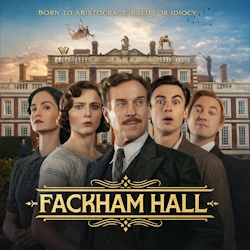
Fackham Hall is a slapstick comedy farce parody of the entire Upstairs Downstairs/Downton Abbey genre (with a little bit of Agatha Christie thrown in for good measure), directed by Jim O’Hanlon, and co-written by standup comedian Jimmy Carr with The Dawson Brothers, Steve Dawson and Andrew Dawson, who have contributed to numerous British comedy sketch shows and TV series over the last 15-20 years. The film stars Thomasin McKenzie, Ben Radcliffe, Katherine Waterston, Tom Felton, and Damian Lewis, and the plot centers on the relationship that develops between an unassuming young lad named Eric, and Rose, the youngest daughter of the wealthy Davenport family, owners of Fackham Hall. However, when a murder takes place in the aftermath of a chaotic wedding, a police inspector is sent to investigate – and immediately points his finger at Eric as the most likely suspect. The plot is really just a flimsy excuse for the filmmakers to engage in an endless series of sight gags, rude double entendres, and silly moments of farce, but the filmmakers also made a lot of effort to get the period details right, and that brings me to the music.
 These types of projects have always contained a very particular type of score – the ‘BBC English period drama sound’ – which composers like George Fenton, Rachel Portman, and Patrick Doyle adopted on the big screen, and which composers like Debbie Wiseman, Anne Dudley, and Carl Davis adopted on the small. Downton Abbey was famously scored by Scottish composer John Lunn, who won several Emmys for his trouble, but the score for Fackham Hall is by composer Oli Julian, who will likely be an unfamiliar name to most people reading this, but has been working extensively on British TV projects since the early 2010s – his most prominent scores include popular sitcoms like Episodes, Catastrophe, Crashing, Sex Education, and the TV version of The Full Monty, as well as period pieces like Renegade Nell and The Completely Made-Up Adventures of Dick Turpin.
Julian understood exactly what the assignment entailed and wrote a score for Fackham Hall that is completely serious, in that it could easily have actually been written for the real Downton Abbey (or something similar), instead of a parody of the genre. This was exactly the right approach – the first rule of comedy is always to score the drama, because that makes the jokes funnier – and Julian absolutely nailed the entire assignment. His score is a lush, fully orchestral, sweeping, thematic delight, full of romantic interludes, gorgeous classical waltzes, sparkling piano melodies, and rich moments of beauty. If you didn’t know this was a comedy score, you would be forgiven for thinking it was a score for a lavish new Shakespeare adaptation, or something by Jane Austen or one of the Brontë sisters. It’s that good.
Everything about the score overflows with class, elegance, and that indefinable sense of ‘Britishness’ that is difficult to describe with words, but immediately announces itself when heard. The “Opening” sets the tone for the entire score; it’s a bubbly, vivacious, charmingly upbeat piece for dancing pianos, flighty woodwinds, warm horns, and sparkling pianos courtesy of soloist Steve Holness. Everything about it is perfect; it speaks to the wealth and privilege of the Davenport family, to the beauty of the rural landscape, to the musical conventions of the time period, and to the cultural heritage of the characters. As an Englishman of a certain age, there is something about this music that just speaks to me, as if it is in my DNA. I adore it.
As the score develops Julian stays mostly within the same musical world, but keeps finding ways to add new layers and new depths, and as a result every single cue has something to say. “No One” is a wonderful orchestral piece in playful waltz time, anchored by a scintillating solo violin part and backed by mischievous bassoons, and this idea carries through into the subsequent “Pleasure Doing Business”. There is a captivating feeling of optimism and dramatic purpose to the glorious statement of the main theme in “Back to Fackham,” and then there is pastoral elegance and inherent romance in the interplay between the violins and pianos in “First Wedding”.
There is a gorgeous, rolling, undulating sense of fiery passion to the piano lines and sweeping strings in “Stop”. The rather unfortunately-named “Cockeater” is surprisingly emotional, pianos and strings providing a certain bittersweet pathos. There is tenderness and romantic beauty in the lovely “Walking Home,” which in its second half turns superbly melodramatic and imposing. The “Funeral” is soft and sentimental, and features an increased use of brass, while the piano lines and string passages in “Proposal” become more dramatically potent as the cue progresses. The rippling pianos in “The Other Side” are magical, and the strings beautifully reprise the main theme once more.
The score’s only action cue is “Fete Run,” and sees Julian adding a layer of percussive drive and vigor to his spirited string and piano runs; this general dynamic then carries over into the dramatic conclusion, “A Wee Tiff”. The finale cue, “Inspector Watt To You,” is a sweeping reprise of the main theme, and this then leads into the equally lush and satisfying “Credits,” which ends the album on a super high.
In addition to Julian’s score, the legendary (and much-missed) composer David Arnold composed two original comedy songs for the film, with lyrics Steve Dawson, Andrew Dawson, and Tim Inman. The first, “London’s My Favourite,” is performed by the movie’s cast, while the other, “I Went to the Palace,” is a rude little ditty performed by actor Adam Woodward, who plays Bert Chester, a character based on Noël Coward. Confusingly, the film’s credits read “composer Oli Julian, music by David Arnold,” which is something I have never seen before, but everything I have seen indicates that Julian wrote the entire score, with no contribution from Arnold at all.
Unfortunately, at the time of writing, the score for Fackham Hall is not available for commercial purchase – this review is of a promotional album that Julian released for awards consideration purposes – but sources tell me that an album will be released later in 2026. This can’t happen soon enough – based on all the praise and acclaim I wrote above, for me, Fackham Hall is easily one of the best comedy scores of 2025, and I can’t wait for the score album to be released so everyone can listen to it for themselves.
Buy the Fackham Hall soundtrack from the Movie Music UK Store
Track Listing:
- Opening (1:29)
- No One (1:45)
- Pleasure Doing Business (1:29)
- Back to Fackham (1:33)
- First Wedding (1:37)
- Stop (1:24)
- Fingertips (0:31)
- Cockeater (1:05)
- Walking Home (2:49)
- Remain Here (1:38)
- Funeral (0:35)
- Proposal (2:21)
- Nothing I Swear (2:00)
- The Other Side (1:10)
- Fete Run (2:12)
- A Wee Tiff (2:27)
- Inspector Watt To You (1:26)
- Credits (1:06)
Promo (2025)
Running Time: 29 minutes 02 seconds
Music composed by Oli Julian. Conducted by Anthony Weeden. Orchestrations by Anthony Weeden. Additional music by Ethan Jeffrey, Helen Lyon and Andrew Swarbrick. Featured musical soloist Steve Holness. Recorded and mixed by Rupert Coulson. Edited by David Rodger. Album produced by Oli Julian.
Leave a comment

Shop at the Movie Music UK Store

Member of the

 MOVIE MUSIC UK
Thank you for the review but… Why is David Arnold referred to as “much missed”? A quick internet search confirms he is alive, and working.
Because he hasn’t scored a movie in a very long time!