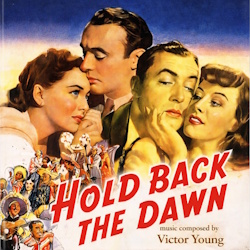
HOLD BACK THE DAWN – Victor Young
 GREATEST SCORES OF THE TWENTIETH CENTURY
Original Review by Craig Lysy
The genesis of Hold Back the Dawn was writer Ketti Frings’ story, “Memo to a Movie Producer”. Paramount executives decided that the romantic drama would translate well to the big screen, and so paid $5,000 for the film rights. After the novel was published and well received, the working title of the movie was changed to the novel’s title, “Hold Back the Dawn”. Arthur Hornblow Jr. was assigned production, Mitchell Leisen was tasked with directing, and Charles Brackett, Billy Wilder and Richard Mailbaum wrote the screenplay. A stellar cast was hired, which included Charles Boyer as Georges Iscovescu, Olivia de Havilland as Emmy Brown, Paulette Goddard as Anita Dixon, Victor Francen as Van Den Lueken, and Walter Abel as Inspector Hammock.
The story is set in 1940 and follows the fortunes of Georges Iscovescu, a Romanian gigolo who has fled Romania with the onset of WWII. He seeks entry into the United States and waits in a Mexican border town an opportunity to present itself. After six months he is broke, and desperate. He reacquaints with his former dance partner Anita Brown, who is now a US citizen. She shares her successful scheme; marry an American, and then divorce them once you have citizenship. He selects his target; a visiting school teacher Miss Emmy Brown, and ends up marrying her. He has no plans to consummate the marriage and feigns a shoulder injury. Yet one night while Emmy bathes in the moonlight he is overcome, and makes love to her. He then realizes that he has fallen in love with her. All is shattered when Anita, who has been secretly in love with Georges, callously relates his deception to Emmy. Yet love overcomes all obstacles and Georges and Emmy eventually reconcile. The film was commercially successful, was praised by critics, and received six Academy Award Nominations for Best Picture, Best Cinematography, Best Screenplay, Best Art Direction, Best Actress, and Best Scoring of a Dramatic Picture.
Producer Arthur Hornblow Jr. hired Victor Young to score the film. Young was Paramount’s premier composer, a song writer at heart, and Hornblow Jr. believed that his gift for melody would lend itself well to the story. I believe Young understood that the film offered emotional complexity with themes of love, deception, and the desperation of European refugees. He would need to establish the palpable tension and despair of the border town setting, where refugees are anxiously waiting for American visas, while also supporting moments of warmth, tenderness, and hope. Above all, I believe he understood that he would need to speak to Georges Iscovescu’s journey of redemption, from a mercenary charismatic gigolo, to a man no longer acting, but genuine in his love.
 For his soundscape, Young created a love theme, which offered a sentimental instrumental ballad featuring an elegant romantic violin solo. This beautiful melody however, is heard but twice in the film for the opening credits, and the finale, which I will explain in my summary. Most of the film takes place in Mexico, and Young does a fine job draping his soundscape with the requisite cultural sensibilities, including the use of ballads, Mariachi, dances, hymns. He also includes a number of popular songs and a national anthem to support the narrative.
There is no bona fide commercial release of the score. As such I will use scene descriptors with film time indices for musical reference. 00:00 “Main Title” offers a score highlight where Young establishes the film’s narrative – a love story. It opens with grand trumpeting fanfare as he supports the Paramount Pictures logo. This ushers in a sweeping exposition of the Love Theme, rendered fully in ABA form, which supports the flow of the opening credits against a depiction of a Mexican church. At 0:43 laudatory supports the display of producer and director credits. At 01:03 the Love Theme resumes and supports narrative script of how this story began; “One day last August into the Paramount Studios in Hollywood walked a man…” At 1:08 we enter the film proper carried by musical pleasantry as we see Georges Iscovescu entering the Paramount Pictures main entrance. Musical support ends here. At the main desk he asks to speak to Mr. Dwight Saxon. He is told he is shooting on Stage 5, but is turned away after he discloses that he has no appointment. Outside he blends into a tour, and then sneaks into Stage 5. As they break shooting for lunch, Georges reintroduces himself to Dwight, who recalls their meeting in Nice. He says he has a story to sell for $500. Dwight attempts to direct him to the story department, but Georges says he cannot wait as the Federal police are pursuing him. When Dwight asks why? Georges says that is part of the story. This piques Dwight’s interest and he invites Georges to sit down and relate his story.
05:50 “Flashback” is unscored as Georges reveals his story as we shift to Mexican border town of Juarez. He applies for a visa, but then receives devastating news of the ‘Quota System”; the U.S.A. admits 150,000 immigrants a year, and each country also has a quota. He is told there are few openings for Romanians, many applicants, and that he could anticipate a wait of five to eight years. Georges leaves stunned and says he could not envision staying so long in a scorching, impoverished, fly infested town. He was lucky to secure a room at the Hotel Esperanza for $1 a day after a room became available due to the previous renter hanging himself in the room. 09:56 “Weariness” opens with a panorama of the town square supported by an obscure American marching tune wafting over from the American side of the border. We see him laying on the bed in his room with a rising sense of futility and despair. Fellow immigrant Professor Van Den Lueken invites Georges to join his family, Josef and Berta Kurz and Banbois Boulanger in celebration the 4th of July, but he declines. Instead, Immigration Inspector Hammock arrives and invites himself to the party and we watch how everyone ingratiates themselves as he is the one man you do not want to offend. The Marching Band tune resumes as Georges descends into the hotel lobby meet with hotel owner Flores. He again asks for a dollar loan, but Flores advises that he cannot as he is two months behind in his rent, and owes $39. Yet, Flores relents and as Georges walks down Main Street, Tony, a young boy keeps throwing fire crackers, which explode and surprise him. Teacher Emmy Brown stops the car and demands Tony apologize to the gentleman, but Georges is not gracious, and informs her that Americans should celebrate on their side of the fence they built to keep people out. She takes umbrage, pulls away, and collides with the car in front of her.
15:23 “A Fateful Meeting” reveals Georges entering the saloon supported by festive Cantina song, which is sung and played by a small ensemble. He orders a shot of tequila at the bar, Anita, his former dance partner sees him, and goes up to the band leader and asks him to play “La Cumbacita”, long known as the Tango anthem. She surprises him at the bar and they reacquaint happily. He is stunned when she says he can become an American in four weeks – just marry and American and you are processed. After that, you just get a divorce and begin your new life, as I did. She is flirtatious, but he is unreceptive, as he realizes, that his goal is now within his reach. She leaves with her drunken boyfriend, and Georges sets out to find a wife. 19:48 “Georges Begins His Search” reveals him attending a bull fight, which Young masterfully supports with a Pasodoble, a vibrant, dramatic dance meant to translate an actual matador bullfighting into dance. In the arena, narration informs us of Georges stalking his prey. He finds an unescorted blonde and secures the seat next to her. She falls for his charisma, chivalry, and charm, yet everything unravels when he is advised of Clarence – her husband. As he walks down the Main Street, and passes various saloons, a medley of tunes waft into the street. He is depressed until he passes by an auto repair shop where he sees the school teacher trying to manage her raucous students.
24:14 “A Second Chance” reveals Georges and Emmy Brown reacquainting, with Georges apologizing for contributing to her problems. His charm, and charisma ameliorates the memory of their first encounter and she is thankful when he offers the use of his hotel’s phone so she can inform Principal MacAdams, that they will be late returning. As they wait for Flores to place the call, his charm becomes amorous, which makes her shy and nervous. She takes the call, and advises the MacAdams of her circumstances. The mayhem erupts as the boys rush in with the mechanic who accuses them of stealing the distributor cap, which was in reality kicked by Georges into a drain to delay Emmy’s departure. Georges, uses chivalry to save the day, arranging for everyone to sleep in the lobby until a new part can be ordered in the morning. Emmy is overwhelmed, and for the first time we see a nascent attraction for Georges. 34:30 “Hello, Georges” is unscored, and reveals Georges returning to his apartment and finding Anita applying make-up. She is clearly amorous, and he, clearly not interested as he asks her to leave as she is taking up his time. She does not relent, offers a lawyer, anything he wants so they can resume their dance career in the States. He coldly rebuffs her efforts saying he has matters under control, but then takes her up on her offer of ‘anything’, and slips a ring off her finger saying he needs a wedding ring.
37:12 “Hold Back The Dawn” is unscored, and reveals Emmy waking and surprised to see Georges sitting across from her, his eyes affixed. He confesses his love, yet she asks him to go away. He persists, offering storytelling of a shared fate, one that binds them, and cannot hold back the dawn. She walks to the window, he follows and his amorousness irresistible, as we see her defenses begin to fall. Yet she musters her strength, and again says, no as she walks away. He follows, takes her into his arms and says it is not this kiss I desire, but all your kisses, and all your life. He then says to look at her left hand, and he says, behold, your wedding ring. He said he placed it while she was asleep, and that it was his mother’s. He finally kisses her, and as she accepts, all her defenses collapse, overcome by his testament of love. He then says that she should not be afraid as he departs. As he walks down the street, he hears running footfalls, turns, and is joined by Emmy. Narration of his thoughts are self-congratulatory for pulling off the perfect con; “The trap was set. She never had a chance”. They get married by a Mexican Justice of the Peace, and she is just ecstatic and can’t wait to introduce him to her family. She is taken aback when he discloses that he cannot return with her for four weeks as he must wait for the American government to issue him a visa. She then prepares to depart, but asks him to recite the wedding ring vow, which he struggles to do with sincerity. After her departure he and Anita conspire to resume their dance career in New York, after a brief stop in Azusa to inform Emmy, that it was just not meant to be.
52:00 “Bad News” reveals Bonbois Boulanger receiving his letter from the Immigration Board, and Den Leuken advising that his lineage derives from the Marquis de Lafayette who, along with his descendants, were granted honorary citizenship in gratitude for his assistance defeating the British. Mr. Hammock arrives and goes upstairs to speak to Mrs. Berta Kurz. He brings her devastating news; her husband has been denied entry because he suffers from Tuberculosis. He gives her false hope saying that they may enter someday, when he has healed. Young supports diegetically with Josef playing a non-descript classical piece on piano. 54:45 “Champagne For Good Luck” reveals Anita sealing Georges’ visa request letter with her lips wet from champagne supported by a gentile Mexican song played by guitar. As they toast to their new life in New York, Mr. Hammock joins. He knows, that Anita knows that he is aware of her marriage con and is not surprised that she divorced her husband of convenience a year ago. Georges sees Emmy’s car outside and excuses himself. He goes to hotel room and finds an ecstatic Emmy who kisses him and shows him a cake she brought. She shows him wedding gifts from mother, father and relatives and that she was given a week off to celebrate their honeymoon. He steps out to park the “newlyweds” decorated car in the hotel lot, but instead meets Hammond and Anita. He manages to hide the sign celebrating the Iscovescu marriage. After Hammond leaves, he gives Anita money to pay his bills and accepts her advice to get Emmy out of town to avoid Hammock. Back at the room he tells Emmy they are leaving to stay at a proper place for their honeymoon.
In an unscored scene, Georges takes a wrong turn in the storm and just continues to drive and get as far away from Hammond as possible. Emmy relates to him that sound of the wipers seems to say the word, ‘together’. The next day back at the hotel, Hammock is offered a piece of wedding cake by the maid and he sees its for Mr. and Mrs. Iscovescu. She informs him that he met an American teacher on July 4th, and they married on July 5th. 1:06:20 “Colonia” reveals their arrival in the town supported by festive Mexican source music as they are celebrating All Saints Day. As the walk through the town a danza festivamente supports people dancing in the streets. They soon join a processione riverente with all the other couples to receive a marital blessing. A woman’s choir sing the Ave Maria hymn as the church bell chimes. The priest blesses the congregation, and then one by one each of the newly wed couples who kneel before him. When it is Georges and Emmy’s turn, the priest after the blessing, wishes them well in English. We then shift outside to a celebratory Mariachi band that supports happy couples dancing. Then everyone goes again to the town’s olive tree where each grooms shake its branches. The number of olives that fall will be the number of children they will have. When it is Georges’ turn, three olives fall, and Emmy gently picks up each one, as though they were precious. A soft Mexican ballad plays as she relates their children’s names; Joshua, Helen and Gregor after his father, and that she refused her parent’s suggestion that they change their family name Iscovescu. We see him becoming increasingly uncomfortable as she is no longer a cardboard woman of convenience, but someone whom he now fully knows, makes him laugh, makes him happy, and does not deserve to suffer what he intends. When she moves in to kiss him, he accepts and the Mariachi join to support. Later Georges prepares the wagon, as they will sleep there. He carries her over the threshold into the back seat, and she says, I love my husband very much. As she gets ready for their wedding night consummation, we hear in his mind his now, very real moral conflict as his conscience makes its presence known. He says he has no right to touch her, no right to involve her, as he wanted her to remain, Miss Brown. And so, he feigns a shoulder dislocation while placing his luggage in the front seat to make love-making, impossible.
1:19:24 “I’m So Sorry” reveals his apology, and Emmy returning to the station wagon back to sleep as he remains in the driver seat upright so there is no pressure on the shoulder joint. The car radio offers a source danza romantico as he gazes at her through the rear-view mirror and we see the a conflict of conscience in his eyes. He turns the mirror down, and then drifts off contemplating his future. He narrates that the next morning they drove to Tabutaio, where he informs us that he saw a doctor, whom placed his arm in a sling, and then to San Miguel. She continues to worm herself into his heart with more stories of her life and American culture. In 1:20:43 “Love Awakens” the temperature is over 100 degrees and the car overheats, so they pull onto a beach to fill a container with sea water to refill the radiator. When he returns, he finds Emmy’s outer clothes and shoes on the sand, turns and sees her happily swimming in the waves. He smiles and fills the radiator. Emmy returns, she is cold, that her hair is soaking, and asks for her scarf. She comes to him she says she is cold and to feel her cheek. When he does, he is overcome and takes her into a passionate kissing embrace.
In 1:23:27 “July 13th” narration informs us that it was the last day of Emmy’s vacation. Berta refuses doctor’s advice to go to hospital as her delivery is near, insisting the baby will be born in the United States. As she goes downstairs, her husband’s piano playing supports. Georges and Emmy arrive and he goes in to retrieve her luggage as she must be back in Azusa for an 8:00 pm meeting. On the way he bumps into Anita, who is ecstatic as she has secured booking for them in New York. He however, defers, and tells her to go to New York without him. He add that if he is going to be a swine, he will do it on his terms. 1:28:10 “Anita’s Forces Georges’ Hand” reveals Anita’s anger at Georges’ betrayal, and decides on a diabolical plan; to go upstairs and confront Emmy as a wrecking ball of truth. She joins Emmy and callously unveils; that the wedding ring is hers, that she convinced Georges to gain citizenship like she did, luring a citizen into marriage, and then dumping them once safely in the country. Emmy is stunned, asks her to leave, but Anita doubles down, revealing Georges sordid past as a womanizer and gigolo. Outside on the street, Berta walks into the United States Customs and Immigration compound and is stopped by a guard. She says Mr. Hammock told her to wait for him in his office. The guard let’s her pass and she goes into his office. Hammock runs into Georges at the hotel and orders Flores to bring Emmy down to him as he has questions. Georges is told to sit down and shut up, which he does with obvious anxiety Back in the room, Anita is relentless in poisoning Emmy’s heart saying she’s a tramp, dirt like he is, and that she loves him and that we belong together. Flores joins, and informs them that Mr. Hammock demands Emmy meet with him. Anita is now panicked, for if Emmy discloses what she just said, Georges’ citizenship will be denied and he will be stuck in Mexico forever.
1:55:42 “The Interrogation” reveals Hammond interrogating Emmy as Anita watches from the upstairs balcony. He discloses Georges’ sordid past, offering her an annulment of her marriage as Georges was duplicitous, does not love her, and was only using her to gain citizenship. Her response stuns Hammond, and Georges. She says she proposed marriage, not him, that she knows everything about his past, and that she loves him, and he loves her. Hammond is flummoxed and storms out in disbelief. Georges says thank you, and she says she blames herself for being so vain. She says goodbye, places the ring on a table, and drives past the border gate returning to America. Back at Hammock’s office, Berta’s plan succeeds; she gives birth and the child is declared an American citizen. Returning to his room, Anita confronts Georges, yet she is invisible to him, and his silence, and cold indifference, damning. On the road home, Emmy tosses her scarf out the window, it blows back into her face blinding her, and she crashes off the highway into a ditch. Flores is informed by phone and relays the bad news to Georges, that she is injured badly and at Los Angeles General Hospital.
1:41:55 “Georges’ Fateful Decision” reveals him taking Flores’ car, determined to reach Emmy. Anita is frantic saying if he crashes the border, they’ll arrest him and he will be forever barred from America. He drives off, past the checkpoint, and Hammock personally accompanies a pursuit squad of cars and motorcycles. He manages to evade them, and gets directions to Los Angeles at a gas station. Hammock arrives shortly thereafter, confirms the car with the attendant, and pursues. As the sirens near, Georges again evades and resumes his drive. He arrives at hospital at 5:00 am, and goes in, desperate to see Emmy. He meets Mr. MacAdams, and Emmy’s mother and they advise of a chest injury, and that she does not appear to be fighting. He goes in the doctor says she does not hear; however, Georges persists telling her he is here and her hand begins moving. He keeps telling her to breath and to remember the rainstorm, when the wipers kept repeating, ‘together’. He says Emmy, we are together and her eyes at last open. Police cite George’s car for illegal parking, and call in to confirm it is the Mexican car being sought by border patrol. He sees through a window Border Patrol arrive, leaves the hospital and we return to the present as he relates to Mr. Saxon that the $500 was to repay Emmy for the money used during their honeymoon.
In 1:50:27 “Hammock”, when Saxon asks about Hammock, he shows up and apprehends Georges despite Saxon’s intercession. He escorts him out, and narration says the real end of the story happened several weeks later, and we shift to the border crossing town where an American band plays the French national anthem, “La Marseillaise”. When Hammock asks why, he is advised that it is a celebration for a very special honorary citizen and we see the Marquis Bonbois Boulanger. He says goodbye to his fellow American citizens; the Kurz’s, the Den Leukens, and Mr. Flores. The band shifts to “California, Here I Come” as Hammock reacquaints with Anita and her new, very rich benefactor. Hammock then meets Georges who is sitting on a bench, and informs him that he did not file charges, and that he needs to cross the border to see his wife who is holding all his papers. Georges, is joyous, turns and see’s Emmy waving, and the Love Theme carries his run to her, culminating with a grand flourish and, “The End”.
I understand why there is no commercial release of the score, as there is less than three minutes of original score. How to spot music in a film is one of the first issues, which must be addressed by the director and composer. This is the sparsest scores I have ever reviewed with a dialogue rich narrative carrying the film. For his score, Young composed a sumptuous Love Theme for Georges and Emmy, yet restricts it to a grand performance in the opening credits, and the joyous finale. The obvious question is, why? From my perspective, the love theme is not one of yearning, desire, or passion, but instead, epiphanous. From the opening reel we see Georges as a desperate con man, duplicitous, amoral, and covetous; not for love, but instead for American citizenship, which will allow him to again resume his comfortable parasitical gigolo life. Emmy is reduced to a means to achieve an end, that once used, is to be casually, and I would add, callously discarded. And so, only late in the film when Georges realizes he is truly in love, a love, whose redemptive power transforms him, does Young express it as Georges runs across the border to take the love of his life into his arms. I must confess, that I believe Young’s insight, and intuitive approach actually worked. He also did a fine job infusing the requisite Mexican cultural sensibilities, creating a wonder confluence with the film’s setting. Folks, more is not always better, and this score offers a testament to minimalism. I highly recommend you take in the film on one of the streaming services, and see a testament to Young’s genius.
I regret that, for those of you unfamiliar with the score, I cannot find a YouTube link to Victor Young’s music.
Track Listing:
- NOT AVAILABLE
Music composed and conducted by Victor Young. Orchestrations by Leo Shuken and Sidney Cutner. Recorded and mixed by XXXX. Score produced by Victor Young.

Shop at the Movie Music UK Store

Member of the

 MOVIE MUSIC UK