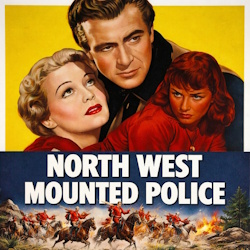
NORTH WEST MOUNTED POLICE – Victor Young
 GREATEST SCORES OF THE TWENTIETH CENTURY
Original Review by Craig Lysy
In 1939 legendary director Cecil B. DeMille decided that his next project, which would be his first film shot in technicolor, would be an epic Western. He purchased the film rights for the 1938 novel The Royal Canadian Mounted Police by R. C. Fetherstonhaugh and sold his vision to Paramount Pictures. DeMille would manage production with a smaller budget than he wanted. As such due to budget restrictions, the movie was filmed on sound stages at the Paramount lot as well as on location in Oregon and California, even though the film was based on a real-life incident in Saskatchewan, Canada. Demille would also direct and narrate, and Alan Le May, Jesse Lasky Jr. and C. Gardner Sullivan would write the screenplay. For the cast, Gary Cooper would star as Texas Ranger Dusty Rivers, joined by Madeleine Carroll as April Logan, Paulette Goddard as Louvette Corbeau, Preston Foster as Sergeant Jim Brett, Akim Tamiroff as Dan Duroc, and Lon Chaney Jr as Shorty.
The film is set in Saskatchewan Canada 1885 against the backdrop of the Northwest Rebellion by Louis Riel, leader of the Métis people (Mixed race people of French and Indian heritage), and the Cree and Assiniboine Indian tribes against the Canadian government. Métis leader Dan Duroc, and whiskey runner Jaques Corbeau convince the former Métis leader Luis Riel to leave exile in the United States and return home to lead a rebellion. Texas ranger Dusty Rivers arrives at Fort Saskatchewan with an arrest warrant for Corbeau. He becomes romantically involved with nurse April Logan, which is not received well by her suitor Sergeant Jim Brett. Another romance between April’s brother Mountie Ronnie Logan and Corbeau’s daughter Louvette creates addition intrigue. After a number of battles, Dusty arrests and extradites Corbeau, and accepts April choice to remain in Canada with Jim. The film was a huge commercial success, and was Paramount Pictures biggest box office hit of 1940. Critical reception was favorable and the film received five Academy Award Nominations for Best Cinematography, Best Art Direction, Best Sound Recording, and Best Original Score, winning one for Best Film Editing.
Victor Young was assigned to score the project, and ended up establishing a friendship with director Cecil B. DeMille, which resulted in five more collaborations until Young’s health gave out in 1956. DeMille always thought big, and wanted a “frontier-showman” vision for the film. As such he tasked Young to employ bombastic and rousing orchestral arrangements to accompany wide vistas and action sequences. Upon viewing the film, I believe Young also understood that the red coat Mounties needed an empowering march with the requisite military bugle work. The hero, Dusty Rivers would also require an Americana theme, the romantic triangle between April, Jim and Dusty would need competing Love Themes, as well as Ronnie and Louvette would also need Love Theme.
 For his soundscape, Young composed seven primary themes. Foremost is the Mountie Theme; a bold, jaunty, horn empowered, and rhythmic motif used to represent the Royal Canadian North West Mounted Police (N.W.M.P.). It emotes as a marcia vivace in ABA form, with the A Phrase bold, forthright and confident, and the B Phrase underscoring their determination, discipline and duty. Young often employs the opening fanfare declarations as a discreet motif for the Mounties. Associated to this theme is the requisite reveille bugle calls used to declare orders. Dusty’s Theme supports our humble, laconic, soft-spoken and dry witted Texas Marshall. Young choose to animate him not heroically, but instead with folksy simplicity, and classic Americana. The theme, like himself, often plods along with no sense of urgency, yet during battle fanfare with trumpet-led flourishes empower him and highlight his American frontier background. Remarkably, there is a tertiary form that evolves late in the film, a Love Theme. Tender, string borne, and still bearing a folksiness, yet in the end, it is unrequited. April’s Theme offers a lush, string-heavy rhapsodic melody used for our Florence Nightingale like heroine. Throughout the film, the theme’s articulation is conflicted, reflecting April’s romantic entanglement with long-time suitor Jim and interloper Dusty, who courts her, promising a new life together with him in Texas.
The Canada Theme offers the sweeping wonder and grandeur of the beautiful, pristine Canadian countryside. DeMille tasked Young with supporting, his vista and panorama shots of the mountains, rivers and forests of Canada, and Young I believe, delivered the goods. Young’s Indian Theme offers cultural juxtaposition, and supports Chief Big Bear, and by extension, the Cree and Blackfeet Indian tribes. Its construct is rudimentary, and led by a meandering nativist flute, which shifts like a breeze over soft drum rhythms. The arboreal, idyllic form however militarizes with ferocious aggression when the warriors are on the warpath and in battle. I surmise that Louvette, a Métis woman and paramour of Ronnie Lang posed the greatest challenge to Young as she was the most emotionally mercurial and volatile of all the characters. She is introduced musically with woodwinds, which express her thievery, mischievousness and playfulness, however, her theme is also offered in manipulative and seductive guises, and even a Love Theme as she conspires to lie, cheat, steal and murder to take Ronnie as her own. Lastly, there is Todd’s Theme, which supports our Scottish scout. Young goes fully ethnic and supports with a festive Scottish jig.
There is no bona fide commercial release of the score. As such I will uses scene descriptors with film time indices for musical reference. 00:00 “Main Title” opens with ominous strings, which support the Paramount Pictures logo. Dramatic horns militare declare the Mountie Theme fanfare as the emblem of the North West Mounted Police displays against a radiating red sachet. The opening credits commence, supported by a proud Mountie Theme rendered in ABA form as a marcia vivace. The march concludes with fanfare regale, which supports credits for Producer and Director Cecil B. DeMille. 01:25 “The Métis” reveals fiery dawn clouds and a panorama of the majestic, towering Rocky Mountains. Young supports with the Canada Theme rendered as an idyllic string borne musical narrative as DeMille’s narration informs us how French pioneers intermarried with the native Indians to form a new race, the Métis. For two centuries, this race of half-breeds prospered as hunters and trappers, a law unto themselves, free from government interference. Here the musical narrative begins to change, darken, and become aggrieved as we are informed that things began to change as surveyors, homebuilders, ranchers and farmers pushed ever westward bringing British laws of land and property, which threatened to end the freeways of the wild trails and Métis life. In 1885, the Métis under the leadership of Luis Riel revolted against the arrival and imposition of British law. Against this backdrop a brigade of Mounties in scarlet coats, the North West Mounted Police (N.W.M.P.) arrived as Canada’s destiny was threatened by rebellion, led by a renegade leader dwelling across the border in Montana.
02:39 “You Must Return!” opens in Montana at a school where the children sing the American patriotic song, “Columbia, the Gem of the Ocean”. Former Métis leader Louis Riel, now a teacher in exile, is startled when the current Métis leader Dan Duroc, and whiskey runner Jacques Corbeau enter the classroom, which leads him to dismiss school early. They inform Louis they are angry; aggrieved, and that they are taking him back to Canada to save the Métis from the whites. Louis reminds them that he failed fifteen years ago, which is why he is in exile. They counter things are different now as the Blackfeet and Cree will join as allies. We end darkly as Riel hesitates and reminds them what happens if they fail again; blood will run like water. 06:48 “The Métis Arm” opens with military declarations opening with trumpets and shifting among the horns. Sergeant Jim Brett and private Ronnie Logan ride warily into town carried by the Mountie March. In the town square the Métis are training, but Duroc orders them to disband as two Mounties are seen riding into town. As they ride through town, they notice a huge Stache of pistols, rifles and ammunition. A sassy, and mischievous Louvette’s Theme supports her tossing pebbles at Ronnie who smiles, but signals her to lay off. She instead follows carried by her theme, a woodwind pastorale infused with comedic accents as Ronnie pushes her away and tells her to meet him tonight at the usual place. Jim reproaches Ronnie for being involved with a half breed as we again shift to her mischievous theme as she steals some cloth. The trumpet led Mountie Theme resumes as they observe Duroc in the distance, and boldly carries them to Jim to Dan. Both men state their terms, and Dan hands Jim a manifesto that tells the British have one day to leave, and that they are setting up a Métis government. As he tries to ride out the crowd turns on him, but April saves the day yelling to Shorty that he has a new son. This diffuses the crowd and allows Jim to pass and visit his girl, April.
In 14:56 “Bad News”, after pleasantries, April offers bad news to Jim, that the Royal Nursing Service had transferred her to a new post 1,600 miles away in Nova Scotia. Young introduces their Love Theme, a tender string borne romanza, yet we discern undercurrents of uncertainty as she answers his question; “Do you love me?”, with, “I might”. Yet he is determined to win her and their theme blossoms as he takes her into a kissing embrace, crowned with muted Mountie trumpets as her brother Ronnie returns. Jim sends Ronnie out, and then declares that he has one month to make her mine and departs, fortified by their Love Theme. Jim recruits Todd, a Scotsman to scout for the Mounties and departs. Dan takes offense and threatens Todd, but the Scotsman is firm, he will not fight against the queen. 18:14 “I Am A Texas Marshal” opens with reveille as the Union Jack is lowered at sun down. Sergeant Brett presents the Commander with Duroc’s manifesto ultimatum. The Commander frets that one day is insufficient time to discuss with high command. Reveille sounds again as all civilians are ordered out of the fort at night. Dusty rides in, and ignores both a private’s order to leave, and then Sergeant Brett’s. He walks into the commander’s office and says he is a Texas Ranger pursuing a man for murder. He presents his papers and the Commander orders Sergeant Brett to prepare quarters and provide him with the necessary forms.
22:09 “Ronnie and Louvette” reveals their secret rendezvous in the stable and we are graced with an extended exposition of their Love Theme. Young also composes a romanza, but woven within its narrative are Louvette’s many impulses; yearning, playfulness and effusiveness. There is a little Indian girl quality to her love and Young speaks to this tenderly with shifting nativist woodwinds. Suspense intrudes as Jim enters the stable causing them to hide in the hay. A child-like, tinny horn variant of the Mountie March carries his inspection of the horses. He leaves, and a relieved variant of her theme carried by nativist woodwinds supports their thankfulness. Back at the barracks Dusty and the men share some good-natured ribbing, with Reveille calling for lights out. 26:43 “Gatling Gun” reveals the idyllic Canada Theme supporting a small wagon train traversing the valley below. The Mounty Fanfare joins on muted trumpets as two Mounties observe its passage from their hilltop view. They ride down to intercept carried by a stately Mountie fanfare and Young sow tension as they greet Riel and Corbeau and ask to inspect. When asked to produce a warrant, they say these are extraordinary times and move to the wagon. They uncover the gatling gun, marked by ominous strings, and are immediately shot dead by Corbeau, their deaths punctuated by dire horns. Sad strings of regret support Riel’s complaint against murder, only to be brushed aside callously by Corbeau. The idyllic strings of the Canada Theme carry their departure.
29:10 “I’ll Kill You!” reveals Louvette trying to pedal stolen goods to Dusty, who is wise to her scheme. Todd calls out to Dusty to warn him that she sells stolen goods, and an angry musical narrative erupts as she grabs a scythe and threatens to kill him. She charges him, attacks and Todd easily disarms her, and then does a public spanking, which the crowd enjoys. Young animates the scene with Todd’s delightful Scottish jig. Jim ends the spectacle and asks Ronnie to walk with him after he tried to defend Louvette who he notices was wearing a Logan family ring. He dresses down Ronnie, who defiantly declares he intends to marry her, until Jim jolts him by declaring that her father is Jacques Corbeau. April roars into town on a wagon bearing the two Mounties that were shot. One is dead, and they unload the second for emergency surgery. The doctor saves the man’s life who discloses to the Commander that they were smuggling a gatling gun. While he could not identify the men, he did identify an unusual saddle with a silver horn ornament. Dusty, declares that it is a Mexican Charo saddle owned by the man he is seeking – Jacques Corbeau. The disclosure stuns the room and we see Dusty has taken a liking to April. 32:41 “Pursuit” reveals the Commander ordering boots and saddles to assembly a column to pursue the gatling gun and murderers. Reveille sounds as the men assemble, followed by an extended, rousing exposition of the Mountie Theme. Reveille sounds again for the men to mount their horses. Fresh horses are brought out for April’s wagon, and Dusty’s offer to latch them is accepted. A warm and folksy rendering of his theme supports as he introduces himself. The music sours as Jim turns and sees them enjoying each other’s company. The Commander orders his men to mount and the Mounties Theme shifts from a marcia vivace to a marcia maestro as they assume the line. A quarrel erupts between Jim and Dusty when he refuses Jim’s order to remain behind, which escalates as Jim refuses to let April kiss her brother goodbye. The Commander orders Sergeant Brett to depart as a courier arrives. He reads the communique and then orders Brett to stand down, and report to his office with Marshall Rivers.
In an unscored scene the Commander says they have been ordered to hold until reinforced by forces under the command of Colonel Irvine, which will delay them a week. He grants Sergeant Brett’s request for a solo mission by him to Big Bear’s camp to try to keep him loyal, as well as Dusty’s plan, which calls for him and Todd to proceed to the rebel capital of Bartoche and arrest Corbeau. 39:26 “Two Missions” reveals a fuming Jim watching his girl depart with Dusty and Todd for Bartoche. Young empowers their departure with a folksy Dusty’s Theme rendered as a travel motif. We shift to Jim traversing a stream carried by the Mountie Theme horns and the Canada Theme. We shift back to Dusty and April slowly traveling with his folksy theme. Dusty and April begin to acquaint and Young shifts to a canzone rendering of Dusty’s Theme as Dusty’s romantic interests become apparent to April. Todd notices and his Scottish Jig joins to rib Dusty, asking; If Texas horses are as fast as their men”. Tension surges as April looks up and sees a caravan of people ahead. They are refugees from Bartoche as Duroc and Corbeau have taken over, looted the trading post, and driven them out of our homes. This elicits Dusty to ride on with urgency as Corbeau’s location has been confirmed. 42:38 “The Rebellion” reveals Corbeau, Riel, and Duroc holding a town hall meeting. Corbeau offers a fiery speech saying 10,000 Indians will be unleashed on Saskatchewan, killing all who oppose our new government. After his rousing speech, which animates the crowd, the men break out singing “Does the Moon Shine Through the Lonesome Pine?” Riel rises to give a speech, but is interrupted by the arrival of Dusty and Todd. Duroc recognizes him and declares that he is a Texas Marshall from America. Dusty identifies himself, and masterfully maneuvers Riel in declaring the Métis Government desires good relations with America, and would indeed cooperate with the extradition of criminals taking refuge in our territory. Dusty seizes the moment and declares he has a warrant for the arrest of Jacques Corbeau on the charge of murder. This causes an uproar, and Riel dismisses the council and advises Dusty to wait here. Riel and Corbeau hatch a plan; Dusty will be told Corbeau is negotiating in Big Bear’s camp and to arrest him there. Corbeau and Big Bear will bushwhack the ranger whose death on Indian land will not involve the Métis nation.
46:04 “Big Bear’s Camp” opens with a calm and idyllic Indian Theme, with shifting woodwind auras and a soft drum rhythm as a camera offers a panorama of the camp. In the tribal tent the elders have convened and we see Corbeau and Jim making speeches to recruit the tribe to their respective sides. Corbeau uses the gatling gun to assure them of victory and their freedom. Jim reminds the Chief Big Bear how the Great Queen fed his people who were starving. He says that he is too wise to let a liar make bad blood between us. Big Bear counters that the White Queen no longer rules us, and that the red coat no more our friend. The Chief orders Corbeau to make the gun talk, but as he arms it, Dusty and Todd are brought in bound. Dusty declares charges of murder against Corbeau who pummels him with a punch. Dusty masterfully maneuvers the Chief into granting him the right to face off with Corbeau in a fight. The Chief agrees and frees and arms Dusty, who calls Corbeau out. Corbeau refuses, knowing he is no match and is exposed as a coward. He turns the tide by firing the gatling gun, which stuns the Chief. He tasks Corbeau with bringing to him blood soaked redcoats as proof the gun is big medicine. If he does, Big Bear promises to order his tribe to the warpath.
54:19 “The Mission” reveals Jim, Dusty and Todd back at the Fort Carlton. The Commander decides to strike and recover the ammunition stolen by Duroc before the relief column arrives. He dispatches Jim to lead the column and recover the stolen ammunition. The Mountie Theme, rendered as a marcia militare, carries their progress. He posts two sentries Ronnie and Jerry at a key pass overview with orders to alert him of any sighting of Corbeau and Duroc transporting the ammunition. Back at Bartoche an Indian woman whose daughter she treated advises of an ambush planned for the red coats tomorrow with the big gun, and the killing of the two sentries by the cabin overlook. April exhorts Louvette to warn Ronnie not to march on Duck Lake as an ambush is planned at Beardy’s Basin. She is shamed into going to prove she really does love Ronnie. 59:42 “Louvette’s Warning” reveals her caried by her Love Theme, surprising Ronnie at his shack window. He is not happy that she did not disclose that Jacques was her father. As she softens, and uses her feminine wiles to ask if his hatred for her father was more than her love for him, their Love Theme blossoms, as he takes her tenderly into his embrace and promises marriage after this rebellion is finished. She says that will be too late and asks that he leave with her tonight to get married. When he refuses, and says he has his orders, she tears off his bracelet and says you do not love me. They quarrel and the Love Theme shifts so a solo violin triste. She tries to run away, but he grabs her, says he loves her, and takes her into a kissing embrace. She says we will only be gone for a short while, and we see his mind gears working; 10 minutes with the priest and an hour to get back here and the music surges with exhilaration. We close with him writing a letter to Jerry. Out on the trail, we see Duroc mortally wound Jerry on patrol with two arrows.
1:04:07 “Louvette’s Betrayal” reveals Ronnie and Louvette galloping to Bartoche propelled by the Mountie trumpets and a galloping cadence. A painful and beleaguered musical narrative carries the wounded Jerry to the cabin where he cries out to Ronnie – “They’re coming through! Get back to the fort!” as he collapses. Ronnie and Louvette arrive in Bartoche.bThey go in her cabin and Ronnie is ambushed by three Indians. As he pleads for her to help, and struggles, the Mountie Theme struggles against the Indian Theme. He is stunned when she says no, you will not need a gun now. We see his sense of betrayal, and an aggrieved Loved Theme follows as she orders them to tie him to a chair. She pays them off with booze and the music darkens for the reckoning. She refuses to untie him saying he needs to stay or be killed like the others. She says 1,000 half-breed waits in ambush at Duck Lake and plan to kill all the red coats. He is furious and threatens to kill her. She hugs his cap, and says you can kill me as all that mattered was that you were safe. 1:07:20 “Ronnie’s Desertion” reveals the Red Coat column across a river empowered by the Mountie Theme rendered as a marcia vivace. The music become ominous, fortified with the Indian Theme as we shift to the forest where Corbeau, Duroc and the Métis army, flanked by Indians wait with the gatling gun armed and ready. At the outpost, Jim arrives to find Jerry dead, supported by muted horns of remembrance and an ominous quote of the Indian Theme. Jim dispatches two riders to alert the column of a possible ambush. Jim and Dusty enter and find a note from Ronnie to Jerry saying he went to a wedding and will be back soon with some cake. When Ronnie finds some of Louvette’s bracelets, her theme joins on Indian woodwinds. Dusty burns the note to protect Ronnie from a firing squad, and April from losing him. Gun fire erupts, and both men rush out to join the fight.
1:09:43 “Ambush” offers a ferocious score battle highlight. It reveals the column ambushed and being riddled by the gatling gun. Young drive his orchestra to fury with aggressive interplay of the Mountie Theme, and Todd’s Theme pitted against the menace of the Métis Theme. The Mounties overturn their wagons and take cover as the gatling gun wreak havoc. A rapid furioso propels the arrival of Jim and Dusty’s wagon and the Commander says to offer cover fire. A dire trumpet supports the Commander being shot, followed by trumpets of remembrance. Dusty and Jim arrive and an aggrieved Dusty’s Theme enters the fray after his hat is shot off. The Commander orders a retreat to get out of the crossfire, which Jim initiates. The bugler sounds the retreat and the men begin moving out. Young shifts to a horrific tempest as the Mounties withdraw and suffer severe casualties as Corbeau mows them down relentlessly with the gatling gun. A shift to Ronnie offers his mind’s eye of the carnage. He begs Louvette to let him go to them to no avail, as she says again that she will not let him be killed. 1:14:47 “The Commander Dies” reveals the company back at the Fort Collins. The doctor and April tend to the wounded, and she hears some men complaining that Ronnie was a deserter. She becomes distraught after Jim joins, and says he has to report the desertion to the Commander. Jim goes to the commander who orders the doctor to treat his men first. A lamentation joins, and subtly woven into its fabric, is the Taps melody. He issues his final orders to Jim, then dies; man the bastions and secure the fort, take command, and bring Logan back for justice.
1:18:29 “Dan Dies” reveals Todd sneaking into enemy lines, where he at last confronts Dan. Each throughout the film had boasted about their marksmanship, and now was the day of reckoning. Dan takes the early lead shooting off Todd’s bonnet and sachet, however Todd turns the table blowing off his belt, and his sachet, and then his hat. Dan is helpless and cannot fire as he is forced to hold his pants up. Regretfully a sniper at the fort shoots Dan, twice, stunning both Todd and Dan. A cello affanato supports as Dan dies while Todd rushes to him. We shift to a string borne lamentation, within which is woven Aude Lang Sein, as the two men, opposite sides of the same coin, share intimate time together. 1:24:45 “Dusty Consoles April” reveals April is exhausted from hours of work, and distraught that she may lose her brother. Dusty forces her to rest, and offers coffee. Young reprises a tender rendering of Dusty’s Love Theme, which perfectly supports this intimate moment where we clearly see how much he loves her. The moment is lost when Jim enters and tasks Dusty with and essential mission. To move April, Doc and the wounded across the river under the cover of smoke. When he asks, what smoke? Jim advises that he and the seven men left who can fight, will burn down the fort. Afterwards, April confronts him regarding Ronnie. He says he is alive, a deserter, and if he had remained at his post, many men would not be dead. She is devastated, refuses to believe him and sobs. Her sobs turn to fury when she tells him to do as you always do, place duty over love. He is also wounded, and says he will take seven men to Big Bear’s camp, adding, “Pray that I do not come back”. After Jim departs, Dusty again comforts April, his genuine caring emoted by his Love Theme.
1:30:30 “The Escape” offers a romantic score highlight where we are graced with an extended exposition of Dusty’s Love Theme. It reveals Jim, and his men sending Dusty, April and the wounded on their way. Young sow tension, yet embedded in the musical narrative is a plucky Mountie Theme. We close with trepidation as the boats sail down the river, while Jim and his men make a fateful crossing of the river. A soft and gentile musical narrative supports their paddle down the river. Soon the trumpeting Mountie fanfare is heard, suggesting that Colonel Irvine’s relief column is just around the bend. Dusty informs her that he will be going hunting and his Love Theme joins when he says he will not be hunting for Corbeau, but Louette. She is thankful, that he cares, and then he surprises her with an offer to do more than care, but to join him for a life together in Texas. She says if you still want what is left of me after losing Ronnie, you can have me as she buries her face in his chest. He says she is the loveliest and gentlest lady he has ever known. Dusty orders Todd to put to shore as he has to do some hunting. They continue downstream to Colonel Irvine’s encampment.
1:34:29 “War!” reveals Corbeau tossing dozens of red coats into a pit, including a sergeant’s as he tells Big Bear that he has kept his part of the bargain. He convinces Big Bear who declares that the big gun speaks like thunder and tosses dirt into the air as he declares war! Nativist drums of war thunder as the warriors spear and dance over the pile of red tunics. Yet a bugle declaring the Mountie Fanfare silences the celebration as Sergeant Brett and six Mounties arrive. Big Bear turns to Corbeau and says; “So the dead ride?” In a truly audacious move, they slowly ride with stoic resolve through the stunned warriors to Big Bear and Corbeau. Corbeau raises his rifle, but is stopped by Big Bear; “You cannot kill the dead.” Jim demands the red coats be brought to him, as they contain the spirits of the dead. Big Bear consents, but Corbeau exhorts the warrior to kill them. Jim then declares that if they kill them more red coats then there are sands in the great sea will come and put an end to the Chief’s sons, and their sons. Again, Big Bear consents. Corbeau again exhorts the warriors to kill. This time Jim walks up to him, knocks him to the ground, cuffs him, and declares he is under arrest. A bold declaration of the Mountie Theme supports Corbeau being taken away. Jim then turns to Big Bear supported by the Indian Theme and offers a medallion of friendship if he kneels to the queen. If he does, he will retain being chief. He says the Cree brothers are brave, kneels and horns regale resound as Jim places the royal pendant on Big Bear.
1:39:27 “Dusty Strikes” reveals the Métis freedom fighters fortifying Bartoche, their new capital. Dusty arrives at the lake front and pushes all the canoes into the lake. Music enters on a violin tremolo of suspense as Duroc and his men, who are securing the gatling gun, see them floating away. We shift to strings rapido that carries their run to retrieve them, leaving the gun unguarded. Young uses a crescendo dramatico to empower Dusty lassoing the gun, and dragging it down a cliff propelled by a ferocious accelerando. The gun tumbles off the cliff, breaks apart on the rocks below, and crashes into the lake below. Duroc and his men see Dusty and open fire, but he manages to ride off and escape propelled by strings energico. 1:40:57 “Dusty Finds Ronnie” reveals Dusty seeking Louvette Corbeau. He questions Métis and Indians fleeing Bartoche as to the where abouts of Louvette Corbeau. A silver piece secures information from two Indian women and he proceeds to the Indian camp. A meandering nativist flute offers the Indian Theme over soft drum rhythms. Inside a tepee we see Louvette with Ronnie. She attends to him, but he is bitter and says he regrets ever meeting her. Yet she persists, her Love Theme unwavering, which enrages him as he grabs his gun. When she asks if he is going to kill her, he tosses the rifle down and says that he is too much of a coward to do it, and that he loved her. The intimate moment is shattered by the entry of Dusty, who says, hello Ronnie. He appeals to his sense of honor, duty, and family over fierce resistance from Louvette. When she sees that she is losing she departs, saying she will stop him. She joins a Warrior in his tepee and uses a bribe of silver coins to gain his support. The Indian Theme woodwinds emote with a twisted dissonance, expressing its corruption by Louvette and her bribe. As the warrior departs a giddy Louvette sings a maniacal song. She returns to her tepee to discover Dusty cooking a steak. He says that he loaned Ronnie his horse, and that he was on his way to Bartoche. She runs out frantic as she asked the warrior to kill a white man leaving the camp.
1:47:05 “Ronnie is Killed” reveals the warrior waiting along the forest path in ambush supported by the dissonant form of the Indian Theme. The warrior takes aim as Louvette runs frantically through the woods to save Ronnie, but the rifle shot rings out, and she arrives to find him dead. She holds him in her arms and begins to grieve, singing her theme as a threnody. Woodwinds of alarm support the arrival of Dusty, shifting to his theme borne by a weeping solo violin affanato. He tells her that love does funny things to people. We close on a diminuendo of uncertainty as the scene goes black. 1:49:14 “Ronnie Exonerated” reveals N.W.M.P. headquarters where a tribunal renders judgement on Private Ronnie Logan. The Colonel advises April that the evidence of guilt is overwhelming. He then orders Sergeant Brett to personally bring Mr. Logan to justice. Dusty arrives and stuns everyone when he carries in the body of Ronnie. He shows evidence of wrist cuts from being bound, that he escaped, and then retells a very detailed story of the destruction of the gatling gun, substituting Ronnie as the hero. He convinces the Colonel, who declares that Ronnie will be awarded the highest honors for bravery posthumously. He then orders Sergeant Brett to remand Jacques Corbeau and Dan Duroc to authorities at Regina. Music enters atop reveille at the camp as Corbeau is prepared for transport.
1:54:19 “Finale” reveals Dusty asking Todd to relate to April that he may disappear for a while, but that he will come back for her. In the tent, a knife slices a slit in the tent wall, and then is tossed in. Corbeau grabs the knife, cuts his binds and abandons Duroc. He slices open the tent wall and flees. In the forest he is confronted by Dusty, who disarms him and declares he is taking him back to Texas. As the two men ride through the forest, Dusty’s folksy riding them supports. Muted horns declare the Mountie Fanfare as Jim joins as Dusty’s Theme shifts to discomfort. Jim surprises him when he calls out for April to join them, which she does carried by a tender rendering of her theme. Her theme continues to gently support under the dialogue as Jim advises that there is talk of rescuing Corbeau and if he discovers this back at camp, he will send out Mounties. He then adds that Dusty is 100 miles from the Montana border and that the telegraph lines had been cut. Dusty is shocked as Jim apologies for trying to take someone that belonged to you – April. April then declares that she too has freely chosen, and it is to remain here with Jim. Both men reconcile, compliment each other, and all three depart as friends. April’s Theme, expressed unrequited, carries her and Jim’s departure as we see Dusty pondering, what if… The music darkens as he turns to Corbeau and says; “Come on, sweet heart.” We close as they depart as “The End” displays carried by Dusty’s folksy theme, which ends in a flourish. 1:59:58 “Cast Credits” offers a spirited rendering of the Mountie March, rendered as a marcia vivace.
Regretfully there is no commercial recording of this wonderful, Academy Award nominated score. The larger-than-life director Cecil B. DeMIlle made larger than life films, which in turn required, grand, epic, and sweeping film scores. DeMille and Young bonded on this film and it is a shame that their collaboration ended after five films because of Young’s declining health. Young was afforded with a huge tapestry, with multi-cultural demands, a love triangle, Métis freedom fighters and indigenous Indians resisting the encroachment of imperialism, with a Texas Marshall on a bounty hunt thrown into the mix! Well, Culturally, his classical, martial theme for the Mounties, replete with marches and Reveille, brought the legendary red coats to life. He imbued the Indians with the sensibilities that truly defined them; harmony and oneness with nature, but also with ferocity when once again whites came to control them, take their lands, and end their way of life. And last, the folksy, Americana charm of Marshall Dusty Rivers. The synergy of Cooper’s portrayal and Young’s theme is just superb. The scoring of each of these brought the film’s narrative to life and enhanced its storytelling. I believe the demands of the interpersonal dynamics of a love triangle, inter-racial love affair, and Dusty, who ironically co-opted the unofficial Mountie motto; “We always get our man”, were all well-conceived and executed. Indeed, the fact that Young was able to render love themes derived from the main character themes for April, Dusty, and Louvette is a testament to his skills as a composer. Folks, if you like adventure, suspense, battles, love triangles and the folksy charm of Gary Cooper, then this is the film for you. Do watch it from one of the streaming services to see Victor’s Young’s mastery of his craft.
For those of you unfamiliar with the score, I have embedded a YouTube link to a suite: https://www.youtube.com/watch?v=ByWYayJzQII
Track Listing:
- NOT AVAILABLE
Music composed and conducted by Victor Young. Orchestrations by Charles Bradshaw, Herman Hand, John Leipold, George Parrish and Leo Shuken. Recorded and mixed by XXXX. Score produced by Victor Young.

Shop at the Movie Music UK Store

Member of the

 MOVIE MUSIC UK