HELEN OF TROY – Max Steiner
 GREATEST SCORES OF THE TWENTIETH CENTURY
Original Review by Craig Lysy
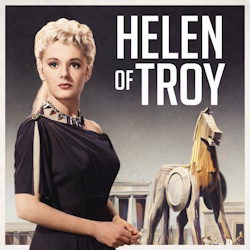
In 1955 Warner Brothers undertook a massive international collaboration with Italian and French partners to bring the timeless tale of Helen of Troy to the big screen. Ancient epics were very popular and they sought to capitalize with a massive undertaking of their own. The film would be shot in Rome, Giuseppe De Blasio and Maurizio Lodi-Fè were assigned production with a massive $6.0 million budget, Robert Wise was tasked with directing, and N. Richard Nash was hired to adapt a story by Hugh Gray and John Twist, which drew inspiration from Homer’s Iliad. An international cast was assembled with Italian actress Rosana Podestà starring as Helen. Joining her would be Frenchman Jacques Sernas as Paris, Englishman Sir Cedric Hardwicke as King Priam, Welshman Stanley Baker as Achilles, Irishman Niall MacGinnis as Menelaus, Englishman Robert Douglas as Agamemnon, and even a young Brigitte Bardot as the slave girl Andraste.
The film is set circa 1180 BCE and follows the fortunes of Prince Paris of Troy. It came to pass that he was tasked with choosing the most beautiful goddess among three contenders: Hera, Athena, and Aphrodite. Each goddess attempted to bribe him; Hera offered him a kingdom and power. Athena offered him wisdom and victory in battle. Aphrodite promised him the love of the world’s most beautiful woman, Helen. Paris chose Aphrodite and earned the enmity of Hera and Athena. With Aphrodite’s patronage, Paris absconds with Helen, wife of King Menelaus of Sparta. The aggrieved Menelaus beseeches his brother King Agamemnon of Mycenae to help him avenge this outrage. Agamemnon sees opportunity to exploit this and increase his hegemony, and so summons all the other Greeks to fight under his banner to avenge Menelaus, his true motive however, is to sack Troy and plunder her riches. A thousand ships are launched and for ten years the Greeks battle the Trojans to a stalemate and apparently withdraw, leaving a massive wooden horse, an homage to the goddess Athena, the patroness of horses. The Trojans pull the massive horse into the city and hold a massive victory celebration, unaware that inside dozens of Greeks hide in waiting. Later in the night when most of the city lay in a drunken stupor they emerged, overcame the gate guards and opened Troy’s massive gates, which allows the Greeks to pour into the city. Troy was sacked and burned, with Priam, and Paris both killed. Helen returns to Sparta with her husband secure in the knowledge that she will rejoin Paris in the afterlife. The film bombed at the box office, losing $2.8 million despite a single day global release. Critics were scathing in their criticism and the film failed to secure any Academy Award Nominations.
Director Robert Wise forged a friendship with Max Steiner at RKO Pictures in the early 1930s when he assisted with the management of the soundtrack as an assistant sound and music editor. He was welcoming of his old friend when Warner Brothers assigned Steiner, whom they considered their premier composer, to score this massive undertaking. Steiner was very pleased with his enormous salary of $17,500 as he was buried in debt. Professionally, he had always wanted to score an ancient epic, and was very motivated to take on a film like this, which offered a massive canvass. Sadly, it would be both his first and last score for a film in this genre. I believe Steiner understood that Helen, the legendary face that launched a thousand ships, would need an eloquent theme, which matched her beauty. He also understood that there would be many massive battle scenes that he would need to empower, including the great Hector vs Achilles duel.
 For his soundscape Steiner composed five themes. Paris’ Theme supports our handsome and charismatic anti-hero and offers a confident, masculine, horn declared and adventurous melody. Yet we also discern within the notes, undertones of foreboding and a portentous fateful destiny. Steiner often uses the declarative first five-notes of his theme as an anthem. When challenged and in battle, his theme swells with strong, dramatic intensity and a sense of “martial urgency” that reflected his role as a catalyst for conflict. Helen’s Theme serves both as her personal identity, but also as the foundation of the Love Theme. It is lyrical, and borne by yearning strings, offering a romanza for the ages. As the film progresses and she surrenders her heart to Paris, her personal musical identity becomes subsumed into a collective Love Theme. This Love Theme, which came to be known as “One Wish”, speaks to the fateful love between Paris and Helen. Steiner composed a beautiful, lyrical, string borne romanza rendered in ABA form. The A Phrase is declarative, professing, and rendered with forthright romanticism, while the B Phrase is more lyrical and yearning. Most impressive is that he joins the themes of Paris and Helen into a new collective identity, much in the manner used by Alfred Newman, who joined the themes of Marcellus and Diana in “The Robe” (1953). In each case, the feminine string borne melody is joined by the masculine identity, which is declared with contrapuntal horns. It is gorgeous; however, I discern within the melody, currents that portend tragedy as Paris’ impulsiveness and lust will in the end, bring ruin to all.
For our villains, Athena’s Theme supports her divine role as an Olympian god in the war in which she foremost, was fiercely supportive of the Greeks. Her theme is both ominous, oppressive, and foreboding. Her presence is pervasive throughout the film, and her retribution is inescapable. Throughout the film, Steiner uses a simple musical construct of repeating strummed harp buttressed at time with dire horns. The Greeks are portrayed unflatteringly as arrogant, ignoble, avaricious and duplicitous. I believe Steiner perceived these qualities and offers a harsh, strident identity empowered forcefully by martial, blustering horns. The theme is both heavy and oppressive and offers a perfect contrast to the more lyrical Trojan identities. Lastly, for cultural sensibilities, authentic Mycenaean music could not be recreated, as such Steiner sought to infuse his music with Greek auras by using Aeolian scales. This natural minor mode was used to evoke and ancient, and exotic cultural sensibility, as well as a sense of mystery and destiny.
There is no bona fide commercial release of this score, only European bootlegs. As such I will use scene descriptors with film time indices for musical reference. 00:00 “Overture” offers a magnificent score highlight and, in my judgement, it is one of the finest in Max Steiner’s canon. In classic golden age tradition, Steiner composes an incidental piece to play before the film commences, offering a presentation of the score’s primary themes to entice the audience’s anticipation. It opens grandly with a dramatic declaration of the Trojan fanfare of Paris’s Theme. Red script displays “Overture” against the interior of a Greek temple, which houses a statue of a goddess Aphrodite attended by snakes; in this guise, she is symbol of fertility, regeneration, and chthonic power. We flow into “One Wish”, the Love Theme, where we are graced with a full exposition rendered in ABA form. The A Phrase is declarative, professing, forthright romanticism, while the B Phrase is more lyrical and yearning. Most impressive is that Steiner joins the themes of Paris and Helen into a new collective identity, with Helen’s feminine string borne melody entwined with Paris’ masculine identity, which is declared with contrapuntal horns audaci. It is gorgeous; however, I discern within the melody, sad currents that portend tragedy. We flow into a wondrous, nautical exposition of Paris’ Theme in which Steiner captures the rolling seas and ocean breezes with arresting writing for strings and woodwinds. Soon the music begins to darken and next we flow into a foreboding musical narrative used in the storm cue. A bright forthright Paris’ Theme rises, but is struck down by Athena, whose ominous and vengeful theme prevails at 4:38. Yet hope beckons and we conclude with a bold and confident Paris’ Theme that ends gloriously in a flourish.
05:35 “Main Title” offers a dramatic score highlight where Steiner captures the film’s core narrative. It reveals that Steiner forgoes his renown MGM Pictures fanfare, instead opening with a bold declaration of the Trojan Fanfare by horns dramatico. We segue into the Love Theme, empowered by the warm contrapuntal horns of Paris’ Theme, which supports the flow of the opening credits in red script, set against a Greek temple, which houses a statue of the goddess Aphrodite. We flow into the sumptuous string borne B Phrase with harp adornment. We return to the A Phrase, and conclude the credits ominously with the portentous fanfare of Athena’s Theme. 07:07 “Troy” supports narration providing a brief history of Troy, and its burning by Greeks in the distant past. Steiner supports with an exotic musical passage draped as a misterioso. The music swells with patriotic pride as we learn that the city was rebuilt behind mighty walls, which made it impregnable, and allowed it due to its strategic location on the east-west trade route, to prosper. As the camera takes us into New Troy amidst a bustling market place, Steiner offers a carefree ambiance as we pass by many merchants selling their goods. The arrival of Lord Aeneas, nephew of King Priam takes us into the throne room, with the music receding as important matters of state are discussed.
In court, King Priam supports his son’s argument to foster peace with Sparta. As he prepares to depart, the high priest criticizes Paris for his singular devotion to Aphrodite, while eschewing Athena, the goddess of wisdom who counseled Troy to arm itself against its enemies. 10:52 “Cassandra’s Warning” Foreboding strummed harp figures introduce Athena Theme, yet Paris is dismissive, which brings forth his sister, the prophetess Cassandra. A plaintive oboe solista speaks to her isolation. With Athena’s harp theme still prominent she arouses Priam’s anger when she refuses to bless Paris’ trip until he pacifies Athena. 11:59 “Cassandra Counsel Ignored” reveals Paris exiting the palace and descending into the forum. Celebratory fanfare supports as he walks through the cheering crowd. Cassandra runs to him sobbing and begs him not to go, to no avail. Athena’s Theme coalesces into a more ominous and potent iteration, portending Cassandra’s dire vision. He leaves her with his brother Hector, mounts a chariot, and waves. Steiner masterfully entwines Athena’s ominous theme with Paris’s Theme declared by horns orgogliose. We close with Paris’ departure carried by a foreboding marcia del destino as Cassandra relates to Hector; “What must be, no one can change”.
13:18 “Voyage to Sparta” reveals Paris’ bireme rowing to Sparta. Steiner supports with a meandering breeze-like woodwind line, which usher in a confident declaration of Paris’ Theme. A montage of sailing shots unfolds, and we slow to a wondrous, languorous musical narrative as Paris and Aeneas debate the importance of women. A strong breeze sweeps in ushered in by trilling woodwinds and is followed by storm clouds. 14:35 “The Storm”, Steiner unleashes a tempest as the ship is buffeted by tumultuous waves and ferocious winds. The crew is fearful and refuse to climb the mast to add sail. Paris decides to show them the way, and his theme is rendered as a bold climbing motif, takes him up the mast. He reaches the top, a lightning bolt strikes and splinters the mask, and a falling descent motif carries Paris into the sea, punctuated by vengeful horn declaration of Athena’s Theme. In 16:13 “Helen Appears!” we shift to a sandy beach supported by a misterioso of weary strings with harp adornment. In Paris slowly wakes and sees people in the distance as a barking dog charges him. Suddenly he beholds the most beautiful woman he has ever seen and a resplendent Helen’s Theme supports here arrival. He is stunned and says; “Aphrodite! She does exist!” We flow into aspirational romanza as we see Paris is love struck. She asks for his identity, and he says, Trojan. Helen commands Aphros and Cora to warm him, but the two say why, as he will soon be executed. A sense of foreboding rises as two armed soldiers arrive, and Helen orders the man’s body covered by a part of a sail. The captain orders Helen to return to the palace for safety as a Trojan ship was seen. She refuses saying she is in good hands. The music darkens upon Athena’s Theme as the captain discovers a flag on the beach bearing the royal emblem of Troy. He insists she depart, but is rebuffed by Helen with defiant regality. We end darkly with the dire horns of the Greek Theme as the men ride off.
19:28 “Helen Rescues Paris” reveals Helen calling for her servant Andraste to assist and bring the man back to their seaside hut to recover. A bubbling musical narrative of delight carries her run to help. Later we see Paris resting on a bed by a hearth fire. He wakes and see Helen come to him with a cup of water carried her theme borne by woodwinds delicato. They acquaint, but she deceives him, saying she is a slave from the palace. He discloses that he is Prince Paris of Troy dispatched to Sparta on a mission of peace. She at first does not believe him, but his regal bearing finally convinces her. He is clearly lovestruck by her beauty and says in Troy someone so beautiful would be a princess. Helen counsels against going to see Menelaus, and he says he will be discreet. Steiner supports softly with pleasantries with oblique references to their themes. As she departs, Paris asks that she promise him to meet again. She does not answer, yet her eyes do as we close on a crescendo romantico of her theme. 24:12 “The Kiss of Destiny” offers a romantic score highlight. It opens with a wondrous travel motif borne by strummed harp and a meandering oboe esotica with sparkling adornment as we see Helen and Andraste traveling on a road. They stop and see Paris approaching. Helen sends Andraste away and walks towards Paris. She joins him, and again counsels against seeing Menelaus as he soon meets with the council of Greek Kings to consider a war against Troy. This only serves to embolden him, and make him more amorous as he declares his intention to petition the queen for her hand as he intends to make her his wife and a Princess of Troy. She at first resists, but after he declares his love, she drops all pretenses and reciprocates her love for him, with the sad caveat that it can never be. Steiner supports with a tender romanza, which blossoms rapturously with the Love Theme as he takes her into a passionate kissing embrace. Afterwards as she departs, she says to not bring this matter up with the queen, and to remember that this moment must be our last. We close the encounter with a bittersweet coda of Paris’ Theme.
In the Spartan palace we see the convening of the great kings of Greece in a war council. Agamemnon of Mycenae and his brother Menelaus of Sparta argue for war, while Diomedes of Argos opposes, and Nestor of Pylos urges caution until Achilles has been recruited. 28:25 “Achilles Arrives” Grand, heraldic fanfare silences the debate, and announces the arrival of Greece’s greatest warrior, Achilles. Achilles is pompous and rancor immediately erupts as his enormous ego clashes with those of Menelaus and the warrior Ajax. Next, Paris arrives and declares himself Prince of Troy on a mission of peace. He is disbelieved and ridiculed, but they agree to put him to the test with a cestus (weighted gloves for boxing), for which he is renowned. In 31:45 “The Fight” Steiner supports harshly with the gloves being tossed on the floor. A foreboding musical narrative unfolds as Ajax and Paris arm themselves. Paris exacts terms from Menelaus; if he wins, they will acknowledge him as Paris, Prince of Troy, and agree to hear his terms of peace. Menelaus agrees, and Ajax sucker punches Paris to the floor. Music recedes and as the fight unfolds, Helen enters unaware. The much larger Ajax again knocks him to the floor, she yells, “Paris!” Menelaus is stunned at her familiarity and a dark chord usher in ominous music. As the fighting escalates, so does the music on a dramatic crescendo di violenza. The tide of battle shifts to Paris and his theme becomes ascendent, climaxing in triumphant as Ajax is pummeled into submission. Throughout the fight Menelaus’ suspicions grow as he sees from Helen’s expression, concern, and emotional involvement. We close with a triumphant declaration of Paris’ Theme. A diminuendo follows, as Menelaus congratulates Paris on his victory, declares that formal talks will take place tomorrow, and that a beautiful slave girl is to be gifted to him for the night.
Paris prepares to ask for the slave girl he met on the beach but is interrupted by the arrival of Helen. 35:35 “Helen Of Sparta” reveals her announcing herself, supported by a graceful rendering of her theme. Menelaus introduces her to Paris as Queen Helen, his wife. Paris is taken aback, recovers, and horns reverenti support him bowing his head in respect. Helen’s conflicted theme supports her aloofness, and regality, and she asks what brings him to Sparta; our arts? He says yes, the art of self-preservation and tosses his cestus at her feet. She is indignant and leaves carried by a grave declaration of Athena’s Theme as a puzzled Menelaus look on. 36:24 “I Am Your Husband!” reveals Helen in her bedchamber self-critical and conflicted, which Steiner reflects in her theme. A dire declaration of the Greek Theme supports the entry of Menelaus into Helen’s bedchamber where he dismisses all her servants. He confronts her duplicity of publicly disliking Paris, yet for him, her true feelings for Paris are transparent. She refuses to make eye contact with Menelaus, which frustrates, and provokes him to angers. He then exposes here duplicity saying; “Admit it! You have been out of the palace and know this Trojan”. Her silence is deafening, and damning, and a musical narrative of anger swells as he in a rage grabs her, forcibly turns her to face him, and places his hands around her neck to strangle her. A two-note stepped crescendo empowers his declarations of; “I am you husband! I am your husband!” She recoils in contempt, and he departs empowered by an ominous Greek Theme saying; “I can think of many ways of dealing with your Trojan, Helen”.
39:40 “The Escape” offers festive music offered by a small ensemble, which supports Andraste walking through a palace corridor. Music stops as she cons the two guards, saying she is his mistress for the night. She enters, warns him that Menelaus is preparing to murder him, and says she will help him escape. Music resumes as a misterioso of suspense empowered by a serpentine motif as we see at Helen’s deaf-mute servant kill two guards on the terrace below. Blaring trumpets and a descent motif carry Paris’ leap down to the terrace where he slays a third guard. Andraste leaps down into Paris’ arms and Steiner propels a flee and pursuit narrative as Paris, Andraste and Helen’s servant escape with palace guards in hot pursuit. 42:08 “Paris Departs” offer woodwinds tranquili, which support Paris’s preparations at the sea side hut to sail back to Troy. Andos and Cora advise that Helen has arranged transport on a Phoenician ship anchored in a nearby cove. Paris confides to the couple that Helen will always walk in his dreams and a sad quote of his theme carries his departure. A misterioso joins as Paris surveys the seaside terrain. A spritely musical narrative propels his stealth run on a rocky beach under towering cliffs. Dire horns support the arrival of Greek soldiers above as Paris hides in the shadows below. Soon after, more soldiers approach along the beach ahead, forcing Paris to climb supported by a light-hearted variant of his theme. Now topside, he begins his trek only to be stopped by Helen, a diminuendo supports as she grants Andraste her freedom, and advises Paris she will always remember him.
45:26 “A Testament of Love” reveals Helen resisting his entreaty to join him, which Steiner supports with a tense, albeit conflicted musical narrative. Paris and Helen hide behind bushes as soldiers approach empowered by the repeating dire four-note declarations of the Greek Fanfare. A sparkling ascent of hope supports Paris rolling Helen over and laying atop her. They kiss, and the Love Theme, now full of yearning unfolds and blossoms as he begs her to come home with him. She asks if he would give up peace for war by doing so, and while he hesitates upon hearing her wise counsel, as does the music, the Love Theme resumes, informing us that love overcomes reason. Yet it is from Paris’ perspective as Helen bids him farewell, and tells him though the sea separates them, he will forever reside in her heart. Dire horns resound as the captain of the guard arrives with archers. He demands the Queen stand aside, she refuses and dares him to shoot her. But when he answers if Paris escapes, he dies, A surge of musical drama supports Paris as he grabs her and they jump off the cliff into the sea. We close on a diminuendo of relief as a small boat rescues them. 49:41 “The Orgy” reveals Menelaus partaking in a drunken orgy and Steiner composed a wild, and orgiastic musical narrative replete with trilling woodwinds. The captain of the guards informs Menelaus that Helen had fled with Paris by ship. Menelaus refuses to believe this, storms out to her locked chamber doors and orders them battered door. Inside it is dark, no servants are found, nor Helen. In an unscored scene, Menelaus is outraged, and his brother uses this affront of honor and decency as a pretext for war. All the Kings of Greece will join together in righteousness, and mobilize the greatest army ever scene to plunder and destroy Troy.
52:51 “The Sailing” reveals Paris and Helen sailing home to Troy on the Aegean Sea carried by the languorous nautical theme. French horns declare a confident Paris’ Theme as he consoles her. His theme animates the scene under the dialogue as we see that she is despondent, voicing that people will declare her a woman who left her husband, and you, a prince turned thief. She begs him to divert to Pelagos where they could live out their days in peace and obscurity. He, however is not prepared to relinquish his obligations as a Prince of Troy. Yet he relents when he sees her despair and orders a course change south to Pelagos, only to have Helen countermand the order, and say, we sail north to Troy. Later, the music brightens and we are graced by a proud and expansive rendering of Paris’ Theme as the ship arrives at Troy’s harbor. 55:29 “Arrival in Troy” offers a magnificent score highlight. It reveals Steiner offering heraldic, antiphonal horns declarations, which rouses the city from commoner to the palace. Aeneas is advised to come to the balcony and witness the unbelievable. When Paris and Helen pass through the city gates past cheering crowds on a carriage they are supported by a celebratory exposition of Paris’ Theme. We conclude with Paris’ warm reunion with his brothers Hector, Polydorus, and cousin Aeneas. Later in court, the musical narrative shifts to an aggrieved rendering of Helen’s Theme as Paris seeks to delay announcing her identity. 57:55 “Her Name is Death!” reveals Polydorus pressing Paris for her name, a string sustain of tension supports as she turns and says my name is… “Death” – declared aloud by Cassandra who stuns all present. Foreboding strummed harp joins the sustain as Helen turns and declares; “I am Helen, Queen of Sparta.” Priam and Hecuba are stunned as Cassandra says Aphrodite came down to earth, assumed mortal form, and while pointing at Helen she declares she will bring the disaster I prophesied. Her name, Helen of Troy, will be written in fire. In the film this portentous prophesy is punctuated by dire horn declarations.
Later, King Priam holds court with the royal family, relatives and nobles in attendance. Paris recounts how Helen twice saved his life, and that he could not leave her to certain death. Priam is outraged, rebukes him for dishonoring his House, and instead of forging peace with the Greeks, that he had instead welded them together and brought war to Troy. Both Hector and Polydorus also rebuke him for his offer to depart to Pelagos with Helen and leave them to fight the Greeks. Hecuba entreats him to send her back and make peace with Menelaus, but Paris is adamant, refusing to give her up. 01:00:20 “Paris is Disowned” Priam announces that Paris is disowned, punctuated by the fateful harp strums of Athena’s Theme, and a forlorn oboe full of despair as his mother also shuns him. Later, Aeneas visits the quarters of Helen. He advises her to depart, and that he will support her departure. 01:02:04 “Our Fates are One” reveals that Helen acquiesces, yet dark strummed chords of Athena’s Theme support with the arrival of Paris. The walls are closing in, and Paris offers Pelagos as safe refuge. She will not have it. And her Love Theme drives her into is embrace as she reminds him of their shared destiny. An angry crowd burst into the royal courtyard and Paris goes out to face them. He is stoned and flees. Aeneas goes to the balcony and exhorts the crowd to embrace patriotism. The crowd’s anger dissipates and we again end with a dire Athena’s Theme informing us that the die has been cast, and what has been done, cannot be, undone. The scene ends with the undying Love Theme as he again counsels Helen to depart. Yet, she settles the matter; “There is no Pelagos if I am their alone.” She speaks of a life only if it can be shared together, supported by an aspirational rendering of the Love Theme.
01:04:02 “Troy Prepares For War” reveals Troy’s armory blacksmiths hard at work supported by a harsh, strident, and mechanistic musical narrative. Narration informs us that Troy prepares for war as weapons are stockpiled, trees felled, and the fields harvested to weather a siege. Next, the music becomes martial as we see a montage of men rigorously training in sword fighting, and archery. We shift to regality as Priam bestows his staff of office to Hector to command the armies of Troy. Hector empowered by a crescendo magnifico raises the staff as the army cheers. As the camera turns, a horrific dissonance supports a close up of the statue face of Athena. 01:05:56 “The Greeks Arrive” opens with crashing gong strikes of alarm, followed by a long string sustain dramatico. Priam arrives at the parapet usher in by the dire horns of the Greeks Theme empowered by a drum cadence of war as he and his court bear witness to the arrival of one thousand ships. Priam summons Paris and Helen, and the Greek Theme becomes strident and dissonant as perspective shifts from the Trojans to the Greeks on the approaching ships. The musical narrative becomes increasingly grotesque as we see the faces of Agamemnon and Menelaus filled with blood lust. The Greek anthem recedes as Paris and Helen arrive.
In 01:07:27 “The Face That Launched A Thousand Ships” the horns shift to Paris’ Theme as Priam admonishes them, saying see what you have wrought, and then looking at Helen and saying; “The face that launched a thousand ships.” They both now realize what they have wrought, lower their heads in shame, and depart carried by a despondent Paris’ Theme. The next day, the music becomes strident and threatening as we see with the morning light the massive Greek beach head. Steiner drives them forward with a ferocious musical narrative empowered by a marcia militare as they march forward towards Troy, unstoppable. (Note): From the bootleg album I referenced, there must have been a massive edit to shorten the film as more than half of this magnificent march, perhaps the finest in Steiner’s canon, ended up with the film on the editing room floor. 01:08:18 “Troy Stands Ready” opens with a repeating three-note martial motif as Hector comes to the parapet and exhorts his men, reminding them that Troy’s massive walls are her strength. He dispatches his commanders but when Paris asks where is his place, he if rebuffed; “With your Spartan woman”. A despondent Paris’ Theme carries his departure. We shift to the Greek commanders arriving on a buff overlook Troy. They are disappointed that the Trojans remain behind their great walls. An ominous Greek Theme supports Agamemnon’s decision to build siege equipment to breech Troy’s walls. 01:09:56 “Building Siege Machines” reveals narration for a montage of scenes where we see the Greeks fortifying their beach head and building towers to breach Troy’s walls. Steiner propels Greek labors with a bustling musical narrative. We shift to a frightening image of the statue of Athena, which resounds with blaring horns bellicoso.
We flow seamlessly into 01:10:24 “The Battle” atop Trojan horns of alarm as we bear witness to the approach of the massive Greek army, now armed with a dozen siege towers, and countless massive ladders. Martial trumpets resound, empowered by strings furioso, drums of war, trilling woodwinds and harp torrents with Steiner masterfully utilizing dynamic shifts in tempo, rhythm, and volume to precisely match the pace and ferocity of the fighting. Early on the Greek Theme dominates as they succeed in gaining the parapets of Troy’s walls with ladders and their siege towers. The Trojan Theme becomes ascendent as Hector summons his reserves who overwhelm the Greeks, forcing a retreat to the siege towers lest they risk encirclement. The retreat becomes a route as the camera reveals the burning wreckage of all the Greek siege towers as their army flees. In my judgement, Steiner unleashed a tempest with one the most impressive battle compositions in his canon. 01:17:43 “Death of Polydorus” opens with a diminuendo, which supports Hector and Paris coming to their brother Polydorus, who is mortally wounded. He reconciles Hector and Paris with his dying breath. A dire Athena’s Theme slowly dissipates on a diminuendo to end the scene. We shift seamlessly atop the violin sustain and Athena’s Theme to the funeral of Polydorus where Priam prays for his fallen son. Athena’s Theme permeates, her will be done, as Cassandra once again portends that Troy, a city of the living dead, will suffer many years of the siege to come.
01:18:52 “Years of Siege” opens with narration that supports a montage of the Greeks reprovisioning and preparing for years of siege supported by dissonant, yet resolute Greek Theme. We shift to an exotic musical narrative empowered by a predatory Greek Theme as narration informs us of the raids, pillaging and rape of the surrounding villages. New narration informs us that during the many ears of siege, Troy would launch countless night raids of harassment supported by charioteers attacking and burning the Greek camps. Steiner propels the action with a horn driven stepped crescendo militare empowered by an aggressive Trojan Theme.
01:20:40 “The Lovers”, offers a supremely romantic score highlight. Paris comes to Helen. She is despondent, and uncertain of her future, while he has never been more optimistic and certain. Steiner graces us with the score’s most exquisite rendering of the Love Theme. The theme is rendered from his perspective and so his theme is more prominent lead, borne by sumptuous strings romantico with harp adornment. 01:22:35 “Helen’s Torment” reveals her tormented by daily the smell of daily funereal pyres and agitators preaching to the crowd that Helen and Paris must go for the welfare of Troy. Hecuba joins her and dissuades her from surrendering herself to Menelaus to end the war, and restore Paris to the love of Troy. Hecuba asks if she would defy the gods, and an ominous Athena’s Theme joins. An aggrieved iteration of her theme joins as Helen berates herself as selfish and as a result, she has brough misery to all. 01:25:10 “Menelaus’ Treachery” reveals a Trojan emissary offering Menelaus the return of Helen, for the cessation of hostilities. Menelaus agrees, and after the emissary departs, we see that Agamemnon is duplicitous, saying they will accept Helen, but will not be so easily bought off, which Steiner punctuates with three dire Greek Theme declarations.
01:26:30 “Helen’s Decision” reveals Paris waking from sleep supported by an ethereal iteration of the Love Theme. He calls for Helen, gets up and is greeted by Hecuba who informs him that she has surrendered herself to the Greeks. Steiner punctuates this with horns irato, which propel his rage as he races off to rescue her. We shift to the Trojan column taking Helen to the rendezvous supported by an oppressive Greek Theme, buttressed by blaring horns of doom. A crescendo dramatico brings the Greeks and Trojan’s together. Dire horns proclaim Athena’s Theme as Menelaus steps forward, and a grim string sustain supports Hector escorting Helen to him. The two-note strumming of Athena’s Theme brings Helen to Menelaus, but Steiner also incorporates a solo oboe triste bearing her bereft theme. Menelaus receives her, offers his kissing embrace, but Helen is remote. He lifts her into his chariot and Hector turns to depart. Paris rolls up by stealth behind bushes and observes. Ominous Greek horns resound as Agamemnon calls to Hector to stop and render payment. Hector protests there was no such agreement, and Menelaus says they played him as a fool. They demand half the treasury of Troy, and 1,000 talents tribute every year.
01:30:38 “The Rescue” offers a tour de force score highlight. We open with an aggressive Trojan Theme as Agamemnon orders the Trojans arrested. Paris yells no, charges and disables Menelaus. He then rides off in Menelaus’ chariot with Helen and Steiner whips his orchestra into frenzy, propelling the pursuit with interplay of the Love and Greek Themes as the Trojans flee with the Greeks in hot pursuit. The Love Theme becomes ascendent as our lovers flee with Patroclus closing. Both Paris and Patroclus throw their javelins, and both javelins find their mark, however Paris is only wounded while Patroclus is killed. Paris’ Theme carries them to the gates of Troy and we close with a diminuendo of pain following as Achilles grieves over the corpse of his beloved Patroclus. Achilles demands his armor and dire declarations of the Greek Theme resounds as Agamemnon thanks the Trojan for returning the body of Patroclus, as he knows this will now unleash Achilles’ rage. In an unscored scene, Priam and Paris reconcile as it has been revealed that avarice, not love of Helen motivates the Greeks. Aeneus then advises all present that Achilles will soon do personal combat with Hector to avenge the death of Patroclus. Paris protests, saying by right he should fight, but Aeneas says he would fight in your stead as you are overmatched. In the courtyard Hector stands ready to answer Achilles raging call for single combat so he may avenge the death of his beloved Patroclus. Andromache tries to dissuade him to no avail, and Hector rides out to his destiny.
01:35:21 “Achilles and Hector” offers another tour de force score highlight. As soon as Achilles sees Hector, Steiner unleashes another tour de force with an aggressive charging theme, once again whipping his orchestra into frenzy utilizing dynamic shifts in tempo, rhythm, and volume to precisely match the pace and ferocity of the fighting. A savage string driven ostinato propels a crescendo dramatico as Achilles begins to dominate the fight. Achilles senses victory and in a blood-lust clearly takes the advantage, his ferocity is unmatched. Trumpets of doom resound with the Greek Fanfare as Achilles disarms Hector and begins to pummel him with the metal ball end of his spear. A bludgeoned Hector falls, and two lethal spear thrusts to his heart, which Steiner punctuates, kills him. 01:37:49 “Achilles Revenge” Achilles, empowered by a horrific Greek Theme, tosses his spear at the Trojans watching from the wall in contempt. He then, abandons decorum and decency for savagery by tying Hectors legs to his chariot. A grotesque musical narrative propelled by the Greek Theme follows as Achilles defiles Hector’s body by dragging it around the city. Trojan archers rain arrows down upon Achilles, but they all bounce off, his body impervious, save the right heel, where his mother Thetis held him to dip him in the river Styx. Paris calls for Zeus to guide his arrow, he shoots, strikes Achilles in the right heel, and Achilles falls off his chariot crushing his skull on a large rock. Ulysses says; “So dies Greek courage, but not Greek cunning”. We close on a lamentation within which is woven Athena’s Theme. Ulysses conceives a diabolical plan for the fleet to depart and leave behind an homage to Troy’s victory – a large wooden horse, in which fifty Greeks will hide. The Greek army will return in the dead of night and after the Trojan’s celebrate and go to sleep drunk, they will sneak out, unlock the main gates and the Greek army will rush in.
01:42:13 “Priam’s Fateful Decision” opens with Greek horns sounding retreat, and then to set sail. A foreboding Greek Theme supports the return of Aeneas, who informs Priam that the Greeks had departed. Priam orders the lighting of the Victory Torch and that a torch bearer announce the happy news throughout the city. He begins his run empowered by celebratory horns. The people are joyous and open the gates to breathe the fresh air of freedom once again. A paean of thankfulness unfolds on the Trojan Theme as clouds part and allow moonlight to bathe all with a sense of wonderment. 01:44:06 “Beware of Greeks Bearing Gifts” offers a testament to Steiner’s mastery of his craft. The moonlight now illuminates a massive wooden horse left by the Greeks. Dire horns resound and descend in register joined by a portentous Athena’s Theme entwined with a serpentine flute, as Helen presages to Paris; “Beware of the Greeks bearing gifts”. Cassandra, and Paris join and counsel Priam to burn it on the plain. An eerie dissonance joins as Priam makes a fateful decision, saying it is a tribute from Athena, and a reward to our people for the bravery. Paris and Helen move away to a parapet and she wonders aloud if she will ever really be accepted as a Trojan. Paris says that now that the war is over, they need not remain here, and may seek happiness together anywhere. Steiner supports with a warm and tender iteration of their Love Theme. As the people salute Paris and bring the horse into the city, a warm and thankful rendering of his theme supports. 1:46:06 “The Trojan Horse” reveals the people pulling through the gates, the massive tribute horse as a massive crowd cheer. Steiner supports with gifted insight, empowering the spectacle with a grand processione della sventura. Yet the procession is dirge like, and the use of a minor key informs us that Priam’s fateful decision will bring ruin to all. 01:47:02 “Celebration” offers a festive score highlight. It reveals the city partaking in a raucous celebration of victory, unleashing ten years of deprivation and confinement. Steiner whips his orchestra into a dazzling, festive, frenetic tempest, which perfectly animates the on-screen drunkenness, and orgiastic debauchery. Later, a woman wanders about playing an aulos, and then jumps into the arms of a man who takes her away as we see the changing of the Trojan night watch.
01:50:02 “The Fall of Troy” reveals the Greeks opening a hatch, and one by one descending by rope. They sneak up to the parapet and music enters with Steiner simulating arrow strikes as archers take out the night watch. Frenetic horns surge as a torch is lit and waved to summon the Greek army. Steiner sow suspense and a rising tension as the Greeks move to the main gate controls. A sentry detects them, sounds the alarm horn but is killed quickly with an arrow. Inside the barracks a few soldiers stir out of drunken stupor. The Greeks open the gates and their soldiers flood in propelled by a ferocious tempest, and empowered by a now monstrous Greek anthem. The Trojan soldiers arm themselves and run out, but without protective armor, which makes them easy prey. A crescendo della violenza surges like an unstoppable juggernaut as the palace is attacked. Woven into the very complex musical narrative are the Greek and Trojan Themes. We observe that the Trojan Theme strives to assert itself, but is overwhelmed as the Greek Theme gains supremacy. The Greeks begin torching the city and Steiner supports with a conflagration maelstrom. A diminuendo of despair supports Aeneas and Paris locking the massive doors to the throne room. The Trojan Theme now emotes with despair and resignation as Priam says Troy is lost. He orders Aeneas to flee out the North gate with Andromache and his grandson. He then orders Paris and Helen to also flee. They hesitate, but they too depart, carried by a sad rendering of their Love Theme. We shift outside and Steiner continues to propel the carnage with a shrill, dissonant, churning juggernaut of destruction, using waves of harp glissandi to support the conflagration. A desperate Love Theme supports Paris and Helen’s run through the chaos. Musical bludgeons support as Greeks batter open the doors to the throne room. Priam and Hecuba are taken prisoner and a vengeful Athena’s Theme empowers their forced removal. The Love Theme supports as Paris and Helen are buffeted by the escaping crowd. They are separated, Paris is recognized, and begin fighting.
01:57:02 “The Death of Paris” reveals he and Helen reuniting, however as they turn to flee, they run into Menelaus and his guard, the moment crowned with a trumpet of doom, followed by a vengeful Athena’s Theme. We see rage in Menelaus’ eyes, he orders his guards to stand back, and prepares to take down Paris himself. A dire musical narrative unfolds with Menelaus dominating, but he weakens and the much young Paris gains the upper hand. As Paris is about to strike Menelaus down, a guard thrust his sword in his back. Helen comes to him and their anguished Love Theme, plays as he offers his parting words. Their theme closes on a weeping solo violin with harp adornment as he says she is his heart as he passes. She hugs him, offers a parting kiss, however horns of retribution declare Athena’s Theme and support Menelaus pulling her away. He orders her to go to his ship and two guards escort her, carried by a retributive Athena’s Theme. The theme is sustained as the camera focuses on the Trojan Horse and a burning Troy. We see Helen sailing back to Sparta, her eyes affixed on Troy as their Love Theme offers a final testament as she utters; “It cannot be lost Paris? Can it? What has been lived and shared is never lost. (Paris’ voice) Never Helen! Helen then says that this is not goodbye. You shall always be with me. (Paris’s voice) And you with me.” The film closes as it began, with “The End” supported by the Love Theme fanfare.
I am just dumbfounded as to why this Steiner masterpiece has no commercial release. In my judgement this was the last masterwork of his career, and a testament as to why many, including your author, consider him to be the greatest film composer of all time. Sadly, because the film bombed, his score went down with the ship, and was overlooked for Academy Awards consideration, which is a damn shame. Steiner through his career was able to discern the film’s nexus, and this film was no different. In a masterstroke he composed one of the greatest love themes of all time, joining Helen’s and Paris’ personal identities into a new shared identity with her theme providing sumptuous romanticism, with his offering warm contrapuntal horns. For me, this musical union proved the sum was greater than its parts. Their theme of forbidden love, which launched a thousand ships and changed the flow of history, permeates the film, and is the unifying musical narrative of Steiner’s score. Juxtaposed is Athena’s Theme, whose retributive justice cannot be forestalled, assuaged, or escaped. She is the harbinger of Troy’s doom, embodying cosmic forces beyond human control, guiding heroes and influencing events as a powerful, almost operatic force in the unfolding epic war of destiny. Paris, and by extension the Trojans, are ennobled musically, while Steiner portrays the Greeks as brutal, avaricious, and ignoble. I believe that Steiner’s action writing to be the finest of his career, incorporating marches, aggressive thematic interplay, and often whipping his orchestra into frenzy utilizing dynamic shifts in tempo, rhythm, and volume to precisely match the pace and ferocity of the fighting. The procession of the Trojan horse was brilliantly conceived with the crowds and music celebratory, however, Steiner expresses the procession minor modal, presaging that Priam’s acceptance of the horse will bring ruin to all. Folks, this is a score for the ages, an epic, glorious, and magnificent score, which earns Steiner immortality. Join me and vote for it to be the next recipient of the recent Kickstarter projects at Intrada. Until that time, take in the film on one of the streaming services to bear witness to Steiner’s genius.
Editor’s note: While it is true there are no bona fide commercial releases of the full score, only two European bootlegs, around 20 minutes of the Helen of Troy score was released as part of the 12-CD box set ‘Elmer Bernstein’s Film Music Collection,’ released by Film Score Monthly in 2006. This album was a re-release of an earlier LP containing a Bernstein re-recording of some of the score, which was originally released in 1974.
For those of you unfamiliar with the score, I have embedded a YouTube link to a suite: https://www.youtube.com/watch?v=xUXr2JQMRF4&list=RDxUXr2JQMRF4&start_radio=1
Track Listing:
- Main Title (1:46)
- Paris’ Farewell (3:04)
- Love Theme (2:04)
- Battle (4:34)
- Victory – Trojan Horse (3:13)
- Bacchanal (1:38)
- Finale (4:02)
Film Score Monthly FSM BOX 01 (1956/2006)
Running Time: 20 minutes 21 seconds
Music composed and conducted by Max Steiner. Orchestrations by Murray Cutter. Recorded and mixed by XXXX. Score produced by Max Steiner. Album produced by Lukas Kendall.

Shop at the Movie Music UK Store

Member of the

 MOVIE MUSIC UK