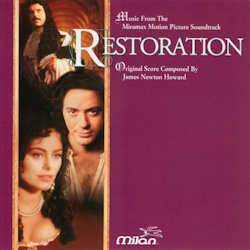
RESTORATION – James Newton Howard
 THROWBACK THIRTY
Original Review by Jonathan Broxton
Restoration is a period drama film directed by Michael Hoffman, adapted from the 1989 novel of the same name by Rose Tremain. The film is set during the Restoration period in England, which began in 1660 when Oliver Cromwell’s Commonwealth – which had overthrown the monarchy of King Charles I a decade or so previously – came to an end and Charles II was restored to the throne as king. The restoration was known for its cultural renewal, scientific curiosity, and political change, but also for its sometimes vulgar and obscene decadence, something which stood in polar opposition to the dourly stringent and sometimes cruel Puritan morality that Cromwell enforced during his time in power. The story follows the experiences of Robert Merivel, a young aspiring physician from a lowly background who, after he inadvertently saves the life of the king’s dog, is summoned to the royal court, and quickly becomes surrounded by a new world of wealth and indulgence.
The film’s ensemble cast includes Robert Downey Jr. as Merivel, Sam Neill as King Charles II, Meg Ryan as Merivel’s lover Katherine, and Polly Walker as the king’s mistress Celia, plus actors like David Thewlis, Ian McKellen, Hugh Grant, and Ian McDiarmid in major supporting roles. While the film was praised for its rich production values – it won Academy Awards for Best Art Direction and Best Costume Design – it received mixed reviews overall, and is something of an obscurity now, rarely discussed as anything more than a minor oddity within the careers of its cast.
However, something well worth taking the time to remember is its score, which was written by James Newton Howard in a significant departure from what was considered his ‘usual’ style at the time. During the Commonwealth under Cromwell, many forms of music had been suppressed or outright banned, but after Charles II returned music came roaring back too, especially at court. Charles had spent most of his exile in France, and actively imported continental tastes upon his return, favoring elegant, dance-inflected, and expressive styles influenced by French and Italian music. Composers like Henry Purcell flourished during the period; Purcell’s music actively blended English traditions with French elegance and Italian expressiveness, and prominently featured violins, as well as the harpsichord, which at the time was a reasonably new invention. Howard’s score is directly influenced by this music in general, and by Purcell in particular, resulting in something that often sounds less like a traditional film score and more like a brand new album of baroque classics, albeit expanded out and re-orchestrated for a full symphony.
 The score album is split between new music by Howard, and new recordings of Purcell music conducted by Rick Wentworth and Robert Zeigler. The Howard music, which runs for just around 45 minutes, is outstanding in every regard, some of the richest and most sumptuous of his career to that point.
The score opens with the “Main Titles,” a ravishing explosion of triumphant pageantry full of rousing brass fanfares, thunderous rumbling timpanis, and vivacious strings backed by a harpsichord. It’s just tremendous – an authentic intentional pastiche of Purcell’s sound brought roaring into contemporary life with modern orchestrations. As the score develops several themes emerge; not only the main theme from the main title sequence, but a group of similar-sounding romantic and lyrical themes which represent Merivel, his ill-judged affair with Celia, his romance with the delicate Katherine, and then ultimately his increasing desire to extricate himself from the excesses of Charles II’s court life and genuinely dedicate himself to serving the London’s poor underbelly – a desire which is hastened both by the looming threat of the plague, and then by the Great Fire of London which devastated parts of the city in 1666.
Highlight cues that explore these more romantic ideas include the tender string and woodwind writing of “A Night With Lulu,” the more intimate and slightly bittersweet oboe theme that emerges in “A Creature of the New Age,” the deeply romantic “The Wedding,” the tender melancholy of “The Land of Mar,” and “Merivel Woos Celia,” which is surface-level pretty but has a streak of darkness running through it, foreshadowing Merivel’s fall from grace when the king learns of Celia’s infidelity with him.
Elsewhere, “The Cabinet of Curiosities” reprises the fulsome theme from the main title with boldness and ecstatic grandeur, and places special emphasis on the interplay between the brisk woodwind lines and the cavorting harpsichord textures. There is a quirky playfulness to this music that I really enjoy, and Howard seems to have an excellent time exploring these sounds and techniques.
“Katharine Sleeps” is a tender, delicate piece for high woodwinds and crystalline strings that emerges during the sequence at New Bedlam Hospital where Merivel falls in love with a mentally ill patient named Katherine, initiating a relationship which eventually inspires him to change his ways. The writing here is quintessential Howard romance; there are echoes of his love themes from scores like The Man in the Moon and Wyatt Earp, and of themes he would later explore in the more intimate parts of things like The Postman, and some of his scores for M. Night Shyamalan. “The Right Knowledge” continues this sound as part of a sequence that underscores scenes where Merivel struggles with his past, and how he squandered his medical talents while selfishly living the decadent lifestyle King Charles offered to him. The finale of the cue is impressively heartbreaking, a score highlight.
Once Merivel and Katherine return to London they are immediately faced with the onset of “The Plague,” and Howard captures the devastating impact of it all with some appropriately ominous writing for strings and harps. The subsequent pair comprising “Katherine’s Death” and “Night Sweats” are outstanding examples of Howard’s increasingly impressive dramatic writing, as he combines statements of both the main theme and the love theme for Merivel and Katherine into a series of gut-wrenching variations which really drive home the tragedy of the whole thing. Howard’s use of tolling bells and a haunting liturgical choir in “Night Sweats” is especially excellent, revisiting the religioso sound of Flatliners and (to a lesser extent) Alive, while again foreshadowing some of the music he would later write for M. Night Shyamalan, especially Lady in the Water.
The growing sense of determination and resolve that runs through the powerful “Hospital” climaxes during the wonderful “Doctor Merivel,” where the exultant sound of the pipe organ brings the tone of the score back to the flamboyance and optimism of the main title cue. “The Fire” underscores the dramatic climax of the film, which occurs during the Great Fire of London in 1666, and sees Merivel heroically rescuing an elderly woman from a burning house. Howard accompanies the scene with a powerful action setting of the main theme full of boisterously rhythmic percussion passages and darkly-hued courageousness, soaring strings with brass counterpoint. The conclusive cue “Your Child I Believe” then reprises the main theme again with a sense of stoic resolve and appropriate redemption, acknowledging the restoration of Merivel’s reputation as a man of morality and honor.
The Purcell music, which runs for just around 15 minutes and is intertwined with Howard’s score throughout the album, is drawn mostly from several key works: his 1691 opera about the life of King Arthur, his 1692 opera The Fairy Queen adapted from the Shakespeare comedy A Midsummer Night’s Dream, the ode “Welcome To All The Pleasures,” the incidental music he wrote for a 1695 staging of Aphra Behn’s play Abdelazer, and some music from his unfinished 1695 opera The Indian Queen, which he was in the middle of writing when he died at the tragically young age of 36. There is also a piece from 1711 by the French composer and viol player Marin Marais, and a vivacious new arrangement of the traditional folk song “Newcastle”. It’s all excellent, and fans of that period in classical music history will enjoy it very much indeed.
Had 1995 not been literally one of the strongest years in the history of film music James Newton Howard’s score for Restoration would undoubtedly have been a strong contender for an Oscar nomination in the Drama sub-category, but it’s competition that year included all-time greats like Apollo 13, Braveheart, Sense and Sensibility, and Nixon, plus several other masterpieces which didn’t get nominated either, including Cutthroat Island, First Knight, Mr. Holland’s Opus, Crimson Tide, Batman Forever, and Howard’s own Waterworld, among many others, so it was overlooked.
For me, though, Restoration remains one of James Newton Howard’s most intellectually and emotionally satisfying works of the 1990s. The way he successfully captures the essence of the time period through his music, especially the way he blends the stylistics of Henry Purcell with his own dramatic sensibility, is outstanding. The richness of the orchestrations, the depth of the emotions, and the thematic interplay, are all top-notch, and the way Howard’s music on album combines perfectly with new recordings of Purcell’s actual music makes for a superbly satisfying experience. Listeners will have to be comfortable with authentic music from the period – especially the sounds of harpsichords – but those who do will find themselves consistently engaged and entertained.
Buy the Restoration soundtrack from the Movie Music UK Store
Track Listing:
- If Love’s A Sweet Passion from “The Fairy Queen” by Henry Purcell (1:31)
- Main Titles (2:57)
- Frost Dance in C from “King Arthur” by Henry Purcell (1:34)
- A Night With Lulu (1:21)
- Minuet in G from “Abdelazer” by Henry Purcell (0:53)
- Here the Deities Approve from the Ode “Welcome To All The Pleasures” by Henry Purcell (2:28)
- A Creature of the New Age (1:09)
- Overture in D from “The Fairy Queen” by Henry Purcell (2:25)
- The Wedding (1:39)
- Hornpipe in D Minor from “The Fairy Queen” by Henry Purcell (1:26)
- Arrival in Bidnold (1:08)
- The Cabinet of Curiosities (2:54)
- The Land of Mar (1:11)
- The Lie (1:19)
- A New Ground in E Minor by Henry Purcell (0:52)
- Merivel Woos Celia (2:26)
- Katharine Sleeps (3:23)
- Taking Bidnold Back (1:35)
- Muzette 1 in A Minor from “3e Livre de Pieces de Viole” by Marin Marais, performed by Laurence Dreyfus and Jakob Lindberg (2:56)
- The Right Knowledge (2:06)
- The Plague (2:09)
- Katharine’s Death (4:37)
- Night Sweats (3:03)
- Hospital (2:54)
- Doctor Merivel (1:50)
- Listening to Celia’s Heart (1:39)
- The Fire (3:18)
- Allegro from Sinfonia (Act II) from “The Indian Queen” by Henry Purcell (1:19)
- Your Child I Believe (1:13)
- Newcastle (traditional) (0:38)
- 2nd Overture in D from “King Arthur” by Henry Purcell (1:27)
Running Time: 61 minutes 20 seconds
Milan Records 7313835707-2 (1995)
Music composed by James Newton Howard. Conducted by Artie Kane, Rick Wentworth and Robert Zeigler. Orchestrations by Brad Dechter, Don Nemitz, Frank Bennett, Geoff Alexander, and James Newton Howard. Recorded and mixed by Geoff Foster, Paul Hulme, and Shawn Murphy. Edited by Bob Hathaway, Jim Weidman, and Robin Clarke. Album produced by James Newton Howard, David Franco, Emmanuel Chamboredon, and Toby Pieniek.

Shop at the Movie Music UK Store

Member of the

 MOVIE MUSIC UK