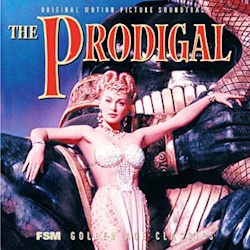
THE PRODIGAL – Bronislau Kaper
 GREATEST SCORES OF THE TWENTIETH CENTURY
Original Review by Craig Lysy
The massive success of 20th Century Fox’s The Robe in 1953, with its Cinemascope color format, reinvigorated studio interest in grand ancient epics. Writers Sam Larson and Joseph Breen wrote a 60-page story based on the Prodigal Son biblical tale, and managed to sell it to MGM studio executive Dore Schary. Charles Schnee was assigned production with a $2.783 million budget, Maurice Zimm was hired to adapt the story, and Richard Thorpe was tasked with directing. Casting was problematic as the original leads, Ava Gardner and Vittorio Gassman both dropped out. The new cast would showcase studio star Lana Turner as Samara, and joining her would be Edmund Purdom as Micah, James Mitchell as Asham, Louis Calhern as Nahreeb, and Joseph Wiseman as Carmish.
The film draws upon the story preached by Jesus Christ according to Luke 15:11-32 and shifts it to a setting in the city of Damascus. It follows the life of Micah, a young man who covets the high priestess of Astarte, Samara. He demands from his father his inheritance, squanders it on Samara who seduces him, betrays his faith, only in the end to be cast aside. Now completely broken in spirit and resources he returns home and is not only forgiven by his father but welcomed back with open arms. In mid-production Schary tried to axe the film, which by all accounts was a disaster, but was dissuaded by the finance department, which said cancellation would result in an even bigger loss. Well, the film was indeed a commercial disaster losing $771,000. Critics praised the film for offering a well-directed, finely acted, lavish story. It earned two Academy Award nominations for Best Art Direction and Best Costume Design.
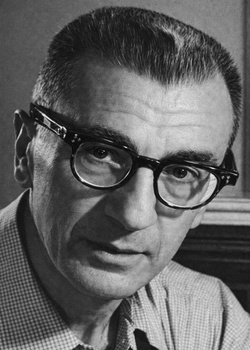
Fox’s Director of Music Johnny Green assigned Bronislau Kaper to the project. After viewing the film Kaper realized the task was daunting, as there were insufficient superlatives to describe just how bad a film this was. Never the less he was a true professional and his score did succeed in elevating the film. He understood that that his music would have to speak to the two cultural identities in the film; the monotheistic Hebrews, and the pagan worshipers of Baal and Astarte. I surmise that he believed that the villains, Nahreeb, Rahkim, and Bosra would need musical identities. His traditional orchestra was augmented with additional instruments indigenous to the Levant, to provide the requisite regional and cultural auras. Fanfares, which herald great personages, processions, and marches would also be needed to establish the formality and pomp of the temple court.
 For his soundscape Kaper conceived four primary themes. The Hebrew Theme serves as the collective identity of the Hebrew people. It speaks musically to their tribulations, and long-suffering history. To that end, it emotes minor modal, has a palpable sadness woven into the notes, and is voiced by wordless men’s choir, evoking the tradition of the Jewish cantor. Yet it also operates on a personal level as an emblem for Micah, or pangs of his conscience. The Familial Theme speaks to duties, responsibilities and obligations imposed on Micah by Jewish culture, a culture in which the father decides who, when, and how a son marries. Kaper expresses the theme intimately, with an array of woodwinds, which grace us with shifting solo performances. We again discern an undercurrent of sadness, and resignation as Micah is a free spirit who cannot seem to accept familial constraints on his freedom. Samara’s Theme is dichotomous, offering a long-lined, eleven note statement that serves as her personal identity, as well as her larger than life, revered status as High Priestess of Askarte. When personalized it offers an alluring, irresistible and seductive power. In her capacity as High Priestess, her theme is remote and bears a regal countenance. Nahreem’s Theme supports our villain, the truly evil, avaricious, and malignant High Priest of Baal. Kaper offers a malevolent plodding marcia diabolica replete with muted horns and repulsive, woodwinds sinistri. His theme extends to empower his villainous allies; Rahkim and his henchmen, and the avaricious Bosra. Lastly, the film offered a number of scenes that required source ambiance and dances. As such, Kaper employed a small ensemble of indigenous woodwind and percussion instruments to impart the requisite cultural auras.
“Main Title” offers a score highlight where Kaper masterfully establishes the tone of the film. It opens with low registers drums rumbling with wordless men’s chorus as the MGM Studio and CinemaScope logos display. We flow seamlessly into the Opening Credits, which display in gold script against a rustic red wall relief with Canaanite warriors. Kaper empowers the credits with solemnity, with a wordless, solo male voice singing the Hebrew Theme over rumbling drums and horns reverenti. At 0:53 a cymbal clash supports and expansion of the theme to full orchestra and mixed choir. At 1:27 we exit the credits and behold narrative script; “Thou shall have no other gods before me. The first Commandment”. At 1:36 we enter the film proper with additional narrative script, which provides insight to Canaanite culture. We are informed that they revere the male god Baal and his female consort goddess Astarte, who ensured fertility of the earth. Kaper supports the narrative subtly with auras of the levant borne by a meandering English horn, recorder and soft percussion. The music darkens when we are told that in return for their favor, Baal and Astarte demanded the annual sacrifice of money, jewelry and human life. Narration informs us that our story opens in the seaport of Joppa in the year 70 B.C., and explores the tale of the prodigal son, as told in Luke – Chapter 15. We segue at 2:25 into “Chase” which reveals Rakhim on horseback chasing down Asham, his master Nahreeb’s runaway slave. Kaper energetically propels the chase with horns regali, strings spiritoso and percussion. At 2:55 the city gate is closed, and Asham, in desperation begins climbing carried by tremolo strings, yet the music darkens and becomes grim as Rakhim throws two daggers, which strike Asham’s tunic sleeves, pinning him to the gate. Rakhim then pulls out his spear, and we close on a descent motif as Micah pulls Rakhim down off his horse.
“Spear” reveals Micah settling the issue by paying Rakhim twenty pieces of silver for the slave. Music enters with forlorn woodwinds as Micah frees Asham from the gate and says he is free, and should leave. Micah walks away, rejoins his brother Joram, with Asham following. At 0:22 the music swells with anger as Rakhim throws his spear at Micah, only to be saved by Asham who is struck in his right upper chest. Rakhim rides away and the brothers decide to take Asham home. “Eli” reveals Eli disclosing to Micah his plans to betroth him to Ruth. When asked if he chose right, Micah replies that he admires, and respects her – and Eli discerns that he does not love her. The conversation shifts to Rachel, his mother, and how Eli misses her as Micah completes his wash before dinner. This is an intimate father-son moment and Kaper scores it with subtlety using a tender woodwind borne Family Theme. I discern within the notes, auras of sadness, which reflects Eli’s longing for his departed wife, and Micah’s dismay that he is now bound to a woman he does not love.
“Ruth” offers a score highlight, which features exquisite, intimate, chamber-like writing for woodwinds. It reveals a frustrated Micah leaving the betrothal meeting as his father Eli and future father-in-law Tobiah argue over the name of Micah’s future first son. The sadness, and futility of the Familial Theme supports, its soft melody shifting gracefully among the woodwinds. At 0:21 a playful, and comedic musical passage unfolds as Asham surprises Micah who lectures him of not continuing his bedrest so the wound may heal. Asham waves him off, counters that he is fine with some acrobatics, only to become dizzy and be helped down to rest. Micah begins asking probing questions of Asham’s past and the music borne by woodwinds, softens, becomes more tender, and intimate. At 1:35 an oboe delicato supports Ruth giggling from the balcony, which elicits Micah to join. They speak of their betrothal and he informs her that he will have no problems learning to love her, and that their marriage cannot come soon enough. He informs her that he is going to Joppa to invite the Grand Rabbi for the signing of their betrothal contract, and asks what gift he should bring for her. She says, a dove and he departs full of joy. Once again Kaper graces us with an intimate woodwind graced musical narrative of exquisite beauty.
At 3:26 we segue into “Tent” where the brothers Micah and Joram ride through Joppa with the caged dove gift for Ruth. Kaper supports with an exotic musical narrative adorned with indigenous instruments, and led by an alluring solo woman’s wordless voice. At a tent, Micah sees Rakhim enter. He dismounts and follows him in to exact revenge for his attempted murder. Inside he is greeted by Nahreeb, high priest to the temple of Baal in Damascus. Micah is contemptuous of this idol worshipper who offers to buy Asham back. Micha refuses offers of 200, 1,000 and 2,000 pieces of silver saying that Asham is his friend and he will not sell him to death. At 4:59 we segue into “Samarra” where Micah becomes transfixed by the beauty of Samarra, who Nahreeb discloses will soon be installed as High Priestess of the Temple of Astarte. She parades remote and aloof with altar torches in front of the adoring crowd. A hymn-like wordless women’s choir attended by a retinue of exotic percussive instruments introduce Samara’s alluring theme. Masterful is how Kaper weaves together a musical narrative, which joins veneration, and seduction. Afterwards Micah, now consumed by lust, tells Nahreeb to name his price as he means to have her. Nahreeb says she is not for sale to any believer of Jehovah, to which Micah replies, I will have her, one way, or another. After Micah departs, Nahreeb and Rakhim conspire to humble Micah and bring Asham to justice.
“Window” reveals Asham watching a conflicted Micah pace back and forth through a window. He is torn between his duty to Ruth, and lust for Samara, and Kaper supports this conflict with a tête-à-tête by a solo oboe triste and bassoon. Micah joins Asham outside at 0:19 as we segue into “When Daylight Comes” carried by flute solista emoting Samara’s Theme. He frets to Asham as her theme shifts to wordless women’s choir, that he cannot shake her from his mind as she is in his blood. “Departure” offers a score highlight of heart-wrenching pathos, and one of the finest compositions in Kaper’s canon. After dinner, Micah discloses to his father that he cannot proceed with the betrothal. Eli tries to counsel him, yet it is clear he does not understand that the reason is not cold feet, but instead, lust for another woman. When Joram at last discloses it, and Micah confirms his desire for Samara, High Priestess of Astarte, it is more that Eli can bear. He reproaches Micah for betraying his faith, his family, and the community. Masterful is how a crescendo dramatico crests at 1:05 with silence, as Kaper felt silence best supported Eli slapping Micah twice, and then disowning him. Kaper supports the rupture of the father-son bond, and Micah’s descent into evil with heart-wrenching, molto tragico exposition of the Jewish Theme borne by strings affanato.
“Farewell” is a scene full of heartache as Eli, has shed his anger, forgives Micah, and declares his love, gifting him half of his inheritance. Joram gifts him his first son ring hoping that Micah will not forget his family roots. Kaper offers, a musical narrative of heartache and regret, in many ways I feel this is a lamentation and the writing for woodwinds, profoundly moving. We pause at 1:41 to shift scene to Micah’s final task – saying goodbye to Ruth. She is bitter, he, self-deprecating and apologetic. She says he will come back, but that she will not be waiting for him. Kaper offers a bitter musical narrative full of regret. After Micah departs, Ruth releases with a harp glissando, her caged dove, yet it flies back to her as a harbinger of hope. At 2:14 we segue atop a refulgent flourish into “Nubian”. Kaper bathes us in exotic majestic auras as the camera pans the grand temple complex of Baal and Astarte. We flow inside and find Samara tutoring Yasmine, her protégé who will one day succeed her as High Priestess. Kaper scores the scene with simplicity with a female servant softly strumming a lyre in the background. At 4:15 we segue into “Bosra” where the corpulent moneylender Bosra conspires with Nahreeb on a diabolical plan to purchase this year’s short harvest. As people begin to starve, demand for his grain will soar, as will the price he will charge. Kaper supports our avaricious villains with Nahreeb’s Theme, a malevolent plodding marcia diabolica replete with muted horns and repulsive, woodwinds sinistri.
“Hunger” offers a bleak musical narrative as we see streets filled with starving people. At 0:27 racing strings disperati and blaring horns support a thief stealing a loaf of bread. When the baker pursues, a mob storms his unguarded store and pillage it. At 0:43 a crescendo di violenza erupts as police arrive on horseback, whip the crowd, but depart unable to make headway. At 0:54 a diminuendo supports women pleading for alms from Micah and Asham. Micah tosses some silver coins behind them, and the women in a frenzy fight for them. A forlorn piccolo supports a coin rolling to a beggar and shyster, Carmish, who bites the coin, and then goes to Micah and Asham. “18 Pieces of Silver” was dialed out of the film and features a playful, and animated musical narrative, which speaks to Carmish’s effusive persona. Carmish manages to curry favor with Micah and take him on a tour of the ‘Tinted Wall” where women of all ages, shapes and sizes are available for purchase. When Micah declares that the only woman that he seeks is Samara, an angry mob surrounds Micah accusing him of sacrilege. Carmish saves the day, when he tosses 18 silver coins, which pacifies the mob. Rakhim watches from afar as Micah repays him twice fold and is escorted to a barber to have his beard trimmed. At 0:30 we segue into “Beard” where Micah refuses to follow custom for Damascus and have his beard shaved off, instead maintaining fidelity to Hebrew law that forbids men to be clean shaven. Kaper softly intones the Hebrew Theme to underpin Micah’s adherence to his culture.
“One Piece of Silver” reveals Micah buying a resplendent green and white robe fit for a noble man, and then purchasing a villa from the loquacious Bosra, who warns him that Asham is a malcontent, and that to be accepted in Damascus society, he must shave off his beard. Music enters with a meandering, and repeating, eleven-note narrative led by a solo oboe tenero as Micah confides to Asham that sometimes a man must make a little trouble, which elicits a smile from Asham. The woodwind narrative carries Micah and Asham to the temple of Astarte where entry requires the supplicant to declare their intention to serve and sacrifice for Astarte. When Micah knocks, he is cursed as a bearded infidel with the peep hole cover slammed shut. At 1:02 Micah chalks a message on the wall of the tinted market – “Samara, One piece of silver. Micah” This elicits at 1:10 an angry cry of “You Infidel!” from a man who charges carried by a crescendo di violenza. Micah pummels him to the ground and then with arrogance, tosses him a silver coin. At 1:29 the woodwind narrative resumes and supports Micah and Asham’s departure as Micah declares that this will get the temple’s attention, with Asham responding with a sliced throat warning. Later that night the woodwind motif carries a messenger, the slave girl Elissa, to Micah’s villa. She relays an invitation for him to visit as the boldness he displayed at the tinted wall must be rewarded. Micah places a dagger in his tunic belt and we close on a dark coda as he orders Asham, who in lovestruck, that they are leaving.
“Terrace of Heavens” reveals the three walking up the temple stairs. An ethereal Samara’s Theme voiced by wordless, women’s choir supports. Elissa’s knock opens the doors, but guards forbid Asham to enter. As they traverse the temple the other-worldly women’s choir support with Samara’s Theme. At 1:16 Elissa departs and the woodwind motif carries Micah’s entry into Samara’s enclosure. On a balcony Rakhim frets, while Nahreeb counsels, patience. Micah enters her bedchamber, and beholds her laying on pillows, waiting with an inviting allure as the choir dissipates on a diminuendo misterioso. In an unscored scene, a seductive Samara informs Micah that all things are possible, including her, for a proper gift to Astarte. One by one she directs his eyes to gifts from suitors from Kashmir, China, Bagdad. For him, she asks for the greatest and purest pearl ever known, the one gifted by King Solomon to the Queen of Sheba, which will be placed in the crown of Astarte. Micah is forthright, saying that for her, he would give anything, but nothing for her hollow bronze idol. When she asks is this because you worship Jehovah? And he answers firmly yes, quoting the first commandment. Undeterred, Samara now rises, places her arms around his neck, and says that he will bring the pearl that Solomon gave to Sheba and then initiates a kiss, to which he responds, passionately. After they finish, she adds the caveat – the pearl will be for my goddess, and both she, and you, will be grateful.
In “Micah’s Exit” he tosses one silver coin, the price he offered for her at the tinted wall and begins to depart full of himself. Her theme resumes. Borne by ethereal women’s voices as she calls to him. He stops, turns, and she says that he will return with less faith in his God, and more in hers. She then wishes him safe travels, and adds that she awaits his return. At 0:36 we segue into “Prayer” atop a cello solenne and the Hebrew Theme by wordless men’s choir, as we see Eli praying formally in temple with Joram and the elders in attendance. He prays for the welfare of Micah, and that he finds his way back to his people, his family, and the one true God. At 1:26 we segue into “Micah’s Party Part 1”, a cue that was dialed out of the film when the scene was edited shorter. It offers a festive, danza esotica animated by indigenous woodwinds, percussion and rhythmic tambourine accents. “Micah’s Party Part 2” offers the rewrite for the previous, now shortened scene. It also offers an original danza esotica animated by indigenous woodwinds, percussion and rhythmic tambourine accents. The music juxtaposes a troubled Micah, who confides to Asham that he knows not what to do. Asham points in the direction of Joppa, and Micah contemplates that perhaps it is time.
“I’ll Break Him” reveals an aggrieved Nahreeb seeking revenge for Micah daring to call him a pig. He shares a diabolical plan with Bosra that he plans to impoverish Micah, break his body, and what he calls, his soul, by making him his slave. Kaper supports with a dire, serpentine musical narrative, which portends Micah’s doom. “Bosra’s Party” reveals Micah, invited to join Nahreeb, Bosra, and the Governor of Damascus for cards. Kaper supports with festive indigenous music by a small ensemble, which establishes a perfect ambiance. After Nahreeb taunts Asham, Micah challenges Nahreeb to a one card draw match, offering his winnings for the night if he loses, and Nahreeb gifting Elissa if he loses. Nahreeb agrees and Micah is blessed with good luck. He wins, gifts Elissa to a stunned Asham, and departs. Micah declines the shameless offer of sex from Uba and is stopped by Bosra. Micah says he is impatient to sell his villa, and then reproaches him for misleading him to believe Samara would be here tonight. From the balcony he hears; “She is”, and he climbs up to her as a moth flies to the flame.
“She Is” offers a second festive piece by an indigenous small ensemble. Micah is bewitched, lustful, and the astute Samara unleashes her seductive power over him, ensnaring him with a kiss. She speaks again of how he gains her; gifting the pearl of Solomon to Astarte, and then departs. We segue into “Deal” as he follows her but is intercepted in the adjoining corridor by Bosra, who dangles the pearl that will secure Samara. Kaper sustains the ambiance of the party with a third festive piece by small ensemble. “Wedding” reveals Asham and Elissa, street shopping. They come upon a wedding procession, which Kaper supports with a festive piece borne by a small ensemble of indigenous instruments. “Granary” reveals Nahreeb and his henchman Rahkim gazing down from a balcony on an endless line of starving peasants waiting in the rain to pay his dispenser for their paltry grain ration. Nahreeb’s malignant theme permeates as he confides to Rahkim the next step in his diabolical plan. At 0:52 a crescendo grottesco joins as he discloses that he will use the rains to reinforce his power as High Priest of Baal to secure blessings for a bountiful spring planting. At 1:06 we segue into “Fanfares” as fanfare reale as the temple herald announces the High Priest’s plan for a sacrifice to Baal and Astarte, and Samara’s intercession to secure a bountiful harvest. A second round of fanfare follows the herald’s declaration.
“It’s Micah” reveals him finally persuaded by Carmish that to gain the woman of his dreams, he must shave off his beard. As he is shaved, a Hebrew Theme, full of pain and betrayal supports. At 0:21 a child-like theme borne by flute delicato supports Eli’s grandson David, who refuses to eat, while the family dines and celebrates the Hebrew holiday Sukkot. Eli goes to David to spoil him and convinces him on why he should eat his chicken, and why they celebrate the feast of the tabernacles. As he explains the history of Sukkot, warm and comforting French horns declare a solemn Hebrew Theme. At 1:46 horse footfalls approach, Eli stands ready to receive Micah, and Ruth runs out carried by a crescendo di speranza. Yet hope dissipates unto disappointment as she declares it is Asham. Eli asks Asham if his son is well, and receives the sealed container sent by Micah. Eli discloses to Joram and Ruth that Micah requests the balance of his portion. Joram objects, but Eli says he us entitled under the Law. In “He Is Dead” Eli gives Asham Micah’s remaining portion of gold. He is told to deliver this message, that from this day forward, I know not his name. From this day forward he is dead…in my heart. Eli then weeps as he performs the Kriah, the tearing of his clothes. In Jewish tradition this symbolizes a torn heart, and offers a ritual mourning practice expressing deep grief and loss upon a loved one’s death. Kaper supports Eli’s heartbreak with a grievously wounded Hebrew Theme borne by strings affanato. At 0:38 we segue into “Invocation”, a magnificent score highlight. We behold a grand, trumpet declared, choral empowered processione religiosa that takes Samara into the Temple of Astarte. A young man is also borne on a liter and joins her kneeling at the altar as High Priest Nahreeb prays to Baal and Astarte.
“Sacrifice” opens with two resounding and portentous declarations French horns and then trumpets as Nahreeb orders the young man to go now, to live forever in the four halls of the Heaven. At 0:27 the processione religiosa resumes as Samara ascends stairs left of the fire pit, and the young man ascends on the right stairs. They meet on a platform overlooking the fire pit. She kisses him on the forehead, he turns, and we conclude with magnificence as he jumps to his death in the fire pit. “Pearl” reveals Micah signing a contract for the pearl with Bosra, which offers his estate and specified penalties for non-payment, which Bosra twice encourages Micah to read. But he is impatient, grabs the promissory note and foolishly signs without reading its stipulations. Dire, portentous horns of doom resound as he signs. At 0:07 we shift to the Temple of Astarte where Samara places the pearl on the forehead of the Astarte’s statue. Alluring woodwinds buttressed by horns supports swell to declare with magnificence her theme as she takes Micah by the hand and they depart. At 0:41 a more intimate flute tenero borne exposition of her theme supports them in her bed chamber as she lays and strokes his hair. At 1:43 a transfer of the melody to clarinet continues the intimacy, however I discern auras of sadness at 2:08 we segue into “Beth”, which was with its scene edited out of the film. It features strummed three-note phrasing by a lute.
“What Is Wrong” Reveals Samara asking a troubled Micah; “What is wrong?” A solo oboe triste draped with soft strings offers her theme as he remains silent, yet she persists and shakes the truth from his lips at 0:37 as her theme blossoms on lush, strings romantico to support his admission that he wants her as his wife, and is unwilling to share her with other men. She pulls away and says that she could never belong to only one man. When he asks why? She declares she is High Priestess of Astarte, her life calling. She takes his hand and says to accompany her to the temple to learn why. They arrive, and as she descends stairs into a crowd she says; “And now Micah, you shall see.” He observes that as she passes through them, they all kneel and bow in reverence. In “Elissa’s Death” Asham at last returns home and is greeted by Elissa. Music enters harshly unfolding with an ominous musical narrative as Rakhim orders his henchmen to break into Micah’s house and steal gold located in two saddle bags brought by Asham, with the caveat to not kill the mute as Nahreeb has other plans for him. A crescendo launches a ferocious tempest of violence as the henchmen storm and set fire to the house. At 1:03 horns of death support Rakim’s dagger throw that slays Elissa, as they take the gold. We close with weeping strings affanato as Asham kneels over Elissa and lays his head down on her in agony.
Several unscored scenes follow. Bosra advises Nahreeb and Samara that the contract stated the loan was to be repaid in gold, or body, and now that Micah’s gold was stolen, and the villa burned, he must repay with enslavement. She and Nahreeb quarrel when he discloses that he bought Micah from Bosra and will make him admit that Baal and Astarte are the true gods. Later we see Micah housed in a dungeon with other slaves, and then performing toiling manual labor under the lash of Rahkim’s whip. Samara prays to Astarte to liberate Micah and is warned by Yasmin that the penalty of praying for an infidel, is death. Nahreeb then joins and makes Samara an offer; convince Micah to publicly renounce his belief in Jehovah, and he will be freed. Later, Rahkim brutally whips Asham, who breaks free and begins whipping Rahkim. Micah joins the fight only to see the guard stab Asham. “Message” offers a poignant score highlight. Samara travels to the dungeon to convey a message to Micah. She finds him grieving over Asham. She advises Micah that Nareeb will grant him his freedom, if he publicly renounces his belief in Jehovah. He refuses and she counsels deception – say it, but do not believe it. They then both reassert their unshakeable beliefs in their deities. In the end, they realize the futility of their circumstance. Kaper masterfully supports with a nuanced musical narrative, which incorporates a tête-à-tête between the Hebrew and Samara themes, which mirrors the ebb and flow of their conversation. We close painfully at 2:25 on her theme borne by solo violin affanato after he declares that he hates what Baal and Astarte have done to the people of Damascus, and to you, and she gives him a parting kiss, as she declares that the penalty of loving an infidel is to be buried alive.
“Miracle” offers a profoundly moving score highlight, which achieves a sublime cinematic confluence. It reveals Micah kneeling over Asham’s body following Samara’s departure. He recites with reverence, the sacred Jewish prayer, Shema Yisrael. Kaper reveals mastery of his craft with one of the finest compositions in his canon. We open with reverence with the Hebrew Theme borne by solo cello solenne. It is soon joined by tremolo strings slowly swelling on a crescendo inesorabile, climaxing gloriously at 0:50 with choral magnificence as Micah recites the last line, and we see Asham stir to life.
In “Vultures”, Micah’s cell mate Ramadi has long sought to overthrow the tyrant Nahreeb. When Micah offers his support, they devise a scheme to have Micah feign death. Ramadi has him memorize contacts on the outside ready to support a rebellion to seek after he escapes; Zubeir the potter, Nisbin the carpenter, the anvil shop on Straight Street, Salkhad the fieldworker, Abu the stonemason, Lirhan the snowman, Dura the perfumer, and Chaim the water carrier. Micah feigns death and is removed by the guards and tossed into the vulture pits. Music enters as a musical maelstrom with primal ferocity to support a violent life and death struggle with a huge vulture, that swoops down and attacks. Its beak and talons rend Micah’s flesh, but he after a protracted struggle bludgeons the bird with a femur bone, and then strangles it. “Full of the Moon” reveals Micah making contact with the men on Ramadi’s list, organizing a meeting attended by Carmish. He foments a slave rebellion to take place on the night of the full moon to overthrow Nahreeb, and liberate Damascus from Baal and Astarte. Kaper weaves a musical narrative of tension and intrigue to support Micah’s efforts. We close ominously at 1:37 as we see Samara and Yasmin on a balcony with a full moon in sight. Yasmin drops a bombshell and swears she saw Micah in line at the granary. Samara is dumbfounded and sets off to verify if this is true.
“Fight” is a score highlight, which features a dynamic action piece. It reveals Micah’s men seeded in the granary line as Rakim stands guard. Carmish pulls Micah out of line and leads him to a pottery shop where Samara waits. She is happy he is alive and confesses her undying love, yet the conversation goes south when he orders her to leave for her own safety. When he admits he leads a rebellion to destroy Nahreeb’s tyranny, she raises the alarm to defend her faith. Micah is forced to initiate the attack, and Kaper unleashes a firestorm of violence, a maelstrom rich with counterpoint, propelled by blaring horns and strings furioso. Woven within this narrative is contested interplay of the Hebrew, Nahreeb’s and Samara’s themes. A personal fight between Asham and Rakim takes center stage as a conflagration engulfs the granary. Blaring trumpets at 1:26 supports Rakhim plunging to a fiery death. The battle’s rhythm shifts and becomes more pronounced with a martial Nahreeb’s Theme as the temple guards on horseback arrive challenged at 1:55 by martial Hebrew Theme as the battle becomes fierce. Soon after, an imperious Nahreeb himself arrives on chariot with his theme ascendent. Micah commandeers a chariot and pursues as Kaper whips his orchestra into frenzy. At 3:52 Micah throws a dagger into the throat of Nahreeb and the violent musical narrative dissipates.
“Storm” reveals the angry mob racing up the Temple of Astarte steps, overwhelming the guards, and surging into its courtyard. Bosra pleads with Samara to depart with him on a galley to Biblos, but she refuses, convinced her people will never harm her. She sends Yasmin away with him, gifting her the diadem of the High Priestess. Music enters with a grave rendering of Samara’s Theme’s processional iteration as the mob reaches the gates leading to the temple’s inner sanctum. They surge to the altar with trumpets irato blaring, yet all their hostility seems to dissipate as Samara stands composed and serene in front of the altar. In “Samarra’s Death” Ramadi pleads with Micah that Samara must die or we fail. Micah, with reluctance nods approval and music enters with a molto tragico rendering of Samara’s Theme as she is stoned, and falls into the fiery altar fire pit. At 0:30 the music surges to frenzy as the statues of Astarte and lastly Baal are all cast into the fire pit, bringing an end to their reign.
“My Son” reveals Micah returning home with Asham. He pauses on a hill to see his father’s estate in the valley below, and remarks to Asham; “I would rather be a servant in my father’s house, than a king in Damascus”. The woodwind borne Family Theme joins with this revelation, and carries them to the house. Eli sees him, cries out Micah to Joram, and runs to him carried by a tear evoking Hebrew Theme full of happiness. They hug, and then Micah falls to his knees, declaring he has sinned, and is unworthy to be called his son. Eli, will not have it. He orders Caleb to call family, relatives and friends to a feast to celebrate this blessed day, as my son was lost, and now he is found. At 1:31 we segue into “Celebration” as we see Micah reunited with his family, relatives, friends, and even Ruth. Joram however is bitter, complaining to Eli that he as his first-born son served and obeyed him, and yet never has he been rewarded a feast with a fatted calf as is done now with Micah. Eli grasps him and says; “Son forever you are with me, and all I have is yours. It was meat that we should make merry and be glad. For this your brother was dead and is alive again. And was lost, and is now found”. He adds, ask yourself Joram; “Have I not judged my brother too harshly?” At 3:15 Micah leaves the dance, runs to Joram and they shake hands with Kaper supporting with a tear-evoking statement of the Hebrew Theme. We end with Eli declaring; “My sons. My rock. My future”. We segue at 3:31 into “End Title and Cast” for a final, heartwarming choral empowered statement of the Hebrew Theme.
I would like to thank Lukas Kendall for restoring Bronislau Kaper’s magnificent score to The Prodigal. The score’s remix and digital remastering of the original stereophonic source by the technical team achieved an excellent audio quality, which provides the listener a wonderful listening experience. Upon viewing the film Kaper felt it lacked cohesion, and suffered from a lackluster script and poor direction. He was well aware that MGM CEO Dore Schary assessed whether the studio would lose less money cancelling the film mid production. Undeterred, he pressed on, and I believe he succeeds in providing one of the finest Golden Age contributions in the Biblical genre. In a masterstroke he conceived a Hebrew Theme, which operates transpersonally as a powerful emblem of the Jewish people, but also personally as a manifestation of Micah’s conscience. The theme is solemn, long-suffering with a reserved nobility, however in the finale when it supports the joyous return of the prodigal son, it becomes, transcendent. Masterful is Kaper’s conception and execution of Samara’s Theme, expressing her as a woman who is alluring, and seductive, as well as a High Priestess, who is remote, serene and demanding of veneration. For me, iterations of her theme offer some of the score’s finest moments; the glorious, regal, choral empowered processione religiosa, in cue 24 “What Is Wrong” where it is rendered with unabashed yearning romanticism, which offers painful irony as it is also the moment, she and Micah realize that their differences are irreconcilable, and lastly, the molto tragico pathos of her death scene stoning. Although there is only one action piece, it is one for the ages in which Kaper weaves together in contested interplay the Hebrew, Nahreeb and Samara Themes within a ferocious maelstrom of violence. Folks, Kaper never achieved the status of contemporaries Alfred Newman, Max Steiner, Dimitri Tiomkin or Miklós Rózsa, never the less as you explore his canon, you discern beautiful and inspired compositions that earn our praise. This score offers one, which transcends its flawed film. It enhances, elevates and empowers so well as to almost mitigate its imperfections. I highly recommend you purchase this quality album, and take in the film.
For those of you unfamiliar with the score, I have embedded a YouTube link to a seventeen-minute suite: https://www.youtube.com/watch?v=b9oIpyozPYA
Buy the Prodigal soundtrack from the Movie Music UK Store
Track Listing:
- Main Title/Chase (3:15)
- Spear (0:56)
- Eli (1:36)
- Ruth/Tent/Samarra (6:56)
- Window/When Daylight Comes (1:22)
- Departure (3:06)
- Farewell/Nubian/Bosra (6:37)
- Hunger (1:09)
- 18 Pieces of Silver/Beard (0:54)
- One Piece of Silver (2:11)
- Terrace of Heavens (1:58)
- Micah’s Exit/Prayer/Micah’s Party Part 1 (2:44)
- Micah’s Party Part 2 (1:34)
- I’ll Break Him (0:53)
- Bosra’s Party (2:10)
- She Is (1:10)
- Deal (0:27)
- Wedding (0:43)
- Granary/Fanfares (1:27)
- It’s Micah (2:01)
- He Is Dead/Invocation (2:30)
- Sacrifice (1:43)
- Pearl/Beth (3:20)
- What Is Wrong (1:14)
- Elissa’s Death (1:36)
- Message (3:02)
- Miracle (1:07)
- Vultures (1:44)
- Full of the Moon (1:42)
- Fight (3:59)
- Storm (0:47)
- Samarra’s Death (1:01)
- My Son/Celebration/End Title and Cast (4:17)
- Celebration/End Title and Cast (Alternate) (2:48)
Film Score Monthly FSMCD Vol. 5 No. 9 (1955/2002)
Running Time: 73 minutes 59 seconds
Music composed by Bronislau Kaper. Conducted by Andre Previn. Orchestrations by Robert Franklyn. Recorded and mixed by XXXX. Score produced by Bronislau Kaper and Johnny Green. Album produced by Lukas Kendall.

Shop at the Movie Music UK Store

Member of the

 MOVIE MUSIC UK