THE TALL MEN – Victor Young
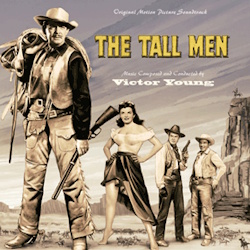 GREATEST SCORES OF THE TWENTIETH CENTURY
Original Review by Craig Lysy
In a coup, 20th Century Fox CEO Darryl F. Zanuck signed the aging 53-year-old star Clark Gable to a contract in May of 1954. Gable had long been revered as the “King of Hollywood” and Zanuck sought to capitalize on his iconic status. That vehicle came along quickly in a novel “The Tall Men” by Heck Allen. Producers William A. Bacher and William B. Hawks purchased the film rights, along with novel’s sequel “The Big Pasture” for only $10,000. Bacher and Hawks would manage production with a $3.1 million budget, Raoul Walsh would direct, and Sidney Boehm and Frank Nugent were tasked with writing the screenplay. Gable would star as Colonel Ben Allison, joined by Jane Russell as Nella Turner, Robert Ryan as Nathan Stark, and Cameron Mitchell as Clint Allison.
The story is set in Texas circa 1865 and explores the fortunes of two brothers, Ben and Clint Allison. In the Civil War they fought for the Confederacy in Kansas with Quantrell’s Bushwhackers, and upon discharge they gave up pursuing a life of crime to lead an epic cattle drive from Texas to Montana. Along the way they save Nella Turner from the Indians, and she decides to join the team. During the arduous journey they are forced to confront rough terrain, snow storms, cattle rustlers, Jayhawkers guerillas and Sioux Indians commanded by Chief Red Cloud. In the end, they overcome every obstacle earning praise as “The Tall Men”. The film was a massive commercial success, earning the studio a profit of $8.9 million. Despite this, critical reception was harsh, with the film disparaged as a formulaic hackneyed horse opera. The film received no Academy Award nominations.
Composer Victor Young had firmly established himself in the Western genre with the successes of “Dark Command” (1940), “Rio Grande” (1950), “The Sun Shines Bright” (1953) “Shane” (1953), “Jubilee Trail” (1954) and “Johnny Guitar” (1954). As such he, with director Walsh’s blessing, was recruited for the project by 20th Century Fox director of Music Alfred Newman. I believe that upon viewing the film, that Young understood that this epic tale, filmed in cinemascope, needed a main theme that was big, sweeping, expansive, and expressed the romanticism of America’s westward expansion. I believe he also understood that he needed to romantically support the romance of Ben and Nella, several intense actions scenes, stampedes and offer cultural juxtaposition with the native Americans.
 For his soundscape, Young chose to utilize three primary themes; the major modal Main Theme offers a proud, sweeping, long-lined, romanticism, long associated with America’s pioneering westward expansion. The film centers on an epic 1,400-mile cattle drive from San Antonio Texas to Mineral City Montana and Young uses the Main Theme to empower its progress and find confluence with the vastness of the western prairie lands. Two five-note fanfare declarations usher in the theme, and Young often uses these five-note phrases to drive the film forward. For the tempestuous Nella, Young decided to duplicate his recent success with “Three Coins in a Fountain”, by again interpolating the titular song melody as a theme. The song melody of “Cindy” by Ken Darby was recast with new lyrics as the comical, and often silly, “The Tall Men”. Jane Russell sings it throughout the film, and its lyrics keep shifting, reflecting her feelings towards love interest Ben. The third theme is the Sioux Indian Theme, which offers the predictable pentatonic Hollywood cliché of the era. Despite this, when declared in dramatic form, it offers a proud, indomitable and ominous identity, which offers a perfect juxtaposition to the Main Theme. Lastly, the wistful Mexican ballad “Cancion Mixteca” by José López Alavés is used as a leitmotif for the Vaqueros (Mexican cowmen).
Cues coded (*) contains music not found on the album. (*) “Logo” offers Alfred Newman’s extended Cinemascope version of his iconic 20th Century Fox Fanfare. We flow into “Main Title”, a score highlight, where Young in a masterstroke captures the film’s emotional core. We are carried by a racing ascent by strings furioso, which usher in two declarations by horns nobile of the Main Theme fanfare, as the opening credits unfold in red script against a panorama of the snow crested Rocky Mountains. From this arises a sweeping, long-lined, major modal, exposition of the Main Theme, which fully embraces Manifest Destiny, and the romanticism associated with America’s pioneering westward expansion. The credits close with a reprise of the Main Theme fanfare for Producer and Director acknowledgement, and at 1:08 narrative script informs us that Ben and Clint Allison, tall men, left a ravaged Kansas after the Civil War to see their fortunes in the gold fields of the west. The theme softens, is embellished with a twinkling effect, but also gains a foreboding under current of unease as we see Ben and Clint struggling to ride through the deep snow of a mountain pass in Montana. They see a small town in the distance, and head for it, longing for warmth, and a drink.
In (*) “Ben Barters”, they ride to the town Livery for stalls and food for their horses as a honky-tonk song wafts out of the saloon. The Livery owner charges an exorbitant $16 per night, which arouses Clint’s rancor. Ben calmly barters with the man and secures a profit of $9 after he purchases some Civil War souvenirs. (*) “Black Nugget Saloon” reveals it has a gambling area as Ben and Clint look through the window and case the joint. A medley of piano played honky-tonk song continues to support. Ben coaches the short-fused Clint before they enter; we are here on business, very little drinking, and the war is over. Inside a round of shots cost $8 and they discover a lot of money being brought to the owner in a back room. His name is Nathan Stark, and he departs with a loaded money belt for Butte as Ben and Clint observe. Clint and Ben rob Nathan in the Livery and take him with them as they do want to be pursued by a posse. “The Barn” reveals the men riding out carried by a repeating, ever shifting two-note fragment of the Main Theme fanfare. At 0:29 a dire musical narrative unfolds as they reach a cabin where they bunked the night before and tell Nathan, who is clearly uneasy, to go in. Inside, in an unscored scene, Nathan decides to gamble. He confides that he was headed for Texas to organize a cattle drive to Montana, which has not seen beef since the war. He would buy at $4 a head, and sell for $50. He says you can spend the new $100 bills you stole from me, draw attention to yourselves, and be hunted down, or go into business with him and make more money than they could ever dream of. Ben and Clint agree to his offer of a 50/50 split, to handle the cattle driving and security, and return Nathan’s money belt to him.
“Tempest Grove” reveals the three battling a ferocious blizzard. A beleaguered Main Theme empowers their torturous struggle. As they ride by a river the bank gives way and their supply horse is swept away by the icy waters. At 0:58 the storm and music subside as they exit the open plains and enter a forest. Foreboding musical undercurrents drape the Main Theme, which brings them to a camp, where they are greeted, and welcomed by a woman. In an unscored scene, Ben and Nella acquaint and they both realize they are starving. Ben decides to slaughter one of their mules to survive. “Next Day” reveals Ben, Clint and Nathan preparing to ride off in the morning. Ben promises to send help back to Nella and her party, and at 0:25 a nascent Love Theme supports his warm goodbye to Nella. We flow seamlessly into “The Skull”, which reveals the three again riding through very deep snow carried by ever shifting variations of the five-note Main Theme fanfare. At 0:32 the music darkens as they approach a burnt-out wagon. At 0:45 dire pentatonic fanfare declares the Sioux Theme as the discovery a steer skull bearing pictograms of the Sioux Oglala tribe, known as the throat-cutters. Ben is wary of proceeding as planned as this would mean abandoning Nella. He orders Clint to continue on to San Antonio, while he goes and rescues Nella.
“Ben And Indians” reveals Ben returning to rescue Nella. He encounters Sioux killing Nella’s fleeing companions and with expert marksmanship, kills several. He rescues Nella and they both flee atop his horse with meat from last night’s supper. Young supports with an aggressive and propulsive musical narrative that blends strings furioso with interplay of the Main Theme and Sioux fanfares. At 1:13 a desperate musical narrative of flight propels their escape. At 1:55 a forceful Main Theme Fanfare declaration supports their sighting of a cabin in the distance. We flow seamlessly into “The Cabin” with horns of hope declarations of the Main Theme fanfare as they arrive at the cabin. A diminuendo of unease follows as the call out, with no one answering. They dismount and approach the cabin door warily. At 0:33 they enter carried by a warm, and thankful Main Theme as she sits on a bench, cold and exhausted. He asked her to start a fire with the kindling on the dirt floor, while he takes his horse Jeb for shelter in a semi-open barn. He returns and helps her get off her boots and socks as he tries to warm her feet by the fire. Later we see her wet clothes drying as she rests under a blanket. At 1:36 Young supports with interplay of a warm Main Theme, and a nascent Love Theme, which slowly emerges at 2:57 as he offers her some mule steak. She begins to flirt with him, caressing his back with her feet as he eats. She asks if he had ever been in love before, and he answers, no, as he is bashful. At 3:56 Young creates a blizzard wind effect that supports an external shot of the cabin being buffeted. We return inside at 4:02 with interplay of the Love Theme as Nella dresses, and the Main Theme as Ben feeds his horse outside.
“Nella” and the following cue offer beautiful score highlights. There is an album-film variance for this cue. On the album we have an orchestral version of the titular song, while in the film, Nella, who aspires to love, sings the song as Ben listens outside by the barn. Afterwards, Ben joins, and we see that he takes her into a kissing embrace and we see he has fallen for her. He discusses his dreams of returning to a ranch on Texan prairie land, while she suggests the world is much bigger, and asks if he had considered seeing it? He says he did, during the war, and he saw enough for a lifetime. She takes some roast rabbit off the fire, they take a bite and then kiss, with him complimenting her on the molasses flavor, and she countering, that was not molasses, but the taste of a woman. The cue offers one of the score’s finest with beautiful interplay of the Love Theme and the Main Theme.
“Nella And Ben” opens with Storm Motif, which again supports an external shot of the cabin being buffeted by howling blizzard winds. She asks how much he will make on this drive, and he says possibly $50,000. She suggests that would be enough to start a business in California. He again shares his dreams of ranch life in his beloved Prairie Dog Creek, a quiet life secluded from a harsh and violent world. An idyllic, twinkling rendering of the Main Theme by xylophone give way to yearning strings. She asked if he is tied to this dream, and he answered beyond any untying, to which she asks, even if I feel different? He is surprised, and says he just assumed she wanted the same life he did. She relates her disappointing life growing up like that on a farm, how unfulfilling it was, and her desire for much more, to see the world. He tries to persuade her that he will make a happy life for her. But this is dashed against the rocks when she says she is sorry that his and her ideas just don’t seem to fit, adding that she wants more out of life than that. At 1:57 sadness enters the musical narrative, descending like a pall as he now realizes that she does not have the same aspirations for what he seeks in life. When she exhorts him to dream big, he apologizes and says, he dreams small. At 4:04 a crescendo romantico supports him taking her into a kissing embrace, yet she does not reciprocate. He releases her realizing that love is not enough. He becomes bitter, as he declares that she was not the woman he thought she was. We close with a return of the xylophone led version of the Love Theme, this time as a sad statement for what could have been.
“The Blanket” reveals that Nella and Ben are both angry, and they angrily shake out the dust from their blankets as they prepare to sleep apart. Young supports with a comedic musical narrative empowered by an animated Main Theme. In “Morning” Young masterfully supports a scene with a complex intersection of conflicted emotions. The music mirrors the landscape; cold and bleak. We discern an undercurrent of regret as Ben prepares the horse for departure. At 0:17 trumpets militare resound as he sees an Army cavalry unit approaching. A sad musical narrative unfolds as Nella joins and asks Ben if his feelings had changed, to which at 0:48 he replies curtly, no. The Main and Love Themes engage in a tête-à-tête, yet neither is listening to the other. Soft muted horns mark the arrival of the soldiers. They have brought an extra horse, and will escort them, thanks to being alerted by Clint. We asked for a stagecoach to California, the Captain advises Nella there are none until winter’s end in two months, but she could take one to San Antonio and depart to California by the southern route. “The Stagecoach” reveals Nella and Ben travelling by stagecoach south to San Antonio. With she riding in the cabin, and he topside with the driver. Both are unhappy in spirit, and unfriendly in conversation. Young supports their progress with a spirited travel motif with twinkling adornment, which joins with a refulgent Main Theme. At 1:02 the motif becomes animated as they arrive in town and park outside the Longhorn Hotel. Nella and Ben part ways with barbs and she enters the hotel.
(*) “Nella and Nathan” reveals the two reacquainting in the lobby. When he discerns that she is no longer interested in Ben, he makes his move; he offers her his suite, which has a bathtub, which she accepts with no strings attached. When he asks her to join him for dinner, she says she has no fancy dress. After he says that he will purchase one and to trust his taste, she agrees and she and the porter head up to her room. Young supports under the dialogue softly with a danza gentile. In an unscored scene, Ben reunites with Clint, Chicksaw Charlie, and Luis. They advise that many of his fellow Quantrill riders are in town and are willing to ride north with him on the cattle drive. Ben is happy with the reunion and news, and they all head off to celebrate their reunion. In “Nella Swings Hips” Maria assist Nell with her corset and answers her probing inquiries about Ben, discovering that he is quite the charmer and ladies’ man, but also that no one had yet to capture his heart. Maria informs Nella that when wearing a corset, you have to walk a certain way to capture a man by swinging your hips. Nella practices and Young supports with a silly and playful rendering of her theme.
(*) “Nathan” reveals Maria departing and joining Nathan in the adjoining room, where he has ordered a private catered dinner. He pays Maria for her services, $160, and as she departs, she assures him that Nella is very beautiful with a perfect figure. As Nella joins a romantic ambiance is established with by a Mexican guitar and a small ensemble orchestra. In the extended scene Nathan has pulled out all the stops to woo her. She expresses interest, given his wealth, yet remains uncommitted. (*) “Nella Confronts Ben” reveals Nella arriving at Ben’s apartment drunk and spoiling for a fight with him and a Mexican woman who joins. Ben discloses to Nella that the woman is looking for Clint, but she grabs his pistol and sends her on her way at gun point. Now alone, Nella demands that Ben apologize, he refuses, and she takes two swings at him and then passes out on his bed. Clint joins, and Ben notices how tightly bound her corset is, and cuts its straps with his knife, which elicits her to take some well wanted deep breaths. He then decides to return her to her ‘gold mine’. Young supported the scene softly under the dialogue with festive Mexican music. In an unscored scene, Ben offers dozens of vaqueros (Mexican cowmen) $4 a head for every steer they bring to Montana. They shout out their support, yelling we are with you Colonel, and ride off to begin preparations to drive the heard. Ben turns to see Nella arriving in a resplendent yellow dress, escorted by Nathan. He objects, but Nathan says she will be his responsibility. He orders her belongings, which include a bath tub, loaded into his wagon.
“Mexican Priest” offers a wonderful score highlight with an extended exposition of the Main Theme. It reveals Clint complaining to Ben that he saved her life, yet Nathan gets her. Ben says she doesn’t bear his brand, and sends Clint on his ways as Nella gloats. As Clint rides off, a sad rendering of the Main Theme carries him. At 0:15 a priest gives the kneeling vaqueros a blessing, supported by a guitar and strings solenne. At 0:33 Ben shouts out; “All right! Point them north! And the drive 5,000 cattle and horses commences declared by horns audaci, which usher in a sweeping rendering of the Main Theme. This is an inspired passage, with each declarative phrase crowned by answering horns nobile as we see a montage of the massive heard set into motion. At 2:24 we change keys as we shift to a new montage that includes staff and supply wagons. The theme slows and becomes relaxed as the drive slows as the cattle take water at a river. “Night Camp” offers a folksy rendering of the Main Theme by harmonic, banjo and a small ensemble as Ben and Clint converse by a fire pit. Nella opens her wagon’s covering and proceeds to taunt Ben by repeatedly shaking dust from the blanket he gifted her. Nathan joins and she taunts Ben again mocking the ugliness of Prairie Dog Creek. Nathan assures her the land will become ever more beautiful as they head north. He then assists her take off her boots, and departs when she declares that she is turning in. Ben too departs, saying he will be checking in on the heard as they seem restless tonight.
(*) “I Want A Tall Man” reveals Nella singing the song as she prepares for bed. “The Countryside” opens with a warm exposition of the Main Theme, as we see the cattle drive crossing an expansive prairie as they enter the Kansas territory. At 1:17 the music darkens and becomes foreboding as a scout arrives to warn Ben of a shot up wagon arriving. The driver of the wagon warns of Jawhawker raiders up ahead who killed his wife, stripped him of his 500 cattle, and stole all his provisions. Ben thanks him for the news and accommodates the man’s request for food. After he departs, Ben, Clint and Nathan argue on how to proceed. Nathan argues to pay the $1 a head tax, but is out voted two to one with Ben declaring that they will not pay a head tax to the Yankee Jayhawkers. “Jayhawkers” opens ominously with tremolo strings sinistri as a line of three dozen Jayhawkers appear ahead. Young sow a mounting tension as they slowly ride towards them. At 0:29 the Main Theme sounds on confident horns as Ben calmly orders the wagons laid out in a line as planned. Nathan again argues for survival over rashness, but Ben is resolute. At 0:53 a dramatic crescendo minaccioso supports the Jayhawkers arrival. Young softens his music to an undercurrent of tension as Ben and the Jayhawker leader size each other up The Jayhawker leader declares that you confederates will have to repay us a lot for the damage you caused during the war, and he announces his price for safe passage – $5,000. Ben says, in that case, I guess we have to pay, and at 2:37 all hell breaks loose with Young unleashing a maelstrom as Ben, Clint and Nathan open fire killing the leaders. The wagon tarps are then raised to reveal five riflemen per wagon, and they discharge a barrage of withering fire on the surprised Jayhawkers. They turn and try to flee, but most are cut down, suffering massive casualties. Luis and his vaqueros arrive; they were the second wave of Ben’s counterattack, but are not needed as the battle is over.
“Cattle” offers a score masterpiece cue where the Main Theme receives its most grand, romantic and sweeping exposition. It supports an extended scene of Ben’s coordinated crossing of a deep river; first the cattle, then the horses, and last, the wagons, each outfitted with floatation logs. Nella wants to cross further up because the river is narrower, yet Ben says nothing to dissuade her knowing that it is also much deeper there. At 4:41 a comedic interlude supports Nella being tossed into the river by her horse, much to Ben’s amusement, as she suffers her ignominious rescue by Nathan. We close with a film-album variance at 5:26, with the album closing with an orchestral rendering of Nella’s Theme, while in the movie she offers yet another set of silly lyrics as she bathes.
(*) “Clint Takes a Bath” reveals Nella taking her bath and asking Luis to fetch her some water to rinse of the soap. He does so, but Clint, who has been drinking, places a bull frog in one of the pails. He waits outside for the scream, but is instead dosed by Nella who scoffs at him, joined by Ben. Young supports the scene with a folksy, guitar led ambiance. The next day in “The Canyon” the vaqueros can be seen herding the cattle and horses through a long canyon pass. Young supports with another extended Americana exposition of his Main Theme. At 1:44 trumpets militare resound, and we close on a string sustain as Colonel Norris, commander of Fort Bozeman rides out to greet Ben. He advises Ben that the Bozeman Trail is closed because the Sioux under Chief Red Cloud are in rebellion. He suggests they encamp and build shelters for winter. Ben will not have it, and says they will push on over the Colonel’s warnings. “Junior” reveals Clint walking the riverbank and coming across Nell who is bathing. He gathers up her undergarments and clothes, and tosses them into the water one, by one, earning a threatening rebuke. An ominous musical narrative supports the arrival of Nathan, with both men trading threats. Clint draws his pistol, but is outdrawn by the much faster Nathan, who shoots Clint’s pistol out of his hand. Ben arrives, ready to defend his brother, but Clint calls him off, saying he lost fair and square. Ben thanks Nathan for sparing his life, and he responds by saying he needs him by your side to get the cattle to Mineral City. Nella complains that she needs cover to emerge, and at 0:55 her comedic theme sounds as Ben cuts down a small sapling and tosses it to her so she can maintain her modesty.
(*) “Canción Mixtexa” reveals the vaqueros sitting around the campfire as the songwriter José López Alavés sings the sad, wistful tale of a man yearning to return to his homeland. Shifting from the campfire, we see Nathan strolling with Nella. We flow into “Clint” as Luis brings to Ben and empty whiskey bottle, which means Clint is drunk. They begin to search and music enters with a dire rendering of the Main Theme as a drunken Clint confronts an unarmed Nathan with two pistols as Nella watches from the wagon. He tells Nathan he is going to kill him, and tosses him a pistol, with a promise to almost let him reach it before killing him. At 0:40 a dire horn blast with a trailing string sustain brings Ben squarely in front of Clint’s pistol. He refuses Clint’s order to move, and subsequent threat to shoot him. Ben refuses to blink, and when he says let’s keep any killing tonight in the family, Clint relents at 1:24, supported by a molto tragico rendering of the Main Theme. He turns and leaves, and horns nobile declare the Main Theme draped with sad auras as a relieved, but shaken Ben ponders what just happened. Nathan and Nella are speechless. At 1:54 trumpets blare and a dramatic musical narrative supports as Clint rides out of camp across the river. Ben orders Luis to fetch him a horse, and soon sets out in pursuit of Clint. (*) “Ben Returns” reveals that it is three days later, and Nella, to Nathan’s dismay, reneges on an invitation for tea with Colonel Norris and his wife, as she is clearly fretting over Ben and Clint’s fates. Ben returns to camps carried by strings tristi, advising Luis that he could not find him.
(*) “Ben and Clint Reunite” reveals the drive continuing the next day. Ben is riding ahead on the left flank and a musical narrative of hope supports the discovery of Clint’s tracks. Young sow grateful happiness when and Clint rides up and the brothers reconcile. As the brothers reminisce, the warmth, confidence and happiness of the Main Theme offers one of the score’s finest presentations. Clint convinces Ben to allow him to ride point so as to stay clear of Nathan, and rides off promising to scout and mark the path so clear that even Ben could read it. “The Caravan” reveals the drive proceeding across the plains carried with the warmth and confidence of the Main Theme. At 0:11 dire horns sound the Sioux Fanfare as the come upon a trail marker made by Clint. Ben says that he is again directing us north as Sioux are gathering from the east and west. A diminuendo of unease follows as Ben relates to Nella and Nathan that the road back to the fort is open, however Nathan declines, saying he prefers to stay with his investment. At 0:33 the warm Main Theme again resumes as they press forward towards Montana. At 0:52, grim horns sound as a horse runs towards them and Ben recognizes it as Clint’s horse. He orders defensive measures as he rides forth in search of his brother. Luis dispatches two vaqueros to join Ben and an urgent musical narrative full of unease unfolds. They reach Ben, and point to the sky as an unsettled flock of birds take wing, supported at 1:41 by a fluttering motif. They ride on with urgency until 1:57 when the dire Sioux Fanfare resounds to support the discovery of Clint’s dead body tied to a tree, his bloody body riddled with arrows. At 2:07 an aching lamentation unfolds on strings affanato as a devastated Ben lowers his head. He orders him cut done and we shift to camp where Luis leads everyone in funereal prayers supported by a woodwind and guitar borne threnody.
“The Plains” offers a poignant score highlight where Young masterfully scores scenes with powerful emotional dynamics. It reveals Ben advising Luis that he will be taking point. When Luis begins to ask what happens… Ben replies, then you will take them through. At 0:18 the Lamentation Theme carries Ben’s departure, the music informing us of his regret and loss. As he rides in the hills, he gazes to the right and at 0:31 a dire Sioux Theme resounds as we see a very large war party riding on the plain below. Young sow both urgency and unease as Ben rides up to gain a new perspective. He sees them moving away from the cattle drive and their warlike theme dissipates as we see from him, a sense of relief. At 1:10 a wistful guitar supports our return to camp where a concerned Nella asked Luis about Ben. Soft, strings and woodwinds tenero join for a beautiful and poignant exposition. Nella is moved when Luis tells her that he loves Ben, as he saved his life two times. He adds that if asked, he would lay down his life for Ben without hesitation. This revelation, along with several before, have clearly made an impression on Nella, and we sense a change in her perspective. In an unscored scene, Ben returns with a grim assessment; they are boxed in and their only exit is through the canyon in front of theme, and that is where the Sioux wait to ambush. Ben declares his plan, deny the cattle water, and then drive them hard ahead of the wagons, letting their thirst sweep everything ahead of them away. He then tells Luis to have Nella ride on the Chuck wagon, and to watch her.
“The Towering Rock” offers a poignant score highlight. It reveals Ben looking at the Towering Rock monument and contemplating an uncertain future, which Young supports with a pensive statement of the Main Theme. As the drive proceeds, the Main Theme regains its confidence. An ascent motif supports as Ben rides up into the hills to reconnoiter. At 0:32 the ominous Sioux Theme joins as he spots their encampment at the head of the valley. At 0:50 restless strings of urgency carry Ben’s ride back. He offers a sobering assessment of what awaits them. He orders blankets and shirts for every man to wave and stampede the herd. He then directs Nathan to position Nella’s wagon on the far side of the herd. At 1:31 a noble rendering of the Main Theme brings Ben to Nella. The theme becomes wistful and tinged with regret as she recalls his small dreams on a ranch, and her big dreams of seeing the world, saying both will soon be dashed on the rocks ahead. Ben tells her to stay low in the wagon, and departs. He then orders the vaqueros to watch for his signal, and then stampede the heard hoping that the unstoppable horde overruns the Sioux and clears the path out of the canyon to safety.
“Red Cloud” reveals Red Cloud standing on a bluff with his commanders awaiting the arrival of the whites for slaughter. A proud and confident declaration of the Sioux Theme resounds. At 0:26 a determined Main Theme carries Ben to the neck of the canyon where he sees the Sioux assembled. He fires three pistol shots and the vaqueros whip the cattle into a stampede. Young propels the rampaging horde with a tempest fueled by vibrant and festive Mexican energy, which is countered by an ominous contesting Sioux Theme that supports their charge. The stampede is unstoppable and ploughs through the Sioux riders, creating a path for the wagons to escape. Nella’s wagon loses a wheel and Ben rides up and rescues her. Red Cloud is trampled to death, and the Sioux warriors are disorganized and easy prey to the vaqueros’ rifles in the ensuing chaos. The remnants of the Sioux flee before the charging stampede and Ben’s plan succeeds as they reach the river and open plains. Afterwards Luis reports to Ben the loss of only 150 cattle, and he orders everyone to rest and to let the herd water. “Mineral City” reveals Nathan and Stella departing for Mineral City. Nathan tells Ben he will have the herd sold off by time he arrives so he can be paid in full. They ride off, but Nella circles back and retrieves the blanket Ben gifted her carried by a harmonica led version of her theme. As she departs, we discern that the final word between them has yet to be spoken. The music is sustained in her hotel room as she slips into a fine dress and lady’s shoes. At 0:40 she looks out the window, and sees Ben arrive at the saloon carried by a proud Main Theme. She returns to the bed where she finds the blanket and we close on the Love Theme borne by xylophone.
(*) “The Double Cross” reveals Ben walking in to the saloon with his leather cash holders. He asks for Nathan, and the bar tender directs him to Stark’s office. Inside the cash is laid out on the desk, and Nathan informs Ben that tonight he and Nella are celebrating. He says the total comes to $170,000, which means $85,000 each, correct? He then relates, that nobody who puts a gun into me, and robs me, gets away with it. He opens the side door, three vigilantes walk in, and Stark orders Ben to surrender and be hanged. Ben opens half of the two main doors, Luis walks in with a gun, and then Ben opens the other door to reveal the dozens of vaqueros armed with rifles. Nathan chooses discretion over valor, and orders his men to stand down. Ben then demands $16,000 for his men, $10,000 for himself, and a $100 bill to purchase champagne for Nathan and Nella’s wedding tonight. Ben departs, and Nathan discloses to his men that Ben was the only man he has ever respected. Outside of town the Vaqueros sing “Canción Mixtexa” and prepare for a night of drinking. Ben gives Luis the $16,000, tells him to divide it up equally among the men, and says he will not be celebrating tonight. In “Finale” a sad rendering of the Main Theme supports Ben’s return to his wagon. He unstraps his bedding, yet when it is unraveled, he finds the blanket he gifted Nella. Here a film-album variance takes place. In the film Nella begins singing a reprise of her song, while on album, we have an emotional rendering of the melody. She comes out and says howdy, he smiles, and she continues. The Vaqueros over hear and yell “Salud!” Nella says her feet ache and will he take off her boots, and at 0:39 we conclude the film on a crescendo magnifico of the Main Theme, which ends grandly in a flourish.
I commend Nick Redman for this most welcome restoration of Victor Young’s sweeping score to “The Tall Men”. The original studio master 35mm source was transferred, edited, and mastered by the technical team, and their efforts were largely successful, with only a couple imperfections noticeable. By the 1950s, Victor Young’s career was flourishing, having earned an impressive fifteen Academy Award nominations between 1939 – 1951. Like his peer Dimitri Tiomkin, he seemed to thrive in the Western genre, with the “Tall Men” serving as the latest testament to his skills. In the 20th century, Americans were taught in school a romanticized version of the country’s western expansion, driven by ‘Manifest Destiny’, a belief coined by John O’Sullivan in 1845, that predicated that the United States had secured the mandate of Heaven to expand across the North American continent, from the Atlantic to the Pacific, spreading, Christianity, democracy and American values. To that end, Hollywood composers all accepted as formulaic, that their scores needed a sweeping, grand, and epic Main Theme that forthrightly expressed this belief. For the “Tall Men”, Young struck gold, composing a sweeping Main Theme for the ages, that embodies pioneer confidence, optimism and righteous determination. Given that the film tells the tale of an epic 1,400-mile journey the theme and its five-note fanfare, permeates the score and empowers the many scenes of this massive cattle drive crossing grand vistas of the western plains. It is a melody that makes you wish you were part of the adventure. For our tempestuous Nella, Young chose to interpolate a song melody written be Ken Darby, who provided new lyrics that better aligned with the character. The song’s lyrics are folksy, comedic, and at times silly, changing as Nella’s feelings toward Ben change. In my view, Young imbued the necessary romantic comedy elements to endear us to Nella and Ben, offering a respite from the drama, killing and conflicts. While the Sioux Theme embraced the traditional Hollywood cliché, it was never the less authentic in its cultural bearing, sensibilities, and warlike aggression. Folks, if you like western scores with big sweeping themes, romantic comedies, intrigue, and plenty of action, this is a score for you. Do also take in the film to see how Young animates and transforms this film.
For those of you unfamiliar with the score, I have embedded a YouTube link to the cue “Cattle”; https://www.youtube.com/watch?v=EKvhHq1WEMc&list=RDEKvhHq1WEMc&start_radio=1
Buy the Tall Men soundtrack from the Movie Music UK Store
Track Listing:
- Main Title (02:05)
- The Barn (00:47)
- Tempest Grove (01:44)
- 4 Next Day (00:44)
- The Skull (01:09)
- Ben and Indians (02:23)
- The Cabin (04:39)
- Nella (03:41)
- Nella and Ben (04:49)
- The Blanket (00:32)
- Morning (02:09)
- The Stagecoach (01:32)
- Nella Swings Hips (00:22)
- Mexican Priest (03:51)
- Night Camp (02:46)
- The Countryside (00:34)
- Cattle (05:58)
- Jayhawkers (03:13)
- The Canyon (01:57)
- Junior (01:21)
- Clint (02:25)
- The Caravan (03:05)
- The Plains (02:41)
- The Towering Rock (03:01)
- Red Cloud (02:24)
- Mineral City (01:12)
- The Tall Men (03:13) (vocal by Jane Russell)
- Finale (01:11)
- The Tall Men (Demo) (04:41) BONUS
Varese Sarabande CD Club VCL 1107 1070 (1955/2007)
Running Time: 70 minutes 09 seconds
Music composed and conducted by Victor Young. Orchestrations by Edward B. Powell. Recorded and mixed by XXXX. Score produced by Victor Young. Album produced by Nick Redman and Robert Townson.

Shop at the Movie Music UK Store

Member of the

 MOVIE MUSIC UK