MR. HOLLAND’S OPUS – Michael Kamen
 THROWBACK THIRTY
Original Review by Jonathan Broxton
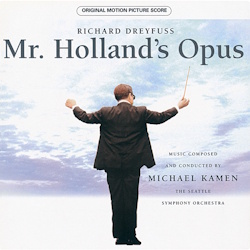
I have always had a soft spot for films about inspirational teachers – Dead Poet’s Society is one of my all-time favorite films – and 1995’s Mr. Holland’s Opus is another one that offers a similar sentiment. Directed by Stephen Herek and written by Patrick Sheane Duncan, the film stars Richard Dreyfuss as Glenn Holland, a talented but struggling composer in Oregon in the 1960s who becomes a high school music teacher, intending to do the job temporarily to earn money so he can finish his symphony. At first, Holland’s students are bored, but he begins to inspire them by incorporating rock and roll and other popular music into his lessons; over the course of the next 30 years his role at the school becomes central to his identity, even as he struggles to balance his career with his personal life, most notably his relationship with his son Cole who is born profoundly deaf.
Eventually, after decades of teaching and inspiring countless students’ lives, the school cuts its arts program due to budget pressures, and Holland is forced into early retirement. Just when he fears his life’s work has been in vain, numerous current and former students from the length of his entire career – including one former student who has since become the state governor – surprise Holland in the school auditorium and ask him to conduct them in a performance of the symphony he has been quietly working on for years, revealing that his true opus has been the impact he has in the lives of others. It’s a wonderful scene, played with a pitch perfect emotional depth by Dreyfuss, who more than earned the Oscar nomination he received for the role. The utter joy on his face as he conducts his life’s work for the first – and probably only – time never fails to move me to tears.
While it was a popular and successful film at the time, some contemporary commentators have pointed out some unfavorable aspects of the story. First, Holland’s relationship with his son Cole, and the long-term emotional neglect of him, is a little troubling; Holland’s initial reaction to his son’s deafness – grief framed largely around his own loss of a musical heir – comes across as self-centered, and their eventual reconciliation comes too late and is too neat to fully address the harm done. Secondly, the subplot involving Rowena Morgan, a gifted student who develops a crush on Holland, fails to properly address the power imbalance inherent in teacher-student dynamics, and treats the fact that he was genuinely, albeit briefly, tempted to leave his wife Iris for her as a romantic gesture rather than something more problematic. However, despite acknowledging these issues, I still find the film to be exceptional, a true testament to the value of arts education and the teachers who express it.
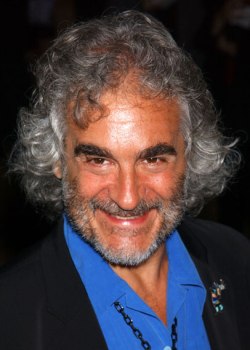 The score for Mr. Holland’s Opus was by the great Michael Kamen, who here re-teamed with director Herek after they worked together on The Three Musketeers in 1993. His music is central to the film’s emotional power and to its central metaphor about legacy, and cleverly he wears two hats in the movie: first, he wrote the fictional symphony that Holland struggles to complete over three decades and which is the centerpiece of the film’s finale, and then he wrote the score, different aspects of which are drawn from the symphony and represent different periods in Holland’s life. The idea is that the symphony itself represents musically wherever Holland was is in his life when he wrote that bit of it – a bar here, a passage there, squeezed out whenever he can – and its different movements represent different things: his relationship with his wife, his relationship with his son, his relationship with Rowena, the political climate in America, and Holland’s own love for fusing genres together. These elements of the symphony then become the dramatic score, one feeding the other, a sort of musical ouroboros in reverse. It’s rock and jazz and a classical orchestra, all mushed together. A true life in American music.
Tonally, Kamen structures his score as a romantic, accessible orchestral work, emotionally direct rather than avant-garde, reflecting Holland’s idealism and earnestness. Kamen favors warm string writing, noble brass, and pianos performing clear melodic lines, avoiding irony or restraint. It openly embraces sentiment, and welcomes the cross-pollination of styles and influences, mirroring Holland’s teaching philosophy: meeting students where they are and using familiar sounds as a bridge to deeper musical understanding. It’s full of dozens of the little musical gestures and flourishes, instrumental combinations and chord progressions, that are immediately recognizable in Kamen’s work, and as such fans of his canon will find this to be appealing on all fronts.
“Mr. Holland Begins” is the theme for Glenn, an optimistic, positive, dramatic overture that shares compositional similarities with the overture from Robin Hood: Prince of Thieves, and speaks directly to who Glenn is at the beginning of the film: young, energetic, full of drive, potentially on the verge of glorious achievement and success as a classical composer. It’s a tremendous piece, celebratory and dynamic in all its symphonic glory. Both the theme, and the four-note fanfare element from within it, re-occur frequently in the score proper, with Kamen changing the emotional drivers and instrumental makeup to reflect the changes in Glenn’s life.
“Iris and Glen” is the gentle romantic theme Holland and his wife, a pretty piece for a solo piano backed by lilting woodwinds and soft strings, intimate and tender, reflective of the love they share at the beginning of their marriage. The four note-fanfare from Glenn’s theme is present here, in a smaller, lullaby-like arrangement, and the whole thing comes across as a sentimental reflection of family life; warm and inviting. The longer version of Glenn’s inviting theme continues to be the centerpiece in “Practice, Practice, Practice,” which in its second half grows to become an amazingly fast and fluid scherzo for dexterous pianos and gallivanting string runs, sprightly and almost comedic, but wonderfully entertaining.
The first hints of the beautifully bittersweet theme for Glenn’s son Cole appears in “New Baby/Coltrane/Children Should Listen to Mozart,” again playing in lovely combination with different parts of Glenn’s theme as he and Iris find out that they are pregnant. “Rush to Hospital (While Parents Listen to Beethoven)” is a frantic piece that pits Kamen against Beethoven in a madcap symphonic dash of furious action as the new parents race to ensure their son is not born in the back of a car. The sequence culminates with the full performance of “Cole’s Tune,” which is rendered as a beautiful flute melody that at times recalls some of Ennio Morricone’s best romantic pieces – I was especially reminded of the theme for La Califfa, one of my all-time favorite lush Morricone pieces. Kamen again blends Cole’s theme with elements of Glenn’s theme, speaking to the bond that is eventually sealed between them once Glenn learns to communicate with his son through sign language.
The darker parts of the score, and of Holland’s life, are captured in a 10-minute sequence in the album’s second half that significantly increases the depth of the work as a whole. “Vietnam (We Know Too Many of these Kids)” speaks specifically to Terrence Howard’s character Louis Russ, a star athlete from a troubled family who becomes a bass drum player in the marching band, but then is drafted in the Armed Forces and later killed in action; Kamen’s Vietnam music is appropriately morose, filled with moody string and woodwind textures. “Rowena” is the music for Jean Louisa Kelly’s character Rowena Morgan, a talented and attractive high school senior who wants a career as a singer, has a crush on Holland, and seriously tempts him to leave his wife for her. Rowena’s theme is a seductively romantic piece that moves between woodwinds and cellos, backed by slow, seductive strings and harp glissandi, in what comes across as sort of an inverse version of Iris and Glen’s love theme. There is longing in this piece, but also regret, speaking to the fact that Glenn often feels his musical career has been sacrificed for his life with Iris and Cole, and that Rowena offers him a way out. It’s a brilliant piece, full of complicated, conflicting emotions.
The finale of the score begins with “Thank You Mr. Holland,” a joyous outburst of unashamed sentiment that accompanies the scene of Glenn entering his high school’s auditorium and discovering it filled with friends and family, current and former students, all there to celebrate the life and career of the man whose influence on them was deeply profound. The statements of Cole’s tune and the love theme are excellent, the comedic scherzo in the middle of the cue is a delight, and the way it builds to a climax, with multiple glorious statements of Glenn’s theme as he slowly realizes what is happening, is superb.
Everything comes to a head in the 8-minute “An American Symphony (Mr. Holland’s Opus),” which Holland steps up to conduct in the film’s wonderful conclusive scene. The film itself only contains the final three minutes or so of the symphony, everything from the drum riff at 5:13 onwards, but the soundtrack contains the full symphony itself, and it is outstanding. Chronologically it features Glenn’s theme, Glenn and Iris’s love them, Cole’s tune, and Rowena’s theme, both in clear statements and in clever allusions, but then the finale is all about Glenn’s theme. The incorporation of a rock drum kit and electric guitars into the ensemble caused a little bit of consternation thirty years ago, but in context it makes perfect sense: Holland’s problem in getting through to his students was that they found traditional classical music ‘boring,’ so he got their attention through rock and roll, and cited it as an integral part of American musical history. Of course rock and roll should feature prominently in an American Symphony! Even now, thirty years later, these 8-9 minutes stand as some of the best, most satisfying music Michael Kamen ever wrote.
 The album also includes two classical pieces, one by Beethoven and one by Bach, as well as a pop sung rendition of Cole’s Tune performed by John Lennon’s son Julian Lennon. There is also a second album of music featuring the carefully-selected pop, rock, and jazz music featured in the film, including cuts by Spencer Davis Group, Stevie Wonder, Jackson Browne, and two songs which feature in key scenes: John Lennon’s “Beautiful Boy,” which Glenn sings to his son as part of his apology to him, and George Gershwin’s “Someone to Watch Over Me,” which Rowena surreptitiously sings to Glenn during a school concert recital, trying to seduce him. I actually recommend this album too; the music is wall-to-wall great.
Mr. Holland’s Opus won Kamen a Grammy for Best Instrumental Arrangement in 1997 (Grammy years are weird), and in a weaker year he probably should have been nominated for an Oscar, but 1995 was literally one of the greatest years in the history of film music, and he was up against Braveheart and Apollo 13 and Sense and Sensibility so we’ll give the Academy a pass for overlooking him. The score’s impact also extended beyond the film itself as Kamen, who was deeply moved by the story and the real-world threats to arts education, subsequently co-founded the Mr. Holland’s Opus Foundation, which supports music programs in public schools.
Despite having a career that was mostly defined by big action scores, Die Hards and Lethal Weapons, and blockbusters like Robin Hood: Prince of Thieves, I have always felt that Michael Kamen wrote his best music for smaller, more personal films that dealt with more emotional themes, and for me this score is a perfect example of that. As someone who dedicated his life to music and art you can tell that this story affected Kamen deeply, and he responded to it by writing a score that is moving, beautiful, intricate in its structure, intelligent in its dramatic development, and truly captures the heart of American music in the way it combines symphonic grandeur with rock and roll cool. Kamen himself was a combination of those two things, and so in many ways this is the closest he ever came to writing about himself.
For more information about the Mr. Holland’s Opus Foundation please visit: https://mhopus.org/
Buy the Mr. Holland’s Opus soundtrack from the Movie Music UK Store
Track Listing:
- SCORE ALBUM
- Mr. Holland Begins (2:56)
- Iris and Glenn (2:28)
- Practice, Practice, Practice (3:51)
- New Baby/Coltrane/Children Should Listen to Mozart (3:17)
- Rush to Hospital (While Parents Listen to Beethoven) (3:17)
- 7th Symphony – Allegretto (written by Ludwig von Beethoven) (11:06)
- Cole’s Tune (4:18)
- Vietnam (We Know Too Many of these Kids) (4:30)
- Rowena (6:11)
- Concerto for Three Harpsichords in C – 1st Movement (written by Johann Sebastian Bach) (7:50)
- Thank You Mr. Holland (5:08)
- An American Symphony (Mr. Holland’s Opus) (8:27)
- Cole’s Song (written by Michael Kamen, Julian Lennon and Justin Clayton, performed by Julian Lennon) (3:49)
- SOUNDTRACK ALBUM
- Visions of a Sunset (written and performed by Shawn Stockman) (4:31)
- One, Two, Three (written by John Madara, David White, and Len Barry, performed by Len Barry) (2:25)
- A Lover’s Concerto (written by Sandy Linzer, Denny Randell, and Christian Petzold, performed by The Toys) (2:38)
- Keep On Running (written by Jackie Edwards, performed by Spencer Davis Group) (2:42)
- Uptight (Everything’s Alright) (written by Stevie Wonder, Sylvia Moy, and Henry Cosby, performed by Stevie Wonder) (2:53)
- Imagine (written by John Lennon and Yoko Ono, performed by John Lennon & The Plastic Ono Band) (3:01)
- The Pretender (written and performed by Jackson Browne) (5:52)
- Someone To Watch Over Me (written by George Gershwin and Ira Gershwin, performed by Julia Fordham) (3:32)
- I Got A Woman (written by Ray Charles and Renald Richard, performed by Ray Charles) (2:50)
- Beautiful Boy (Darling Boy) (written by John Lennon, performed by John Lennon and Yoko Ono) (4:00)
- Cole’s Song (written by Michael Kamen, Julian Lennon and Justin Clayton, performed by Julian Lennon) (3:48)
- An American Symphony (Mr. Holland’s Opus) (written by Michael Kamen, performed by The London Metropolitan Orchestra) (3:14)
Running Time: 67 minutes 43 seconds — Score
Running Time: 41 minutes 26 seconds — Score
London/Decca 452-065-2 (1995) — Score
Polydor 31452 9508 2 (1995) — Soundtrack
Music composed and conducted by Michael Kamen. Performed by The Seattle Symphony Orchestra. Orchestrations by Michael Kamen and Jonathan Sacks. Recorded and mixed by Stephen McLaughlin, Andy Warwick, Joel Iwataki and Andy Swanson. Edited by Michael Ryan and David Olsen. Album produced by Michael Kamen, Stephen McLaughlin and Christopher Brooks.

Shop at the Movie Music UK Store

Member of the

 MOVIE MUSIC UK