Under-the-Radar Round Up 2025, Part 7
 Original Reviews by Jonathan Broxton
I’m pleased to present the latest installment in my on-going series of articles looking at the best under-the-radar scores from around the world.
This article, the seventh of 2025, covers another six scores released this year from a wide array of genres and countries, including a French documentary feature about the forgotten women of the Revolution, a Spanish mystery TV series about a pair of missing teenage girls, a French comedy film about the first African astronauts, a drama about the love affair between two of the most famous actors in French cinema in the 1960s, a horror-thriller for a film based on a mysterious short story by Edgar Allan Poe, and a Swedish historical murder mystery TV series involving a murderous bear.
AUX ARMES, CITOYENNES! LES FEMMES DANS LA RÉVOLUTION FRANÇAISE – Laetitia Pansanel-Garric
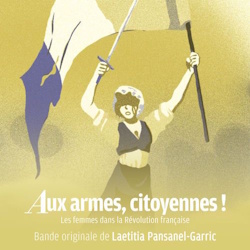 Aux Armes, Citoyennes! Les Femmes Dans La Révolution Française – which translates to “To Arms, Citizens! Women in the French Revolution” and takes its title from a line in the French national anthem “La Marseillaise” – is a French language documentary film highlighting the important and often forgotten role of women during the French Revolution. It uses archival material, expert commentary, and animation to recount the journeys of several notable figures, including playwright Olympe de Gouges who wrote the Declaration of the Rights of Woman and of the Female Citizen, Théroigne de Méricourt who was the co-founder of the Parisian Revolutionary Club, Pauline Léon who co-founded the Society of Revolutionary Republican Women, and Reine Audu who led the Women’s March on Versailles.
The score for Aux Armes, Citoyennes was written by French composer Laetitia Pansanel-Garric, who already impressed me enormously last year with her score for the children’s fantasy adventure L’Home dels Nassos, and again earlier this year with her score for the animated film Hola Frida. This score offers a new side to her musical personality; this is big, bold, emotional, French patriotic music that celebrates the achievements of these groundbreaking women in the face of overwhelming odds.
The whole score is an absolute delight. “La Marche des Femmes Sur Versailles – Scène d’Ouverture” is a powerful, driving action sequence full of throbbing, pulsating brass underpinned with string ostinatos, snare drum patterns, and a heroic choir. “Trompette de la Garde” is a romantic and florid trumpet melody backed with dancing Renaissance-style strings and harpsichord accents. “Olympe, Le Pas Vers l’Échafaud” starts out a gorgeous, haunting lament spotlighting a solo cello, but grows into something grand and celebratory.
“Pauline Léon, Militante” is a sparkling scherzo, full of fiery passion and determination. “Louise de Keralio” is softer and more restrained, and is full of sinister little textures for strings and harps. “Reine Audu” makes excellent of regal chanted chorales backed by lavish prancing strings and harpshicords. “Théroigne de Méricourt, l’Amazone” is a whirling, driving action sequence, dramatically underpinned by a lyrical central melody. “Bastille” is militaristic and threatening, “Mission” builds on the same sound with additional emphasis on harpsichord textures and religioso chanted vocals, and the conclusive “Le Clos de l’Atre” is a dynamic and hypnotic, and has a prominent role for syncopated pianos.
Overall, this score is outstanding, a rich, thematic, multi-faceted score which will impress anyone with a liking for bold, fully orchestral, classical film scores with a Gallic flavor. Had this film been made in the 1960s or 70s I can see how a composer like Georges Delerue or Michel Magne would have scored it and, honestly, Pansanel-Garric’s approach is similar in approach and quality. Unfortunately, the soundtrack for Aux Armes, Citoyennes has not been released as a physical CD, but a short album of highlights is available to stream and download on Amazon and most other major digital music services on the 22D Music label.
Track Listing: 1. La Marche des Femmes Sur Versailles – Scène d’Ouverture (2:43), 2. Trompette de la Garde (2:28), 3. Olympe, Le Pas Vers l’Échafaud (2:40), 4. Ressentiments (1:39), 5. Pauline Léon, Militante (1:04), 6. Louise de Keralio (1:43), 7. Reine Audu (1:02), 8. Théroigne de Méricourt, l’Amazone (2:07), 9. Le Droit de Monter à la Tribune (0:58), 10. Bastille (0:54), 11. Mission (1:33), 12. Le Clos de l’Atre (1:06). 22D Music, 19 minutes 57 seconds.
DOS TUMBAS/TWO GRAVES – Marc Timón Barceló
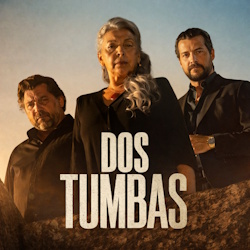 Dos Tumbas is a Spanish-language three-part TV mini-series for Netflix, directed by Kike Maíllo. The story involves Isabel Luque, a grandmother whose teenage granddaughter Verónica, and Verónica’s friend Mandy, disappeared under mysterious circumstances two years previously. The police closed the case due to lack of evidence and suspects, but Isabel is not satisfied and begins her own investigation to find out what happened and bring whoever is responsible to justice. The series starred Kiti Manver as Isabel, with Álvaro Morte and Hovik Keuchkerian, and was a popular success when it first aired in August
The score for Dos Tumbas is by the Los Angeles-based Spanish composer Marc Timón Barceló, and it is one of the best of its type this year. The score is anchored by its sensational main title theme “Dos Tumbas,” a rich, powerful, stirring, darkly dramatic piece for strings and piano that sets the scene perfectly. This is one of those tremendous, Gothic powerhouses that uses to accompany these sorts of mysterious thrillers; there is some Bernard Herrmann in this, some 1990s Christopher Young, and it all builds over the course of three minutes to a huge, rapturous finale. It’s one of my favorite main title themes of this year.
The rest of the score is very much cut from the same cloth, but naturally offers variations and differences as the show demands. The main theme occurs frequently – in cues like “Títulos de Crédito,” the more intimate “En El Fondo Del Mar,” on romantic pianos in “Melancolía,” the tragic “El Funeral,” and the softly melancholy “Tú Nunca Estuviste”– and each time it appears the score is enlivened with a burst of beauty and elegance, especially when the focus shifts to a florid solo violin . Some cues are more textural and dissonant, speaking more directly to the dark part of the murder mystery at the heart of the story, and there are also a couple of diverse action cues, notably “Malos Caminos,” “La Huida,” and the bombastic “El Último Aliento” where Timón lets things rip with more modernistic ferocity. Beyond these cues Timon sometimes sweetens his ensemble with electronic sounds, but these are few and far between and do not affect anything in a negative way.
Other moments that stood out to me include the outstanding use of the church organ in “Destinos,” the classical flamboyance of “Toccata,” the stunning piano performances in “Isabel” and the pretty “Piano a Cuatro Manos,” the emotional “Verónica,” the revelatory “Adiós”.
Unfortunately the soundtrack for Dos Tumbas has not been released as a physical CD, or as any kind of commercial album; Netflix chose not to release it, for reasons I still do not fully understand. Thankfully, Timón has released the score himself on his own Soundcloud page here: https://soundcloud.com/marctimon/sets/dos-tumbas-original-soundtrack-by-marc-timon, and I unhesitatingly recommend it to anyone who yearns for those achingly rich, classical Gothic melodramatic thriller scores.
Track Listing: 1. Dos Tumbas (3:19), 2. Títulos de Crédito (0:48), 3. Destinos (2:34), 4. En El Fondo Del Mar (1:49), 5. Melancolía (1:18), 6. Toccata (1:18), 7. La Venganza (1:37), 8. Isabel (2:39), 9. Piano a Cuatro Manos (0:46), 10. El Funeral (1:35), 11. Investigaciones Peligrosas (2:47), 12. Del Mal Querer (1:02), 13. Cazada (1:22), 14. Verónica (1:03), 15. No Hay Vuelta Atrás (1:07), 16. Adiós (1:04), 17. Tú Nunca Estuviste (1:47), 18. Desaparecidas (1:29), 19. La Desesperación de Lupe (1:27), 20. El Reencuentro (1:25), 21. Sentimientos Oscuros (0:43), 22. Yamila (1:07), 23. Malos Caminos (2:07), 24. Sangre y Vida (2:14), 25. Los Pendientes (1:56), 26. Salazar (1:42), 27. La Huida (1:56), 28. El Último Aliento (2:01), 29. Me Equivoqué (2:25), 30. Yo No Amenazo (1:43), 31. Aquella Noche (2:22), 32. Beltrán (1:22), 33. Nada Es Lo Que Parece (2:15), 34. Un Cadáver (4:08), 35. Muerte (0:53). Promo, 61 minutes 10 seconds.
LE GRAND DÉPLACEMENT/BLACK TO THE FUTURE – Guillaume Roussel
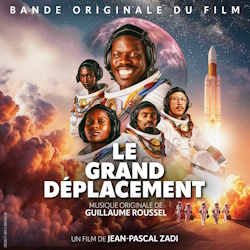 Le Grand Déplacement, or ‘Black to the Future,’ is a French comedy film, directed by and starring Ivorian Jean-Pascal Zadi. Int the aftermath of an environmental disaster on Earth, a group of African nation join forces to organize the first African space mission, convinced that other countries will abandon their continent if and when the world becomes uninhabitable. The crew, from multiple different African countries, intends to explore the planet Nardal, assessing its potential as a refuge for all Africans; however, during the long interstellar mission, the greatest issue facing the astronauts is whether or not they will be able to get along.
The score for Le Grand Déplacement is by French composer Guillaume Roussel, and is an excellent pastiche of patriotic American space exploration scores – think The Right Stuff, or Apollo 13, with a French flavor, and a few subtle hints of traditional west African music. Roussel has been one of my favorite young composers to emerge in French cinema in recent years, off the back of scores like Black Beauty (2020), C’est Magnifique! (2022), Loups-Garous (2024), and his two Les Trois Mousquetaires scores, and Le Grand Déplacement is another one to add to that list.
“La Crème de la Crème de l’Afrique” is dark, militaristic march for pulsating brasses and snare drums underpinned with mysterious electronic textures. “Lancement Black Starline” is noble and heroic, but has a twist that comes from the unexpected incorporation of guitars and jazz flutes; this is reprised in the conclusive “Gaz Ressuscitant”. “Vitesse Supra-Luminique” uses more of those bubbling electronic textures to accentuate the futuristic tone, but then launches into another performance of the heroic main theme.
The action music in cues like “Zion Dans Un Champ d’Asteroïdes” is busy, exciting, and complicated, with dense orchestrations and fluid, energetic rhythms that often emerge into more statements of the main theme. Later, the scenes of the astronauts exploring the planet Narval – “Narval en Approche,” “Exploration Exoplanétaire,” “Mariama Repart Sur Terre” – focus more on the electronics and are perhaps a little more abstract, a little more moody, and have a sense of anticipation and magical wonderment underpinned with a sense of trepidation that I really appreciate. “Mariama Repart Sur Terre” uses especially haunting vocal sounds to excellent effect. This is good stuff all round, engaging from start to finish; I only wish it was a longer and more comprehensive album, as I’m sure the film has much more music in context.
Unfortunately the soundtrack for Le Grand Déplacement has not been released as a physical CD, but a short album of highlights is available to stream and download on Amazon and most other major digital music services on the Gaumont label.
Track Listing: 1. La Crème de la Crème de l’Afrique (1:07), 2. Lancement Black Starline (1:27), 3. Vitesse Supra-Luminique (1:09), 4. Zion Dans Un Champ d’Asteroïdes (2:18), 5. Narval en Approche (2:20), 6. Exploration Exoplanétaire (1:31), 7. Mariama Repart Sur Terre (2:17), 8. Gaz Ressuscitant (1:25). Gaumont, 13 minutes 34 seconds.
KOKA BJÖRN/TO COOK A BEAR – Anne Chmelewsky
 To Cook a Bear is a Swedish-language TV mini-series for Disney+ and Hulu, directed by Trygve Allister Diesen, based on Mikael Niemis’s popular book Koka Björn. The series stars Gustaf Skarsgård – yes, another one! – Ane Dahl Torp, and Pernilla August, and is set in a mid-19th century village in northern Sweden; it follows the story of a preacher who arrives in the village with his adopted Sámi son, and quickly becomes entangled in rumors of man‑eating bear attacks, which then turns into an unexpected murder mystery investigation.
The score for To Cook a Bear is by the UK-based French composer Anne Chmelewsky, who impressed with her debut feature score Where Hands Touch in 2018 and has since written music for films and TV shows like The Shepherd, Maestra, and Guillermo del Toro’s Cabinet of Curiosities.
Chmelewsky’s music for To Cook a Bear is rich, moody, and has a definite influences both from medieval church music in some of the chord progressions, and from traditional Nordic folk music running through her use of traditional instruments such as a Hardanger fiddle, a nyckelharpa, and vocal techniques such as ‘kulning,’ the high-pitched Nordic herding call historically used by women in Sweden and Scandinavia to summon livestock from distant forests and for communication between shepherds.
The score is often more textural than it is thematic, and often it is more interested in evoking a particular atmosphere, but it’s all tremendously authentic and paints a superb musical picture of isolated farms, rugged landscapes, hardy people, and the insidious threat from deep in the forest.
Cues such as the opening “At Dawn,” “Beronius,” the more action-oriented opening of “Corpse,” “A Sisterly Presence,” “Home,” the second half of “Body Recovery,” and the shockingly intense “I Already Have a Home” feature the traditional instruments and the kulning vocals prominently. I love the way the violins seem to be breathing like a hibernating animal in “A Bear’s Soul”. Strongly classical string figures are prominent in “A Discovery” and “A Pastor’s Awakening,” giving the score a powerful dramatic surge.
Large parts of “Hunted” are anguished and guttural and full of scraped string harmonics. There is a sense of not quite warmth, but at least thawing emotions, in “Salvation,” and then a sense of impending menace in “Save Him From the Devil”. There is an unexpectedly jaunty undercurrent to the otherwise threatening “Autopsy,” like the dark side of a folk festival. The first half of “Body Recovery” is a kaleidoscope of horror, while the breathing textures in “It’s You I Think Of” verge on the orgasmic. The warmth of the Hardanger fiddle is “Jussi Teaches” feels like emerging into the sunlight, while the kulning sound in “Redemption” oscillated between folk-like and angelic.
To Cook a Bear is sometimes difficult and not always pleasant listening, but there’s something about the tone, and the specific instruments, that intrigues me, and makes me want to keep coming back to it, and it’s to Anne Chmelewsky credit that she makes what could be a rather abrasive soundtrack tonally fascinating while staying true to the culture and the time period. Unfortunately the soundtrack for To Cook a Bear has not been released as a physical CD, but is available to stream and download on Amazon and most other major digital music services via Hollywood Records.
Track Listing: 1. At Dawn (1:50), 2. See You in Church (1:11), 3. A Bear’s Soul (2:25), 4. Beronius (1:21), 5. A Discovery (1:24), 6. Corpse (2:38), 7. It Wasn’t Her Fault (1:51), 8. Murder (1:11), 9. Hunted (6:30), 10. Wonders Never Cease (0:51), 11. Salvation (2:00), 12. A Pastor’s Awakening (1:33), 13. A Sisterly Presence (1:18), 14. Heather (1:46), 15. Save Him From the Devil (2:35), 16. Autopsy (3:22), 17. Home (0:53), 18. An Announcement (0:45), 19. Body Recovery (3:17), 20. I Already Have a Home (1:07), 21. I Worship You (1:14), 22. Sirii (0:44), 23. It’s You I Think Of (1:13), 24. Inquest (1:38), 25. Schooling (1:16), 26. Jussi Teaches (1:37), 27. Redemption (2:15), 28. Meted Out Justice (2:24), 29. To Cook a Bear (0:55). Hollywood Records, 53 minutes 07 seconds.
MOI QUI T’AIMAIS – Philippe Sarde
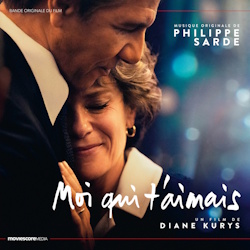 Moi Qui t’Aimais is a French drama film directed by Diane Kurys, starring Marina Foïs, Roschdy Zem and Vincent Colombe. The film examines the tumultuous real-life love story between two of the biggest stars of French cinema – Yves Montand and Simone Signoret – which began in 1949, continued through the height of their careers, and only ended with Signoret’s death in 1985.
The score for Moi Qui t’Aimais is by the legendary French composer Philippe Sarde, who was one of France’s premier composers during the careers of both Montand and Signoret, and scored many classic films starring one or the other of them, including Le Chat in 1971, La Veuve Couderc in 1971, César and Rosalie in 1972, Vincent, François, Paul et les Autres in 1974, La Vie Devant Soi in 1977, L’Adolescente in 1979, Le Choix des Armes in 1982, L’Étoile du Nord in 1982, and Garçon in 1983.
In the album’s press notes, Sarde muses: “When I read the script for this film, I thought Diane Kurys had written a film that retraces my entire professional life, since it brings together many of the directors I’ve worked for. That’s why the project moves and touches me particularly. The music had to express a simple emotion. Because Diane likes things that convey emotions simply, without complexity. From the script stage, I worked on her instructions. I was wary of all the pitfalls of easy music that has nothing to do with simple music. I initially wondered if there should be a connection with the score of the films mentioned, like those by Sautet, for example, but Diane didn’t want to, and she was right. For the score, I favored the piano. What’s simpler and more complicated at the same time than a piano? What’s more moving than a piano?”
Sarde’s resulting work is a beauty; elegant, sophisticated, romantic, very very French, a perfect encapsulation of the style and sound of cinema français at that time, and of the shifting emotions the central pair endure. Although the piano dominates the score, Sarde augments the piano with simple accents for a small string section, sometimes with special emphasis on violons and cellos, plus solo woodwinds, horns, and occasional light percussion, while maintaining a mostly consistent tone throughout; one of gentle, intimate romance, underpinned by that slight air of bittersweet reflection and nostalgic melancholy that only the French can seem to achieve.
The score features numerous excellent cues, including the opening “Avant le Tournage,” the bright “Les Dents de Marilyn,” the tasteful “Le Départ de Montand,” the effortlessly charming “Hellé,” the beautiful “La Loge,” the warm brass version in “La Nostalgie N’est Plus Ce Qu’elle Était,” the summery “Saint-Paul-de-Vence,” and the sensitive guitar version in “Au Restaurant Avec Murielle”. The sequence from “Après Le Repas” through to the end of “Solitude” deal mostly with Signoret’s death from colon cancer aged 64 in 1985, and offer an increased amount of sadness and longing for the pair who suffered so many turbulent years but whose love endured nonetheless. The changes in tone and emotional content between these cues is subtle, but deeply meaningful, and by the time we come to the conclusive “Les Choses de la Vie” Sarde is performing his theme for the full orchestra.
This is a lovely work, and a reminder that even at the age of 77 Philippe Sarde is more than capable of contributing excellent new film music to his extensive canon. The score for Moi Qui t’Aimais is available to stream and download via MovieScore Media, here: https://moviescoremedia.com/newsite/catalogue/moi-qui-tamais-philippe-sarde/, and as a physical CD from Music Box Records.
Track Listing: 1. Avant le Tournage (1:40), 2. Première Dispute (0:46), 3. Les Dents de Marilyn (1:50), 4. Le Départ de Montand (1:18), 5. Hellé (Le Monde Nous a Changés) (1:44), 6. Le Baiser de Montand (0:58), 7. La Loge (1:41), 8. Simone (1:23), 9. La Nostalgie N’est Plus Ce Qu’elle Était (2:42), 10. Saint-Paul-de-Vence (1:43), 11. Oiseau de Nuit (0:34), 12. Au Restaurant Avec Murielle (2:26), 13. La Lettre de Carole (0:57), 14. Madame Rosa (1:46), 15. Les Photos Brûlées (1:20), 16. Après Le Repas (0:55), 17. Annonce de la Maladie (1:00), 18. À Travers La Nuit (1:45), 19. Solitude (2:32), 20. Les Choses de la Vie (2:34). Moviescore Media MMS25018/Music Box Records MBR-255, 31 minutes 41 seconds.
THE OVAL PORTRAIT – Andrew Morgan Smith
 The Oval Portrait is horror-thriller directed by Adrian Langley, starring Simon Phillips, Louisa Capulet, and Paul Thomas, which was released straight-to-streaming just in time for Halloween 2025. Loosely based on a short story by Edgar Allen Poe, the plot involves a thief who attempts to rob an antique store, but becomes inexplicably drawn to a portrait of a beautiful woman he finds there. Eventually the thief meets both the artist and the shopkeeper, and comes to discover that the portrait contains the haunted spirit of a vengeful ghost.
The score for The Oval Portrait is by Louisiana-born composer Andrew Morgan Smith, many of whose previous scores have been released by Moviescore Media, including Jeepers Creepers 3, You Might Be the Killer, Average Joe, and especially the outstanding Bunker from 2023. In the press notes for the Oval Portrait album, Smith recalls that when director Langley approached him to score he offered him a daunting task, asking him: “What if a Waxman, Korngold, or Bernstein scored this movie? Can we bring these old sensibilities back to sell that we’re making a throwback film.”
Smith responded to his director’s challenge and rose to the occasion tremendously, writing a superb Gothic throwback score that is drenched in moody atmosphere, dark romance, and has a clear, intentional Golden Age orchestral sensibility. The most impressive track, for me, is easily the outstanding “Oval Portrait Overture,” which is drenched in that overarching atmosphere, starts out being bold and thunderous, but then erupts into a wonderfully evocative romantic theme a minute or so in, and in doing so becomes one of my favorite film music moments of the year.
The rest of the score is no less impressive; “Whitlock’s Morning” is full of expressive Herrmannesque writing for strings and flutes backed by harp glissandi. “Twists and Turns” starts by reprising the superb romantic violin theme from the Overture before becoming really quite menacing, filled with imposing brasses atop a brooding bed of low strings. “Retelling Stories” is full of spiky, chaotic energy and builds to a striking finale. “Reading Microfilm” features some notably superb, refined writing for woodwinds.
There are some terrific, rambunctious action moments in “Alone.” The title track “The Oval Portrait” sees Smith arranging the main theme for the fullest full orchestra in its largest and most striking performance yet, making it a real score highlight. The sweeping romance of “Writing the Will” is excellent in a different way, and then the conclusive “Reunited” is actually quite complicated, emotionally, in that it is ravishingly romantic, but has an undercurrent of tragedy.
One interesting thing that I noted is that, in addition to the Hollywood scores that the director requested, there are also clear stylistic echoes of several classic British Hammer horror scores, which is something I appreciated enormously. There’s a real sophistication to Smith’s work here, emerging from the details in a number of impressive ways. You can feel the musicianship at work here, and that’s not something you can often say these days about the score from a lower-budget horror thriller.
This is tremendously impressive stuff from Andrew Morgan Smith, a clearly very talented composer who, for some reason, has yet to be given his chance on a major mainstream film. I hope that big break comes soon. The score for The Oval Portrait is available to stream and download via MovieScore Media, here: https://moviescoremedia.com/newsite/catalogue/the-oval-portrait-andrew-morgan-smith/ and I recommend it unhesitatingly to anyone with an ear for rich, Gothic suspense, romance, and melodrama.
Track Listing: 1. Searching the Basement (3:54), 2. Oval Portrait Overture (1:56), 3. Whitlock’s Morning (4:19), 4. Twists and Turns (2:05), 5. Retelling Stories (3:40), 6. Lose More Than (3:30), 7. Reading Microfilm (2:09), 8. The Easel (3:12), 9. Alone (3:06), 10. The Oval Portrait (2:13), 11. Writing the Will (2:01), 12. B & E (2:48), 13. A Strange Request (3:12), 14. Story of Love (5:30), 15. Reunited (5:04). Moviescore Media MMS25028, 48 minutes 41 seconds.
-
February 6, 2026 at 8:01 amMovie Music UK Awards 2025 | MOVIE MUSIC UK

Shop at the Movie Music UK Store

Member of the

 MOVIE MUSIC UK