Archive
AVATAR: FIRE AND ASH – Simon Franglen
 Original Review by Jonathan Broxton
WARNING: THIS REVIEW CONTAINS PLOT SPOILERS. IF YOU HAVE NOT YET SEEN THE FILM, YOU MIGHT WANT TO CONSIDER WAITING UNTIL AFTER YOU HAVE DONE SO TO READ IT.
The whole situation concerning the Avatar movies continues to fascinate me. When James Cameron’s ambitious sci-fi epic arrived in cinemas in December 2009, it was instantly acclaimed as a visual landmark. The film showcased some of the most advanced and convincing visual effects ever seen on screen, while also pushing 3D presentation and motion-capture technology to unprecedented new heights. It went on to win three Academy Awards, received six further nominations including Best Picture, and earned approximately $2.9 billion worldwide, cementing its status as one of the most commercially successful films in cinema history. However, in the decade that separated Avatar from its long-awaited sequel, Avatar: The Way of Water, the mood surrounding the original film shifted noticeably. The unusually long gap between installments did little to sustain enthusiasm, and a growing critical backlash took hold. Commentators increasingly highlighted perceived weaknesses in the narrative, unacknowledged parallels with earlier films, and a number of troubling elements tied to its reliance on so-called “white savior” and “noble savage” tropes. Then the sequel film came out and it grossed another $2.3 billion at the global box office, despite many people – including me – feeling that, even though it was still visually astonishing, it was significantly inferior to the original in terms of story, writing, and performances. Read more…
THE PRODIGAL – Bronislau Kaper
 GREATEST SCORES OF THE TWENTIETH CENTURY
Original Review by Craig Lysy
The massive success of 20th Century Fox’s The Robe in 1953, with its Cinemascope color format, reinvigorated studio interest in grand ancient epics. Writers Sam Larson and Joseph Breen wrote a 60-page story based on the Prodigal Son biblical tale, and managed to sell it to MGM studio executive Dore Schary. Charles Schnee was assigned production with a $2.783 million budget, Maurice Zimm was hired to adapt the story, and Richard Thorpe was tasked with directing. Casting was problematic as the original leads, Ava Gardner and Vittorio Gassman both dropped out. The new cast would showcase studio star Lana Turner as Samara, and joining her would be Edmund Purdom as Micah, James Mitchell as Asham, Louis Calhern as Nahreeb, and Joseph Wiseman as Carmish. Read more…
BALTO – James Horner
 THROWBACK THIRTY
Original Review by Jonathan Broxton
Balto is an animated adventure film very loosely inspired by true events that happened in Nome, Alaska, in 1925, during an especially harsh winter. Balto is a half-wolf, half-husky who lives on the outskirts of town and is teased by other dogs because of his mixed heritage; his only close friends are a goose named Boris, two polar bears named Muk and Luk, and a young human girl named Rosy. When a diphtheria epidemic breaks out, threatening the lives of the town’s children – including Rosy – the townspeople organize a relay team of sled dogs to bring a lifesaving antitoxin from a remote railway station to Nome. Balto enters a race to join the team, and initially wins, but is later disqualified when a rival dog named Steele reveals his wolf ancestry. However, the sled team carrying the serum gets lost and stranded, and so Balto – with the help of his friends – sets out to find the team, navigate treacherous terrain, and bring the medicine back to Nome. Read more…
ELLA MCCAY – Hans Zimmer
 Original Review by Jonathan Broxton
Ella McCay is the first new film from director James L. Brooks in 15 years (since How Do You Know in 2010), and as such is a landmark event considering that he is the creator of such lauded works as Terms of Endearment, Broadcast News, As Good As It Gets, and of course The Simpsons. It is a political comedy-drama starring Emma Mackey in the title role; Ella is an idealistic, progressive young politician who becomes the governor of her state when her boss and mentor, Governor Bill Moore (Albert Brooks), unexpectedly resigns. In addition to her new role as a politician of significance, Ella also finds herself navigating her complex family relationships, especially when her long-estranged father Eddie (Woody Harrelson) re-enters her life. The film has a stellar supporting cast – Jamie Lee Curtis, Jack Lowden, Kumail Nanjiani, Ayo Edebiri, Rebecca Hall – but unfortunately critics have not been kind to it, with many people criticizing it for poor writing, a contrived plot, and tonal inconsistency. Read more…
THE TALL MEN – Victor Young
 GREATEST SCORES OF THE TWENTIETH CENTURY
Original Review by Craig Lysy
In a coup, 20th Century Fox CEO Darryl F. Zanuck signed the aging 53-year-old star Clark Gable to a contract in May of 1954. Gable had long been revered as the “King of Hollywood” and Zanuck sought to capitalize on his iconic status. That vehicle came along quickly in a novel “The Tall Men” by Heck Allen. Producers William A. Bacher and William B. Hawks purchased the film rights, along with novel’s sequel “The Big Pasture” for only $10,000. Bacher and Hawks would manage production with a $3.1 million budget, Raoul Walsh would direct, and Sidney Boehm and Frank Nugent were tasked with writing the screenplay. Gable would star as Colonel Ben Allison, joined by Jane Russell as Nella Turner, Robert Ryan as Nathan Stark, and Cameron Mitchell as Clint Allison. Read more…
MR. HOLLAND’S OPUS – Michael Kamen
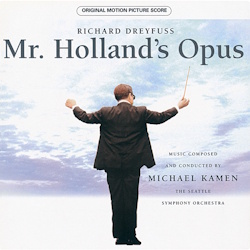 THROWBACK THIRTY
Original Review by Jonathan Broxton
I have always had a soft spot for films about inspirational teachers – Dead Poet’s Society is one of my all-time favorite films – and 1995’s Mr. Holland’s Opus is another one that offers a similar sentiment. Directed by Stephen Herek and written by Patrick Sheane Duncan, the film stars Richard Dreyfuss as Glenn Holland, a talented but struggling composer in Oregon in the 1960s who becomes a high school music teacher, intending to do the job temporarily to earn money so he can finish his symphony. At first, Holland’s students are bored, but he begins to inspire them by incorporating rock and roll and other popular music into his lessons; over the course of the next 30 years his role at the school becomes central to his identity, even as he struggles to balance his career with his personal life, most notably his relationship with his son Cole who is born profoundly deaf. Read more…
SCL Award Nominations 2025
 The Society of Composers and Lyricists (SCL) has announced the nominations for the seventh annual SCL Awards, honoring the best in film and television music in 2025. The SCL is the premier professional trade group for composers, lyricists, and songwriters working in the motion picture, television, and game music industry, and is headquartered in Los Angeles. The nominees are:
OUTSTANDING ORIGINAL SCORE FOR A STUDIO FILM
- ALEXANDRE DESPLAT for Frankenstein
- JERSKIN FENDRIX for Bugonia
- LUDWIG GÖRANSSON for Sinners
- JONNY GREENWOOD for One Battle After Another
- MAX RICHTER for Hamnet
- STEPHEN SCHWARTZ and JOHN POWELL for Wicked: For Good
OUTSTANDING ORIGINAL SCORE FOR AN INDEPENDENT FILM
- SARA BARONE and FOREST CHRISTENSON for To Kill a Wolf
- JÓN ÞÓR “JÓNSI” BIRGISSON and ALEX SOMERS for Rental Family
- BRYCE DESSNER for Train Dreams
- DAVID FLEMING for Eternity
- FABRIZIO MANCINELLI for Out of the Nest
- DARA TAYLOR for Straw
HAMNET – Max Richter
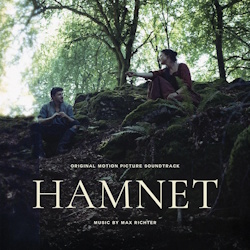 Original Review by Jonathan Broxton
Director Chloe Zhao’s film Hamnet, which is based on the 2020 novel by Maggie O’Farrell, is a lyrical reimagining of the brief life and death of Hamnet Shakespeare, the son of the legendary poet and writer William Shakespeare and his wife Agnes “Anne” Hathaway, musing on the fact that his passing may have inspired the creation of one of the greatest works of literature in history. The story centers mostly on Agnes, who is portrayed as a perceptive, intuitive woman with a deep connection to nature; the first half of the film looks at Agnes and William’s early courtship, their subsequent marriage, and offers a portrait of family life in Elizabethan England circa 1580, following the birth of their twin children Hamnet and Judith. In time William begins traveling to London to write and perform his plays, but eventually the spread of plague brings sickness to the Shakespeare household, and Judith falls gravely ill. Hamnet, who has been charged by his father with looking after the family in his absence, desperately attempts to help her, and asks God if he can swap places with her; Judith eventually recovers, but Hamnet contracts the plague too, and dies aged just eleven. After Hamnet’s death, the story then explores how Agnes and William grieve differently: Agnes’s sorrow is visceral and consuming, while William channels his grief into his work. Read more…
DARK COMMAND – Victor Young
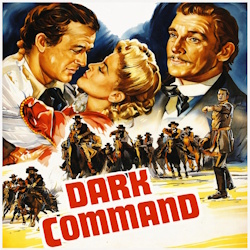 GREATEST SCORES OF THE TWENTIETH CENTURY
Original Review by Craig Lysy
Renowned novelist W.R. Burnett had a well-established reputation for writing modern day crime stories. However, his 1938 novel “The Dark Command” was a departure, a rare historical drama, which became a best seller. Republic Pictures decided to capitalize on its success and purchased the film rights. Sol C. Siegel was assigned production with a $750,000 budget, Raoul Walsh was tasked with directing, and a team of four screenwriters was hired; F. Hugh Herbert, Lionel Houser, Grover Jones, and Jan Isabel Fortune. A stellar cast was assembled, which included Claire Trevor as Mary McCloud, John Wayne as Bob Seton, Walter Pidgeon as Will Cantrell, Roy Rogers as Fletch McCloud, Gabby Hayes as Doc Grunch, Porter Hall as Angus McCloud, Marjorie Main as Mrs. Adams, and Raymond Walburn as Judge Bruckner. Read more…
Under-the-Radar Round Up 2025, Part 7
 Original Reviews by Jonathan Broxton
I’m pleased to present the latest installment in my on-going series of articles looking at the best under-the-radar scores from around the world.
This article, the seventh of 2025, covers another six scores released this year from a wide array of genres and countries, including a French documentary feature about the forgotten women of the Revolution, a Spanish mystery TV series about a pair of missing teenage girls, a French comedy film about the first African astronauts, a drama about the love affair between two of the most famous actors in French cinema in the 1960s, a horror-thriller for a film based on a mysterious short story by Edgar Allan Poe, and a Swedish historical murder mystery TV series involving a murderous bear.
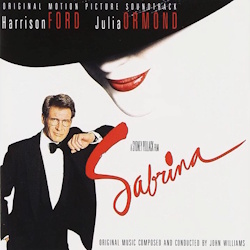
SABRINA – John Williams
 THROWBACK THIRTY
Original Review by Jonathan Broxton
Sabrina is a modern remake of Billy Wilder’s 1954 romantic comedy which starred Audrey Hepburn, Humphrey Bogart, and William Holden, and which was itself based on the stage play Sabrina Fair by Samuel Taylor. Directed by Sydney Pollack, the story follows Sabrina Fairchild (Julia Ormond), the shy and awkward daughter of a chauffeur who works for the wealthy Larrabee family on Long Island. Sabrina has spent her life quietly pining for David Larrabee (Greg Kinnear), the charming but superficial younger son. After a transformative stay in Paris, she returns home confident and stylish, immediately catching David’s attention, just as he is about to marry a woman whose family is vital to a major business deal. To protect the merger, David’s older brother Linus (Harrison Ford), the work-obsessed head of the Larrabee corporation, inserts himself into Sabrina’s life to distract her. His plan is to win her over and then send her back to Paris, but as they spend time together, Linus unexpectedly falls in love with her, and she discovers her long-standing infatuation with David has been eclipsed by a deeper connection with Linus. Read more…
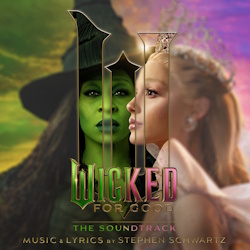
WICKED, PART TWO: FOR GOOD – John Powell, Stephen Schwartz
 Original Review by Jonathan Broxton
I don’t expect that even the most ardent fans of the original stage musical could have anticipated the impact and acclaim received by Wicked, Part One, following its release just before Christmas in 2024. It received 10 Oscar nominations (winning for Best Costume Design and Best Production Design), grossed more than $750 million at the global box office, and became something of a cultural phenomenon, turning the already-famous leading actresses Cynthia Erivo and Ariana Grande into megastars, and raising the profile of lead actor Jonathan Bailey enormously. Read more…
Golden Globe Nominations 2025
 The Golden Globe Foundation (GGF) has announced the nominations for the 83rd Golden Globe Awards, honoring the best in film and American television of 2025.
In the Best Original Score category, the nominees are:
- ALEXANDRE DESPLAT for Frankenstein
- LUDWIG GÖRANSSON for Sinners
- JONNY GREENWOOD for One Battle After Another
- DAVID LETELLIER (“KANGDING RAY”) for Sirāt
- MAX RICHTER for Hamnet
- HANS ZIMMER for F1
These are the first nominations for Letellier and Richter. It is the fifteenth nomination for Desplat, the fourth nomination for Göransson, the third nomination for Greenwood, and the sixteenth nomination for Zimmer. Desplat previously won for The Painted Veil in 2006 and The Shape of Water in 2017. Göransson previously won for Oppenheimer in 2023. Zimmer previously won for The Lion King in 1994, Gladiator in 2000, and Dune in 2021.
In the Best Original Song category, the nominees are:
- NICK CAVE and BRYCE DESSNER for “Train Dreams” from Train Dreams
- MILEY CYRUS, ANDREW WYATT, MARK RONSON, and SIMON FRANGLEN for “Dream as One” from Avatar: Fire and Ash
- EUN-JAE KIM (EJAE), MARK SONNENBLICK, JOONG-GYU KWAK, YU-HAN LEE, HEE-DONG NAM (IDO), JUNG-HOON SEO (24), and TEDDY PARK for “Golden” from KPop Demon Hunters
- RAPHAEL SAADIQ and LUDWIG GÖRANSSON for “I Lied to You” from Sinners
- STEPHEN SCHWARTZ for “No Place Like Home” from Wicked: For Good
- STEPHEN SCHWARTZ for “The Girl in the Bubble” from Wicked: For Good
The winners of the 83rd Golden Globe Awards will be announced on January 11, 2026.
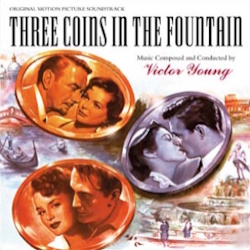
THREE COINS IN THE FOUNTAIN – Victor Young
 GREATEST SCORES OF THE TWENTIETH CENTURY
Original Review by Craig Lysy
During the 1950s a shift in movie making called “Hollywood on the Tiber” emerged. Rome and its Cinecittà studios blossomed, becoming a hub for international filmmaking. 20th Century Fox decided it wanted to feature their latest rising star Maggie McNamara in a romantic comedy, and chose Rome as the perfect location. Sol C. Segal was assigned production with a $1.7 million budget, Jean Negulesco was tasked with directing, and John Patrick would write the screenplay, adapting the 1952 novel ‘Coins in a Fountain” by John H. Secondari. A fine cast was hired, including Clifton Webb as John Frederick Shadwell, Dorothy McGuire as Miss Frances, Jean Peters as Anita Hutchins, Louis Jourdan as Prince Dino di Cessi, Rossano Brazzi as Giorgio Bianchi, and Maggie McNamara as Maria Williams. Read more…
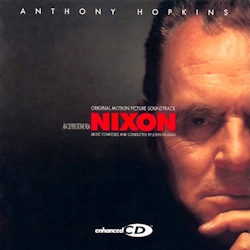
NIXON – John Williams
 THROWBACK THIRTY
Original Review by Jonathan Broxton
I am not a crook! — Richard Nixon, November 17, 1973
I shall resign the Presidency effective at noon tomorrow — Richard Nixon, August 8, 1974
Director Oliver Stone’s film Nixon is an epic biographical drama tracing the life of the 37th President of the United States, Richard Nixon. Structured as a psychological portrait, the film moves back and forth in time, depicting a number of major turning points: his humble California upbringing in the 1930s and 40s, his early political rise in the 1950s and his stint as Vice President under Dwight Eisenhower, his triumphant election victory in 1968, the pressures of the Vietnam War, and above all the widening shadow of the Watergate break-in and subsequent cover-up which led to his eventual downfall and his resignation as president in 1974. Stone presents Nixon as both deeply ambitious but profoundly insecure, a man shaped by personal trauma and driven by a desire for power and recognition that eventually turned to paranoia, criminality, and disgrace. Watergate, for those who don’t know, refers to an event where a group of Nixon operatives broke into the Democratic National Committee’s headquarters in the Watergate office complex in Washington DC in order to illegally plant surveillance equipment, ostensibly to obtain political intelligence on the Democratic Party prior to the 1972 election. Read more…

Shop at the Movie Music UK Store

Member of the

 MOVIE MUSIC UK