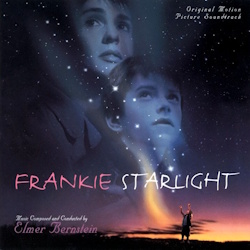
FRANKIE STARLIGHT – Elmer Bernstein
 THROWBACK THIRTY
Original Review by Jonathan Broxton
An adaptation of the best-selling semi-autobiographical novel ‘The Dork of Cork’ by Chet Raymo, Frankie Starlight is a nostalgic comedy-drama film directed by Michael Lindsay-Hogg, written by Raymo with Ronan O’Leary. The film stars Corban Walker as Frank Bois, a writer with dwarfism who is looking back over his life. The film charts his experiences as a child with his mother Bernadette (Anne Parillaud), a French woman who, toward the end of WWII, stows away on an Allied troop ship bound for America, but is taken to Ireland instead. There she meets Jack Kelly (Gabriel Byrne), a customs officer who eventually becomes a surrogate father to Frank, teaching him about astronomy, nurturing in him a lifelong passion and mystical obsession with the cosmos, and giving him his nickname ‘Frankie Starlight’. Later Bernadette meets Terry Klout (Matt Dillon), an American GI, and the three of them move to Texas; however, life in America doesn’t feel like home, and as he grows up Frankie dreams of returning to Ireland.
The film explores numerous poignant issues, from Frankie’s dwarfism – which is central to the narrative, with his physical differences shaping how he relates to the world – to his relationship with his mother, and how stars become a symbol of wonder, escape, and meaning for a young boy searching for exactly that. The film is mostly forgotten today – it barely registered at the box office, and received middling reviews – but amongst film music fans it is notable for the fact that its score was a strong late-career entry for composer Elmer Bernstein.
Despite being most famous for his bold, iconic scores for westerns like The Magnificent Seven, war movies like The Great Escape, and biblical epics like The Ten Commandments, Frankie Starlight operates in a much gentler register, and sees Bernstein approaching the story with quiet lyricism and delicacy. Tonally it has much more in common with scores like To Kill a Mockingbird in the way that it tries to evoke a sense of childhood nostalgia, memory, and longing. There’s also a faintly celestial quality to parts of the score that matches Frankie’s fascination with the stars. The score was also written during the period where Bernstein was making a concerted effort to move away from the broad (albeit massively successful) comedies that dominated his work in the 1980s, and score things with more depth, and more emotional nuance, even if the box office returns were likely to be lower.
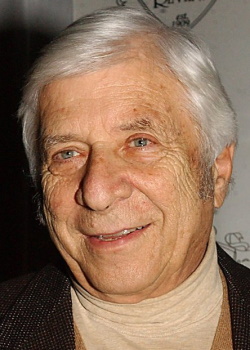 The score is written for a chamber ensemble, with orchestrations that are light, transparent, and intimate, but also capable of rising to sweeping heights. The orchestra is augmented with a number of prominent passages for solo instruments, ranging from traditional high strings and woodwinds to subtle harps, pretty woodwinds, and most notably the famous ondes martenot with which Bernstein was seemingly obsessed for the last 20 years of his career, and which he tried to somehow work into every score he wrote. It is especially impressive here, its theremin-like whine giving the score a palpably magical sheen.
Bernstein uses a handful of recurring motifs throughout the score. The main theme, Frankie’s theme, is a gentle, melodic idea that feels wistful, and seems designed to capture both his vulnerability and his internal wonder. Bernadette’s theme is more lyrical and romantic, with a warm European tinge reflecting her French origins, but which is also slightly melancholic, acknowledging the hardship and sacrifice in her story as Frankie’s mother. Finally, the “Starlight” motif is a lighter, more ethereal idea associated with Frankie’s cosmic dreams and with Jack’s astronomy lessons, and this is where Bernstein’s orchestration becomes almost magical, awash in gorgeous shimmering textures. For the film’s scenes set in Ireland sequences Bernstein sometimes gives his score a folk-inflected softness without being stereotypically “Irish,” creating a sense of peacefulness. This contrasts with the later scenes during Frankie’s time living in Texas; here Bernstein pulls back almost entirely, reflecting the characters’ emotional displacement and their uneasy feeling of being far from home with music that is darker and sometimes performed in minor keys.
The album opens with a sublime vocal performance of Frankie’s main theme, “From My Window,” written by Elmer Bernstein and his then 27-year-old daughter Emilie A. Bernstein, and performed by soprano Belinda Pigeon atop a lush solo piano enlivened by the magical, haunting, ondes martenot sound. The main theme for Frankie then gets possibly its loveliest statement in “Moon (Main Title),” the melody emerging from some impressionistic textures for flutes, pianos, and ondes martenot, and slowly building into something sweeping and passionate. Bernstein was always a tremendous melody writer, but this theme from Frankie Starlight is for me one of his underrated career best – and considering what else he has written, I don’t say that lightly.
The main theme appears frequently as the score develops; with tenderness but also bittersweet pathos in “A New Life,” with a sense of openness and adventure in “Wild Ride,” and with elegance and warmth in “Rooftops and Starlight,” a cue which also features an excellent prominent statement of the starlight motif in its second half. Perhaps the best of all is “Jack and Bernadette,” an exquisite exploration of their romantic relationship which sees Bernstein taking threads from both the main theme and Jack’s ‘starlight’ motif and weaving them around each other. The orchestration on this piece is sensational, and the way the main theme is passed around from cello to ondes martenot to piano, and back, is at times breathtakingly beautiful.
The rest of the score is no less impressive. I love the intricate expressiveness of “Windows and Memories,” which feels like a musical representation of a Monet painting in a way that I can’t fully articulate. “Flashback” sees Bernstein using more forceful pianos coupled with pretty woodwinds to introduce the first performance of Bernadette’s theme, which as I mentioned has a melancholic sound, very French, but also has a sense of life and buoyancy that I love. “At Play” is a delightful scherzo, full of energy and verve, and with hint of the Magnificent Seven in the tambourines. “In Paris” reprises Bernadette’s theme with an appropriately Gallic sense of charm and romance, albeit one that is underpinned with a slight sense of anxiety. Darker sounds for tremolo strings and more prominent martial percussion give “Visions” a different flavor. There is suspense and a little bit of intense action in “Emma’s Revenge,” as well as some minor-key bitterness and stirring drama in “Release.”
The conclusive pair, “Farewells” and “Roofdance (End Credits)” focus mostly on the main theme for Frankie, and are just gorgeous, effortlessly nostalgic and appealing, and filled with exquisite textures that again feature pianos, strings, flutes, and the ondes martenot most prominently. The performance of the main theme during the finale of the latter cue is a real showstopper, one of my favorite moments from the final decade of the composer’s career.
If Frankie Starlight the film was as well-known and critically acclaimed as, say, To Kill a Mockingbird, or some of those other intimate dramas he scored so well, I maintain that Elmer Bernstein’s main theme would be one of his most beloved. As it is, the score is unfortunately destined to remain something of an obscurity, much like the film it accompanies. However, anyone who makes the time and effort to seek it out will be presented with a late-career masterpiece, one which blends tender romance and nostalgic longing with the aspirational quality that one attains from gazing at the heavens.
Buy the Frankie Starlight soundtrack from the Movie Music UK Store
Track Listing:
- From My Window (written by Elmer Bernstein and Emilie A. Bernstein, performed by Belinda B. Pigeon) (3:36)
- Moon (Main Title) (2:23)
- Windows and Memories (1:39)
- Flashback (1:43)
- Visions (2:33)
- A New Life (1:01)
- Jack and Bernadette (3:46)
- Emma’s Revenge (2:41)
- At Play (1:09)
- Wild Ride (1:35)
- Rooftops and Starlight (2:00)
- Release (2:18)
- In Paris (1:56)
- Farewells (1:39)
- Proposal (2:42)
- Roofdance (End Credits) (4:03)
Running Time: 36 minutes 44 seconds
Varese Sarabande VSD 5679 (1995)
Music composed and conducted by Elmer Bernstein. Orchestrations by Emilie A. Bernstein. Recorded and mixed by Andrew Boland. Edited by Kathy Durning. Album produced by Elmer Bernstein and Robert Townson.
Leave a comment

Shop at the Movie Music UK Store

Member of the

 MOVIE MUSIC UK
I was listening to this on random the other day and caught myself thinking “what a theme!”.