TOY STORY – Randy Newman
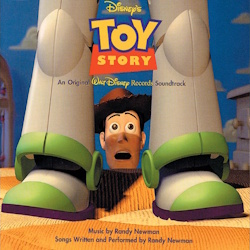 THROWBACK THIRTY
Original Review by Jonathan Broxton
To infinity and beyond!
There are only a few films that you can point to as marking a genuine turning point in the history of cinema, but 1995’s Toy Story is one of them. Directed by John Lasseter and produced by Pixar Animation Studios in collaboration with Walt Disney Pictures, it was the first entirely computer-animated feature film, and as such is a landmark of the genre. Pixar’s roots trace back to Lucasfilm’s Computer Division, founded in 1979. Among the early team members was John Lasseter, an animator who had previously worked at Disney but was dismissed after pushing too hard for computer animation in an era when Disney remained committed to traditional hand-drawn techniques. At Lucasfilm, Lasseter found a place where computer graphics were the focus, and he began experimenting with short animated sequences that combined storytelling and new technology.
Initially, Pixar was not an animation studio – it was a hardware company, selling a high-end graphics workstation designed for medical and scientific imaging. However, the hardware market was limited, and Pixar’s most creative work came from its animation department, which produced short films to showcase the computer’s capabilities. Throughout the 1980s Pixar produced commercials and short films while developing proprietary software, which became an industry standard for high-quality 3D rendering. One of these shorts, Luxo Jr. from 1986, was particularly significant as it was the first CGI film nominated for an Academy Award; the hopping desk lamp would go on to become Pixar’s mascot and logo symbol. In 1989 the company shifted decisively toward animated storytelling, thanks to Lasseter’s growing creative vision, and then in 1991 Pixar signed a landmark deal with Disney to produce three computer-animated feature films – the first of which became Toy Story.
Toy Story is set in a world where toys come to life when humans aren’t around. The film centers on Woody, a pull-string cowboy doll (voiced by Tom Hanks), who has long been the favorite toy of a young boy named Andy. Woody’s comfortable position is challenged when Andy receives a flashy new toy, Buzz Lightyear (voiced by Tim Allen), a space ranger action figure who believes he’s a real intergalactic hero. Woody fears that Buzz will usurp his position as the favorite, and his jealousy leads to an accident that results in both he and Buzz getting lost, prompting them to embark on a perilous journey to find their way back to Andy before the family moves to a new house.
Toy Story was a sensation, a massive critical and commercial success which grossed over $350 million worldwide at the box office and earned several Oscar nominations, including one for writers Joss Whedon, Andrew Stanton, Joel Cohen, Alec Sokolow, John Lasseter, Pete Docter and Joe Ranft for Best Original Screenplay – the first time an animated film had received such an accolade.
 Disney’s music department at the time was, by and large, the sole domain of composer Alan Menken, who had written the music for almost every Disney animated film since 1989, and enjoyed an unprecedented level of success while doing so – his scores for The Little Mermaid (1989), Beauty and the Beast (1991), Aladdin (1992) and Pocahontas (1995) all won Oscars, and the only reason he didn’t score The Lion King in 1994 was because of scheduling conflicts. It won an Oscar too. However, for Toy Story, director John Lasseter wanted an approach different from ‘classic Disney,’ notably in the fact that none of his characters would sing. To achieve this Lasseter turned to legendary singer-songwriter Randy Newman to composer the score, and to write a handful of original songs that he would sing himself, commenting on the story from the outside, like a friendly narrator.
Apart from his legendary status as a rock and pop artist, Newman had enjoyed enormous success in film music prior to 1995, receiving Oscar nominations for his scores and original songs from Ragtime in 1981, The Natural in 1984, Parenthood in 1989, Avalon in 1990, and The Paper in 1994. Lasseter and producer Ralph Guggenheim especially admired his score for Parenthood, which mixed whimsy with genuine emotional depth, and captured ‘the heart and honesty of everyday life,’ something that Pixar wanted as the emotional undercurrent for Toy Story. Newman’s musical style, with its roots in American pop, jazz, and folk traditions, evokes exactly that atmosphere, while his warm, slightly offbeat songwriting style and wry lyrical sensibility matched the film’s blend of humor and heart.
The three songs that Newman wrote are “Strange Things,” “I Will Go Sailing No More”, and of course “You’ve Got a Friend in Me,” the latter of which is performed twice, first by Newman alone, and then in a duet with country singer Lyle Lovett. For them, Newman dropped almost all his trademark cynicism and irony and got straight for the emotional point, and in doing so he essentially re-defined a significant portion of his career, suddenly endearing himself to six-year-olds across the world and establishing a creative partnership with Disney and Pixar which, at the time of writing, now encompasses 11 films between 1995 and 2019.
“Strange Things” plays over a montage showing Buzz’s rapid rise and illustrates Woody’s growing jealousy as Andy replaces his cowboy-themed decorations with space motifs, and Woody watches helplessly as his status fades. Musically, it’s energetic and rock-influenced, emphasizing the chaos and upheaval Buzz’s arrival causes. “I Will Go Sailing No More” is one of the bittersweet ballads that Newman does so well, and tonally it reminds me of songs like “I Think It’s Going to Rain Today” from 1968, or “Marie” from 1974. In context it underscores Buzz’s devastating moment of self-awareness when – after seeing a TV commercial for “Buzz Lightyear Action Figures,” he attempts to “fly” out a window, only to crash. The lyrics capture his shattered illusion and loss of purpose, and it’s really quite heartbreaking. Newman was always so good at doing that.
The cornerstone, however, is “You’ve Got a Friend in Me,” a cheerful, jazz-tinged song that introduces Andy’s world and his bond with Woody. Musically, it’s upbeat and slightly ragged, Newman’s iconically raspy voice combining with a swing rhythm and bluesy piano that make it feel friendly and human, capturing the warmth and simplicity of Andy’s relationship with Woody, and by extension, the emotional heart of the film. It quickly became the most recognizable part of the score – and in time it became the musical soul of the entire Pixar brand and one of the most enduring pieces of film music from the 1990s, instantly recognizable from its opening piano chords.
As far the score is concerned, Newman’s contribution there is less well-known, but is no less impactful in context. The thing which is likely to be make-or-break for listeners is the fact that, for large parts of it, Newman adopts an idiosyncratic Carl Stalling-style ‘classic cartoon music’ approach, relentlessly mickey-mousing every scene within an inch of its life. Your tolerance for this approach will directly affect your level of appreciation for the score as a whole, because Newman’s music is relentless in its constant sense of movement, constant changes of direction, wildly different approaches, and wildly different styles, often within seconds of each other in the same cue. One minute it’s classic children’s orchestra, then it’s ragtime jazz, then it’s western pastiche, then it’s 1950s-style sci-fi space music. It’s all brilliant, but sometimes quite exhausting.
Thematically, apart from a very brief section at the beginning of “Woody and Buzz,” there is very little crossover between the songs and the score, which is a bit unusual considering that the same man was responsible for both, and with hindsight feels like an oversight and a missed opportunity. Instead Newman came up with a handful of individual ideas for different characters and concepts, each of which tend to follow a pattern of similar orchestrations rather than having clearly identifiable themes.
Woody’s theme is a classic western theme in the grandest Elmer Bernstein, Jerome Moross tradition. Buzz’s theme is more traditionally heroic, with undertones of classic space adventure music, and an especially prominent flute part which tends to come to the fore during Buzz’s aspirations of flight and freedom. There is a fun militaristic march for the platoon of little green soldier men who come to Buzz and Woody’s rescue on numerous occasions. And then there is a creepy Elfmanesque waltz-like theme featuring prominent bassoons and tubas that accompanies the mutant toy creations made by Sid, Andy’s next-door neighbor, a bully who destroys toys for fun.
Sadly there is no real instrumental identity for any of the other supporting toys – Mr Potato Head, Slinky Dog, Rex, etc. – nor is there any kind of motif for the little alien men, crane game toys who live in the claw machine at Pizza Planet, but the Pizza Planet sequences themselves do at least give Newman the opportunity to lean into his hard rock persona for a few moments.
Frustratingly, Newman also never really leans into any deeper contextual writing either; there is no motif for Woody’s relationship with Andy, nothing really denoting the conflict between Woody and Buzz, and nothing that denotes the pathos of Woody’s increasing feelings of rejection. As I said earlier, taking ideas from the song melodies and turning them into score would have addressed these issues, but for some reason Newman chose not to do that, and this results in a score which remains somewhat surface-level. Newman was so good at that too, as his scores for films like The Natural, Awakenings, and others attest.
Having said that, there are still some standout moments. The classic western pastiche that plays throughout “Andy’s Birthday” is brilliant, playing sort of like a more serious version of his score for Maverick, crossed with The Magnificent Seven and The Big Country. This sound plays in conjunction with a series of interludes that are steeped in the stylistics of Gershwin-style New York jazz, and are notable for their excellent, dexterous writing for trumpets and clarinets. The march for the toy soldiers appears first in “Soldier’s Mission” and then later during the finale of “Hang Together” and throughout excellent action sequence “On the Move,” and it’s a ton of fun, sometimes coming across as a more light-hearted take on Jerry Goldsmith’s score for Patton.
Buzz’s noble, heroic theme makes its first appearance in the eponymous “Buzz,” plays in amusing contrast to Woody’s western theme in “Woody and Buzz,” and then anchors the exhilarating, rousing, uplifting action finale “Infinity and Beyond”. The music for Sid’s creations in “Mutants” is outstanding, and special recognition should be given to the rich and complex orchestrations by the great Don Davis, which have an incredible range of textures and tones, from magical wonderment to playful whimsy, to something approaching light horror. The emotional high point of the score is the lovely “Hang Together,” which sees Newman engaging in some of his trademark lush string writing to capture the growing friendship between the two pint-sized adversaries.
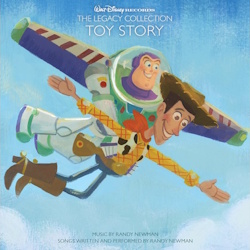 The original album for Toy Story ran for just under an hour, just over 40 minutes of score, plus the songs. In 2015 Disney released a more complete and comprehensive version of the score as part of their Legacy Collection series, which expanded the score’s running time to just under 90 minutes, with the addition of several previously un-released score tracks, song variations, alternate cues and demos. While collectors and devotees of the film are likely to be thrilled by this, I actually find the longer album something of a chore to sit through, and I much prefer the condensed, shorter album as a listening experience. Your mileage may vary.
As a part of the history of animation filmmaking, Toy Story’s legacy is unmatched. The story and look of it all still holds up today, and the fact that a fourth sequel, scheduled for 2026, is already in the works confirms its enduring appeal. Newman’s songs are excellent, with “You’ve Got a Friend in Me” taking its place in the pantheon of all-time great Disney movie songs. As far at the score is concerned; it works tremendously well in context, but you have to be in the right frame of mind – and willing to endure a lot of mickey-mousing – to properly appreciate it. It’s creative, beautifully orchestrated, and fun, but Newman would do better work for other Pixar films later down the line as he became more comfortable with the medium.
Buy the Toy Story soundtrack from the Movie Music UK Store
Track Listing:
- 1995 ORIGINAL RELEASE
- You’ve Got a Friend in Me (written and performed by Randy Newman) (2:04)
- Strange Things (written and performed by Randy Newman) (3:18)
- I Will Go Sailing No More (written and performed by Randy Newman) (2:58)
- Andy’s Birthday (5:58)
- Soldier’s Mission (1:29)
- Presents (1:09)
- Buzz (1:40)
- Sid (1:21)
- Woody and Buzz (4:29)
- Mutants (6:05)
- Woody’s Gone (2:12)
- The Big One (2:51)
- Hang Together (6:02)
- On the Move (6:18)
- Infinity and Beyond (3:09)
- You’ve Got a Friend in Me (written by Randy Newman, performed by Randy Newman and Lyle Lovett) (2:40)
- 2015 LEGACY COLLECTION
- Opening (1:28)
- You’ve Got a Friend in Me (written and performed by Randy Newman) (2:04)
- Andy’s Birthday is Today (0:42)
- They’re Alive! (1:12)
- Staff Meeting Everybody! (0:43)
- You Too, Bo Peep (0:39)
- Andy’s Birthday Party (1:33)
- Code Red (1:30)
- A Good Soldier Never Leaves a Man Behind (0:37)
- Presents: Who Invited That Kid? (1:19)
- Surprise Present (1:09)
- What Are You Doing Under the Bed? (0:22)
- Buzz Revealed (1:07)
- Buzz Flies (0:44)
- Strange Things (written and performed by Randy Newman) (3:25)
- Woody/Bo Peep (0:20)
- Sid (1:22)
- Virtual Realty (0:17)
- Woody Plots (0:58)
- Rube Globeburg (0:25)
- Woody Did It (1:07)
- Rescue Attempt (1:11)
- Buzz, You’re Alive! (0:32)
- Buzz and Woody Fight (0:35)
- Buzz’s Mission (0:19)
- It’s a Spaceship, Buzz (0:58)
- Pizza Planet Rock (0:37)
- What? Hello? A Space Port! (1:28)
- The Claw (2:18)
- Dr. Sid (1:09)
- Mutant Toys (1:12)
- Woody’s Gone (0:52)
- Sorry Guys, Dinner’s Canceled (0:53)
- Scud (0:45)
- Buzz Lightyear Commercial (0:54)
- I Will Go Sailing No More (written and performed by Randy Newman) (3:02)
- Out the Window (0:45)
- Sid’s Toys Fix Buzz (1:29)
- The Big One (1:23)
- Sad Andy (0:47)
- Buzz, I Need Your Help (2:16)
- Working Together (Leads to Failure) (0:45)
- The Rescue Pt. 1 (3:41)
- Sid Counts Down (1:09)
- The Rescue Pt. 2: Play Nice, Sid (1:30)
- Chasing the Van (1:42)
- RC to the Rescue (2:28)
- To Infinity and Beyond (2:12)
- Together Again and a Very Merry Christmas (1:47)
- You’ve Got a Friend in Me (written by Randy Newman, performed by Randy Newman and Lyle Lovett) (2:40)
- End Credits (2:21)
- Strange Things (Piano/Vocal Demo) (3:00) BONUS
- Plastic Spaceman (Piano/Vocal Demo) (3:20) BONUS
- I Will Go Sailing No More (Piano/Vocal Demo) (3:37) BONUS
- The Fool (Piano/Vocal/Background Vocal Demo) (2:08) BONUS
- You’ve Got a Friend in Me (Instrumental) (2:06) BONUS
- Strange Things (Instrumental) (3:19) BONUS
- I Will Go Sailing No More (Instrumental) (2:57) BONUS
- Thanking the Orchestra (Spoken) (0:41) BONUS
Running Time: 53 minutes 49 seconds — Original
Running Time: 87 minutes 50 seconds — Legacy Collection
Walt Disney Records WD771302 (1995) — Original
Walt Disney Records 050087325558 (1995/2015) — Legacy Collection
Music composed and conducted by Randy Newman. Orchestrations by Randy Newman and Don Davis. Recorded and mixed by Frank Wolf. Edited by Jim Flamberg. Original album produced by Frank Wolf, Don Davis, Jim Flamberg and Randy Newman. Legacy Collection album produced by Chris Thomas.
Leave a comment

Shop at the Movie Music UK Store

Member of the

 MOVIE MUSIC UK
Excellent and explanatory review, with a helpful historical context. Thank you!