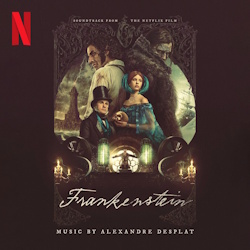
FRANKENSTEIN – Alexandre Desplat
 Original Review by Jonathan Broxton
It’s astonishing to think that there have been more than 50 cinematic adaptations of the story of Frankenstein since it was first penned, one haunted summer in 1818, by the then 20-year-old English author Mary Shelley. In writing Frankenstein Shelley essentially invented the science fiction literary genre as we know it; before Frankenstein, stories about the unnatural or the fantastic were usually supernatural, rooted in magic, myth, or divine intervention. Shelley’s innovation was to ground the creation of life in the science of the time, and it changed everything. On film, adaptations have differed wildly in tone and approach, from the early classic James Whale films starring Boris Karloff, to the Hammer horror films of the 1950s and 60s with Christopher Lee and Peter Cushing, Mel Brooks’s campy comedy Young Frankenstein, and director Kenneth Branagh’s Gothic take from 1994. This new version, by the Oscar-winning Mexican director Guillermo del Toro, may be the best of them all.
Del Toro has described the film as the culmination of his three-picture series that explores ‘sympathetic monsters,’ after The Shape of Water in 2017 and Pinocchio in 2022, and although the film does take some creative liberties with some of the details of the original novel, the core of Shelley’s work remains intact. The story follows Victor Frankenstein, a brilliant young scientist, who becomes obsessed with unlocking the secret of life following the death of his beloved mother. Consumed by ambition, he secretly assembles a creature from parts of dead bodies, and then harnesses the power of electricity in lightning to bring it to life. Horrified by its grotesque appearance, and by the realization of the magnitude of what he has done, Victor abandons his creation, who disappears into the wilderness. Alone and rejected, the creature teaches himself language and human behavior by observing a family, and befriending a blind man who is not afraid of him as he cannot see him. However, when society continually shuns him, the creature turns to bitterness and rage, and he sets out on a redemptive quest to seek out his ‘father’.
The film is a stunning, sumptuous, wonderfully cinematic powerhouse, anchored by outstanding performances from Oscar Isaac as Frankenstein, Mia Goth in a dual role as both Elizabeth and Frankenstein’s mother, David Bradley as the kind old blind man, and Charles Dance as Victor’s strict and oppressive father. However, for me the standout is Jacob Elordi as the Creature, who here is simply revelatory despite being buried under mounds of special effects makeup, perfectly balancing his imposing physicality with an astonishing level of sensitivity and emotional openness. Having already shown a great deal of range on projects as diverse as the TV series Euphoria, the Kissing Booth teenage romance movies, and the 2023 drama Saltburn, his performance here is going to make him a bonafide star.
As I mentioned, Del Toro’s screenplay does alter some of Shelley’s details – for example, the sub-plot about the servant girl Justine being framed for killing Frankenstein’s brother William no longer appears, the creature does not save a little girl from drowning, Victor’s father dies much earlier, and Elizabeth is killed on her wedding night to William rather than to Victor. Similarly, characters such as Henry Clerval do not appear in the film at all, while others, such as Christoph Waltz’s Henrich Harlander – a wealthy arms manufacturer who funds Victor’s experiments – were created anew. However, the core tenets of Shelley’s prose remain: the pursuit of knowledge and the consequences of pursuing that knowledge without moral responsibility, the dangers of playing God, and the innate human need for companionship.
Visually, the film is an absolute masterpiece. Everything, from Dan Laustsen’s cinematography to the production design, costumes, and makeup, is lavish and sumptuous and inherently cinematic; from the full size Royal Danish Navy ship that Del Toro had constructed for the film’s Arctic-set wraparound story, to the dazzling electric energy of Frankenstein’s laboratory, and the dusty luxuriousness of the Frankenstein family mansion, which has echoes of Stanley Kubrick’s Barry Lyndon to it. The look of the creature moves away from the clichéd bolts-in-the-neck style of Boris Karloff, and instead takes inspiration from Bernie Wrightson’s acclaimed 1983 graphic novel, resulting in a creature character who feels more realistic. I also loved the aesthetic of Frankenstein’s nightmarish dream sequences – especially those related to the ‘burning angel’ – which felt like a William Blake painting brought to life. It’s all just magnificent.
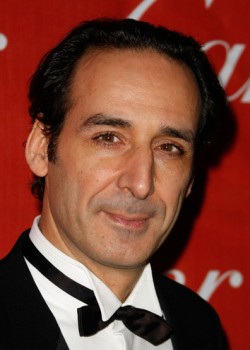 For the music, Del Toro again turned to composer Alexandre Desplat, who previously scored both The Shape of Water and Pinocchio for the director, and won an Oscar for the former. Many composers have written outstanding music for Frankenstein films over the years – Franz Waxman, James Bernard, Carl Davis, Patrick Doyle – and Desplat’s music for this version joins that pantheon of excellence. Interestingly, Del Toro and Desplat decided early in their discussions that the score should not be a traditional orchestral horror score; instead, Desplat was asked to write music that was lyrical and emotional, and which ‘looked for the fragility, delicacy, and suffering’ in the story, especially in terms of the twisted father-son relationship between Frankenstein and the Creature. The film was apparently temp-tracked with Wojciech Kilar’s score for Bram Stoker’s Dracula, which gives you an insight into the thinking behind its conception.
Much of the score is anchored by violin performances by Norwegian virtuoso soloist Eldbjørg Hemsing, and it is her sound that often carries the score’s emotional weight. Stylistically the music adopts the classical sensibilities of the time period, and so it often has a sound that is a little bit baroque, a little bit romantic, and sometimes structured in formal waltz time. The score then features numerous themes and smaller motifs, binding the story together and revealing its emotional connections.
The main theme for Victor Frankenstein is an elegant 7-note motif, rich and classical, but also a little twisted and tortured, capturing the heart of the dichotomy of a character who is blessed with wealth and privilege, but driven to near madness with his obsession. Hemsing’s violins dance about the orchestra, but Desplat also counterbalances this with a rumbling electronic bass, clearly hinting that all is not well. The opening “Frankenstein” features this theme prominently, and it appears regularly throughout the rest of the score: dramatically in “Explosion,” for delicate pianos and brooding cellos in “Victor’s Tale,” with ominous intent at the end of “William and Father,” with bold Gothic grandeur and tempestuous violin passion in the outstanding “The Castle,” with sublime emotional pathos in “Awakening,” and with bold fervor throughout the showstopping “Fire”.
There is a secondary theme for Victor that is warmer, softer, but also a little introverted and touched by heartbreak; it seems to speak to the various relationships in Victor’s life, and grows increasingly tragic as the film progresses, as first his mother dies, then his father, then his relationships with both Elizabeth and the Creature irreparably break down. You can feel the anguish in the violin writing of “Burning Angel,” in the Mozart-esque funereal dirge of “Mother Dies,” in the tenderness at the end of the aforementioned “The Castle,” and in the hesitant gentleness in “God’s Design” as he bonds with Elizabeth over their shared fascination for the natural world.
The first hints of the theme at eventually becomes the theme for the Creature appears in “Lecture,” which underscores the scene where Victor presents his ungodly ideas for corporeal re-animation to his university professors with eerie glassy tones and elongated string textures that erupt into vivid harpsichords. The Creature’s music starts to become more fully realized during the creation sequence – more on that later – and then afterwards Desplat captures the duality of the creature’s nature with two distinct motifs that derive from the same source. Cues like “Everything is New” and “Floating Leaf” address his child-like curiosity, while cues like “Creature’s Tale” become more about his increasing senses of helplessness, abandonment, and eventual rage.
A pleasant, dainty, slightly bittersweet piano and violin motif for “Elizabeth” appears in the cue that bears her name, but it’s not quite as prominent in the rest of the score as one would expect considering how central she is to the story. Instead, there is an angst-ridden quasi-love theme for high strings and harps for the Creature and Elizabeth which seems to be an offshoot from the Creature’s motif, and can be heard in “Elizabeth Meets the Creature,” with melodramatic romantic power during the otherwise penetrating and portentous “Confrontation,” and with a sort of poignant tranquility in “Laying to Rest,” a cue which has a definite Kilar influence to its overall sound.
More propulsive music appears in the film’s action and suspense sequences, notably pieces like “Explosion,” “Symmetry,” the aforementioned “Fire,” “A Merciless Life,” and the powerfully muscular “Don’t Delay”. In these cues Desplat often employs a bed of undulating string textures to drive the action forward, passing rhythmic ideas between cellos and basses, while also making his brass growl throatily, trilling his woodwinds, and then accentuating the sound with a choir that is sometimes angelic, sometimes monstrous. Later, “Hunters” is lithe and dexterous, fluttered interplay between flutes and strings, while “Wolves” groans and howls and throbs like the titular animals savaging a flock of sheep.
Other cues of note include the stylish, slightly whimsical music for “William and Father” which is vintage Desplat, pretty in the way that scores like Girl With a Pearl Earring or The Painted Veil were pretty, and featuring some lovely interplay between pianos, strings, and choir that sometimes reaches a dramatic crescendo. The blind man the Creature befriends, and who teaches him the value of kindness and empathy, has a lovely pastoral motif that can be heard prominently in the ebullient “Family Life,” and the touching “A Friend,” with echoes later in “A Good Man.” Finally, “Victor in Love” and “Victor & Elizabeth” are a pair of sumptuous waltzes that try to capture the sense of freedom and gaiety Victor feels through his (eventually unrequited) love for Elizabeth. Quintessential Desplat.
However, for me, the standout sequences are the aforementioned ‘creation’ sequence comprising “Body Building” and “The Tower,” and then the sweeping and emotionally poignant finale. “Body Building” is an elaborate waltz backed by choral textures which plays in ironic juxtaposition to scenes of Frankenstein dismembering various cadavers in a variety of stomach-churning ways. The subsequent “The Tower” is Desplat’s equivalent of Patrick Doyle’s “Creation” cue from his Frankenstein score, and is a thunderous, propulsive, dramatic representation of the doctor’s God-like success in bringing his monster to life, swirling and churning as he harnesses the power of a lightning storm. The way Desplat arranges his statements of Victor’s theme with increasing intensity is outstanding, and the richness of the orchestral sound is superb, festooned as it is with pulsating church organs and harpsichords. A striking choir, shrieking and cooing and whispering, adds a final layer of majesty to it all.
After a flurry of action in “Tent & Dynamite,” the finale of the film sees Frankenstein and his creation – father and son – reconciling in the captain’s quarters of a Danish navy ship, stuck in the Arctic ice. Desplat scores this final moment of grace and humanity with statements of Victor’s theme, the Creature’s theme, and their Relationship theme; throughout both “Forgiveness” and the lush “Eternity” the themes intertwine and express themselves with depth and pathos, with the statement of the Relationship theme in the latter offering an especially satisfying conclusion.
As is always the case, Frankenstein is technically magnificent. Desplat again worked with his long-time orchestrators Conrad Pope and Jean-Pascal Beintus to create a sound that is steeped in everything that has always made his music so unique to him; those specific instrumental combinations and textures that have followed him ever since he first burst onto the international film music scene almost 25 years ago. The recording by Peter Cobbin and Kirsty Whalley is as crisp and pure as always, each detail and nuance rendered in crystal clarity. I will point out, however, that this is a very long album – 104 minutes – and so anyone who doesn’t connect with the score from the outset, or who suffers from a lack of patience, may find the whole thing challenging.
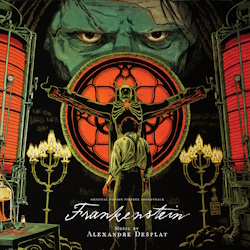 The score is available to stream and download via Netflix Music, and several vinyl versions of the score have been announced by Mutant Records. The first, according to the press release, is an exclusive ‘slipcase edition’ containing a 2-LP gatefold housed inside a bespoke die-cut creature slipcase and comes complete with an obi strip and insert, and featuring stunning artwork by Francesco Francavilla recalling classic horror movies of the 1930s and 1940s, meticulously hand-drawn, painted, and beautifully detailed. The second is a lavish 2-LP special edition which features a 28-page hand-stitched booklet with liner notes by Desplat and film music journalist/IFMCA member Charlie Brigden, plus behind-the-scenes photos, medical drawings from the film, and sheet music. They are available here: https://www.madebymutant.com/. No word yet on a CD.
Overall, this is an exceptional score, and what stands out for me is how Desplat and Del Toro have clearly understood and brought out the emotional heart of the story with the music; they acknowledge the omnipresent horror in the story, of course, but it is the hearts and souls of those characters involved that leave their mark. When you look at this work, and consider that this year Desplat has already written music for The Phoenician Scheme, Jurassic World: Rebirth, and L’Homme Qui Rétrécit [The Incredible Shrinking Man], and has Eagles of the Republic still to come, 2025 is likely to go down as one of the most successful years of his career. As icing on the cake, an Oscar nomination for Frankenstein is essentially guaranteed.
Buy the Frankenstein soundtrack from the Movie Music UK Store
Track Listing:
- Frankenstein (1:12)
- Explosion (3:31)
- Victor’s Tale (1:25)
- Burning Angel (2:56)
- Mother Dies (2:22)
- William and Father (3:41)
- Lecture (3:35)
- Meet Harlander (3:32)
- Elizabeth (3:58)
- The Castle (3:36)
- Victor in Love (1:21)
- Victor & Elizabeth (2:52)
- God’s Design (1:32)
- Symmetry (0:59)
- Body Building (4:19)
- The Tower (7:02)
- Awakening (1:27)
- Everything Is New (3:33)
- Elizabeth Meets the Creature (1:48)
- Floating Leaf (2:28)
- Harlander’s Body (0:55)
- Fire (3:15)
- Creature’s Tale (3:23)
- Hunters (2:04)
- Family Life (4:11)
- Wolves (1:42)
- A Friend (4:40)
- Recollection (1:28)
- Return to the Tower (3:09)
- A Good Man (2:29)
- A Merciless Life (1:36)
- Confrontation (6:00)
- Laying to Rest (2:39)
- Don’t Delay (1:22)
- Tent & Dynamite (2:19)
- Forgiveness (3:35)
- Eternity (2:54)
Netflix Music (2025)
Running Time: 104 minutes 50 seconds
Music composed and conducted by Alexandre Desplat. Orchestrations by Alexandre Desplat, Conrad Pope, and Jean-Pascal Beintus. Featured musical soloist Eldbjørg Hemsing. Recorded and mixed by Peter Cobbin and Kirsty Whalley. Edited by Gerard McCann. Album produced by Alexandre Desplat and Dominique Lemmonier.
Leave a comment

Shop at the Movie Music UK Store

Member of the

 MOVIE MUSIC UK
Great score … maybe an Oscar nomenee for 2026 🙂
Hope there will be a CD-release soon before Christmas also 🙂
Good review as always, Jon. By the way, there’s a motif you didn’t noticed that it’s for Herr Harlander. You can hear it on The Tower and Harlander’s Body. Also, the theme for the Creature is quite similar to the secondary theme from Desplat’s score for Nyad