JUMANJI – James Horner
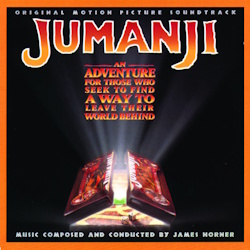 THROWBACK THIRTY
Original Review by Jonathan Broxton
Jumanji is a children’s fantasy action-adventure film starring Robin Williams, Bonnie Hunt, Kirsten Dunst, Bradley Pierce, and Jonathan Hyde, directed by Joe Johnston, based on the 1981 illustrated children’s book by Chris Van Allsburg. The titular object is a mysterious and dangerous board game that brings jungle hazards to life. In 1969 a young boy named Alan Parrish discovers an ancient board game buried at a construction site. When he plays it with his friend Sarah strange supernatural events occur, and Alan is suddenly sucked into the game after rolling the dice. Sarah, terrified, flees, and the game is left behind. Years later, in 1995, siblings Judy and Peter Shepherd move into the now-abandoned Parrish house with their aunt. They find the dusty board game and begin to play, unwittingly releasing Alan – who is now an adult and has been trapped inside the game’s jungle world all these years. As the game’s curse continues every roll brings new dangers into the real world, from rampaging animals to a hunter named Van Pelt, and in order to end the chaos Alan, Judy, and Peter must find Sarah and persuade her to finish the game with them.
The movie was a huge commercial success, grossing over $260 million worldwide, and over time became one of Robin Williams’ most beloved family films. The film was one of the earliest major productions to blend live-action filmmaking with extensive digital visual effects, and it’s groundbreaking CGI was, at the time, considered state-of-the-art, particularly for the stampede and animal sequences. Jumanji later inspired a franchise, including the successful modern sequels Jumanji: Welcome to the Jungle in 2017 and Jumanji: The Next Level in 2019, which re-imagined the game as a video game rather than a board game.
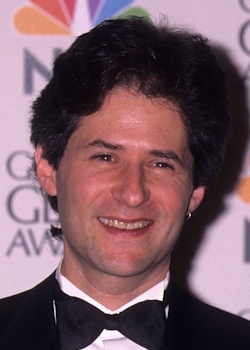 The score for Jumanji was by James Horner, re-teaming with director Johnston on another adventure after Honey I Shrunk the Kids in 1989, The Rocketeer in 1991, and The Pagemaster in 1994. Despite them having apparently a very successful creative relationship, this was the last time they would work together, but it was quite a way for them to go out. Ironically, for the longest time, I actually didn’t like the score for Jumanji. The film came out at the end of the period where I first really properly noticed and discovered James Horner – the 1-2-3 punch of Legends of the Fall, Braveheart, and Apollo 13, with a bit of Casper thrown in for good measure – and I initially found Jumanji to be too madcap, too frenetic, too all-over-the-place, especially in comparison to these other masterworks. In my original amateurish review of the score from 1996 I wrote that the score was ‘incoherent, and at times rather noisy and irritating,’ and it’s only in recent years, and with the benefit of three decades of hindsight, that I have started to appreciate it more.
Jumanji reflects an interesting balance between adventure, wonder, and menace, mirroring the film’s shifting tone between fantasy excitement and real danger. Horner’s music is initially moody and mysterious, resonating to deep brass sounds backed by tribal percussion that evokes both the ancient power of the game and the jungle chaos it unleashes. These moments of suspenseful anticipation then burst out into numerous sequences of bold, densely-orchestrated action for the stampedes, monsoon scenes, and encounters with wild animals, resulting in a series of cues which are challenging and sometimes wildly anarchic. Counterbalancing all this chaos are Horner’s more emotional passages, accompanying Alan’s early scenes and his reunion with Sarah, which feature tender strings and woodwinds, and ground the fantasy in emotional reflections of home, childhood, and reconciliation.
After a dissonant and atmospheric opening few moments for orchestra and shakuhachi, which plays like a combination of Thunderheart and the darker parts of Willow, the “Prologue and Main Title” introduces the two main themes back-to-back, the Jumanji theme appearing first on ominous solo horns, and then the Parrish theme for pretty pianos, strings, and the unusual sound of a South American quena Andean flute. The overall sound of the Parrish theme has a lot in common with the family drama scores Horner wrote in the early 1990s – The Man Without a Face, House of Cards, Jack the Bear, things like that – as well as the slightly ominous Americana of Something Wicked This Way Comes, while also foreshadowing some of the things he would to later in scores like The Spitfire Grill. There is an innocence, playfulness, and sense of whimsy in this music that is easy to appreciate.
One or both of these two themes appear in virtually every cue in one way or another, but one of the score’s main drawbacks is that, with just one or two exceptions, they are never really given a chance to really stand out and shine; the Jumanji theme especially is often embedded into the action music, and is surrounded by so much symphonic pandemonium that it’s hard for it to stand out. The Parrish theme does get a little more love – there are notable statements of it in the lovely “A New World,” in the second half of “Alan Parrish,” and during the “End Titles,” with the one in “Alan Parrish” enjoying a notably satisfying, noble sweep – and in doing so it clearly establishes itself as the score’s emotional heart.
The score’s focus, however, is on its action, and in each of those sequences Horner really throws everything at the score, orchestrating it within an inch of its life, and pushing the raucousness buttons to the max. Stylistically, it’s got a little bit of Willow, a little bit of Honey I Shrunk the Kids, and a little bit of We’re Back! A Dinosaur’s Story in terms of the sheer bombastic energy of it all. These bold orchestral outbursts are then layered against the more tense and nervous percussive parts of things like Clear and Present Danger, or Apollo 13, while the specialist ethnic instrumentation provides echoes of the aforementioned Thunderheart, sometimes even going as far back as the South American-flavored score for Vibes.
Each action cue underscores a specific set piece related the results of a dice roll, and so each one has a slightly different flavor, which in turn gives the score an episodic feel, as if each bit of it is a standalone vignette. The statements of the Jumanji theme and the Parrish theme are glue which hold the score together; as I mentioned earlier, even though they never really receive bold singular performances, a familiar run of notes anchors each cue, giving the score the cohesiveness it desperately needs.
After the intensely dissonant and aggressive “First Move,” “Monkey Mayhem” is the score’s first notable action sequence, a massive outburst of orchestral chaos that blends the riotous circus-style antics of We’re Back with a specific rhythmic idea that appears to be Horner’s recurring career-spanning motif for anything to do with apes; it’s an idea that first appeared in the score for Project X back in 1987 (a film about monkey test pilots) and would later go on to appear in Mighty Joe Young in 1998, a King Kong variant. I think these intellectual and emotional connections that Horner made are absolutely fascinating – the fact that essentially variations on the same motif appear in three different films with scenes of ‘monkey mayhem’ really reinforces the ‘Horner career symphony’ theory, and how he consistently reacted the same way, musically, to different visual and conceptual stimuli. Anyway, the cue is terrific, classic Horner action stylistics which feature shakuhachis and anvils crashing over the top of a bed of intensely complex orchestral textures.
After the ominous and sinister “It’s Sarah’s Move” comes “The Hunter,” a superb piece of dynamic adventure music related to the Van Pelt character who emerges from the game and attempts to ‘bag’ the children as his latest trophy. The Hunter motif is a terrific heraldic two-note motif for brass, and the orchestra that accompanies it is equally dynamic, and often features bouncing spiccato strings. Interestingly, the basic sound of Hunter motif would later go on to inform the swashbuckling theme for the main character in The Mask of Zorro. Later, both “Rampage Through Town” and “Stampede” are enormous action chase sequences that feature the main Jumanji theme in a variety of different settings, with emotional drivers that range from oppressively dark and scary, to emotionally poignant, to child-like wonderment, and even light comedy. The huge, resonant version of the main Jumanji theme at the beginning of “Stampede” is one of the score’s best,
The lithe, playful woodwinds and harpsichord-like electronics of “A Pelican Steals the Game” offer a more bright and almost cheerful interlude, but this is followed by the much more intense “The Monsoon,” which features some clever cascading effects for harps and metallic percussion textures underneath and increasingly intricate interplay between powerful strings, resonant brass, breathy rhythmic shakuhachi pulses, and piano clusters.
The conclusive “Jumanji” is, at almost 12 minutes, by far the longest track on the album, and it underscores the film’s final moments where Alan and children desperately try to finish the game before their home town is finally overrun by all the creatures that have emerged from within it. Horner throws absolutely everything at this cue, and does so at breakneck speed, barely letting up for the entire running time. The main Jumanji theme appears frequently, and there is a heroic action variant on the Parrish theme towards the end that is quite superb. The shakuhachi blasts are wonderfully shrill, the horns are powerful and resonant, the strings are dynamic and expressive, and the percussion section picks up both a xylophone and a snare drum in prominent roles. Best of all is the incredible sequence of flutter-tongued brass at the 5:04 mark that simply has to be heard to be believed.
The “End Titles” offers a nice coda to the whole thing, initially revisiting the boisterous monkey mayhem action music, and then offering a lovely final statement of the wholesome Parrish theme (with echoes of An American Tail), before allowing the score to slowly, almost imperceptibly drift away over the course of a minute or so via the tribal drums, shakuhachi textures, and Thunderheart-style vocals from the opening cue.
 The original 1995 Jumanji album offered a well-constructed 51-miniute presentation of the score’s most important parts, and honestly I have always felt that this was enough, but in 2022 Intrada Records released a 2-hour 2-CD set of the complete score, which collectors may want to check out. The new album’s additional cues don’t offer any major standouts, although “Mosquito In Car” and “Plant Almost Eats Peter” are fun new action sequences.
Considering the staggering quality of James Horner’s output in 1995, Jumanji is something of a minor work, but even with that in mind there is still plenty of music or fans of his style to enjoy. The two main themes, while never destined to be classics, are decent in and of themselves, with the Parrish theme especially being a pleasant development on the wholesome Americana of Something Wicked This Way Comes. However, it is the action that is the main draw, and Horner’s everything-including-the-kitchen-sink means that there will likely be something for everyone to glean from it somewhere. Listeners who prefer more focused, coherent, less frenetic action music may find Jumanji to be way too exhausting, but over the years I have found my enjoyment of its creativity and pure, anarchic energy increasing.
Buy the Jumanji soundtrack from the Movie Music UK Store
Track Listing:
- ORIGINAL 1995 RELEASE
- Prologue and Main Title (3:42)
- First Move (2:20)
- Monkey Mayhem (4:42)
- A New World (2:40)
- It’s Sarah’s Move (2:36)
- The Hunter (1:56)
- Rampage Through Town (2:28)
- Alan Parrish (4:18)
- Stampede (2:12)
- A Pelican Steals the Game (1:40)
- The Monsoon (4:48)
- Jumanji (11:47)
- End Titles (5:55)
- EXPANDED 2022 INTRADA RELEASE
- Prologue and Main Title (3:40)
- Alan Finds the Game (1:54)
- Oven Sounds/First Move (2:26)
- The New House (1:23)
- Bats in the Attic/The Exterminator (1:36)
- Monkey Mayhem (5:23)
- A New World (2:40)
- Alan Parrish (4:21)
- Mosquito In Car (1:24)
- Alan Explains the Dangers (0:49)
- It’s Sarah’s Move (2:34)
- Plant Almost Eats Peter (2:05)
- The Hunter (1:54)
- Stampede! (2:10)
- A Pelican Steals the Game (1:38)
- Hunter Sniffs the Game (0:25)
- Hunter Shoots at Alan/Monkeys Start Looting (1:03)
- Rampage Through Town Pt. I & Pt. II (2:55)
- Store Mayhem (1:58)
- Car Crash (2:23)
- Peter’s Tail/Van Pelt’s Hand (1:29)
- The Monsoon (5:12)
- Jumanji (11:42)
- Peter, Judy and Parents (0:52)
- End Titles (5:58)
- Monkey Mayhem (without klaxon horns) (5:24) BONUS
- It’s Sarah’s Move (Alternate) (2:34) BONUS
- Jumanji Drums (0:35) BONUS
- Prologue and Main Title (3:42) ORIGINAL ALBUM PRESENTATION
- First Move (2:20) ORIGINAL ALBUM PRESENTATION
- Monkey Mayhem (4:42) ORIGINAL ALBUM PRESENTATION
- A New World (2:40) ORIGINAL ALBUM PRESENTATION
- It’s Sarah’s Move (2:36) ORIGINAL ALBUM PRESENTATION
- The Hunter (1:56) ORIGINAL ALBUM PRESENTATION
- Rampage Through Town (2:28) ORIGINAL ALBUM PRESENTATION
- Alan Parrish (4:18) ORIGINAL ALBUM PRESENTATION
- Stampede (2:12) ORIGINAL ALBUM PRESENTATION
- A Pelican Steals the Game (1:40) ORIGINAL ALBUM PRESENTATION
- The Monsoon (4:48) ORIGINAL ALBUM PRESENTATION
- Jumanji (11:47) ORIGINAL ALBUM PRESENTATION
- End Titles (5:55) ORIGINAL ALBUM PRESENTATION
Running Time: 51 minutes 04 seconds — Original
Running Time: 129 minutes 31 seconds — Expanded
Epic Soundtrax EK 67424 (1995) — Original
Intrada Special Collection ISC 473 (1995/2022) — Expanded
Music composed and conducted by James Horner. Orchestrations by Steve Bramson. Featured instrumental soloists Michael Fisher, Ralph Grierson, Tony Hinnegan, James Horner, Randy Kerber, Qu-Chao Lui, Kazu Matsui, Mike Taylor and Ian Underwood. Recorded and mixed by Shawn Murphy. Edited by Jim Henrikson. Original album produced by James Horner. Expanded album produced by Douglass Fake and Roger Feigelson.

Shop at the Movie Music UK Store

Member of the

 MOVIE MUSIC UK