THE FOUNTAINHEAD – Max Steiner
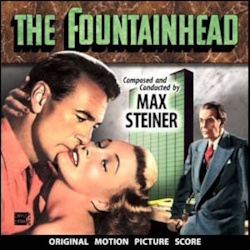 GREATEST SCORES OF THE TWENTIETH CENTURY
Original Review by Craig Lysy
The genesis of The Fountainhead lay with actress Barbara Stanwyck. She had read the 1943 novel by Ayn Rand and coveted the role of heroine Dominique Francon. She sold Warner Brothers Co-CEO Jack Warner on the story and he purchased the film rights for her. Henry Blake was placed in charge of production with a $2.375 million budget, Mervyn LeRoy would direct, and Ayn Rand was hired to write the screenplay with a contractual stipulation that not a single word would be changed. The project floundered for three years due to intervention by the War Production Board. LeRoy left the project and was replaced by King Vidor. Creative control proved problematic with Vidor, Rand and Warner Brothers often at odds. Casting was also problematic as Vidor wanted Humphrey Bogart and Lauren Bacall for the leads, Rand wanted Gary Cooper. In the end Stanwyck was passed over as too old, yet Cooper who was also too old (two decades older than the character) was selected to play Howard Roark. Patricia Neal would play Dominique Francon, joined by Raymond Massie as Gail Wynand, Kent Smith as Peter Keating, and Robert Douglas as Ellsworth M. Toohey.
Ayn Rand was a 20th century philosopher-writer who fostered Objectivism, which posits that man is a heroic being, with his own happiness as the moral compass of his life, with productive achievement as his noblest activity.” This film offered her commentary on the conflict between individualism and collectivism. Her champion is Howard Roark, an individualistic modernist architect who chooses to struggle in obscurity rather than conform by compromising his design aesthetic and artistic vision. He fights to design modern architecture despite resistance from the entrenched traditionalist architectural establishment. In the end he overcomes all obstacles and builds a magnificent edifice the like of which the world has never seen. The film was a commercial success, earning a $611,000 profit. Critical reception was decidedly harsh, finding it preachy and pedantic. The film earned no Academy Award Nominations.
Director King Vidor had previously collaborated well with Max Steiner for “Bird of Paradise in 1932, and as Warner Brothers premier composer, he was assigned to the project. Upon viewing the film, I believe Steiner realized Roark was the nexus of its narrative, and that his personal journey would require his music to his speak to his idealism, his unflinching obstinacy, and his refusal to compromise his design aesthetic and artistic vision to conform and thereby succeed. We also find Roark often at the intersection of powerful emotional dynamics such as sex, power, deception, redemption, and renewal, which would also need to be integrated into his musical storytelling.
 For his soundscape Steiner composed four primary themes, and several motifs. The first two are linked and offer a masculine-feminine juxtaposition. The first theme for Roark, our protagonist, is brilliantly conceived. He builds skyscrapers, which soar to the heavens, and so Steiner offers a questing and aspirational identity that spirals ever upwards in an effort to break free of his earthly bonds so to gain Heaven itself. As such there is a heroic feeling to the theme. Conversely, Dominique’s Theme speaks to her emotional elusiveness and remoteness with an identity that spirals ever downwards cloaked in an unassailable feminine mystic. Also brilliant is how Steiner presages Roarke and Dominique eventually joining romantically. He does so by offering a harmonic linkage of their two themes. A secondary theme, the Struggle Theme speaks to his struggle to overcome the rigid, and repressive forces of the architectural profession, which smother all who dare deviate from orthodoxy and traditionalism. Steiner saw this as the collision between the immovable object and the irresistible force and so offers turbulence, tension, ana swirling tempest, which never resolves.
For our villain Ellsworth Tooley, who opposed Roark’s individualism and fidelity to his aesthetic, I perceive that Steiner had an intuitive understanding of Rand’s conception of this character. He understood that she loved the sumptuous romanticism of her favorite composer, Sergei Rachmaninov. He also was aware of Rand’s anathema for the modern works of Arnold Schoenberg and Igor Stravinsky. As such he conceived to imbue modernism into Ellsworth’s Theme, which offered a sinister, serpentine and dissonant identity, juxtaposed to the romanticism of Roarke’s and Dominique’s themes. Lastly, we have the Redemption Theme, which is not linked to any one character. Rather it offers and inspired identity, which manifests whenever one of the characters undergoes renewal, or achieves redemption. Lastly, we have the character Gail Wynard who is Ellsworth’s boss. He eventually loses control of his newspaper when Ellsworth manipulates and mobilizes staff against him, which forces Wynard’s capitulation in supporting Roarke. Steiner supports Wynard with a variant of Ellsworth’s Theme, which informs us that the tail wags the dog. In the end, when Wynard succumbs to Ellsworth, his humiliation and fall are supported by a dirge.
For “Main Title”, Steiner abandons his iconic Warner Brothers fanfare and instead opens with the heroism of Roark’s Theme, which soars to the heavens, with a questing and aspirational identity that spirals ever upwards in an effort to break free of his earthly bonds so to gain Heaven itself. We flow into the opening credits, which unfolds as script on a book’s white pages. At 0:21 we are buffeted by the turbulent Struggle Theme, which speaks to Roark’s embodiment of the struggle of individualism versus collectivism. “Montage: Roark’s Early Life” at 1:02 we enter the film proper for a three-scene montage. In scene one, Steiner offers a dark and dire musical narrative as Roark is rebuked by the dean for his audacity in deviating from orthodoxy;
“You want to stand alone against the whole world? There is no place for originality in architecture. Nobody can improve on the buildings of the past. One can only learn to copy them. We have tried to teach you the accepted historical styles, but you refuse to learn. You won’t consider anybody’s judgement but your own. You insist on designing buildings that look like nothing ever built before. This school has no choice, but to expel you”.
At 1:32 in scene two Steiner offers Roark’s Theme, shorn of its soaring optimism, and instead smothered as his friend Peter Keating counsels Roark. He counsels that if you want to be successful, you have to compromise with the public’s taste. At 1:52 we segue into the third scene, Henry Cameron, who owns an architectural firm interviews Roark for a job. Cameron, was also a rebel who fought for modernism, but in the end surrendered in order to succeed, descending over time into embittered alcoholism. Steiner brilliantly scores this scene. We open with the music dark and foreboding as Cameron rages against Roark’s audacity, yet when he looks at his modernist drawing, he relents and says as Roarke’s Theme begins to soar, that he wishes that he would have designed something like this when he was young. But the hopeful respite is snuffed out as the drawing reminds him that he sold out. Steiner masterfully captures his resultant anger and bitterness. Yet Cameron socks both Roarke and the audience when he says that he is hiring him. As Roarke departs at 2:34 we close the montage with his theme borne by a solo violin, which nurtures a kernel of hope.
“Cameron’s Heart Attack” reveals an inebriated Cameron walking the streets in the morning raging about his life. Roarke comes upon him and escorts him back to his office, which was once Cameron’s. Cameron rages against the establishment and frets, saying that as his heir, he will suffer the same fate as he did. Yet Roark is impervious declaring that he does not care what people want, nor what the critics say. I have only built four buildings, and the people who want me, will find me. Cameron can take no more, raging against magnate Gail Wynard and his newspaper’s attack dog Ellsworth Toohey. He smashes a window with a T-square and music enters as he collapses. Strings furioso empower a dramatic tempest as Roarke calls for an ambulance. At 0:21 a diminuendo takes us into “The Ambulance”, where Cameron looks out the window as he rambles a litany of regret supported by a musical narrative of futility. At 1:05 he sees a modernist building, and with pride says – I built that. Steiner crowns the joyous respite with the soaring refulgent strings of his Redemption Theme, yet the moment is fleeting and we again descend into the anguish of a life wasted as Cameron orders Roark to burn everything he ever designed; his papers, his drawings, his contracts, so that no trace of his failed life remains. At 1:34 Steiner evokes a heart wrenching pathos as he tells Roark to compromise, or suffer the same fate. Roark refuses, and Cameron says, “God bless you as you are on the path to Hell”, and then expires. At 2:00 we return to Roark’s office where we see him burning the bitter fruits of Cameron’s legacy. Steiner empowers with a heavy, and oppressive, descending dirge of despair.
In “Awaiting the Board’s Decision”, Peter, who is full of himself, visits and announces that he has been made partner at Guy Francon, the premier architecture firm in the country. Peter discovers just how bad off Roark is when he finds a, electricity cut-off notice, an eviction notice, and that Roark only has $14 to his name. Peter offers him cash, but Roark refuses, say things will work out. Peter makes a last effort to convince Roarke to compromise, build the same buildings everyone else does, and become rich like him. Roark again refuses saying he will stand alone. Peter departs, the phone rings, and he is informed that a decision by the Security Bank of Manhattan is postponed until Monday. Roark accepts the news with full understanding that he may be evicted before that. He ends the call, supported by a plaintive woodwind borne rendering of his theme. We shift to the board office at the bank, where they announce at 0:14 that he has earned the contract and his theme soars joyously until they say, there is a caveat. That he must soften the structure with classical elements. They bring out molds that transform the modernist base, as well as a classical relief embellishment. They say it is a compromise, joining the past and future so everyone is pleased. “Ellsworth Toohey” reveals that Roark stuns the board by refusing to compromise his aesthetic. He is told this will surely end his career as no one will hire him. He responds without flinching, that he would rather work as a day laborer than compromise, and walks out. The camera shifts to the far end of the table and the pompous Ellsworth Toohey is introduced, supported by repeating quotes of his modernist, serpentine and sinister theme. We discover that he is the mastermind that recommended Roarke, and then the modifications of his design. When asked why, he answers, as an experiment, and that they now consider another architect.
In “Wynand and Toohey”, an ominous Tooley Theme resounds (not on the album) as the camera reveals grand signage displayed on an ornate, Corinthian columnated building, modelled after a Greek temple – “New York, The Banner, The Newspaper For The People” – and we shift to the grand office of Gail Wynand, owner of The Banner. Toohey promotes his choice of architect for the Security Bank of Manhattan, Peter Keating. He offers poster displays of his collective works, which Wynand disparages as mere copies of ancient works. Toohey responds by disparaging modern architecture promoted by individualists. He asserts that artistic value is achieved collectively by each man subordinating himself to the standards of the majority. Wynand knocks the poster display to the floor, and offers with disdain that every architect he has hired is as unoriginal and inept as the other. He returns to his desk, and has an epiphany. The dissonant Toohey Theme supports as he tells Toohey that he has a good idea, and will make is decision on the Banner’s architectural experts. He opens the latest edition, which display Toohey’s latest column, but the camera shifts to the next page at 0:21, supported by a nascent string borne Dominique Theme as he says I will also consult a rival. The screen displays a column; “Your House” by Dominique Francon. Toohey’s Theme shifts to an agitato as Wynand decides to depart and visit her at her home, her theme joining as he leaves the aggrieved Toohey. At 1:09 we segue atop strings dramatico into “Down the Airshaft” as we see Dominque poised at an open window cell holding a classical statue. She drops it down a courtyard air shaft, its descent carried by a descending piano glissando. A diminuendo of unease follows, dissipating as Wynand enters unannounced.
“Dominique’s Fear of the World” reveals an interesting emotional dynamic between Dominique, and her boss, Wynand. He speaks of the bank project and how he is considering Peter, your fiancé for architect. She says he is a third-rate architect, and has no interest in him or his work. Wynand is covetous, and seeks just what she desires to be happy, to no avail. Undeterred, he invites her and Peter to his place for dinner tonight. Her theme on strings enters as she describes how she shattered a statue she bought in Europe so she would not have to love it. With each phrase reprise of her theme, there is an increase in agitation and evidence of a mind in conflict. We feel this as much in Neal’s performance as Steiner’s music. “A Woman Incapable of Feeling” reveals Wynand offering Peter the commission with the caveat that he calls off his engagement to Dominique. Peter is taken aback, but when Dominique does not protest, he accepts Wynand’s proposal and departs. Now alone, Wynand reveals just how amoral and unscrupulous he is, declaring there are no honest people, or people with integrity, and that everyone can be bought. She asks, so this was to justify yourself to me? He answers yes, she asks why, and he takes her into a kissing embrace. Music enters with emotional juxtaposition. Her theme is warm now buttressed by French horns, yet she is cold, and unresponsive to his amorousness. He pulls back and she declares that she is one of those women incapable of feeling, and unwilling to surrender to love. He is undeterred and at 0:38 a crescendo dramatico empowers him declaring that he will wait no matter how long. She answers that if she ever decides on self-punishment, she will agree. The crescendo crests and then dissipates on a falling diminuendo as she says she is going to stay with her father so she will not have to see anyone. When he asks what she is really seeking, she says, freedom… to want nothing, to expect nothing, and to depend on nothing. At 1:07 we segue darkly into “The Sound of Blasting” where we see Roarke working as a laborer in a granite quarry, where he detonates an excavation explosion. We shift to Dominique waking up in the morning empowered by a hopeful rendering of her theme, adorned with harp glissandi with intrusions of the explosions drawing her to the window.
“The Quarry” offers a score highlight. Dominique takes a stroll to her father’s granite quarry and gazes at the men working with tireless monotony to wedge separate the granite into blocks. Music enters as she notices Roarke, and becomes enraptured. By chance, as he wipes the sweat from his face, he notices her. Their eyes lock, and a powerful emotional attraction and desire, smolders, empowered by Dominique’s Theme shimmering in the upper register atop violins, joined by flute, and draped with an ethereal vibraphone resonance. The confluence achieved in the wordless scene is, sublime. In “Dominique Fantasizes About Roark” the quarry superintendent recognizes Dominique and offers her a tour. As they walk past Roarke a yearning rendering of her theme, joins, and is sustained in the following scene where she combs her hair as she looks lost in thought into her make-up table mirror. At 1:15 his image appears in her mirror and her theme transforms into a dreamy, surreal iteration with a xylophone expressing his drill. “Dominique Smashes the Marble” reveals Dominique on another visit to the quarry. Again, their eyes lock, with mutual desire. She asks him to stop looking at her lest she have him fired. Unflinching, he calls her bluff and offers to call the superintendent. She then tells him, that in the future he should stop looking at her as it may be misunderstood. Music enters on her theme as he responds, I don’t think so. She then turns and departs attempting to suppress fluster. At 0:06 we see her back at her bedroom unsettled, and almost crazed with her theme rendered as an agitato of desperation. At 0:31 a frenzied accelerando by violins furioso propel her across the room to the fireplace, where dissonance engulfs us as she grabs a poker and repeatedly slams it into the front hearth marble, gouging it. She then goes to the telephone and makes a call, and her theme, regains composer, shifting to a dreamy rendering full of anticipation. Roarke arrives, and Dominique orders him to replace the gouged marble slab, which he does as she leers at him.
“The Wrong Man” reveals Dominique paying Roarke with a large tip, and asking him to return and set the slab. We close with a quote of her theme, draped with disappointment. The next day Dominique waits in a night gown and we close with dissonance of exasperation as a diminutive bald man arrives, frustrating her plan for seduction. “Dominique’s Wild Ride” offers and the following cue offer score highlights, enduring testaments to Steiner’s genius. It reveals her riding on her horse, crop in hand, in a crazed frenzy. Steiner propels her in this state of mind with a frenetic galloping narrative, achieving a riveting synergy. She spots him walking home, and charges as the tempest shifts to rage. At 0:43 she reaches him and the music dissipates as she asks why he did not return to set the marble. When he answers; “I did not think it would make any difference to you who would come, or did it Miss Franco?” This enrages her and at 0:51 she strikes him on his cheek with her riding crop, which Steiner punctuates, and then rides off carried by the frenetic tempest. At 1:03, we segue with an ominous statement of the Struggle Theme into “The Rape” as Roarke walks into Dominique’s bedroom from the terrace and finds her at her make-up table. Their eyes lock, she flees to the door, but is caught. He forces her into his arms, she beats on his chest, but then acquiesces as they kiss passionately. She then runs to the terrace, trips and falls, and lay weeping as Roarke comes to her. He smiles and we see in his eyes that matters are not finished, with the rape not filmed, but implicit. Steiner’s music transcends the scene by informing, and expressing everything forbidden by the censors, of all that was felt yet unspoken. Dominique’s Theme is the substrate of the musical narrative, infused and empowered by the intersection, and collision of passion, desire, and fury, offering an astounding musical passionata. We segue into “Enright’s Letter” at 2:13 as Roarke returns to his boarding room carried by a lingering Dominque’s Theme. He lights a candle, finds a letter, reads it and at 2:31 his theme soars as the letter from millionaire Roger Enright, who says he admires his work, and offers him a job building his special project. Yet the joy dissipates, replaced by a reprise of a passionate Dominique’s Theme, which informs us that he is conflicted. He begins to pack, informing us that his passion for architecture is greater than his passion for Dominique. Steiner supports with a molto tragico rendering of her theme. At 3:23 we segue into “Roark is Gone” as his soaring theme supports the arrival of Dominique at the quarry. The superintendent informs her that he left for New York two days ago. Dominique had nurtured hope in her belief that love may indeed be attainable, only to find herself betrayed. We close with a tragic statement of her theme, punctuated with a coda of anger.
“What is Toohey After?” reveals editor Alvah Scarret fretting to Toohey and Dominique that he needs to embark on a new crusade to boost sales. Toohey tosses a magazine with a photo of the Enright Apartment building, an appalling testament to modernism, which must be vilified. As they leave, Toohey’s malignant theme joins when he admits to Dominique that it is a great building, and that she will know what he intends in due time. In an intervening unscored scene, Dominique’s entreaties to Wynand to suspend his paper’s attack on the Enright House fails, as he values greed more than architectural greatness. She will have no part of this, and resigns. The cue resumes at 0:08 in “Montage: Toohey’s Crusade” as we see a narrated newspaper montage vilifying both the Enright Apartment tower and its ‘incompetent and amateur’ architect Howard Roarke. Steiner supports this diabolical campaign with Toohey’s Theme, which each iteration as repulsive as the next. At 1:26 we segue into “Construction of the Enright House” atop Roarke’s ennobled Theme. The theme soars to the heavens empowered by horns brillante as Enright and Roarke marvel at its magnificence, which dwarfs all the buildings around it. Enright intends to show his contempt for all their critics by hosting a ball to inaugurate the building’s opening. We flow seamlessly into “Piano for Secondhanders” soaring on Roarke’s Theme as we behold the magnificent tower alight at night. Inside Steiner supports the ambiance with solo piano piece infused with the dissonance of the many critics we see.
“Dominique’s Theme for Piano” offers a soft, and lyrical extended rendering of her theme on solo piano, which supports the arrival of Roarke. At 1:57 we flow into “In Roark’s Apartment”, another brilliant masterpiece of a cue. We see him relaxing alone in his apartment. Dominique arrives and the two drop all pretenses. Steiner offers a turbulent romanza woven from Dominique’s Theme, led by a solo cello romantico, as we bear witness to her progressing through an ever-shifting sea of emotions, surging on a number of crescendos full of yearning and passion, which in the end, never bear fruit. She pleads that she cannot bear to see him destroyed, and that she loves him. At 3:10 a dramatic, breath-taking, crescendo appassionata swells as she adds that she cannot remain to see him destroyed because they hate you for your greatness, your integrity, your individualism, and that they cannot corrupt or rule you. She says she will leave him rather than see him destroyed. He moves closer and she drops the last of her defenses and surrenders as he takes her into his arms, lifts her, and carries her to the sofa where they embrace and kiss. Her theme softens as he responds that he loved her from the very first moment he saw her. He says he cannot change, and if she is going to leave him? She answers yes, and he says he will not stop her. She then says she does not want to leave and counters with an offer of marriage, a new life in a small town, and her selfless love if he gives up architecture. His theme joins presaging his answer when he says he wish he could tell her it was tempting, and she says, yes or no, to which he replies with a firm no, buttressed at 5:43 by horns of rejection. We flow into a marcia funebre, an allegory which informs us that Dominique has given up. As she grabs her coat and he says that she must learn to not be afraid of the world, and that when she learns this lesson, she will come back to him. He adds that they will not destroy him, that he loves her, and to come back to him. As they join in a parting kissing embrace, we close softly on her theme. “Dominique Agrees to Marry Wynand” reveals her the next day in a speedboat racing to Wynand’s yacht, on which he is returning from vacation. He greets her and she makes an unexpected declaration, that she has decided to marry him. He is very happy, says he does love her, and that he will grant her everything she wishes. He takes her into an embrace where he kisses her neck, and as she looks across the river to the imposing Enright building, Steiner informs us of the man she truly loves, by reprising the cello romantico iteration of her theme used to express her love for Roarke.
The following four cues support a complex, multi-scene narrative, which Steiner scores masterfully. “Blackballed” reveals Roarke suffering the loss of another commission due to the malignant machinations of Toohey, which is supported by a sinister rendering of his theme. At the elevator he looks down through a window and dark chords resound when he discovers Dominique in a wedding gown, entering a limousine with Wyland. This only serves to add insult to injury, and a wounded, rendering of his theme carries his entry into the elevator. At 0:37 we segue darkly into “Montage: Roark Defeated”. It reveals a montage of Roarke walking the streets of New York viewing building projects whose commissions he failed to win, again due to Toohey’s relentless campaign to destroy his career. Toohey’s Theme permeates this montage, mutating into an oppressive marcia della sconfitta. At 1:35 the march dissipates and we segue into “But I Don’t Think of You”. It reveals a chance encounter between Roarke and Toohey in front of a building project, that Roarke lost. Toohey, who is proud of his diabolical handiwork, and buttressed by his theme, declares that it was by his doing that Roarke’s career had been destroyed. His insatiable ego compels him to ask Roarke what he thinks of him. In a shattering rejoinder Roarke, states; “But I don’t think of you”, and then walks away leaving Toohey for the first time in his life, speechless as his theme fades to nothingness. At 2:25 we segue on an ascendent Roarke’s Theme, into “Montage: Roark Ascendant”. It reveals the indefatigable Roarke’s resolve rewarded as he breaks through Toohey’s machinations to win a series of impressive commissions. A montage follows with a musical narrative borne of declarations of his theme crowning the transformations of his drawings into actual buildings; a gas station, a store, and a farm. At 3:06 his theme swells on a crescendo magnifico when we behold a stunning modernist seaside mansion. Thematic declarations continue with an office building and lastly, a factory. At 3:39 we segue darkly into “Roark Interviewed”. It reveals him being interviewed atop one of his buildings. Toohey’s sinister theme reprises as he is asked how he managed to thrive despite the relentless attacks by Toohey and The Banner’s smear campaign. Roarke’s Theme soars as he declares that men of vision see through this, adding; “Any man who calls for me, is my kind of man”. We close on his theme as we see him arriving at his office.
We flow seamlessly atop a grotesque Toohey Theme into “Summoned by Wynand” as his secretary advises that he has an appointment at 3:00 pm with Gail Wynard. At 0:10 ominous chords reveal the arrival of Roarke. A calm, yet assured statement of his theme carries his walk to Wynard’s desk. The rest of the scene is unscored. Wynard lauds Roarke for the magnificence of his design aesthetic and requests that he build a grand house, an edifice to both his ego, and temple of love for his wife. Roarke struggles, yet maintains his composure, and when pressed, agrees to build it. When told he will be introduced to his wife, Roarke informs Wynard that they have met, to which he replies, good, then you understand what I desire. “Dominique Assails Wynand” reveals Wynand returning home and finding Dominique in the parlor. We discover that his love for her is unrequited, but she admits that she is comfortable and no longer hates him. He then says he brings good news, that he has hired Howard Roarke to build their dream house. The first 18 seconds of the cue, which was dialed out, reprise the frenzied music of the “Dominique’s Wild Ride” cue. Music enters as a dire, stepped chordal descent with Wynand’s revelation. Dominique is horrified and her impassioned, yet tortured theme surges with fury as she reminds Wynand of his smear campaign against Roarke. A decrescendo dramatico supports her declaring he was just another genius you threw to the mob. Wynand admits he had forgotten, and Roarke did not remind him. Dominique interrupts, and declares, because he knew he had won, and beaten you. This enrages his ego and Wynand vows to break him, declaring that nobody beats me. But she says that he is a man of integrity that you cannot break. To which he replies, I can. Most interesting is that Roark’s Theme joins at 1:09 without bravado, gaining increasing strength and as Wynand becomes more and more resolute to break him. At 1:37 a forthright and confident Roark’s Theme supports the architectural drawing of the Wynand house.
In “Wynand Tempts Roark”, and the following cue, Steiner demonstrates his mastery of his craft. Wynand repeatedly taunts Roarke with The Banner smear campaign against him, which he declares he fully supported. Yet Roarke is impervious, and does not take the bait, deflecting salvo after salvo saying he has forgotten it, and so should you. Unable to breach Roarke’s steely impassiveness, he declares a threat; sign a contract to build all my buildings in the future and become enormously wealthy, or refuse and I we see that you never build again. He states that he wants you design his buildings as the public wishes them to be designed; colonial houses, Rococo hotels and semi-Grecian office buildings. You will take your genius, and subordinate it to the tastes of the masses. That is what I want, and Steiner punctuates it with a dire chord. Roarke says he agrees, and at 0:09 a spirited scherzo energico unfolds as he grabs a blank drawing sheet and offers a new version of Wynand’s house, which is non-distinct, predictable, and banal. He shows it at 0:41 to Wynand, asking is this what you want? Howling trombones sardonica and shrill dissonance support him saying of course not! Roarke then tells him to shut up and to never again try to coerce him to change his design aesthetic. At 0:48 Roarke’s forthright theme resounds as he adds that the two of them are cut from the same cloth, self-made, but that Wynand chose the wrong path to succeed. At 1:03 Wynand maneuvers Roarke into a cull-de-sec, where he must accept an invitation to join him and Dominique tonight for dinner and the presentation of his design plans for their house. Steiner offers a musical narrative that weaves together dark comedy joined by Dominique’s Theme. At 1:47 we segue darkly into “Dominique and Roark Reunited” with two-note phrases of dread as Dominique sees the drawings, and Wynand goes to greet Roarke. Their reunion is friendly, cordial with neither revealing any discomfort. A gentile Dominique’s Theme supports under the dialogue, yet we discern a subtle undercurrent of yearning. Both men declare they offer the house as a temple for her and declare victory, which elicits Dominique to ask Roark, if he ever withdraws feelings once granted? Roark answers no with firm resolve, which shatters her inwardly. At 2:52 her theme descends into the pathos of regret, cresting torturously at 3:21 when she realizes that she is still in love with Roarke, and declares that she could never live in that house! Yet she regains composure, apologizes, saying after the Enright House… To which Roarke replies, please forget the Enright House.
In an unscored scene, Peter complains to Toohey that his career is floundering since Francon retired. He begs him for the massive government low rent Cortlandt Housing project. Toohey gives him the plot diagrams and tells him if he succeeds in presenting a plan that solves all the project’s problems, he will advocate for his hiring. We flow into “Roark Agrees to Design Cortlandt” as Peter begs Roarke to help him. Roarke agrees under very strict conditions; Peter may take all the money, public credit, but there are to be no changes to his design, no changes by you or anyone. Peter agrees, gives his word and as they shake. A triumphant Roarke’s Theme is declared and animates a narrative as a newspaper headline reports that the Cortlandt challenge had been solved, and the design of architect Peter Keating accepted. “Dominique’s Jealousy” reveals Wynand, Dominique and Roarke resting on the lakefront of Wynand and Dominique’s new home. The newspaper displays the winning design for Cortlandt by Peter Keating, but both inform Roarke that it is clear that he designed it. Roarke refuses to discuss it. Wynand then decides to invite Roarke on an extended cruise on his yacht, which he accepts, which elicits jealousy by Dominique. Wynand departs to make celebratory drinks and Dominique’s Theme joins in its distorted, conflicted iteration, which reflects her inner turmoil. She begs him not to go, admits that she is jealous of the time and company he gives Wynand, but he shuts her down firmly with; “I do not want to discuss it, Mrs. Wynand”.
In an unscored scene Wynand and Roarke are on the deck of his yacht. He points to the location overlooking he harbor where he wants Roarke to build an edifice to his life, the greatest of all buildings, the Gail Wynand building by Howard Roarke. Roarke already envisions its design in his mind, and agrees to build it. We flow into “Keating is Overruled” atop a proud Roarke’s Theme as we see his miniature model of the Cortlandt project displayed. The theme slowly loses vitality and dissipates into despair as the owners advise Peter that they have hired two additional architects to assist, given the size of the project, and agreed to changes to the design. Peter objects, is overruled, and told to sue if he does not accept their decision. We segue seamlessly into “Cortlandt Homes” atop a cymbal clash as one of the architects smashes a part of the miniature’s buildings and declares, let’s get to work. At 0:10 a mutated, and corrupt iteration of Roarke’s Theme supports him joining Peter to gaze upon the mutilation of the clean lines of Roark’s design aesthetic, now marred with balconies and Greco reliefs. Peter explains that he fought, but was overruled and marginalized. The music builds with mounting fury, which externalizes Roark’s rage as we see him resolved to exact revenge. At 0:56 we segue into “Roark Plots with Dominique” atop of a foreboding Dominique’s Theme as we see Roarke in his office reviewing his blueprints for the Cortlandt Project. She arrives, he tells her to go, but she refuses. She declares that she remains in love with him, reminded everyday by the house he designed, and that she cannot bear it anymore. At 1:05 her yearning theme, borne by cello romantico shifts at 1:33 to violin with harp adornment as her entreaties of love become more intense. We blossom on full orchestra as she declares she is leaving Wynand. At 2:27 an ominous musical narrative of ill-purpose unfolds as he asks if she will assist him without conditions, and she agrees. He reveals his plan and tasks her with driving up to Cortlandt next Monday at 11:30 pm.
“Roark Dynamites Cortlandt” reveals Dominique arriving at the night watchman’s shack. She says she is out of gas and asks if she can call for assistance. He says no because the lines just went down. She gives him $20 and asks him to go to a station down the road and he agrees, which paves the way for Roarke to enter unnoticed. Once the watchman is out of sight, music enters as flight music, which propels her across the work site until she reaches a ditch, which she jumps into. An interlude of silence is shattered at 0:16 by an eruption of the Struggle Theme joined by cascading explosions, which consume the Cortlandt monstrosity. The theme slowly dissipates as she runs back to her car, which has been damaged by raining debris. A defiant Roarke’s Theme rises from the ashes as she gets into the car, throws dirt over herself, and then slices her arm with a glass shard. Police arrive, find Roarke by the plunger, and he declares; “Arrest me. I’ll talk at the trial.” At 1:20 we segue into “Toohey’s Rally” where he raves as a demagogue, vilifying Roark’s egotism, and calling for his complete and utter destruction. Steiner supports by shifting Toohey’s theme from a lurking, malignant and slithering form, to one that is overtly strident and vengeful, culminating on a horrific crescendo grottesco. At 1:54 we segue into “Wynand’s Soliloquy”, where he offers to the camera, an impassioned soliloquy exalting Roarke, and in support of egotism. Steiner again reveals his mastery of insight by supporting with a reprise of the Struggle Theme iteration used in the cue 10; “Dominique Smashes The Marble”, thus musically linking Dominique’s love and Wynand’s admiration, to Roarke.
“Wynand Crusades for Roark/Hospital Visit” reveals Wynand, for the first time in his life embracing integrity and against all the odds, catalyzing with The Banner, a crusade to save Roarke. He relates his plan to Dominique who is recovering from a near fatal self-inflicted cut, as she severed an artery. She supports Wynand and they both stand united in their support of Roarke. Music enters with the Redemption Theme, which supports a montage of The Banner headlines defending Roarke. At 0:20 we commence a musical passage, which supports Roarke, who is out on bail, visiting Dominique at the hospital. A
a solo violin d’amore emotes Roarke’s Theme as he holds her hand affectionately and confesses his love. He wants to begin a life together; however, he is wary of the trial establishing a connection if they declare their romance publicly. He says they should wait lest she be implicated, and if he is convicted, she should remain with Wynard for her and his benefit, and never disclose our love. At 1:18 her theme, also draped romantically with harp adornment, joins and supports her belief that he will be acquitted. But she adds, that if he is, it will not break her as she is no longer afraid of them. At 1:49 we segue into “Keating’s Confession”, which was dialed out of the film. It was intended to support Toohey brow beating Peter into confessing that Roarke, not him, designed Cortlandt. Peter, now a sobbing broken man, succumbs and writes down his confession. The cue begins with dire chords, which portend doom. The narrative is animated by a malignant extended rendering of Toohey’s Theme. I believe having watched it with and without the music, that this was a creative error as the confluence of music and Toohey’s oratory brought out his irredeemable malevolence.
(*) “Toohey Strikes” reveals Wynand meeting with Roarke and Dominique in his home. He informs the unrepentant Roarke that he is using his power through The Banner to sway public opinion, and by time the trial starts, no jury in the world will convict you. He gloats at his power, but is interrupted by a phone call from managing editor Alvah Scarret. He is stunned to learn that Toohey forced Keating to confess, that all the other papers ran the story as a headline, and that he had to follow suit. Wynand departs and advises Roarke he will fight with every resource he owns. Wynand returns to the office and is informed by Alvah that everyone has quit on Toohey’s orders. Wynand remains defiant as Toohey arrives and informs him that while he was out making money, he was accumulating power, and now wields it over the staff. He orders Wynand to rehire him to run The Banner as Managing Editor. Wyland, is defiant, orders him out, and Toohey leaves with an assured smirk. In (*) “The End of The Banner” Steiner reprises his oppressive Marcia della Sconfitta Motif from cue 17 “Roarke Defeated”, concluding with a threnody by strings affanato. This time he employs it as an allegory for the death of The Banner and Wynand, as hired protesters march with a sea of signs; “We Demand Jail for Howard Roarke”, “We Demand Reversal of The Banner’s Policy of the Cortlandt Case”, “Down with Gail Wynand”, “We Demand Ellsworth Toohey be Rehired” and “We Don’t Read Wynand”. In a scene shift to an elite social, Toohey’s malevolent Theme supports as drinks are served with napkins, which read; “We Don’t Read Wynand.” We conclude with a tempest of violence empowered by the Struggle Theme as paid henchmen overturn and vandalize a Banner’s newspaper stand.
In (*) “Dominique’s Offer”, back at the office, a frustrated Alvah informs Wynand that no one will return to work no matter what salary he offers. When he asks how long can we go on like this, dark portentous chords punctuate his response; “Until the end”. A musical descent of woe carries Wynand to his office where he finds Dominique. She asks for her old job back, which a thankful Wynand approves, asking her to take charge of the city desk as he holds her hand affectionately. Steiner offers juxtaposition, offering Roarke’s Theme on a solo violin tenero to support, thus informing us that her decision is guided by her love for Roarke, not Wyland. Roark’s Theme permeates the subsequent scenes as we shift to the loading dock, we see truck load after truck load returning bundles of unsold newspapers. The foreman says this can’t go on much longer. Steiner sow melancholia as we return to the Banner. A pall of despair has descended as Dominique brings Wynand coffee, only to find him passed out, exhausted. He wakes and her comforting theme on solo cello tenero supports her affectionate hug. He has an epiphany, and declares that he never really had any power, that he was not the ruler of the mob, but instead, its tool. In an unscored scene the Board of Directors confronts Wynand and issues an ultimatum; rehire Toohey, reverse our position on the Cortlandt Case and come out against Roarke, or shut down The Banner. Wyland ponders, and then with resignation, agrees.
We flow into “Wynand Surrenders” a score highlight where Steiner’s music achieves a sublime confluence. We open with despair bound to the Marcia Funebre Motif, as an opinion piece by Gail Wynard offers a personal condemnation demanding that Howard Roarke bear the fullest penalty the law can impose. We shift to the streets atop an aching threnody by strings affanato where Wyland, in the rain, picks up a rain-soaked Banner paper from the street. It falls apart in his hands, an allegory marking his demise, and he sits, a defeated man, as we conclude with a molto tragico declaration of Roarke’s Theme. In an unscored scene Roarke offers a soliloquy condemning Collectiveness, and extoling the virtue of Rand’s Objectivism, which she described as; “the concept of man as a heroic being, with his own happiness as the moral purpose of his life, with productive achievement as his noblest activity, and reason as his only absolute.” After he rests his case, the Judge issues jury instructions and dismisses the jury and we flow into “The Jury Deliberates” atop a grave chord. Steiner supports the wait with a soft musical narrative with a slow building crescendo as the camera shifts between shots of Roarke, Dominique, and Wynand who sits alone and isolated in the back of the court. At 0:31 the stepped crescendo gains force, as a knock is heard on the jury door. We crest powerfully at 0:47 with a dramatic declaration of the Struggle Theme as the jury enters and take their seats. A soft gong is heard as the Not Guilty verdict is announced. We soar at 1:18 on a victorious Roarke’s Theme. At 1:30 the Struggle Theme resounds as Roarke and Wyland’s eyes lock, and Wyland bolts the courtroom. At 1:45 Roarke meets with Enright in his office and he is awarded the contract to rebuild Cortlandt as he originally envisioned. Steiner supports the triumph with a soaring Redemption Theme.
“The Call from Wynand” reveals Roarke’s secretary joining to inform him that he has received an invitation from Mr. Wyland to meet in his office. Roarke agrees and his theme carries him into Wyland’s office. Wyland is impassive and cold. He advises that he has shut down the Banner and hands Roarke a contract. He is to build the Wyland tower, has full creative control, but with the caveat that it is to be the tallest building in the city, and that he never wants to see him again. After the contract is signed, both men stand, gaze at each other in silence, and Roarke departs. Before he reaches the door, Wyland states that the building was to be built to commemorate my life, but now, there is nothing to commemorate. He says to instead build it as a monument to that spirit, which is yours, and could have been mine. After Roarke leaves, Wyland pulls out a pistol from his desk drawer and commits suicide. “Finale: The Wynand Building” reveals a ground to sky shot of the Wyland tower, which soars unto the heavens and a sign that reads; The Wyland Building, The Tallest Structure in the world. Howard Roarke Architect. Steiner offers a heroic declaration of triumph as Mrs. Dominique Roarke arrives. She takes an open-air construction elevator to join Howard on the roof, and as she ascends, her theme sheds its sadness and discontent, blossoming with happiness, as her life at last blessed with her true love. We now see Roarke atop waiting for her arrival, and we conclude the film in grand fashion swelling on a crescendo glorioso, which ends with a flourish.
I would like to thank James d’Arc and his technical team efforts to restore Max Steiner’s masterful score to “The Fountainhead”. The CD source was the composer’s estate’s acetate discs. These were transferred and restored, however cue eight, had to be restored from other sources, and audio imperfection is noticeable. Lastly, music for three scenes were lost. Despite the Herculean efforts of the technical team, the archival monaural sound remains. While happy to have the album, it really requires a re-recording to bring out the magnificence of Steiner’s handiwork. The film offered exceptional acting by the ensemble cast, but its narrative was preachy and pedantic. Steiner, understood the emotional dynamics of each of the four principal characters and crafted a score for the ages. His soaring and heroic theme for Roarke, our protagonist, reaches for the heavens as do the magnificent skyscrapers he designs. Roarke is indefatigable and his theme weathers every storm, joined by his Struggle Theme, which empowers his struggle to overcome an establishment that seeks to destroy him. The score’s most emotional music comes from Dominique’s Theme, which spans a potent spectrum, achieving the score’s most powerful and passionate romantic moments. Our villain, the malevolent and diabolical Toohey offered an insidious, slithering, dissonant, modernist identity, which I found most interesting since in the film, he was Roarke’s adversary, viscerally opposed to modernist architecture. In reality, Steiner musical conception was directed towards author and screenwriter Ayn Rand who hated modernist composers. Also impressive was Steiner’s use of musical allegory, using a march of defeat to express defeats in Roarke and Wyland’s life, as well as a funeral march, which also incorporated a threnody by anguished strings for the death of Wyland’s paper, as well as his demise. Folks, in many ways I believe Steiner’s music transcended the film, elevating its narrative, and achieving a masterful emotional confluence with the acting performances of the ensemble cast. In scene after scene, we again must acknowledge Steiner’s genius in grasping and expressing conflict and complex emotional dynamics. I recommend the purchase of this album, as well as watching the film to bear witness to the power of film music.
For those of you unfamiliar with the score, I have embedded a YouTube link to an eight-minute suite; https://www.youtube.com/watch?v=MH8qxeCMKs8
Buy the Fountainhead soundtrack from the Movie Music UK Store
Track Listing:
- Main Title/Montage: Roark’s Early Life (2:53)
- Cameron’s Heart Attack/The Ambulance (2:31)
- Awaiting the Board’s Decision (0:25)
- Ellsworth Toohey (0:33)
- Wynand and Toohey/Down the Airshaft (1:30)
- Dominique’s Fear of the World (0:41)
- A Woman Incapable of Feeling/The Sound of Blasting (1:51)
- The Quarry (1:26)
- Dominique Fantasizes About Roark (0:36)
- Dominique Smashes the Marble (1:06)
- The Wrong Man (0:22)
- Dominique’s Wild Ride/The Rape/Enright’s Letter/Roark is Gone (4:04)
- What is Toohey After?/Montage: Toohey’s Crusade/Construction of the Enright House (1:53)
- Piano for Secondhanders (2:06)
- Dominique’s Theme for Piano/In Roark’s Apartment (6:24)
- Dominique Agrees to Marry Wynand (0:39)
- Blackballed/Montage: Roark Defeated/But I Don’t Think of You/Roark Ascendant/Roark Interviewed (4:27)
- Summoned by Wynand (0:28)
- Dominique Assails Wynand (1:48)
- Wynand Tempts Roark/Dominique and Roark Reunited (3:44)
- Roark Agrees to Design Cortlandt (0:42)
- Dominique’s Jealousy (0:34)
- Keating is Overruled (0:26)
- Cortlandt Homes/Roark Plots with Dominique (3:15)
- Roark Dynamites Cortlandt/Toohey’s Rally/Wynand’s Soliloquy (2:49)
- Wynand Crusades for Roark/Hospital Visit/Keating’s Confession (4:11)
- Wynand Surrenders (0:55)
- The Jury Deliberates/The Call from Wynand (2:26)
- Finale: The Wynand Building (2:30)
Brigham Young University and Film Music Archives FMA-MS114 (1949/2004)
Running Time: 57 minutes 15 seconds
Music composed and conducted by Max Steiner. Orchestrations by Murray Cutter. Recorded and mixed by XXX. Edited by XXX. Score produced by Max Steiner. Album produced by James d’Arc.

Shop at the Movie Music UK Store

Member of the

 MOVIE MUSIC UK