GOLDENEYE – Éric Serra
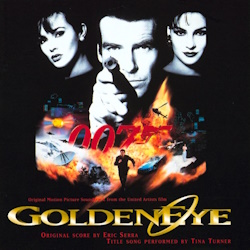 THROWBACK THIRTY
Original Review by Jonathan Broxton
Six years after Timothy Dalton vacated the role, in the wake of the comparative commercial flop of License to Kill, and after several years of protracted contract negotiations, legal disagreements and financial disputes at MGM, and stalled screenplay ideas, James Bond returned with a new face, a new style, and a new sound in 1995 with GoldenEye. Having been previously thwarted by the fact that he was contracted to play Remington Steele on American television in the 1980s, the producers finally cast Irish actor Pierce Brosnan as their preferred 007, and the main supporting cast was rounded out by Sean Bean, Izabella Scorupco, Famke Janssen, and Judi Dench as M, the new head of MI6. New Zealander Martin Campbell was hired as director, and the screenplay was credited to Jeffrey Caine and Bruce Feirstein, based on a story by Michael France.
The film opens with a thrilling prologue set in the mid-1980s, where Bond and his partner Alec Trevelyan (Bean) infiltrate a Soviet chemical weapons facility. The mission goes wrong and Trevelyan is apparently killed, forcing Bond to make a daring escape. Nine years later, in the post–Cold War era, Bond is sent to investigate the theft of a powerful satellite weapon system known as GoldenEye, which can emit an electromagnetic pulse capable of devastating any target. The system is hijacked by a crime syndicate led by the mysterious Janus, who is soon revealed to be Trevelyan, alive and seeking revenge against Britain for betrayals committed decades earlier. Bond’s mission to stop Janus takes him from Monte Carlo to Russia and Cuba; he is aided by Natalya Simonova (Scorupco), a computer programmer from a Soviet satellite control center destroyed by Janus, but faces formidable opposition from Janus’s psychotic assassin henchwoman Xenia Onatopp (Janssen), who kills her victims with her legs during moments of violent pleasure.
The movie was a huge critical and commercial success, grossing over $350 million at the box office worldwide, and re-establishing Bond as a viable modern franchise. I personally consider the film to be the best of the Brosnan Bonds, and I think it contains the best Brosnan performance: he successfully combines Roger Moore’s lightness and suave charm with elements of Timothy Dalton’s darker, morally ambiguous, more introspective Bond, offering the best blend of both portrayals. The Brosnan Bonds tended to become sillier and more far-fetched as the franchise progressed through the 1990s, but GoldenEye remained for me the high point of his tenure.
 GoldenEye was also an important stepping stone for James Bond in musical terms. With John Barry having definitively left the franchise after The Living Daylights in 1987, and with Michael Kamen not being asked to return after License to Kill in 1989, producers Michael G. Wilson and Barbara Broccoli had to find a new voice for the franchise. Their first choice was apparently Robert Folk – what a mouthwatering prospect that would have been! – but instead they eventually hired French composer Éric Serra to write the score, as Serra was signed with Virgin Records, which had an existing all-encompassing soundtrack deal with the production company.
Serra was best known at the time for his collaborations with French director Luc Besson, notably scores such as The Big Blue, La Femme Nikita, and Léon: The Professional, which had been a popular international hit the previous year. Serra’s style leaned toward synth-driven, atmospheric, and minimalist textures, which were very modern for 1995, but far removed from the lush, brassy orchestral sound traditionally associated with Bond. As such, Serra approached GoldenEye almost as if it were a techno-thriller, not a classic spy film. His music makes heavy use of electronic percussion, samples, and processed sounds, features sparse melodic content with long stretches of ambient underscore, and adopts a cool, detached tone, ostensibly to reflect the film’s post–Cold War, cyber-age setting. But more on that later.
Any discussion of Bond soundtracks must always start with the song, and this time around the song in question is “GoldenEye,” written by Bono and The Edge of U2, and performed by American rock legend Tina Turner. The song channeled the sultry, powerful feel of the classic Bond themes, and was full of lush strings and bold brass stabs bolstered by more modern electronic percussion, while Turner herself did her best Shirley Bassey impression with her commanding vocals. It bridged the gap between vintage 1960s Bond glamour and 1990s pop sophistication and was a massive chart hit everywhere except the United States (natch), but as was usually the case in those days, it was entirely overlooked by the Oscars. Interestingly, Depeche Mode were apparently initially approached to write the main song, but could not fit it into their tour schedule and had to pass, which is a shame; hearing Dave Gahan belting out a Bond rock ballad would have been fascinating. Swedish pop band Ace of Base also recorded a song that was optioned to the studio, but eventually rejected.
Somewhat unforgivably, the song melody does not feature anywhere in Serra’s score, just a few scant references to the four-note plucked string motif that plays during the intro. While there may be a few mitigating logistical issues for that, it’s nevertheless disappointing, and contrary to the established Bond style. Under John Barry, the title melody was the backbone of the entire score – heard in lush romantic versions, action variants, and quiet interludes – and that’s what gave films like Goldfinger, You Only Live Twice, or Moonraker their unified sound. By contrast, GoldenEye’s score never develops that central identity, making it feel more fragmented, and less of a cohesive whole. It’s also very indicative of the conflicting musical aesthetics at the heart of the film, where Serra’s mechanical, electronic score bumps up against and undermines the rich, brassy, emotional sound of the song, to the detriment of the entire thing.
Serra’s aesthetic choices for the rest of the score are equally controversial. While Bond has always sought to capture the zeitgeist of the time – who can forget Marvin Hamlisch’s disco antics on The Spy Who Loved Me in 1977, for example – Serra went one step further by essentially ditching everything that made a Bond score a Bond score and doing entirely his own thing. There are virtually no references to or acknowledgements of the main Monty Norman/John Barry Bond theme, and the ones that do exist are quite appallingly rendered on keyboards and what sounds like sampled bongos, or are little more than subliminal echoes buried underneath the layers of electronic tomfoolery. The version of the theme that plays during the iconic opening gun barrel sequence was radically reworked, but didn’t work, getting the entire thing off on the wrong footing.
In place of the expansive orchestra with its raspy, sexy brass, Serra uses incongruous techno rhythms and crude, characterless string textures to underscore the numerous action and suspense sequences. Cues like the “GoldenEye Overture,” the indescribably weird hip-hop scratching in “Ladies First,” “A Little Surprise For You,” “Run, Shoot and Jump,” and the plodding “Dish Out of Water” are prime examples of this. While some could argue that this approach worked well in some sequences – the eerie electronic pulses during the Severnaya control center scenes, for example, or the tension-building sound design in the buildup to the tank chase – overall the score lacks the excitement and grandeur that audiences expect from a Bond adventure.
I do quite like the abstraction of “Our Lady of Smolensk” and parts of “Whispering Statues,” the latter of which underscores the scene where Trevelyan reveals himself to be Janus, and which combine metallic textures with unusual warped Red Army Choir vocal effects, but these are really the only moments of this type that work for me.
Perhaps the biggest travesty of all comes in the St. Petersburg tank chase, included on the album as “A Pleasant Drive in St. Petersburg”. The cue underscores one of the film’s key set-pieces, but Serra’s original take on the scene was an utterly bizarre, proto-dubstep, percussion-and-vocal heavy electronic arrangement of the Monty Norman theme that completely failed to give the sequence the energy and style it required. From my point of view it was an utter disaster. Thankfully, the producers disliked it too, so they brought in the English composer, arranger, and virtuoso saxophonist John Altman to re-score the scene with traditional orchestral bombast, and it’s just glorious, by far the standout musical moment of the entire score, an unmistakably Bondian explosion of style and panache. Unfortunately, the recording of Altman’s replacement cue has never been commercially released, and the album retains Serra’s original rejected version.
There is a string-and-woodwind love theme for Bond and Natalya which appears in cues like “We Share The Same Passions,” the actually quite tragic and emotional “The Severnaya Suite,” on a solo piano in the second half of “Whispering Statues,” and in “That’s What Keeps You Alone” and the conclusive ‘For Ever James”. While it’s pretty enough it’s mostly very uninspiring, noodly and meandery and without a clear melody to grasp onto. It actually sounds more like something from a French art film than from a blockbuster about the world’s most seductive spy; “We Have All the Time in the World” this is not.
You can’t even say that the wishy-washy end credits song, “The Experience of Love,” has any relationship with the score’s love theme, because despite it being written and performed by Serra, the song had originally appeared in an earlier form on the soundtrack for Léon: The Professional the previous year, and was simply adapted and repurposed for GoldenEye.
Beyond this, I couldn’t identity any particular musical ideas unique to Trevelyan, Xenia Onatopp, or the Janus mystery, but there is an exceptionally peculiar ‘sampled shout’ motif that crops up in a couple of cues as what may be intended to a representation of the film’s Russian gangsters, but it’s so baffling and unintentionally hilarious that it’s impossible to take seriously.
Look; if you ignore the fact that this music was written to accompany a James Bond film and just take it solely as its own thing, then sure, there is some fun to be had here. Some of the electronic rhythms are kinda funky and catchy in a 1990s euro-pop sort of way, some of the romantic music is pleasant enough, and some of the more out-there musical decisions Serra made are fascinating as an intellectual exercise. If that’s all you really want, then the score will probably be enough to entertain you. Unfortunately, I can’t do that.
The James Bond films are very important to me. My love of them is something that stems from my relationship with my late grandfather, who loved them too, and my love of the ‘classic’ Bond sound is all a part of that. I understand that this is completely biased on my part but, as I have written in other reviews, it’s impossible to remove bias from any opinion because your biases inform your feelings and your reactions to whatever it is you’re expressing an opinion about. Your bias comes from your life experience, your culture, your personality, and your taste: effectively, it’s the sum of who you are. For me, a piece of critical writing without bias is pointless because then you’re never actually sharing your point of view, never describing how it makes you feel, and most importantly why. All art should make you feel something, because otherwise what’s the point of art? Over time, a critic’s biases will become a clear and important part of what they write, and the reader, if they invest enough time into learning them, will be able to weigh those subjective biases against more objective standards, amd come to their own conclusions.
So with that in mind, it should be clear that, for me, the GoldenEye score is a massive failure. Ambitious? Sure. Innovative? Again, why not. But not James Bond. Éric Serra took a big swing at doing something radically different for an established and globally beloved franchise, but missed the musical target by as wide a margin as it is possible to miss, resulting in what is, for me, the worst entry in the series’s long history. In other contexts this music might be fine – if it accompanied a gritty Euro-thriller, maybe – but in the end too many of Bond’s core elements were discarded by Serra in the process of trying to re-invent the wheel here, and that to me is beyond the pale.
Buy the GoldenEye soundtrack from the Movie Music UK Store
Track Listing:
- GoldenEye (written by Paul Hewson and David Evans, performed by Tina Turner) (4:48)
- The GoldenEye Overture (4:21)
- Ladies First (2:44)
- We Share The Same Passions (4:48)
- A Little Surprise For You (2:01)
- The Severnaya Suite (2:05)
- Our Lady of Smolensk (1:02)
- Whispering Statues (3:25)
- Run, Shoot and Jump (1:04)
- A Pleasant Drive in St. Petersburg (4:31)
- Fatal Weakness (4:46)
- That’s What Keeps You Alone (3:14)
- Dish Out of Water (3:57)
- The Scale to Hell (3:43)
- For Ever James (2:00)
- The Experience of Love (written by Éric Serra and Rupert Hine, performed by Éric Serra) (6:05)
Running Time: 54 minutes 34 seconds
Virgin Records 7243-8-41048-2-5 (1995)
Music composed, arranged, and performed by Éric Serra. Orchestral parts conducted by John Altman. Performed by The London Studio Session Orchestra. Orchestrations by John Altman and David Arch. James Bond theme written by Monty Norman. Recorded and mixed by Didier Lozahic and Steven Price. Edited by Bob Hathaway. Album produced by Éric Serra.
Leave a comment

Shop at the Movie Music UK Store

Member of the

 MOVIE MUSIC UK
Is this “the” Steven Price who recorded/mixed this score? He would’ve been, like, not even 20 years old…
No, his namesake. This Price was a mixer who worked at Air in London, he died in 2017.