DISTANT DRUMS – Max Steiner
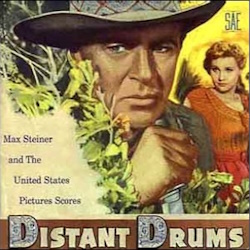 GREATEST SCORES OF THE TWENTIETH CENTURY
Original Review by Craig Lysy
United States Pictures served as a production company for Warner Brothers. For their next project they were assigned production for a film that would showcase Warner Brothers marquee star Gary Cooper. A screenplay was tasked to writers Niven Busch and Martine Rackin, who decided to use the backdrop of the Second Seminole War for their story. Milton Sperling was placed in charge of production, and Raoul Walsh would direct. Cooper would star as Captain Quincy Wyatt, joined by Richard Webb as Lieutenant Tufts, Mari Andon as Judy Becket, Arthur Hunnicutt as Monk, Carl Harbaugh as Duprez, Robert Barrat as General Zachary Taylor, and Larry Carper as Chief Ocala.
The film is set circa 1840 during the Second Seminole War where several Florida Indian tribes fight against the U.S. government. The army has been deployed to enforce an order to expel the Indians from their ancestral lands, with a forced relocation to Oklahoma. After ferocious resistance, General Taylor solicits reclusive Captain Wyatt to lead an expedition against Fort Castillo de San Marcos, which is held by Spanish gunrunners who are aiding the Indian rebellion. Wyatt accepts the mission, sacks the fort and rescues some prisoners, including Judy Beckett, who falls in love with him. The Seminoles counterattack and force a desperate retreat through the hazardous everglades where Wyatt’s brigade suffers casualties. Eventually they are surrounded and Wyatt challenges Chief Ocala to single combat. Wyatt prevails and returns home where he is reunited with his son. The film had modest commercial success, however, critical reception was mixed with many citing the screenplay’s historic inaccuracies. The film received no Academy Award Nominations.
Alex North’s star was rising after his acclaimed scores for Death of a Salesman and A Streetcar Named Desire, and so initially he was hired. He chose to score the film unconventionally with an “all percussion” score. Test audience previews however were negative, and so Director of Music Ray Heindorf rejected North’s score. He brought in Warner Brothers premier composer Max Steiner, who was once again tasked with writing a score under time duress, “to save the movie”. Steiner, who was struggling financially, and a veteran of scoring a film under time constraints, accepted the assignment.
 Upon viewing the film, I believe Steiner understood that Gary Cooper is the nexus of the film’s narrative, its hero, and a hero required a heroic theme. His forthright, masculine, horn empowered identity is bold, confident and resolute. In calm times it is optimistic, and determined without swagger, however in battle it transforms into an anthem abounding with heroism. Quincy’s son, who is no provided a name, is animated by a playful and boyish theme that is tender and draped with innocence. Judy’s Theme offers a quintessential Steiner romanza borne by sumptuous strings romantico, draped with auras of allure. When Quincy at last succumbs to her allure, the theme transforms and blossoms into a Love Theme. Tufts’ primary theme emotes with nautical martial strength and bearing, which reflects his stuffy by-the-book demeanor. There is however a secondary theme, a sardonic sea shanty, which supports the comic moments and when Quincy mocks his advice. There is also a beautiful string borne theme for the rescued plantation owner’s ailing wife who dies during the escape from the fort. The music for me emotes from her husband’s perspective who grieves for her pain, suffering, and death. Strings affanato offer a loving lament full of heartache, music which transcends this character who was never really developed.
Juxtaposed are two themes for Quincy’s adversaries; Ocala’s Theme, which by extension encompasses the Seminole tribe is empowered by primal drums of war, high register woodwinds, nativist rhythms, and ferocious horn chord declarations. When lurking, ever shifting drums speak to their menace and presence, however, when engaged in battle, their theme transforms into a fierce anthem. The Spanish gunrunners are infused with classic Castilian auras, rhythms and sensibilities, Remarkably, and in my judgement, quite effectively, Steiner emotes their theme as a danza Spagnola. Steiner composed several travel themes, as much of the film involves nautical travel, as well as overland travel through the everglades. In each case his music enriches the scenery and provides the necessary forward momentum that sustains the film’s pacing. Lastly, for scenes involving the U.S. Army, Steiner provides the requisite marches and trumpet militare declarations.
“Main Title” opens with harsh, dissonant horn declarations of the Seminole Fanfare, which replaces Steiner’s iconic fanfare for the Warner Brothers Pictures logo. We flow into a scene of Seminole warriors beating drums of war. At 0:12 the camera zooms in on a single drum, and the flow of the opening credits unfold in red letters over it. Steiner unleashes the aggression and ferocity of the Seminole Theme, with its striking rhythms, strident percussion, and woodwind and horn empowered narrative. Each woodwind statement is countered by fierce horn declarations, which evoke menace. I believe Steiner perfectly sets the tone of the film with an opening that sow fear. At 1:07 we segue into the film proper with “Prologue”, where we see navy Lieutenant Tufts narrating his log entry for his perilous journey in the territory of Florida in the year 1840. He relates that the Seminole’s, a defiant and savage opponent had defeated every army incursion for seven years, forcing General Taylor to consider a new approach. Steiner supports with a ponderous rendering of Tuft’s Theme with interplay of the Seminole Theme. At 1:51 we segue into “Lt. Tufts’ Mission” carried by Steiner interpolating the melody of “Columbia Gem of the Ocean”. At 2:04 horns militare support Tufts coming ashore, but the music becomes foreboding as we hear his narration. His orders are to visit retired Captain Quincy Wyatt who lives a secluded life along the shores of Lake Okeechobee with his son. He is to offer a personal appeal from General Taylor to take on a mission to destroy Fort Castillo de San Marcos, which is held by Spanish gunrunners who are aiding the Indian rebellion. At 2:52 Tuft’s jaunty theme supports him riding off with his guide Monk, with a map showing their trek inland. A diminuendo supports Monk making a call sign, and then usher at 3:45, a fierce Indian Theme as Cree Indian approaches. Monk allays Tuft’s alarm, saying they are his scouts who will take them to Webb by canoe. The theme loses it menace, but sustain its ethnic richness and rhythms under the dialogue. At 4:30 a travel theme borne by languorous strings buttressed by Indian percussion and rhythm support their canoe travel with Tuft’s narration speaking of his wonder of this pristine and beautiful realm. At 5:36 the music becomes dire as we see a large crocodile attacking a smaller one. The languorous Travel Theme resumes as they follow the stream, blossoming when it opens up into Lake Okeechobee. At 7:02 they arrive at Webb’s house on an island, and we descend into a quirky variant of the Seminole Theme as Monk tries to extricate himself from the Indian Juanai’s comic, protracted handshake. At 7:30 Steiner introduces a playful and boyish theme for Wyatt’s son, who is fascinated by Tuft’s saber.
“Quincy Wyatt” reveals the arrival of Quincy, who walks with a calm, forthright and confident gait carrying an eagle carcass. Narration by Tuft informs us that he finally gets to meet the man who will share the most exciting adventure of his life. Steiner introduces Quincy’s Theme as a marcia eroica, which swells proudly at 0:18 as he approaches with a quiet determination. At 0:39 the horn empowered music soars magnificently as he throws bait into the lake, which elicits an eagle attack flight and a swoop pickup with its talons, reprised at 0:54 by a second eagle attack. At 1:14 we flow into the Indian Theme, which closes with uncertainty on a diminuendo as Juanai informs him that a naval man is here to meet him. After a cordial introduction, Tuft relates his ridicule of using a forty-man squad to conquer the fort when a regiment is required. A calm, and unruffled Quincy informs Tuft that his forty-man squad can outperform an army regiment in the swamp. In “Farewell”, Quincy’s confident theme carries his departure to change clothes. At 0:12 a foreboding variant of the Seminole Theme supports Monk’s warning Tuft of the dangers of the Okeechobee swamp, which could easily swallow an entire regiment. At 0:34 a pastorale by woodwinds teneri support Quincy, abounding with a father’s love, as he bids his beloved son farewell. They then depart to the headquarters of General Zachary Taylor, the staging point of his swamp men force. At 1:08 the sumptuous Travel Theme borne by languorous strings carry their departure and progress on a map of Florida.
(*) “Arrival at Headquarters” opens with a protracted roll by field drums militari as Quincy is greeted by General Taylor. After exchanging pleasantries, the general wishes him success. After Quincy inspects his men and warmly reacquaints, he issues the order to move out, and we flow into “The Mission Begins” which empowers their departure with Quincy’s Theme rendered as a march. At 0:20 energetic pizzicato strings support Quincy ordering scouts ahead, and their run forward. The march resumes as the map reveals their trek to, and arrival at, Lake Okeechobee. With steely determination the march empowers the men using mules to haul Tuft’s boat, which will transport Quincy’s men fifty miles to the opposing shore, which marks Seminole territory. The march becomes celebratory as the boat reaches the water. At 1:23 a variant of the Sailor’s Hornpipe quote supports Quincy’s wry comment to Tufts, that his boat seems to float. They set sail empowered by a marcia orgogliosa until 2:07 when their transit at night shifts to a nocturnal misterioso. The wind dies and Tuft orders oars deployed. At 2:20 a laborious, cyclic motif empowers the men propelling the boat by rowing. At 2:46 an ominous Seminole Theme supports their nighttime sighting of the far shore beach – Seminole Territory. The theme is sustained to support their stealth approach and landing. Scouts are deployed, the ship unloaded, and Quincy orders the men forward after the scouts send out an “All Clear” bird call as the boat departs to anchor safely off shore. We end the scene on a diminuendo of uncertainty.
“Seminole Patrol” reveals the squad encountering a Seminole war party. They duck into the foliage, and the Seminoles pass through unaware of their presence. Steiner sow menace with the drums bellicoso rhythms of the Seminole Theme. At 0:47 a trumpet militare sounds to support Quincy raising his hand and motioning the men to move out. A tense woodwind travel motif buttressed by strings unfolds propelled by a strings pizzicato cadence. A 1:21 an ominous crescendo swell as Quincy halts the squad saying the smell of gunpowder suggests that the fort is directly ahead. Tufts counters that by his reckoning they are eight miles north of the fort. Quincy is dismissive and at 1:31 Steiner speaks to this with a sardonic quote of a Sea Shanty. The woodwind-pizzicato travel motif carries Quincy, Tuft and Monk forward to a clearing crowned at 1:49 my foreboding horns as we see the imposing brick walls of Fort Castillo de San Marcos. Quincy says he will take a small team at night to scale the walls and clear the guards so the rest of the men can storm the fort. As they turn to depart, horse neighs at 2:10 alert them to the arrival of Seminoles escorting Spanish gun runners. Steiner supports with an ominous Gunrunner Theme rendered as a danza Spagnola. At 2:33 we segue into “Capture Of The Fortress”, which reveals an external view of the fort at night. The Gunrunner Theme supports the stealth approach of Quincy and four men who reach the base of the walls. At 3:04 a glissando crowns Quincy lassoing a parapet tower, with a string borne ascent motif propelling his climb. The Spanish rhythms of the Gunrunner Theme reprise as a six-note string ostinato as one of the two guards patrolling the walls leaves for a meal break, joined by a woodwind ascent as Quincy lay in ambush. As the guard passes, he pounces at 4:21 and bludgeons him with his pistol. Quincy signals that all is clear, and at 4:41 his theme propels half of his men scaling the walls to join him. Quincy’s Theme empowers a slow building crescendo of tension as the men join. His theme resumes atop rhythmic muted woodwinds, as they with stealth, deploy to ambush positions. The Gunrunner Theme joins as they view them below in the courtyard. At 6:16 harsh strikes support the ambush of two guards, clearing the way to the mess hall. Quincy’s confident theme carries them to the entry, and at 6:40 all hell breaks out with Steiner unleashing a tempest of violence empowered by Quincy’s Theme rendered as a battle anthem as they storm in and attack the gunrunners. He opens the gate, and the rest of his men rush in. The gunrunners and Seminoles are shot down like fish in a barrel with Quincy’s Theme boldly triumphing.
“Blowing Up the Fortress” reveals Quincy ordering guns and mules cleared from the fort, the cannons spiked, and gunpowder charges set. They discover captives, a plantation owner, his wife, several workers, and a traveler, Judy Beckett, whom they liberate and evacuate. Textural suspense music enters with Quincy ordering the fuses set. A crescendo dramatico slowly builds, cresting violently at 0:22 as cascading explosions consume the fort. An accelerando propels everyone fleeing as the explosion will draw in Seminole war parties. A diminuendo usher in a new, toiling travel motif by low register strings as Quincy leads everyone to the boat rendezvous. We end ominously with muted war drums as the camera reveals a Seminole scout watching from a tree perch. In “Tree Scout”, a Seminole descent motif supports the scout descending to the ground, and then surging to an aggressive travel motif as the scout runs to alert Chief Ocala. At 0:27 the music becomes grave as the chief is informed. At 0:33 Ocala summons his warriors and orders a pursuit, and Steiner unleashes an aggressive, surging Seminole Theme as the war party races through the jungle. At 0:53 a foreboding diminuendo supports Quincy arriving at the shore and observing the rescue boat anchored far off shore. He posts perimeter guards and orders no smoking, and no fires be started. At 1:21 weeping strings led by a grieving solo violin with harp adornment support the men placing the plantation owner’s ailing wife under a tree. Tufts advises Quincy that she will soon pass. At 2:06 Quincy inquires about the young woman, and strings romantico introduce Judy’s Theme as we see her maid attending to her sore feet at water’s edge. A seductive saxophone joins as we see Quincy pondering. We close at 2:27 with the languorous Nautical Travel Theme joins as the rescue boats approaches the shore.
(*) “Seminoles Attack” offers two well-conceived and executed score highlights, which are inexplicably not included on the album. It reveals Quincy becoming tense as all of the sudden all the bird sounds around them go silent. A scout comes running and informs Quincy of a rapidly approaching Seminole war party. Quincy deploys his men to defensive positions and Steiner sow menace with Seminole war drums, which unleash their anthem as Quincy launches a withering rifle barrage. The Nautical Theme joins as we see Quincy waving off the rescue boat, but it is too late as the Seminoles shoot three sailors leaving just the helmsmen who steers the boat away from the shore. The plantation workers foolishly race to the lake and desperately try to reach the boat, but are all gunned down. The sergeant orders a retreat as they a greatly outnumbered and a beleaguered rendering of his theme propels their flight. (*) “Retreat Into The Swamp” reveals the Seminoles in pursuit, and Quincy making a fateful decision to retreat into the swamp. Grieving strings reprise the heartache of loss as the Plantation owner is pulled away from his dead wife. A ferocious Seminole Theme now dominates Quincy’s Theme, which is rendered in flight mode as they flee into the head high grass surrounding the swamp. Ocala stops at the swamp’s edge and yells “White’s now you die!” and orders his war party into the swamp. As Quincy and the men exit, his theme reasserts itself as he stops and fires several gun shots into the dry grass that unleashes a wall of fire, which forces the Seminoles to retreat. As the camera shift back and forth between the Seminoles and Americans, so too do their themes. When safely out of the grass the menacing drums of the Seminoles resound as Ocala curses the white’s escape as we see Quincy leading his brigade into an ever-increasing dense forest. Messaging drums resound as Quincy leads everyone into the swamp waters. As they rest, Monk informs Quincy that Ocala is alerting all other Seminoles to prepare for our exit from the swamp. Soon a flurry of answering drums, full of menace resound, foreclosing any quick and easy exit from the swamp.
In “The Swamp”, Quincy, over Tufts’ objections, says the only way out is to traverse one hundred and fifty miles of swamp. He orders the men to move out and music joins as a toiling travel motif to support their departure. At 0:07 abyssal woodwinds emote a primal, guttural motif as we see a pack of slow moving, ravenous alligators leave the shore to pursue. The travel resumes with the music shifting to a repeating two-note ostinato until 0:51 when primal, guttural horns sound as Judy, who in on shore, shouts “Alligators!” to warn Quincy. He comes to her, picks her up in his arms and carries her to safety empowered by a heroic rendering of his theme. Interludes of the alligator’s pursuing underwater are supported by primal woodwind menace. At 1:56 Steiner offers a surging primal horror as the trailing soldier is pulled under and torn apart by the ravenous alligators. Judy screams, and Quincy moves quickly to gain the safety of the shore propelled heroically by his theme. On shore, a diminuendo unfolds as Quincy deposits Judy on the ground and walks away without a word. She is perplexed and the scene shifts dramatically at 2:34 to General Taylor’s headquarters. Reveille trumpets militari resound in the film, but are absent on the album. A grim musical narrative unfolds as Cree warriors report that Quincy has opted to traverse the swamp, which they believe means certain death. A toiling musical narrative of woe supports a map showing Quincy traversing the vast everglade, moving further and further into its vastness and away from General Taylor.
As they struggle through the swamp Steiner allows sounds of nature to support their plodding toil. They find a patch of dry land, and Quincy orders the men to rest. He decides that the women and older men cannot make it on foot and so he orders Sergeant Shane to take the young able-bodied men onward on foot, while he and the remaining men cut down dead trees to carve out canoes. In “Nicked”, Tufts sees Quincy dry shaving with his knife, and decides he can do the same. This leaves Judy and Quincy time to acquaint, and they discover their shared, humble Georgia roots. Tufts joins with a cut on his cheek, which he when asked says was caused by a tree branch. A quote of the sardonic Sea Shanty was dialed out of the film. At 0:04 we segue into “Pushing On” a score highlight, which features fierce action music and quintessential Steiner romanticism. The Travel Theme supports as the men place the canoes in the water and they make ready to depart. At 0:24 strings romantico offer an alluring Judy’s Theme as Quincy finds her having her hair combed by her servant. At 0:47 quivering strings of alarm sound as a flock of flamingo flee to the skies. Quincy orders everyone to the canoes, and Steiner sow menace as they flee. At 1:07 a horrific dissonant stinger supports the death cries of a soldier. Quincy goes back, finds him impaled on a tree, and is ambushed by two warriors who he shoots. He flees to the canoes as the Seminoles come ashore from the swamp. Horns bellicoso empower the War-like Seminole Theme as they storm the opposing shore as the canoes escape. Withering fire leads to the capsize of one of the six canoes and the Seminoles descend on the men in blood lust, killing, and then scalping them. Quincy’s men return fire and the Seminoles lose several men. Steiner propels the action by unleashing a ferocious torrent with the strident Seminole Theme forcefully dominating the musical narrative. They manage to escape and as night falls, Steiner serenades the canoe’s progress at 2:23 with a lush Judy’s Theme as we see the first indication of attraction when Quincy gazes at her. She is receptive, and we see that her eyes inviting. Woven within this musical narrative is a muted drums and a lurking Seminole Theme playing in counterpoint.
“Judy and Quincy” reveals Judy making an inquisitive flirtation with Quincy, who is trying to catch some shut eye under a tree. She speaks of plans that could involve him, but he is not interested in refined city life, preferring to live like a king amidst the pristine beauty and serenity offered by his house on Lake Okeechobee. When she counters, yes, living like a king, sleeping cold and alone, music enters atop her theme, as he turns towards her, and their faces close. But the kiss never comes as he says that the life he lives would not appeal to her, and she replies, good night, your majesty, and departs. At 0:35 the drum propelled menace of the Seminole Theme supports their relentless hunt of Quincy’s party. At 0:44 the languorous Nautical Travel Theme joined with a sumptuous Judy’s Theme supports Quincy’s canoe flotilla poling through the everglades past a flock of wading flamingos. Later as they rest on land, the music darkens as Seminole drum rhythms entwine. Some of the men are dispirited when Quincy offers yet another meal of fish to cook. He exhorts his men to carry on as they are very near the end of their journey. The pep talk works as they agree to scale and cook the fish, buttressed by a sardonic quote of his theme as he walks past Tufts. At 3:00, a dream-like rendering of Judy’s Theme supports her deep in thought as Quincy approaches. He asks if she is dreaming of Savannah, and she says, yes. He moves close, asks is that the only thing that matters to her, and offers a passionate kiss. She is receptive, yet pulls away, her theme both passionate and distress as she discloses that it is not the town that matters, but gaining revenge against a man. The music unfolds with sympathy with folksy accents as she relates her humble origins and how he took advantage of her as she was young. The music darkens at 4:23 as she relates how he murdered her father. Quincy asks if she has a plan to avenge his death, and she says yes, and he realizes from her eyes, that she believes he is the one. When he asks her directly, she answers yes and at 4:57 a non-bravado variant of his theme joins, as he pauses, and departs, saying he will see her at the dugout. We shift to the party canoeing and at 5:11 Tufts narration informs us of their seemingly endless journey to rendezvous with sergeant Shane and his men supported by the languorous Nautical Theme. At 5:18 the music darkens with a foreboding tension as Tufts relates, they were enveloped by silence and feelings of death. They beach the canoes on shore and we behold the burial mounds of the Seminoles. As they walk through, Steiner sow a foreboding misterioso. Quincy makes a bird call, yet no one answers, which increases their misgivings.
In (*) “Monk Returns” reveals Quincy orders everyone to rest and wait and we conclude with a lurking tension borne by a nebulous woodwind borne narrative of unease. Dark chords sound and unease escalates as Corporal Peachtree relates that the men are wary and believe we should head out. Quincy says firmly, and with authority, that they will stay and wait for Sergeant Shane. Peachtree relents, but we see the men are restless. As Quincy walks away, a pleasant Judy’s Theme supports her servant combing her hair. He sits down under a tree, she sees that he is troubled, and walks over to join him carried by a folksy variant of her theme. He asks her if she believes they should pull out, and a tender rendering of his theme supports as she responds that she understands why he stays as she knows about his friendship with Sergeant Shane. The intimate moment is lost when a scout alerts him that someone is coming. Quincy deploys his men behind the mounds with rifles at the ready as the footfalls grow louder. Monk staggers out of the brush and collapses with Quincy and the men running to him. He advises Quincy that they were ambushed and it looked like everyone was slaughtered. We segue into “Escape” as a scout declares the Seminoles are coming. Quincy orders a retreat and desperate pizzicato strings rhythms and a strings ostinato carry their retreat. Slowly at 0:16 Quincy’s Theme emerges and swells on a crescendo of urgency as everyone flees. He orders everyone into the marsh waters and at 0:46 the menacing, drum empowered Seminole Theme carries their arrival at their burial grounds. They search the grounds as Quincy and company escape through a narrow tributary. At 1:41 they successfully escape and resume their jungle trek carried by the travel motif. At 2:10 tension surges as a scout relates the approach of Seminoles. They all duck for cover and we close on a diminuendo of tension.
(*) “Seminole Camp” reveals a single warrior who they ambush. They discover to their horror that the warrior wears emblems of Sergeant Shane’s uniform. They tie him up, and use a captured water moccasin snake to force a confession. He says that they have taken white men prisoners. Quincy organizes a rescue party and they surveil the Seminole camp. Steiner sow a textural, amorphous tension as Quincy leads a stealth approach. The camp appears empty as they assume ambush positions. Eerie accents support camera shot of pole mounted skulls encircling the camp. A lone Seminole enters the camp and a horrific stinger supports a soldier impaling him with a knife throw to the back. A descent motif supports another soldier leaping down from a thatch roof to kill another warrior. A bird call by Quincy brings the remaining men into the camp empowered by his theme. A soldier exits a hut and informs Quincy that he regrets finding the men. A musical narrative of horror supports their entry, and then swells with anger as they discover a water pit filled with alligators and soldier hats. In (*) “The Attack” a gunshot rouses them from the hut as a soldier says the Seminoles are coming. Quincy organizes his men into a defensive line and a fire fight ensues with the Seminole Theme gaining dominance as their superior numbers allow them to advance. High woodwinds bellicoso of the Seminole Theme resound with fury as Quincy recognizes they cannot hold. His theme gains strength as he orders half the men to retreat with the women while they hold the line. He orders a retreat, yet a soldier is shot and as he lifts the man and carries him, his theme soars with heroism. The Seminoles sense a route and pursue as their theme swells into a ferocious anthem. They flee into the marsh and interludes of Quincy’s Theme supports his retreat.
(*) “Retreat To Quincy’s Island” reveals him ordering his men to evacuate to his nearby island as he decides to make a last stand. But a wounded soldier refuses the order, says he will draw them away, and bolts, yelling to the Seminoles, who pursue. An aggressive Seminole Theme propels their pursuit and Quincy turns and runs to rejoin his men. In a scene shift, bugles militare take us into General Taylor’s camp. A grim musical narrative unfolds as he is informed that Quincy and his men are likely lost, and that a wall of Seminole stand in their way for a rescue of Quincy’s son. Never the less, Taylor orders a rescue of the boy for Quincy’s sake. We shift back to Quincy and his men who head to his island under duress supported by a beleaguered Travel Theme. (*) “The Last Stand” reveals their arrival on an opposing shore of Quincy’s Island with his theme soaring with jubilation, yet it quickly dissipates as we see his house burnt down and smoking. Horns of death wail and usher in a narrative of despair. A lamentation carries their wade to the island, shifting to a bleak and forlorn narrative of loss as Quincy walks amidst the ruins looking for evidence of his son. A tender, yet aching theme of remembrance borne by a solo violin affanato joins as he finds his son’s burnt toy canoe in the cinders, along with the sea shell necklace of his late wife. Corporal Peachtree orders a retreat, but an angry and vengeful Quincy will have none of it. He declares to the men that they are done running and will make a last stand here. As they dig in, Seminole war yelps intensify as they close in. They arrive on the opposing shore, and Ocala orders an assault of a dozen warriors, but as they wade across, they are easy targets and are gunned down. Ocala stops the attack as nightfall looms, and Seminoles never fight at night. Quincy posts sentries and we shift to night, with Seminole drums and chanting filling the air. Ocala dispatches two young warriors with knifes to swim to the island. Foreboding abyssal bass and eerie woodwinds support their underwater swim. Steiner sow tension as they sneak in from the beach with the steady Seminole chanting and drum cadence. Judy walks over to console Quincy after Tufts informs her that Quincy was married to a Cree Princess who was killed, and now suffers the loss of his boy. He relates that several soldiers, not Seminoles killed his wife. He says that revenge solves nothing, that you can’t carry a grudge forever, and we see her rethinking her plot for revenge. A sentry is knifed to death and his death moan alerts Quincy who crawls stealthily with his knife into the foliage. Quincy knife’s one and then the second warrior who charges him. He then orders Monk to take command in the event his plan fails.
In (*) “The Challenge”, it is morning, and the Seminole war drums and chanting intensify as their attack is imminent. Quincy walks to the beach and insults Ocala’s manhood and pride. He challenges him to personal combat in the water, using the Seminole weapon – the knife. Ocala cannot refuse or he would lose face with his warriors. Ocala sheds his chief’s garb, grabs his knife and races into the water propelled by a ferocious Seminole Theme. Quincy runs in also and a musical narrative of tension unfolds as each try to reach the other underwater. They reach each other when on the surface, and then dive underwater where the battle unfolds with interludes at the surface to regain air. Steiner does not support thematically with either man’s theme, instead using aquatic cacophony replete with harp glissandi to propel the fight. Quincy triumphs with a stab to the gut and a musical narrative of triumph borne heroically by his theme carries his swim with Ocala’s chief’s tomahawk to the beach. He waves Ocala’s emblem of power to his tribe, and the Seminole Theme propels their departure. (*) “Finale” offers a marcia militare propelled by field drums as the relief force arrives with Quincy’s men joyous. Monk relates to Quincy that this could have been a great day had he not lost his son, however Quincy turns and sees Juanai and his son approaching. Son and father run to each other propelled by racing strings, which are transmuted to joy as his son, supported by his theme, jumps into a thankful Quincy’s arms. He sets him down to greet the approaching General Taylor, who is thankful that he is alive, and for his service to his country. A warm and noble statement of Quincy’s Theme supports as the general relates that they found his son ten miles from here hiding in the jungle. He again praises Quincy and says that if he is not out in a month, to come in and rescue him. The marcia militare resumes as the general and his men depart. Tuft them takes off his sword and belt and gifts it to Quincy’s son supported by a noble rendering of his theme. Quincy gifts him Ocala’s chief tomahawk, for his son, they shake hands, and Tufts departs. Judy’s Theme carries her to Quincy. He wishes her well in Savannah, but she says she is not going, as you cannot hold a grudge forever. They kiss and their love theme blossoms to mark the beginning of their life together. Comedy joins as Monk again suffers the long-lasting and exaggerated handshake with Junai, and we close the film on a soaring, trumpet led declaration of Quincy’s Theme, which closes with a grand flourish. (*) “Credits” closes dramatically as the film began with the horn declarations of the Seminole Theme, which ends in a flourish as script offers thanks to the United States Department of the Interior and National Park Service. The album producer advises that the film’s last two reels did not survive and that the following cue, “Conclusion” offers a suite of themes following Quincy’s victory. We open with Quincy’s Theme rendered as a march and at 0:42 we segue into the overland travel theme with Indian adornment. At 0:58 strings affanato offer the heartache of the Plantation Wife’s Theme. At 1:24 we flow delicately into Judy’s Theme and then at 2:01 into a soaring Quincy’s Theme. At 2:20 we close with music I describes above in “Credits”.
The original sources were obtained from Brigham Young University film music archives. Digital editing and audio restoration has greatly improved the archival monaural audio, however, given the popularity of this score, a re-recording would be most welcome. Max Steiner understood that when the picture is weak, you have to compose big in an effort to mitigate its flaws and save it. In my judgement, Steiner was peerless in this regard and while he did not fully overcome the film’s many flaws, he succeeded on all counts it enhancing it in every way. His versatile theme for our hero, Quincy made him larger than life, endeared him to the audience, and just soared in crucial scenes. The Seminole Theme was perfectly conceived and executed, fully expressing their menace, aggression and savagery. Also, how can you have a Steiner score, which does not include a love theme? Well, Judy’s Theme was a most welcome respite from the aggressive and martial masculine identities, and it functioned equally well as a travel motif for their canoes. The theme for the unnamed and undeveloped plantation owner’s wife was supremely moving, and offered the pathos of loss so full of heartache. It is rare to have such an emotional cue for an undeveloped and unnamed character, but it is one of the ways Steiner ‘saved the film”. Folks, the film, though set in the east, was in reality, a ‘Western’ in its storytelling. I believe Steiner succeeded in every way in elevating this flawed film and once again demonstrated his remarkable talent as a composer, and mastery of his craft. Several long sequences of excellent score are not found on the album, and I hope that one day a kick-starter effort will lead to a rerecording of the complete score. Until that day, do take in the film and witness the power of film music.
Editor’s note: this review is of the 1999 release of the music from Distant Drums, which was part of a 2-CD compilation album that also included music from Steiner’s scores for the films My Girl Tisa (1948), South of St. Louis (1949), and Cloak and Dagger (1946).
For those of you unfamiliar with the score, I have embedded a YouTube link to beautiful and romantic cue “Judy and Quincy”: https://www.youtube.com/watch?v=QDSh8-S1H0k
Buy the Distant Drums soundtrack from the Movie Music UK Store
Track Listing:
- Main Title/Prologue/Lt. Tufts’ Mission (8:20)
- Quincy Wyatt (1:30)
- Farewell (1:57)
- The Mission Begins (4:03)
- Seminole Patrol/Capture of the Fortress (8:02)
- Blowing Up the Fortress (2:37)
- Tree Scout (3:06)
- The Swamp (3:42)
- Nicked/Pushing On (4:03)
- Judy and Quincy (6:29)
- Escape (2:31)
- Conclusion (2:48)
Screen Archives Entertainment SAE-CSR-0001 (1951/1999)
Running Time: 43 minutes 14 seconds
Music composed and conducted by Max Steiner. Orchestrations by Murray Cutter. Recorded and mixed by XXX. Edited by XXX. Score produced by Max Steiner. Album produced by Ray Faiola and Craig Spaulding.

Shop at the Movie Music UK Store

Member of the

 MOVIE MUSIC UK