UNSTRUNG HEROES – Thomas Newman
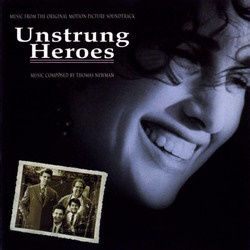 THROWBACK THIRTY
Original Review by Jonathan Broxton
Unstrung Heroes is a coming-of-age comedy-drama directed by Diane Keaton, adapted from journalist Franz Lidz’s memoir of the same name. The story is set in the 1960s and follows twelve-year-old Steven Lidz (Nathan Watt), a sensitive and imaginative boy growing up in Los Angeles. Steven’s father Sid (John Turturro) is a brilliant but eccentric inventor who is emotionally distant, while his mother, Selma (Andie MacDowell), is warm, loving, and supportive. However, when Selma is diagnosed with terminal cancer, the family is shaken; struggling to cope with his mother’s illness and his father’s inability to express vulnerability, Steven decides to leave home and live with his two eccentric uncles, Arthur (Michael Richards) a paranoid conspiracy theorist, and Danny (Maury Chaykin), a gentle, childlike dreamer. Though unconventional, the uncles provide Steven with comfort, eccentric wisdom, and a sense of belonging, and through their unconventional guidance, Steven learns to process grief, embrace imagination, and find resilience in the face of loss.
Keaton made her feature film directorial debut with this project, bringing a sensitive, character-driven style to the material. The film blends gentle humor with melancholy, exploring themes of grief, childhood innocence, eccentricity, and the search for meaning in family relationships. However, while warmly regarded by some critics for its heartfelt performances and Keaton’s direction, the film had a only modest box office run and remains something of an overlooked gem from the mid-1990s.
The score for Unstrung Heroes was by composer Thomas Newman, and is often cited as one of the film’s standout elements. It’s actually a rather important score in terms of the trajectory of his career because, rather than featuring the sweeping orchestral themes and delicate piano and woodwind lines that were the hallmarks of his writing to that point, this score was one of the first ones to focus more on the quirky light percussion items and unusual textures that would come to define his oeuvre as the decade went on, culminating in American Beauty in 1999.
 Newman had explored this type of writing before in earlier works such as Josh and SAM, The Player, and Flesh and Bone, and to a lesser extent in parts of scores like Scent of a Woman, but Unstrung Heroes was really the first score of its type to focus entirely on that sound and that approach. A lot of people find this side of Newman’s musical personality challenging, or even a bit off-putting. I know that I personally prefer his lusher and more lyrical orchestral writing, but even with that in mind it’s hard not to give this score the consideration it deserves for being, at the time, something very new and unique.
There are no real thematic ideas in the score per se; Newman’s music is much more about rhythm and texture and movement and kinetic energy than it is about melody. The whole score sounds mostly the same, with very little variation between cues across the whole 30-minute run time. To create the sound palette Newman collaborated with several musicians who would go on to be key collaborators for decades: Bill Bernstein, Rick Cox, George Doering, Mike Fisher, Randy Kerber, Steve Kujala, and Chas Smith. Doering has a box full of guitars and lutes and mandolins and other instruments that can be plucked in a variety of ways. Smith creates specialty of metallic instruments that can be hit, tapped, and struck, to create a multitude of sounds. Other instruments listed in the score’s liner notes include a psaltery, a vibraphone, a Jew’s harp, a hurdy-gurdy, a bowed bass dulcimer, and more than one type of zither.
Newman’s music sounds exactly like this: electronic zings and tings, strummed and plucked guitars, and endless percussion items, all layered across and within each other to create a fascinating, sometimes disorienting, kaleidoscope of sound. “The Beast Is Coming” is a notable example of when the music gets quite frenzied, while the odd vocals cooing noises in “A Blind Man Could See It” make that cue perhaps the weirdest of them all.
One or two cues do occasionally embrace a more traditional orchestral sound, and use delicate strings, light woodwinds, and pretty pianos to create a warmer and more engaging sound. “Star Machine” is pretty and delicate, like a music box. “Trace Harm” has some engaging violin textures. The main title cue “A Load of Lidz” is quirkily appealing and is built around an idiosyncratic woodwind tune. “Home Movies” is softly sentimental, while the conclusive “There Is No Conspiracy” has an almost Indian flavor to it, and has a hypnotic appeal.
One thing I did find somewhat frustrating, though, is the fact that Newman never really allows his score to emerge into anything approaching a satisfying emotional catharsis. Whereas several of his previous scores contained a degree of traditional orchestral tonality and warmth in their finales, the music in Unstrung Heroes stays defiantly lodged in the world of quirky plinks and plonks throughout.
Intellectually, I know what Newman is going for here. He’s reflecting a certain type of nostalgia for 1960s suburban life while also emphasizing the emotional turbulence beneath the surface. He’s creating a sense of whimsy in cues associated with Steven’s eccentric uncles, balancing humor and melancholy, but then also injecting the scenes of Selma’s illness and Steven’s emotional growth with some restrained poignancy. It’s just that, unless you know what you’re going into, many listeners are going to find it a very odd experience.
Unstrung Heroes earned Newman an Academy Award nomination for Best Original Musical or Comedy Score at the Oscars in 1996, the only nomination the film received, and although he ultimately lost the award to the all-conquering Alan Menken and Pocahontas, and although its oddness cannot be overstated, it should still not be overlooked. As I mentioned, in many ways Unstrung Heroes is something of a turning point in Thomas Newman’s career, in that it was really the first score where he fully embraced his ‘unusual percussion’ side, initiating his slow and almost imperceptible slide where we find ourselves now, with this music dominating his filmography. Newman would write numerous outstanding orchestral scores in the years following this – Oscar and Lucinda, The Horse Whisperer, Meet Joe Black, The Green Mile, many others – but the sound of Unstrung Heroes would gradually become more and more prevalent too, and anyone with a scholarly interest in Newman’s career should explore this score, if only to get a full appreciation where the sound originated.
Buy the Unstrung Heroes soundtrack from the Movie Music UK Store
Track Listing:
- Outside 2B (1:03)
- Inside 2B (1:30)
- Nowhere Near 2B (1:06)
- Is Unstrung (3:12)
- Star Machine (1:28)
- South Pole (0:49)
- Ballsound (0:39)
- Trace Harm (1:46)
- Main Title (A Load of Lidz) (2:42)
- Means What It Means (0:38)
- Influenza (0:51)
- The Beast Is Coming (1:08)
- Lipstick (1:15)
- Possible Ideas/Available Materials (2:11)
- Half Amelia (1:28)
- A Blind Man Could See It (1:05)
- 79 RPMS (0:33)
- Home Movies (2:53)
- There Is No Conspiracy (3:34)
Running Time: 29 minutes 51 seconds
Hollywood Records HR 62035-2 (1995)
Music composed by Thomas Newman. Orchestrations by Thomas Newman. Performed by Bill Bernstein, Rick Cox, George Doering, Mike Fisher, Randy Kerber, Steve Kujala, Chas Smith, and Thomas Newman. Recorded and mixed by Dennis Sands. Edited by Bill Bernstein. Album produced by Thomas Newman and Bill Bernstein.

Shop at the Movie Music UK Store

Member of the

 MOVIE MUSIC UK