THE USUAL SUSPECTS – John Ottman
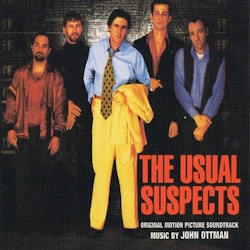 THROWBACK THIRTY
Original Review by Jonathan Broxton
The greatest trick the devil ever pulled was convincing the world he didn’t exist.
This famous quote from the writings of 19th century French poet Charles Baudelaire is at the heart of the story of The Usual Suspects, the film which marked the mainstream debuts of director Bryan Singer and screenwriter Christopher McQuarrie. It is a neo-noir crime thriller that unfolds as a story within a story, as told to federal agent Dave Kujan (Chazz Palminteri) by Verbal Kint (Kevin Spacey), a small-time con artist with cerebral palsy; Kint is one of two survivors of an explosion on a ship docked in San Pedro harbor in Los Angeles. Kint recounts the events leading up to the explosion, telling Kujan that five criminals – himself, plus Michael McManus (Stephen Baldwin), Fred Fenster (Benicio del Toro), Dean Keaton (Gabriel Byrne), and Todd Hockney (Kevin Pollak) – met during a police lineup in New York, and began committing heists together. Eventually, they are drawn into the orbit of the mysterious, almost mythical crime lord Keyser Söze, a figure so feared that most refuse to speak his name. Söze coerces the group into attacking the ship in San Pedro in order to eliminate witnesses who can identify him, and eventually Kujan comes to believe that Keaton – a former corrupt cop apparently trying to go straight – must have been Söze.
The film’s legendary climax reveals the famous twist: after Kint is released, Kujan realizes too late that Kint fabricated much of his story, drawing details from random objects in the interrogation room. Outside, Kint walks away with a normal stride, shedding his limp, and while the true identity of Keyser Söze remains ambiguous, it is strongly implied that Kint himself was Söze all along. It was a brilliant, ballsy conclusion to a gripping film, and it launched the careers of Singer and McQuarrie, while also earning Kevin Spacey his first Oscar, for Best Supporting Actor, among many other awards and nominations for multiple members of the cast and crew. Although the legacy of the film has been somewhat tarnished by the subsequent sexual scandals involving both Singer and Spacey, the film itself remains one of the best of its type from the 1990s.
One of the other individuals whose career was launched by The Usual Suspects was John Ottman, who has the perhaps unique distinction of being both the film’s editor and composer. Ottman and Singer had first met in 1987 when they both worked on a student film directed by a mutual friend, and then Ottman edited and co-directed a short film starring Ethan Hawke called Lion’s Den with Singer. This led to the two of them working on Singer’s feature debut Public Access in 1993, which Ottman was already editing, and which he was asked to score when the original composer dropped out at the eleventh hour, and Singer discovered Ottman’s passion for film music. Public Access won the Grand Jury Prize at the Sundance Film Festival that year, and naturally Ottman’s odd double-duty continued on The Usual Suspects.
 This level of control allowed Ottman to make both film and music sit seamlessly together, a perfect amalgam of sound and vision, unhindered by an outside party’s potentially careless brandishing of an editor’s knife. Because of his early attachment to the film, Ottman was also able to develop an intimate understanding of what the movie needed in terms of music, and was able to time his to cues perfection – sometimes cutting the film to suit his music, and vice versa. However, all this time and effort would be for naught if the composer in question could not deliver the goods by way of good music. Fortunately, with this score Ottman showed he had musical talent in abundance.
Two people comprised Ottman’s music team: Larry Groupé, who was working a full time job as a composer at the Network Music music library company, and Damon Intrabartolo, a who was then a 20 year-old full-time student at the USC School of Music. Groupé conducted and did orchestration and Intrabartolo did transcription, while also playing some piano solos. Ottman did everything else.
Ottman’s score is a neo-classical orchestral tour-de-force, a driving, lyrical, passionate score with rich, full-bodied themes and powerful action sequences. The film’s limited budget required Ottman and his team to jerry-rig the score to make it sound bigger than it was, doubling orchestral performances in post-production, but to everyone’s credit you can’t see the seams, even if you’re looking. It all sounds like it was performed with a full symphony orchestra instead of being pieced together from different takes at a recording studio that could barely hold 25 musicians at a time.
The score opens with a gorgeous performance of the Tchaikovsky-esque waltz-like “Main Theme,” a darkly romantic affair for pianos, strings, and subtle woodwind accents, which gives the whole thing the sophisticated sheen of a classic film noir. The main theme doesn’t re-appear with regularity, which is one of its few drawbacks, because the main theme is so good, but it is clearly reprised in cues like the downbeat “Farewell Fenster,” and the strained, anguished, Stravinsky-inspired “Back to the Pier”.
As the rest of the score unfolds Ottman juggles his music in an attempt to encompass various polar emotions, and accompany different set-pieces. The action material is especially impressive, from the ground-shaking Horner-esque action of “Getting on Board” to the rhythmic power of “Payback Time,” and the near-unbearable intensity in “Keyser Appears,” which somehow manages to be deadly and jazzy at the same time. This cue also includes one of the few uses of voices in the entire score. Elsewhere, cues such as “The Garage” and “The Faces of His Family,” with their chattering Goldenthal-style dissonance, are violently dramatic, and speak of imminent danger. Throughout several of these cues Ottman augments his orchestra with subtle electronic textures to flesh out the depth of the ensemble, while also including an almost subliminal cimbalom sound to acknowledge Keyser Söze’s Hungarian origins.
The sinewy, twisty interplay between strings and woodwinds in cues like “The Story Begins” and the lighter, almost comedic “Verbal Kint” cleverly foreshadow the revelation about Kint’s true identity, and occasionally have a sense of Howard Shore about them, especially the more lyrical parts of thriller scores like The Silence of the Lambs. There is a similar sense of nervous, shadowy uncertainty to the squealing strings of “Kobayashi’s Domain,” while “The Killing of a Rat” rises to almost operatic proportions. The penultimate cue, “The Greatest Trick,” gives the listener a musical wink and a smile as the final twist in the tale is revealed, and has a superb revelatory sound which combines the finale of Jerry Goldsmith’s Basic Instinct with the cascading pianos from the Aquarium movement from Camille Saint-Saëns’s Carnival of the Animals. The final recapitulation of the main theme in “The Water” then provides a perfect end to the score.
One other thing I wanted to point out are Larry Groupé’s outstanding orchestrations, which are always interesting and incorporate a number of unusual touches. I especially like inventive Morricone-esque ticktock percussion in both the aforementioned “Payback Time” and “New York’s Finest,” the nervous syncopated pianos in “The Arrests,” the faintly western-sounding guitars in “Redfoot,” the unexpected sitar in “The Faces of His Family,” and the plaintive cello solos in “I Work For Keyser Söze” and “The Gift”.
There is so much to like in The Usual Suspects. The level of compositional sophistication and dramatic intelligence that Ottman, Groupé, and Intrabartolo show here is really very impressive, especially considering that this was only Ottman’s second ever feature score, it was the first time he had any sort of budget at his disposal, and he was pulling double-duty as the film’s editor at the same time. Singer and Ottman would go on to have a similar relationship on subsequent films, notably Apt Pupil, X2, Superman Returns, Valkyrie, X-Men: Days of Future Past, and Bohemian Rhapsody, the latter of which earned Ottman his editing Oscar, but everything can be traced back to this film, and anyone who has any interest in his career needs to have this title in their collection.
Buy the Usual Suspects soundtrack from the Movie Music UK Store
Track Listing:
- Main Theme (3:41)
- Getting on Board (2:56)
- The Story Begins (1:09)
- Payback Time (1:39)
- Farewell Fenster (0:45)
- He’s Here! (1:48)
- The Garage (2:25)
- Verbal Kint (2:09)
- Keyser Appears (2:34)
- It Was Beautiful (1:18)
- The Arrests (1:17)
- Redfoot (1:39)
- New York’s Finest (1:43)
- Kobayashi’s Domain (2:22)
- The Killing of a Rat (3:29)
- I Work For Keyser Söze (1:37)
- The Faces of His Family (1:45)
- The Plan Begins (1:56)
- Back to the Pier (3:37)
- Casing the Boat (1:55)
- A Gift (1:39)
- The Greatest Trick (3:15)
- The Water (2:33)
- Les Sons et les Parfums Tournent Dans l’Air du Soir (written by Claude Debussy, performed by Jon Kull) (3:30)
Running Time: 53 minutes 35 seconds
Milan 74321-30107-2 (1995)
Music composed by John Ottman. Conducted and orchestrated by Larry Groupé. Featured musical soloist Damon Intrabartolo. Recorded and mixed by Darrell Harvey and Dan Abernathy. Edited by Lia Vollack. Album produced by John Ottman.

Shop at the Movie Music UK Store

Member of the

 MOVIE MUSIC UK