RED SONJA – Sonya Belousova, Giona Ostinelli
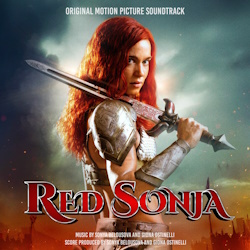 Original Review by Jonathan Broxton
The character Red Sonja was created for Marvel comics in 1973 by writer Roy Thomas and artist Barry Windsor-Smith as a companion to their already-established Conan the Barbarian character, who was himself created by the groundbreaking writer Robert Howard in the 1930s. A flame-haired female warrior in a savage world, she used her sexuality as a weapon as much as her sword, and she accompanied Conan on many comic book adventures; when Conan got his own movie franchise starring Arnold Schwarzenegger in 1982, Sonja quickly followed suit in 1985, with Danish supermodel Brigitte Nielson in the title role. Now, almost 40 years later, a new version of Red Sonja has emerged, directed by M. J. Bassett, and starring Italian actress Matilda Lutz in the title role. The film follows the adventures of Sonja, who unites with a group of unlikely warriors to face off against the evil emperor Dragan and his cruel sorceress wife Annisia, who slaughtered her family when she was a child.
As pretty much everyone knows, the original Conan and Red Sonja movies were scored by Basil Poledouris and Ennio Morricone, respectively. Poledouris’s Conan is one of the greatest scores in cinema history, and while Morricone’s Red Sonja is not quite as well known or well-loved, the legacy of the legendary Italian composer looms large over the franchise as a whole. As such, composers Sonya Belousova and Giona Ostinelli clearly had some big shoes to fill when they agreed to score this film. Thankfully, Russian-born Belousova and Swiss-born Ostinelli have a significant amount of pedigree when it comes to orchestral fantasy music; they scored the first season of the TV series The Witcher beginning in 2019, and then in 2023 they wrote a tremendously impressive score for the first season of the live-action Netflix version of the classic anime One Piece, which was nominated for an IFMCA Award, and was one of my own top TV scores of its year.
Their Red Sonja is a score cut very much from the same cloth as those other excellent works. It was recorded in Skopje, Macedonia, with the FAME’s Project Orchestra, and is a combination of large and thematic orchestral forces with elements of medieval/renaissance music, and world music flavors that come from a variety of specialist regional instruments (including a hurdy-gurdy, an oud, and an array of ethnic winds and percussion), as well as some slightly more contemporary elements to give it a more modern flavor. There are vocal textures and choral parts too, but unlike Morricone’s score there is no choir chanting Sonja’s name here – in fact, Belousova and Ostinelli don’t really acknowledge Morricone’s score at all, which is probably a good thing. Better to go your own way entirely.
 With that in mind, there is a tremendous amount of fun to be had here for fans of the genre. The score is anchored by its outstanding main theme, which is much more lyrical and emotional than one might expect considering the blood-and-thunder persona Sonja the warrior adopts. However, it seems that instead of scoring her power and might, Belousova and Ostinelli often seem to be scoring her vulnerability, her trauma, and the emotional connection to her dead family that is her driving force. The main theme anchors the fantastic opening cue, “Red Sonja,” and is a gorgeous lilting melody that moves around the string section from violins to cellos, and has a non-specific ‘folk music’ edge to it that is sort of Celtic, sort of Nordic, but also sort of eastern European, depending on what instrument is carrying it.
The vocal version of the melody – performed beautifully by Irish vocalist Emma Ní Ghabhainn – that appears in “Òran An Ròin” has a mystical, timeless quality, and sees the composers setting their Sonja theme to the lyrics from a traditional Scots Gaelic song about a selkie – a mythical seal-like creature that can shed its seal skin and take on the form of human – lamenting the loss of its clan to hunters. There are clear dramatic parallels between the story in the song and the story of the movie here, as Belousova and Ostinelli appear to be likening the poignant fate of the selkie with the fate of Sonja herself, both of whom have their families wiped out by brutal invaders. It’s clever stuff, and much more intellectually sophisticated than one might have expected in a score for a film like this.
There are further references to the “Òran An Ròin” idea later, including in the abstract and disorienting opening couple of minutes of “She Will Join the Damnati,” in “This is Where We Part” which is epic and adventurous but also somehow underpinned with trepidation as a result of the off-kilter way some of the strings are phrased, and in “You Were Not the Only One Who Was Alone,” which is poignant and reflective.
The main Sonja melody also appears frequently throughout the rest of the score, in a more traditional and straightforward manner. “Damnati Training” is an exotic arrangement of the theme for all the specialist regional instruments, including Belousova herself playing the hurdy-gurdy, which slowly builds into something which clearly wants to emulate the scope and tone of Miklós Rózsa’s Ben-Hur. Elsewhere, “She’s Coming” and “You Said She Was Dead” are soaring and majestic in all the best ways.
All this emotional depth is counterbalanced by the action and suspense music, which is excellent, albeit in a very different way. “Fantatheriums” introduces two new recurring ideas into the score; the first is a dark, brutal, eerie descending string figure which appears to represent the combined threat of Dragan and Annisia, and the second is a brassy four-note motif which is essentially identical to the famous ‘danger motif’ that James Horner used throughout his career, notably in another sword-and-sorcery score, Willow. This motif is so famous within film music circles that it has to be intentional on Belousova and Ostinelli’s parts, in which case it’s a nice easter egg tribute to a composer who they clearly admire.
 These two motifs combine with action variations on, and deconstructions of, the main Red Sonja theme, as part of a series of striking fight and battle cues that really put the orchestra through its paces. Some of the action music is quite contemporary-sounding, with modern percussive and rhythmic ideas that especially recall their work on The Witcher, but will also remind some listeners of recent scores by Bear McCreary, or perhaps Daniel Pemberton.
In addition to the aforementioned “Fantatheriums” I especially like the heavy sound of “The Book of Secrets,” which blends folk music stylistics with booming action and menacing references to the Dragan/Annisia motif. The second half of “She Will Join the Damnati” is powerful and oppressive, and then “One of Us Dies or We Both Die” is tragically determined, and features a soaring wordless vocal to really hammer home the notion of Sonja’s feminine power.
The 8-minute “Cyclops” is outstanding, a throbbing powerhouse of churning cellos, energetic pulsating brasses, and numerous allusions to the main Sonja theme, all surrounded by endlessly engaging symphonic dynamism. Both “Lady Annisia” and “The Mortiferium Is Ready for the Test” contain extended explorations of the Dragan/Annisia motif, darkly seductive but with an undercurrent of malice and danger. “Where’s My Horse” at times feels like it could be heading into symphonic prog-rock territory. “Bring Me Her Head” is as intense as “Cyclops” and has some brilliant passages featuring a dominant brass motif doubled with a chanting choir, all surrounded by flashing, complicated string patterns. “They’re Quiet” unexpectedly features throat singers, and a guttural, but brilliant, death metal vibe in the way the orchestra is pitched.
The final performance of the main Sonja theme in “I Want to See More of This World” is wistful, almost romantic, and offers a magnificent final statement of the ‘Òran An Ròin’ song. The conclusive “Mighthaven Castle Festivities” has the vibe of a celebratory medieval fête, ending the score on a fun and lively note.
Comparisons between this score and Ennio Morricone’s score for the 1985 Red Sonja original are inevitable, but I think they are unfair, as this is a different type of product entirely. However, for what it’s worth, I really can’t recommend the score for this Red Sonja highly enough, especially to those who like Nordic/Celtic/world music vibes blended with modern symphonic action scoring in a fantasy setting. Judging by the trailer the film itself looks more than a bit ropey – bad special effects, and bad acting from the Hercules/Xena school of thespianism – and it doesn’t bode well that it’s bypassing cinemas and going straight-to-VOD, but Sonya Belousova and Giona Ostinelli’s music over-achieves tremendously, and is more than worth exploring on its own terms. With this score, The Witcher, and One Piece, they are now three-for-three in terms of impressive orchestral fantasy-action scores.
Buy Red Sonja soundtrack from the Movie Music UK Store
Track Listing:
- Red Sonja (3:01)
- Òran An Ròin (2:33)
- Fantatheriums (2:52)
- The Book of Secrets (9:46)
- She Will Join the Damnati (6:02)
- Damnati Training (4:29)
- One of Us Dies or We Both Die (5:46)
- Cyclops (8:00)
- Lady Annisia (2:48)
- The Mortiferium Is Ready for the Test (1:54)
- Where’s My Horse (2:44)
- She’s Coming (4:06)
- This is Where We Part (2:46)
- Bring Me Her Head (7:27)
- You Said She Was Dead (1:46)
- They’re Quiet (3:56)
- You Were Not the Only One Who Was Alone (4:05)
- Becoming Red Sonja (1:03)
- I Want to See More of This World (2:42)
- Mighthaven Castle Festivities (0:47)
BMG Music (2025)
Running Time: 78 minutes 32 seconds
Music composed by Sonya Belousova and Giona Ostinelli. Conducted by Oleg Kondratenko. Orchestrations by Daria Novo, Shinae Lee, and Molly Monahan. Featured musical soloists Sonya Belousova, Giona Ostinelli, Burak Besir, Lindsay Deutsch, Alexander Dion, and Isa Najem. Special vocal performances by Sonya Belousova, Emma Ní Ghabhainn, and Cian Finn. Recorded and mixed by Alfredo Pasquel. Edited by XXXX. Album produced by Sonya Belousova and Giona Ostinelli.

Shop at the Movie Music UK Store

Member of the

 MOVIE MUSIC UK