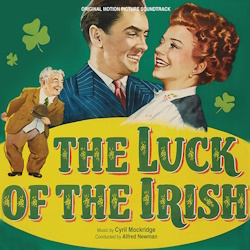
THE LUCK OF THE IRISH – Cyril J. Mockridge
 GREATEST SCORES OF THE TWENTIETH CENTURY
Original Review by Craig Lysy
The husband and wife writing team of Guy and Constance Jones caught the attention of Hollywood studios after Universal successfully adapted their story “Peabody’s Mermaid” for the film Mr. Peabody and the Mermaid, released in August 1948. 20th Century Fox decided to roll the dice and so in July 1947 they purchased the film rights for their second novel “There Was a Little Man” for $50,000, which was adapted into this film, The Luck of the Irish. Fred Kohlmar was placed in charge of production, Henry Koster was tasked with directing, and Philip Dunne would write the screenplay. A fine cast was hired, with Tyrone Power starring as Stephen Fitzgerald, joined by Ann Baxter as Nora, Cecil Kellaway as Horace and Lee J. Cobb as David Augur. The film was made quickly and eventually released just one month later, in September 1948.
The film follows the fortunes of journalist Stephen Fitzgerald who reaches a crossroads in life. He has decided to become the press agent for a powerful New York politician to whose daughter he has become engaged. During a trip to his ancestral homeland of Ireland, he meets by chance a beautiful young woman Nora, and her best friend, a leprechaun. The encounter catalyzes latent feelings of nostalgia for Ireland. He returns to New York only to discover that Nora and her leprechaun are visiting. A crossroads is reached as he tries to decide to follow the path of fame and fortune in the bustling city of New York, or to return to his roots in Ireland to live a quiet, simple and peaceful life. The film was well received by audiences, and a commercial success. Critical reception was also favorable with critics lauding the film for its charming, heart-warming story and actor performances. The film received one Academy Award Nomination for Best Supporting Actor.
Alfred Newman, the 20th Century Fox Director of Music assigned Cyril J. Mockridge to the project. He had collaborated with Newman on the Irish infused score for “How Green Was My Valley” and felt that he could again imbue the score with the authentic Irish sensibilities and auras it required. As such a number of folk songs melodies are woven into the score’s tapestry, including “The Rose of Tralee” by C. Mordaunt Spencer, and the tradition trio “Greensleeves”, “Garryowen”, and “The Irish Washerwoman”. I believe Mockridge understood that he would have to contrast bustling New York, with the idyllic pastoral beauty of the emerald isle. However, I also believe he understood that this story was more than a mere physical journey, but also a spiritual journey of rediscovery, and that his music would have to speak to this.
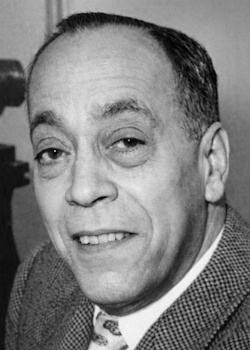 For his soundscape Mockridge composed three primary themes. For our Leprechaun Horace, two themes are used. His personal theme is Irish to the core, fully embracing Irish musical sensibilities. It is playful with a delightful lightness of being. It is also very malleable, expressing pathos when Stephen takes his pot of gold, tenderness when expressing love for Stephen, mischievous during his interventions into Stephen’s life, yet also frenetic whenever Stephen is running after him. The Magic Theme is linked to Horace and speaks to his supernatural powers. The Novachord imparts an otherworldly sound, embellished by a twinkling, ethereal sense of wonderment. Nora’s Theme supports her personal identity, yet from her first meeting with Stephen it is slowly transformed into a Love Theme. It is written for strings and woodwinds, imparted with Irish musical sensibilities, which emotes tenderly with a dance-like sensibility. There is a purity, gentleness and nobility to Nora’s character, which Mockridge perfectly captures.
(*) “Logo” reveals the 20th Century Fox logo, empowered by Alfred Newman’s iconic fanfare. We segue atop wistful strings into “Main Title”, a score highlight, where Mockridge masterfully sets the tone of the film. In the background there is an Irish tourist poster featuring Blarney Castle. At 0:14 the camera zooms in on the poster’s background mountains and the opening credits commence propelled by a festive Irish gig. At 1:05 we enter the film proper and behold pastoral beauty with a flock of sheep front and center. Mockridge supports with the tranquil beauty of the Rose of Tralee song melody. Stephen is driving very fast along the winding dirt roads of the verdant Irish countryside. A comedic interlude supports as he stops and relates to Bill that he must have made a wrong turn. He turns back and resumes his journey again carried by a pastoral lyricism of Rose of Tralee. We close with them stopping at a decrepit wooden bridge over a stream. Stephen gets out to inspect its sturdiness. He jumps up and down, and says this will hold us, and decides to drive on. The central strand however collapses, and into the water they sink. Bill decides to stay with the car as Stephen departs on foot to seek assistance.
“The Leprechaun” reveals Stephen walking carried by a strolling melody borne by woodwinds and strings tranquilli with harp adornment. At 0:14 he enters a forest, and we are draped with the ghostly misterioso. He pushes on, and at 0:44 the music brightens with a sense of wonderment as he hears banging, and comes to a waterfall fed grotto where he sees an old man. They acquaint and a spritely, yet tender musical narrative unfolds as the old man is relieved that Stephen was not seeking him. The music shifts to a delight danza felice alight with Irish tresses as the old man dances around Stephen’s impatient desire for directions. He finally relents and tells him to follow this stream to the coast where you will find the village of Ballynabun. Stephen departs, but at 3:06 the ghostly misterioso resumes as he turns to say thank you, and discovers that the old man has disappeared. At 3:25 Stephen and Bill arrive at Ballynabun carried by a carefree, string borne rendering of the Greensleeves melody. They go to the Kittiwake Inn and book rooms. We close at 4:00 with the flute led Leprechaun Theme as the innkeeper Tatie is taken aback and leaves muttering to himself after Stephen relate, he got directions from an old shoemaker with a green coat and brass buttons by a waterfall.
“Fitz” reveals Nora bringing in fresh towels carried with gentility by her theme. Stephen is not gracious about the accommodations and she relates that they not used to hosting grand Americans. At 0:36 the flute borne Leprechaun Theme reprises as the mumbling Tatie brings in a lamp and then departs. Mockridge offers a rich and eloquent musical narrative draped in Irish auras as Stephen to his dismay discovers that Ballynabun is sea locked, and that he may have to wait a week before Sean O’Fearna can take you. The music after 1:28 is dialed out of the film and intended to support the conversation between Stephen, Bill and Tatie over some whiskey shots. Tatie says again, there is no waterfall in the Burn, and that the old man he met was the leprechaun of the Gentle Burn. He tells Stephen should have demanded his pot of gold, but always remember to spit on it of suffer bad luck the rest of your days. The conversation ends when the Tatie’s daughter Nora glares at him for drinking. It is a shame the music was dialed out as it is quite beautiful with wistful interplay of the Pastoral and Leprechaun themes.
(*) “Stephen Turns In” reveals Stephen returning to his room to bed down carried gently by soft strains of Greensleeves. He realizes he left his pipe and lighter down stairs and a spritely Irish tune carries his return. He sees Tatie take a whiskey bottle and glass, and set in on the Inn’s entry porch. Stephen startles him and Tatie says it brings good luck to be generous to the leprechaun. Stephen returns to his room, opens his window, and we flow into “The Little Man” a richly orchestrated and animated score highlight. It opens with the twinkling, ethereal wonderment of the Magic Theme as a breeze blows in, and the lamp flickers. A playful Leprechaun Theme joins to support his arrival. He takes the whiskey and runs off, with Stephen in pursuit. At 0:41 Mockridge propels the pursuit with an exuberant Irish gig. Stephen tackles him and then demands his pot of gold. The old man feigns ignorance, but Stephen is insistent. The leprechaun pulls a shovel out of his jacket, digs, and to Stephen’s amazement, unearths a large pot. Stephen opens it and it contains ancient gold coins. The leprechaun is distraught at losing his pot of gold and sits down and weeps. Stephen asks if he stole this, and the leprechaun is indignant and says no. Stephen then stuns him saying, well I do not steal either and he gifts the pot back to the leprechaun.
“The Waterfall” offers a wonderful score highlight, which just sparkles. The leprechaun says he will be forever grateful, gifts him one of the coins, and bestows a lifetime of luck upon him. He departs carried by a joyous rendering of his theme, and we close with the twinkling ethereal wonderment of the Magic Theme as he disappears under the waterfall. At 1:02 Stephen wakes up, with woodwinds and strings also struggling to wake up. The Leprechaun Theme joins and the music becomes contemplative as we see him ponder the events of last night. At 1:41 spritely woodwinds support as he heads out to greet the day. He finds Nora pumping water from a well. Her tender theme supports as he complains that he did not sleep well as he dreams too much when he sleeps. He again raises the waterfall, only to be told again that there is no waterfall. At 2:43 he grabs her hand and they begin running supported by spritely musical narrative as he is determined to prove to her that there is a waterfall. They arrive at 3:04 and I believe the scene must have been edited, because the rest of the cue is not heard. On album the twinkling ethereal wonderment of the Magic Theme was conceived for the waterfall, and its use intended to reveal that there is no waterfall. He is perplexed, and at 3:14 a soothing rendering of her theme was intended to join as she offers understanding and tries to console. A delightful musical narrative concludes the cue, which features interplay of the Irish, Leprechaun, Nora’s and the Magical Motif.
“The Coin” offers a beautiful score highlight. It reveals Nora changing the subject, saying that there is a grand view of the sea. She runs through the trees to a bluff carried by the Greensleeves Theme and we behold a panorama of the restless waves of Ireland’ west coast. They talk about their lives, their aspirations of how a man is better off marrying than enjoying his freedom. Her theme joins with the Magic Theme and quotes of the Leprechaun Theme as Stephen begins tossing the coin. We see that she has feelings for him, which manifest musically at 2:12 when her theme shifts to a solo violin d’amore. He shows her the coin, and she says it is a Spanish doubloon, that likely came from one of the Spanish Armada ships that sank off the coast. He realizes that he too has feelings for her and the music ends tenderly with a tinge of sadness as he says we best be getting on our way. “Goodbye, Fitz” offers a poignant score highlight. It reveals that Sean O’Fearna’s boat had returned, and Stephen is escorted to the beach to board a rowboat to transport him to O’Fearna’s boat. A sad rendering of the Greensleeves Theme supports as he tells Nora, that now that he is departing, he half wants to stay. She says do not look backwards, but forward to what you want out of life. Her theme becomes prominent, aching with the sadness of parting. As she looks back from the stairs and sees him sailing away, her eyes fill with tears, which Mockridge speaks to, eloquently.
“New York” reveals a plane flying against a panorama of the New York skyline. Mockridge supports with Broadway style fanfare. Spritely jazz takes Stephen up to New Ear Productions of his boss and future father-in-law David C. Augur. We close on a diminuendo as he enters Augur’s office. Augur announces that he is running for the Senate and wants Stephen to be his speechwriter, campaign manager and advisor. Stephen says he accepts for the money. (*) “Dinner” reveals Stephen joining his fiancée Frances for a dinner date with Mockridge offering a soft jazz ambiance. She says she is glad he has come to his senses and left his nonsensible job, which is already paying off with more money, and an apartment. Augur’s nerdy assistant Tom Higgenbotham shows up, and they quickly bolt, saying they are late for the play.
“Frances” reveals Stephen and Frances relaxing at his apartment. The doorbell rings and it is the new house servant. He escorts the elderly gentlemen to the kitchen. As he is returning to join Frances however, the Magic Theme joins, a startled look appears on his face, and he does a turnabout, returning to the kitchen. The Leprechaun Theme joins with the Irish Theme as Stephen asks probing questions, believing that they had met before. Horace manages to convince him that they have not met and has good references. Stephen leaves, yet at 0:53 the music becomes comic as he returns and pops his head in with a look of puzzlement. The Leprechaun and Magic Themes entwine as a befuddled Stephen rejoins Frances. At 1:17 as they both bend to retrieve a bottle of Scotch, he kisses her, and she then responds with a more passionate kiss supported by their Love Theme, which unfolds as a slow danza romantico. As they are kissing, Horace enters at 1:39 supported by the Magic Theme and asks can he help them, which spoils the moment. Stephen says yes, please fix them drinks. As Horace prepares the drink he is supported by a playful rendering of his theme.
“The Drink” reveals that Frances is exasperated, no longer amorous, and says she is leaving as it is too crowded her. He kisses her in the elevator, returns, and asks the old man; What is his name? What can he do? And how is he paid? He answers, to call him Horace, that he can do anything needed, and that his salary is taken care of by Mr. Augur. Stephen accepts his drink, and gifts the other to Horace. Stephen takes a drink, but recoils, saying it is too strong. Horace apologizes, and says he needs to learn his taste. To his amazement, Horace downs the entire tumbler with ease. Music enters as Horace departs to the kitchen to deliver the two glasses. A playful Leprechaun Theme supports, joined by the Magic Theme as Stephen takes the gold coin out of his pocket and begins tossing it up and down with a look of puzzlement. “Horace” reveals Horace up early, dusting and tidying up the apartment. A whimsical rendering of his theme supports with accents of puzzlement when he looks at a modernist painting on the wall, which elicits befuddlement.
(*) “Horace’s Mischief” reveals the arrival of the actual butler, but Horace scares him away when he relates, they know of his habit of raiding the liquor cabinet. Stephen wakes up and asks for breakfast, and Horace say he will prepare it at once. Stephen follows him into the kitchen, and asks for the newspaper as Horace fetches butter from the refrigerator. The Magic Theme twinkles as Stephen sees it full of milk bottles. When he asks why he has so much milk? Horace says, he thought you might have a cat. The doorbell rings, but Stephen insists he will answer it. It is the manager and the milkman who ask if he got his morning delivery. Stephen says yes, and the manage responds that you are the only one as no one else received theirs. As they depart the milkman affirms that he made all the deliveries. Stephen glares at Horace, and goes to the living room where he looks up the number to the Acme Employment Agency. He calls them to inquiry, about his butler, and they affirm his credentials and offer to provide references. He hangs up, and asks Horace if he stole the milk? He says no. He then shows him the gold coin, to which he replies he has never seen one before. Stephen is exasperated and says that he is firing him with one month severance pay, which causes Horace to start crying. Stephen relents, says he can stay, and angrily goes to his room to change. The talent agency calls, and Horace fakes being Stephen, and says he no longer requires their services. A mischievous rendering of his theme carries his return to the kitchen.
In unscored scenes, on the way to work, Horace feigns the car breaking down and suggests to avoid being late, that Stephen use the subway. In the crowded car a pick pocket steals his wallet. As he gazes around the car, he does a double-take as he sees a woman that looks just like Nora. He moves towards her but the train stops and she disembarks. He does also, runs after her and catches her. He is ecstatic and surprised to find her in New York. They reacquaint, and discovers is wallet is missing when he attempts to buy her chocolate. He decides to skip is luncheon and meeting and accept her offer for lunch. They enjoy their time together and the owner invites him to join the wedding celebration for his daughter tonight. Stephen is noncommittal and returns to work for a press conference. When reporters reveal that Augur and his advisor Fitzgerald hold opposing views on the Crawford Letter regarding Germany, he replies that was his opinion before, now he works for me. Later as Stephen begins typing a retraction article, Horace shows up, and lauds him for his integrity, independence and principles, the reasons why he chose to serve him. He then departs, Stephen tears out the page from the typewriter, and decides to join Augur at his home where he hosts a dinner party with party elders and donors. He shows up, says he needs to meet in private, and is told to wait in the study. Frances gets up from the table to join him. Inside he hands her his resignation letter, she then discloses that he should change his mind since her father’s plan is to make him the CEO of his publishing company. She says that there is an added benefit, me, which elicits him to take her in a kissing embrace.
“Courage” reveals Stephen at home and asking Horace to join him in a drink. Mockridge drapes the scene with pleasant Irish gentility. At 0:41 Stephen asks that Horace toast to his health as he is getting married. The music becomes tinged with sadness and descends as an undercurrent under the dialogue, as Stephen seems unenthused for this important life event. Horace asks him, why did he choose the tall lady”? Stephen answers because she is beautiful, with a man’s courage and a man’s brain. Horace asks, is there anything wrong with a with a woman’s courage and a woman’s brain? Stephen is taken aback, becomes defensive, and says we will not discuss it further. He then accuses Horace of not liking her, which he denies. Stephen presses that no one is forcing you to continue working here. Horace surprises him when he says after the wedding, he will be looking for another place, adding that you will have no further need for me. At 2:23 a musical slide supports as Stephen heads for his bedroom, slips and falls to the ground. The Leprechaun Theme carries him to Stephen, who gets up and bolts angrily into his bedroom, slamming the door. The next day Bill visits and advises that he has a job offer for him, thanks to Nora. In (*) “Stephen and Nora” Stephen joins Nora at the Irish pub’s wedding celebration where the band is playing the exuberant Irish gig “The Irish Washerwoman”. She is happy he came, but want to be suitor Terence Flaherty pulls her away from Stephen to the dance floor. Stephen diverts Terence, a fire fighter by saying he smells smoke. As he runs away to investigate, Stephen pulls Nora aside and they talk as the band shifts to the folk song Garryowen. Later they discuss the job offer as the band supports tenor Jimmy O’Brien singing the heartfelt Irish romantic ballad, “The Rose of Tralee”.
She says she is returning to Ireland tomorrow, but he says he has more to say to her. The now angry Terence returns, finds Stephen holding Nora’s hand, and he punches him. The musical juxtaposition here is amazing. Stephen fights back, and a pub brawl ensues. Terence eventually knocks Stephen out, which earns a slap from Nora, all while an unaffected Jimmy continues on singing the romantic ballad. “Old Tricks” Stephen wakes up on a cot in the pub storage room, with Nora at his side. She apologizes saying it was all her fault. He is stuporous, and a dreamy rendering of her theme supports as he compliments her on her friends. As he sits up their faces touch, and at 0:22 he impulsively takes her into a kissing embrace as their Love Theme blossoms. He gets up and says he has to return home only to realize a crowd had been watching. A gentle violin tenero borne strolling motif carries him escorting Nora home. At her apartment stairs, he says, goodbye Nora, which takes her aback. She said she had hoped he would see her off on the steamer tomorrow. He says he can’t, as he will be in the country with his fiancée. He tells her he is getting married in a month. At 1:23 she is visibly hurt, maintains her composure, yet she is wounded, and her theme, borne by violin and kindred strings, shifting to oboe, descends into sadness. She wishes him happiness, and says goodbye. As she enters the apartment, he is clearly conflicted and the Irish Theme, joined by the Magic Theme at 2:35 support as he tosses the golden doubloon. Yet he realizes it has turned into a rock. The music sours on the Leprechaun Theme as he walks home with determination.
(*) “Tell Me The Truth!” reveals Stephen entering his apartment joined by the Magic Theme. He hears banging coming from the kitchen, enters and finds Horace hammering a shoe as when he first met him at the Burn. He demands an explanation of why the gold coin had turned into a rock. Musical tension rises as he feigns any knowledge and Stephen grabs him demanding an answer. With this Horace leaps up, and runs away with Stephen in hot pursuit. Mockridge propels the chase with the Leprechaun Theme rendered frenetically with slapstick comic accents. Stephen catches him and demands answers. Horace submits and agrees to answer his questions. He confirms he is a leprechaun, and that Stephen is a bit weak-minded, although sane. Horace says he is parched, and asks for a drink from the bottle. Stephen gets the bottle and asks if he brought Nora here? Horace says no, adding that it was you who brought her here in your mind, and that her physical presence does not matter. He adds that he came here with noble intentions because he liked him, but in the end, he failed in his mission. In “The Bottle” music enters with the Magic Theme when Horace says he offered him gold, but that he prefers a pebble. Horace returns to the kitchen as Stephen ponders his words. Strings tristi emote Nora’s Theme, joined by a solo violin informing us of Stephen’s thoughts. Music after 2:03 which features the Magic and Leprechaun Themes was dialed out of the film. It was intended to support Stephen entering the kitchen and discovering that Horace has disappeared.
Later in (*) “Stephen Resigns”, Stephen sits next to Frances fidgeting the pebble in his hand as Augur gives a dinner table political speech. Augur then announces that he will resign as CEO, and is proud to announce that one of the finest men he has ever met will succeed him – Stephen Fitzgerald. Stephen looks at Frances, and then with reluctance gets up to joins Auger. As camera flashes blaze, the Magical Theme usher in the Leprechaun Theme as Stephen sees multiple images of Horace in the crowd. He announces that he declines the offer, saying that his and Mr. Augur’s views do not align. The room is a buzz as he departs, and as reporters swarm him. When asked what are his plans? He responds that he intends to sit under a waterfall with an old friend. When asked if the engagement is also off, he says that is up to Frances. She responds that as Stephen said, she is not cut out for the job. (*) “Kittiwake Inn” reveals an exterior shot of the inn, supported by warm and welcoming strings. Inside we see Stephen sitting with Bill at the Kittiwake Inn. Bill and Stephen argue over Stephen’s latest article. Nora enters and Bill asks her to talk some sense into her pig-headed husband. They all depart upstairs to turn in, and Stephen directs the innkeeper to leave the bottle on the table. Bill returns from his room to fetch his glasses, sees Stephen emerge, and hides in the shadows. A tender rendering of Greensleeves carries him downstairs and we see him look out the window. He the grabs the Whiskey and sets it on the porch supported by a tender Leprechaun’s Theme. He returns inside where Bill startles him. He tells Bill that it is a gift for an old friend. Tender strings carry both men upstairs to their rooms. “A Gift for an Old Friend” offers a spritely rendering of the Leprechaun Theme as Horace arrives, takes the whiskey and happy runs off with merriment as a smiling Stephen watches from his bedroom. A parting shot of a joyous Horace usher in “The End”. “In a Thicket” is evidently attached to a deleted scene. It opens with the Magic Theme rendered as a misterioso, and then shifts at 0:17 to a heartbreaking rendering of the Leprechaun Theme. Yet at 0:37 a sparkling Magic Theme returns with a Leprechaun Theme abounding with happiness. We close at 1:03 warm strings offering “The Rose of Tralee”. “Finale” must have been a discarded version of the film ending. Its opening use of Greensleeves was actually used in the (*) “Kittiwake Inn” scene. As heard on album, it opens with a warm rendering of Greensleeves, which usher in a somber musical narrative, replete with tolling bells. It closes with a reprise of the festive Irish music introduced in the Main Title.
I would like to thank Bruce Kimmel and the late Nick Redman for restoring these two classic Golden Age scores. The original 35mm optical elements were used but there were some emulsion wear persisted. Because Newman used close shot and long shot microphones when recording, the technical team was able to offer full-bodied stereophonic sound. The overall audio quality is good, and provides an enjoyable listening experience. Well, it is clear to me that Cyril Mockridge must have been an Irishman in another life time! His music is quintessentially Irish throughout the film, capturing the Emerald Isle’s very essence. It offers pastoral beauty, the aching romantic longing of “The Rose of Tralee”, the sumptuous romanticism of “Greensleeves”, the festive “Garryowen”, and the unbridled energy of “The Irish Washerwoman”. His original Leprechaun and Magic Themes evoked the mystery, mischievous, and a sense of wonderment evoked by this gentle and endearing supernatural being. Also most impressive is how Mockridge’s musical storytelling slowly awakens within Stephen, his heart’s discontent, and a latent, wistful longing for his ancestral homeland and a simpler life. Folks, Mockridge’s score for this romantic comedy and fantasy film fits it like a glove, and enhances its narrative in every way. In my judgment, this once again demonstrates the remarkable power and utility of film music. If you like music that is fun, wistful, romantic and abounding with gorgeous pastoral beauty, then his is a score for you. I highly recommend that you purchase this compilation album, which also contains the Newman’s wonderful score for “O’Henry’s Full House”.
For those of you unfamiliar with the score, I have embedded a YouTube link to the Main Title: https://www.youtube.com/watch?v=d0IzNmVvmN0
Buy the Luck of the Irish soundtrack from the Movie Music UK Store
Track Listing:
- Main Title (2:52)
- The Leprechaun (4:18)
- Fitz (5:37)
- The Little Man (1:23)
- The Waterfall (5:58)
- The Coin (2:44)
- Goodbye, Fitz (2:36)
- New York (0:54)
- Frances (2:15)
- The Drink (1:27)
- Horace (0:44)
- Courage (2:45)
- Old Tricks (3:47)
- The Bottle (2:41)
- A Gift for an Old Friend (1:18)
- In a Thicket (1:21)
- Finale (1:57)
Kritzerland KR20027-9 (1948/2014)
Running Time: 44 minutes 10 seconds
Music composed by Cyril J. Mockridge. Conducted by Alfred Newman. Orchestrations by Herbert Spencer and Maurice dePackh. Recorded and mixed by XXXX. Edited by XXX. Score produced by Cyril J. Mockridge, Alfred Newman, and Lionel Newman. Album produced by Bruce Kimmel and Nick Redman.

Shop at the Movie Music UK Store

Member of the

 MOVIE MUSIC UK