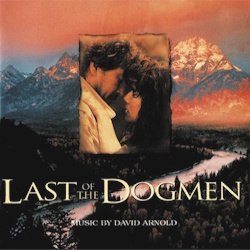
LAST OF THE DOGMEN – David Arnold
 THROWBACK THIRTY
Original Review by Jonathan Broxton
A wilderness action adventure with elements of mystery and historical fantasy, Last of the Dogmen stars Tom Berenger as Lewis Gates, a rugged bounty hunter tracking three escaped convicts in the remote and treacherous wilderness of the Montana Rockies near the Canadian border. During his search, Gates comes across bizarre signs that suggest the presence of a mysterious and elusive group living deep in the mountains – people who shouldn’t exist. After teaming up with anthropologist Professor Lillian Sloan (Barbara Hershey), an expert on Native American history, they investigate the mystery, and discover a hidden valley inhabited by a Native American tribe descended from the Cheyenne Dog Soldiers, fierce warriors who evaded the U.S. Cavalry over a century earlier and have lived in complete isolation ever since.
Last of the Dogmen is (to date) the only film directed by Tab Murphy, who was previously known primarily for his screenwriting work on titles like Gorillas in the Mist, and has since gone on to write screenplays for Disney animated films such as The Hunchback of Notre Dame, Tarzan, and Brother Bear. Murphy’s film is a fascinating story which blends western adventure with speculative fiction, inspired by Native American history and the romantic notion of a lost tribe surviving untouched by time. Filmed largely in British Columbia, Canada, the movie features spectacular cinematography by Karl Walter Lindenlaub that captures the rugged beauty of the wilderness, and is also notable for its stunning score by composer David Arnold.
Last of the Dogmen was only Arnold’s third ever film score, and comes sandwiched between Stargate and Independence Day, two of Arnold’s most popular pre-James Bond works; for me, it is one of his great under-discussed masterpieces. Director Murphy, who is himself a huge film music fan, wanted Arnold to add a sweeping, emotional layer to the film’s tone, and Arnold delivered in spades. Written for a massive symphony orchestra recorded in England with the London Symphony Orchestra, Last of the Dogmen is basically Arnold’s tribute to all the great rousing western adventure scores in film music history, a stirring celebration of the beauty and scope of the landscape, peppered with some respectful musical portrayals of Native American culture, and more than a few powerful action sequences. It’s a little bit Legends of the Fall, and a little bit Dances With Wolves, all filtered through Arnold’s early 1990s stylistics and sensibilities.
 The opening cue, “Last of the Dogmen,” acts as an overture of sorts, presenting both the score’s main themes back-to-back. The first theme, presented right at the beginning of the cue, is ostensibly the film’s main theme, and it’s wonderful: a majestic, epic piece for slow strings backed with deep, rich harmonies, which together perfectly depict the majestic Montana landscape, the mountains, the forests, and that endless open sky. After a brief light hearted interlude for sparkling woodwinds and harps Arnold presents his secondary theme for the first time at the 1:30 mark, the strings this time bolstered by warm brasses and brief hints of tribal percussion. This theme is actually the theme that forms the core of the melodic content in the score proper; in context, it appears to be both a general theme for the Cheyenne Dog Soldiers, and a specific theme for the brave warrior Yellow Wolf (Steve Reevis) who becomes Gates’s friend. The overture ends with a second performance of the main theme, resonant and luxurious, and wholly satisfying.
As I mentioned, the Cheyenne/Yellow Wolf theme is actually the score’s most prominent, and it runs through almost the entire rest of the score, first as Gates and Lilian are tracking the tribe, then after they find them, gain their trust, become their friends, and eventually try to save them from a posse led by Gates’s father-in-law Deegan (Kurtwood Smith), the local sheriff. What I like about the theme is that it goes through a lot of variations and shifts in instrumental texture as the score develops.
In “The Wilderness,” for example, the theme is surrounded by shrill rattling woodwinds and energetic tribal percussion elements, and adopts chord sequences that have a vibe similar to Native American music from classic Hollywood westerns. Then, during “The First Arrow,” Arnold tantalizingly hints at the first few notes of the theme as Gates discovers the first signs of the Cheyenne Dog Soldiers existence in the aftermath of what was, unknown to him at that time, a bloody encounter between them and the escaped convicts.
Later, “The Story of Jacko,” underscores the scene where Gates and Sloan read the story of a “wild child” captured by railroad men in the woods in the early 20th century and who escaped and disappeared, and who they believe is part of this lost tribe. The cue opens with a bed of lovely brasses, develops through an impressionistic sequence full of lyrical interplay between strings and woodwinds, and ends with dark echoes of the Cheyenne/Yellow Wolf theme. “Medicine Run” is initially darker and more tense, filled with shrill woodwinds that counterbalance an aspirational version of the Cheyenne/Yellow Wolf theme, but then grows to an ominous, sometimes overwhelming finale that accompanies a scene where Gates robs a pharmacy to help get medicine for Yellow Wolf’s sick son, and is chased by local law enforcement, including Sheriff Deegan.
“Cheyenne Valley” is perhaps the score’s highlight performance of the Cheyenne/Yellow Wolf theme, and accompanies Gates and Sloan as they are taken through a hidden waterfall and introduced to the lost tribe. Initially Arnold imbues the theme with mystical qualities to match the magic and wonderment of the event – shimmering metallic textures, elegant woodwind lines, and trilled romantic strings similar to the interlude from the first cue – before opening the whole thing up into the most sweeping, stirring statement yet, wholesome and enchanting.
Throughout the score Arnold’s action music is deeply impressive. In the early 1990s Arnold developed a very distinct action music style not only through scores like the aforementioned Stargate and Independence Day, but also on later things like Godzilla, The Musketeer, and his first two James Bond scores Tomorrow Never Dies and The World Is Not Enough, and the action music in Last of the Dogmen is very much of that same style. It’s difficult to describe in words, but you can hear it immediately; it’s something in the rhythms of the percussion patterns, in the way one part of the brass section is doing something dark and brooding while another part is doing something shrill and almost invasive. It’s in the way he phrases the strings in layers that play off against themselves. Nobody else sounded like this, and it’s to Arnold’s immense credit that he was able to craft such a distinct style within two years of him writing his first score. Cues like the intense “Somebody’s Out There,” the heavy and bombastic “War Party,” and especially the brilliant, heroic “The County Line” showcase this Stargate/ID4-style action perfectly.
The finale of the score begins with “The Truth,” a deeply emotional statement of the main theme, which is then followed by the wonderful pair “Go In A Good Way” and “Leaving Forever,” which add weight and depth to the difficult decision that Gates, Sloan, and Yellow Wolf must make in order to protect the tribe from the outside world. The former cue builds to a darkly sweeping finale, moments of poignancy tempered with ominous rumbling percussion, while the latter takes the Cheyenne/Yellow Wolf theme through a series of increasingly emotional statements, ending on a stirring, warmly nostalgic note.
“Faith & Courage” is a bombastic setting of the Cheyenne/Yellow Wolf theme in full-on heroic action mode, incessant snare drum riffs, brass fanfares, swirling energetic strings, and moments of howling dissonance all coming together to underscore the moment where Yellow Wolf saves Gates from Sheriff Deegan, and while doing so sets off explosives that close the entrance to their valley, protecting it from the outside world. Listen especially for the amazing sequence of cascading strings set against imposing brasses at the 1:49 mark, a musical mirror of the waterfall that marks the boundary of their world. “The Last Arrow” then provides the score’s magnificent conclusion, a thematic mirror of “The First Arrow” from earlier in the score, a majestic statement of the Cheyenne/Yellow wolf theme with a notably brilliant brass counterpoint.
Just as a side note, although the 40-minute album is an excellent representation of what the score has to offer, there is still scope for an expanded release in order to really do it justice. Arnold’s music plays almost constantly through the nearly 2-hour run time and there are several excellent sequences of music that remain unreleased. Notably, there is quite a lot more music featuring Native American-style woodwinds and percussion that is only hinted at on the album, and there is an especially gorgeous rendition of the main theme for solo piano in the film’s snowy final scene that adds a whole new dimension and instrumental texture to the score. Specialty labels please take note; just make sure you don’t include any of Wilford Brimley’s intrusive narration in the final product.
As I mentioned earlier, it’s astonishing to me that this was just David Arnold’s third ever score, and that he was just 33 years old when he wrote it. The sophistication, the thematic interplay, and the sense of drama and adventure heard here are all usually domains of much more experienced composers than he was at that time, and looking back it’s no wonder that his rise was as meteoric as it was. Last of the Dogmen is a terrific piece of classic, old fashioned orchestral movie music, soaring and grandiose, thrilling and exciting, which will appeal to anyone who grew up loving the same kind of scores I did. As far as David Arnold specifically is concerned, I miss this sound immensely, and I hope that, someone, somewhere, will give him the chance to write something like this once more.
Buy the Last of the Dogmen soundtrack from the Movie Music UK Store
Track Listing:
- Last of the Dogmen (3:17)
- The Wilderness (1:50)
- Somebody’s Out There (2:46)
- The First Arrow (1:50)
- The Story of Jacko (1:43)
- War Party (3:04)
- Medicine Run (2:51)
- Cheyenne Valley (2:46)
- The County Line (1:59)
- The Truth (2:12)
- Go In A Good Way (1:57)
- Leaving Forever (3:58)
- Faith & Courage (3:55)
- The Last Arrow (1:55)
Running Time: 36 minutes 03 seconds
Atlantic Records 82859-2 (1995)
Music composed by David Arnold. Conducted by Nicholas Dodd. Performed by the London Symphony Orchestra. Orchestrations by Nicholas Dodd. Recorded and mixed by Geoff Foster. Edited by Laurie Higgins Tobias. Album produced by David Arnold.
Leave a comment

Shop at the Movie Music UK Store

Member of the

 MOVIE MUSIC UK
I’ve been waiting for a label to do an expanded edition of this score for years. One of my favorites and one of David Arnold’s best.