OPERATION DUMBO DROP – David Newman
 THROWBACK THIRTY
Original Review by Jonathan Broxton
Loosely based on a real event that happened during the Vietnam War in 1968, Operation Dumbo Drop is a family-friendly action-comedy-drama written by Jim Kouf and Gene Quintano, and directed by Simon Wincer, who previously helmed titles such as Free Willy and Quigley Down Under. The film is set in a U.S. Army base located close to a small Vietnamese village that is sympathetic to the American cause. When enemy forces discover the village’s alliance with U.S. troops, they retaliate by killing the villagers’ elephant, which is not only vital to their livelihood but also holds significant cultural and ceremonial importance. Wanting to maintain the villagers’ trust and rebuild the alliance, the base’s captain, Sam Cahill, is ordered to procure a new elephant, and so he puts together a reluctant crew to help him locate a brand new pachyderm, transport it through enemy territory, and deliver it to its new home. The film starred Danny Glover, Ray Liotta, and Denis Leary, and had an original score by David Newman.
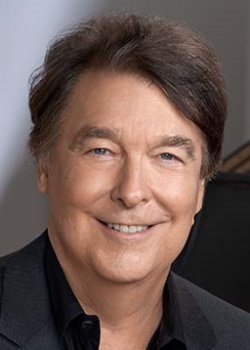
David Newman is, of course, the son of the legendary composer Alfred Newman, nephew of fellow composers Emil Newman and Lionel Newman, brother of Thomas Newman, and cousin of Randy Newman. He had already enjoyed a great deal of commercial success in Hollywood prior to 1995, first as an orchestra violinist, then as a conductor/orchestrator, and finally as a composer in his own right; most notably, he wrote the scores for a series of enormously popular comedies including Throw Momma from the Train in 1987, Heathers in 1988, Bill & Ted’s Excellent Adventure and The War of the Roses in 1989, The Mighty Ducks in 1992, The Sandlot in 1993, and The Flintstones in 1994. However, Operation Dumbo Drop gave him the comparatively rare opportunity to showcase his adeptness at writing bold, exciting action music, and he grasped the opportunity with both hands.
Newman’s outstanding score, which was recorded in the UK with the Sinfonia of London, blends military-style orchestration and jungle adventure motifs with bold emotional cues, reflecting the film’s shifting tone from lighthearted slapstick to moments of genuine warmth and camaraderie. The score makes use of martial rhythms, brass fanfares, and snare drums to evoke the military setting; then to capture the setting and expedition through the Vietnamese jungle, Newman incorporates ethnic percussion, flutes, and tropical textures, which are often reminiscent of classic adventure scores. Bo Tat, the elephant at the heart of the story, receives a gentle and endearing musical treatment for light strings and soft woodwinds, emphasizing her emotional role in the story. Everything then climaxes in its rousing, patriotic finale which underscores the film’s central scene of Bo Tat being transported BY AIR across enemy territory to its new home.
 The original Hollywood Records album is neatly split 50/50 between Newman’s score and a series of period pop picks. The songs, by the likes of Jackie Wilson, Marvin Gaye, The McCoys, and Aretha Franklin, are uniformly good and depict the era of the film’s setting adequately, but the album is sequenced badly and the songs really need to be programmed out in order to appreciate fully Newman’s score because, really, it is quite astonishingly excellent.
After a lush, evocative sequence filled with pan flutes, faintly exotic vocals, and watery-sounding percussion effects, the “Opening” explodes into the first performance of Newman’s main theme, and it’s staggeringly good – bold, warm, heroic, noble, a rousing horn melody backed by sumptuous string harmonies, which then melts into a more romantic secondary theme for strings. A more dangerous-sounding minor-key variation of the theme, complete with grungy synth enhancements and nervous percussion, ends the cue on a darker tone, foreshadowing the terrible events that befall the village and its elephant at the hands of the enemy.
“Botat and Lihn” is a lively and light-hearted action cue that begins with a terrific blend of orchestral passages and jungle-style percussive electronic textures which are used to illustrate the movie’s South-East Asian setting. These slowly give way to a more gentle and contemplative sequence for pretty strings backed by more watery percussion sounds and magical-sounding electronic tones; these remind me very much of the music Jerry Goldsmith wrote for Medicine Man a couple of years previously. There is a yearning, melancholic quality to some of Newman’s string writing here that is really quite excellent, and which really underlines how important elephants are to this culture, and how deeply they feel their loss.
This tone carries on into the subsequent “Elephant Temple/Lihn’s Flashback,” and here Newman blends those sounds with rattling shakuhachi flutes, eerie vocal effects, and an overall sense of ethereal mysticism that builds to poignantly emotional heights. The reprise of the main theme at the 2:55 mark has a purposeful solemnity to it, before the cue returns to the soft and pleasantly ghostly sounds of the flutes, chimes, and electronics and fades out.
The album’s showstopper is the 8-minute title cue, “Operation Dumbo Drop,” which underscores the movie’s conclusive sequence of Cahill and his men risking their lives to transport the new elephant to the village via helicopter. The iconic image of this massive animal hanging in a sling, dangling underneath a chopper, had the potential to look and feel ridiculous, but in David Newman’s hands, the whole thing is a triumph. The cue is a huge, exciting, energetic action piece for the full orchestra, judiciously enhanced with electronic sweeteners, and with special emphasis on patriotic brass. The cue is underpinned with a relentless tribal rhythm for tom-toms, which then combine with a rich array of other percussion items that drive the music forward. The pulsating symphonic lines hint at the melody of the main theme over and over, more prominently with each subsequent recapitulation but never quite resolving fully, until the moment at the 7:00 mark when the theme suddenly does resolve, quite spectacularly, with a huge, inspiring, celebratory statement that I adore. For all his established comedy chops, David Newman has always been a terrific action composer too, and cues like this really underline why this side of his musical personality needs to be better recognized than it is.
The conclusive “Farewell” is as bold and sweeping as one would hope it to be, a satisfying combination of the mystical Vietnamese textures and the militaristic orchestral sound, which contains a final flourish of warmth and friendship thanks to a tender sequence featuring a solo piano, and climaxes with a heartfelt reprise of the main theme.
As I mentioned earlier, the original Hollywood Records album contained just under 25 minutes of David Newman’s music, not nearly enough to do it justice. Thankfully, in 2017, Intrada Records released an expanded edition of Operation Dumbo Drop coupled with Alex North’s score for Good Morning Vietnam. With a much longer running time of almost 50 minutes of score, and properly sequenced in chronological order, Intrada’s album really showcases the powerful, lushly symphonic sound of Newman’s score. Highlights abound – the unexpected Miami Vice vibe of the “Chopper Ride,” the comedic version of the main theme in “Cahill’s Plans/Bo-Tat Wakes Up,” the anarchic knockabout action cues “Banana Chase” and “Get Away,” the more serious but equally thrilling James Horner-esque “River Fight” – all of which combine to confirm this as one of the most unexpectedly brilliant scores of 1995.
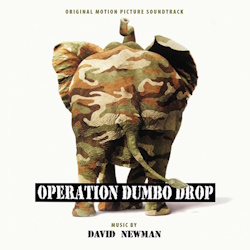
I really can’t recommend Operation Dumbo Drop highly enough. The silly title of the movie, the whimsical cover art, and the film’s plot summary really offer no indication of quite how wonderful David Newman’s music is, but I can categorically state that this is one of the most rewarding scores of his entire career, and that’s saying something considering that he has scores like Hoffa, The Phantom, Anastasia, The Affair of the Necklace, and Galaxy Quest in his filmography. Considering the general state of a lot of film music today it’s astonishing to me that Disney commissioned such a symphonically sophisticated score for what is now a mostly-forgotten family comedy film, or that they allocated enough resources to enable David Newman to see his vision through, but that’s the 1990s for you. We didn’t know how good we had it back then.
Buy the Operation Dumbo Drop soundtrack from the Movie Music UK Store
Track Listing:
- 1995 ORIGINAL RELEASE
- Opening (1:55)
- Higher and Higher (written by Carl Smith, Gary Jackson, and Raymond Miner, performed by Jackie Wilson) (2:57)
- Botat and Lihn (2:57)
- You’se a Son of a Gun (written by Allen Story, Lawrence Brown, and George Gordy, performed by Marvin Gaye) (2:28)
- Elephant Temple/Lihn’s Flashback (6:00)
- Hang on Sloopy (written by Wes Ferrell and Bert Russell, performed by The McCoys) (3:53)
- Operation Dumbo Drop (8:25)
- Think (written by Theodore White and Aretha Franklin, performed by Aretha Franklin) (2:15)
- Farewell (3:40)
- When I See An Elephant Fly (written by Ned Washington and Oliver Wallace, performed by Cliff Edwards, Jim Carmichael, and the Hall-Johnson Choir) (1:54)
- 2017 EXPANDED RELEASE
- Opening (2:04)
- Chopper Ride (1:18)
- Starting the Journey (1:30)
- Bo-Tat Enters Plane (1:20)
- Cahill’s Plans/Bo-Tat Wakes Up (3:21)
- Bo-Tat Runs/In the Jungle (2:46)
- Smart Ass/Banana Chase (1:44)
- Get Away (1:21)
- River Fight/The Watch (4:15)
- Cahill and Lihn/The Temple (6:10)
- Cowboy and Elephant Part 2/Trusting Lihn (1:25)
- Preparation For Operation (3:01)
- You Lie, You Lie (0:31)
- The Jump (8:13)
- The Ceremony/Cahill and Lihn Again/Farewell (4:05)
- End Credits (4:02)
Running Time: 37 minutes 01 seconds — Original
Running Time: 47 minutes 57 seconds — Expanded
Hollywood Records 162-032-2 (1995) — Original
Intrada Special Collection Volume ISC 384 (1995/2017) — Expanded
Music composed and conducted by David Newman. Performed by The Sinfonia of London. Orchestrations by David Newman, Xandy Janko, Randy Miller, Scott Smalley and William Ross. Featured musical soloists Dr. Devious, Arthur McGillycuddy and Marty Frasu. Recorded and mixed by Robert Fernandez. Edited by Tom Villano. Album produced by David Newman. Expanded album produced by Douglass Fake and Roger Feigelson.

Shop at the Movie Music UK Store

Member of the

 MOVIE MUSIC UK