LORD OF ILLUSIONS – Simon Boswell
 THROWBACK THIRTY
Original Review by Jonathan Broxton
Lord of Illusions is an excellent, underrated film written and directed by horror legend Clive Barker, based on his own short story The Last Illusion. The story blends elements detective noir, supernatural horror, and dark fantasy, and was his third directorial effort following Hellraiser in 1987 and Nightbreed in 1990. Scott Bakula stars as Harry D’Amour, a hardboiled private investigator based in New York who specializes in cases involving the occult. After traveling to Los Angeles on a routine insurance case, D’Amour stumbles into a far more sinister world involving the remnants of a doomsday cult once led by the charismatic and sadistic sorcerer named Nix (Daniel von Bargen). Thirteen years earlier, Nix had attempted to unleash dark powers upon the world but was stopped by his former disciple Philip Swann (Kevin J. O’Connor) and a group of fellow magicians. Swann has since become a world-famous illusionist, having buried the truth of his real supernatural powers beneath a layer of stage trickery. As D’Amour investigates further, he becomes entangled in a deadly conspiracy when Swann is killed during a stage performance gone wrong, and Swann’s widow Dorothea (Famke Janssen) enlists D’Amour’s help to uncover the truth behind her husband’s death.
The film received a mixed critical reception upon its release, but has since gained something of a cult status, especially for fans of Barker’s unique aesthetic and myth-building. Having employed Christopher Young to write the score for Hellraiser, and Danny Elfman for Nightbreed, Barker turned to British composer Simon Boswell for the score for Lord of Illusions. Of all the British composers working in film music, Boswell had possibly the oddest route there; having been classically trained on the piano as a child, he then taught himself the guitar and started playing in rock bands, releasing his own music, before going on to become a record producer in Rome. He met legendary film director Dario Argento at a party there, which led to him being asked to help the band Goblin finish their score for his film Phenomena in 1985. The subsequent success of Phenomena led to Boswell scoring a number of genre films in Italy – horrors, action films, comedies – years before he scored his first English-language film, Hardware, in 1990.
 The commercial success of the British thriller Shallow Grave in 1994 led to an increase in Boswell’s international profile, and this (combined with a recommendation from Argento), led to Barker hiring Boswell for Lord of Illusions. The production saw Boswell working in the United States for the first time; he recorded his score in a rock studio in Seattle, where he crammed a 65-piece orchestra into a tiny room, and told them to improvise as much as they could, within the confines of the score. The night before the recording sessions Boswell and his orchestrator Bill Kidd cooked up parts which were deliberately unplayable by certain sections of the orchestra, and the following day they put the tape machines in to record what happened – the resulting cacophony was then edited together afterwards to create some of the more disturbing parts of the score.
Boswell’s score is dark and at times very menacing, often using ambient eerie dissonances and rhythmic pulses to mirror the escalating supernatural tension, but it’s also surprisingly tonal. The main theme for Harry D’Amour is moody and tinged with film noir jazz, subtly reinforcing his role as a classic detective figure. There several more melodic and dramatic passages for character moments, especially surrounding the emotional arc of Harry and Dorothea, the latter of which builds into one of the best love themes of Boswell’s career. The music also occasionally erupts into moments of theatrical orchestral grandeur, illustrating the film’s themes of illusion, magic, and the thin veil between stagecraft and real power. Nix’s music is far more unsettling – ritualistic, droning, and at times apocalyptic – mirroring his status as a self-proclaimed messiah of chaos, while the use of Middle Eastern-influenced motifs explores his desert origins. Finally, the more conventional horror scoring techniques highlight the film’s more violent and supernatural sequences.
The main title, “Lord of Illusions,” begins with a passage of unexpected gentleness, but quickly evolves into a something much more oppressive and orchestrally dramatic, carried by low brass, agitated strings, a heavy and prominent drumbeat, and deep male voice choir, alongside with the score’s gimmick: members of the cast whispering horrific sweet nothings over the music.
“The Detective” contains the first performance of Harry’s theme, Boswell’s homage to all those sleazy film noirs of the forties and fifties, Raymond Chandler and Dashiell Hammett, featuring a sultry saxophone solo and elegant, sweeping strings. This theme is reprised in the conclusive “Magic Sets Us Free” to excellent effect, ending the album on a melodic high.
At the other end of the scale, “God’s Eyes” begins with Daniel von Bargen making you jump out of your skin by shouting at you from inside the speakers, before going on to become hugely atmospheric and disturbing. This is the music that represents Nix and his apocalypse cult and it’s outstanding – a mass of aggressive impressionistic orchestral and choral passages, prominent references to the thematic ideas from the main title, and some really quite astonishingly creative horror dissonances that really stretch the ensemble to its limits. Later cues like the driving “Resurrection” and the massive “Born to Murder the World” revisit this style of music with equal quality, while “Origami Man” is quite possibly one of the most disturbing cues I have heard for a while: about two minutes in, there comes a vocal effect so distressing it defies description. I suppose you’ll just have to experience it yourself.
The mid-album trio comprising “Flesh is a Trap,” “Swann’s Last Act,” and “Dorothea and D’Amour” are more traditionally tonal, and represent some of Boswell’s career-best writing of this type. “Flesh is a Trap” is dreamy and ethereal, with a prominent classical piano part. “Swann’s Last Act” is showstoppingly great – a vibrant, bold, awesomely dramatic piece the full orchestra, aggressively and vividly underscoring the tragic magic trick gone wrong with increasingly intense brass writing, swirling strings, snare drum riffs, and cymbal clashes. Then the love theme for “Dorothea and D’Amour” is gorgeous, full of soft, melodic, romantic strings that provide a welcome break from the mayhem.
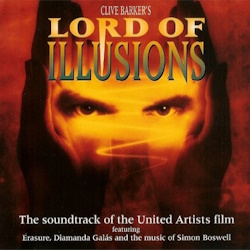
In addition to Boswell’s score, the album contains British pop duo Erasure’s cover version of Burt Bacharach’s “Magic Moments”, which takes on a surprisingly surreal quality when it strikes up, especially after hearing Famke Janssen softly breathing ‘Flesh is a trap but magic sets us free” seconds earlier. Then there is also the cover of Arthur Schwartz and Rick Dietz’s 1931 jazz standard “Dancing in the Dark,” originally recorded by Bing Crosby. This version is by the Greek-American avant-garde vocalist Diamanda Galás, and I will warn you it’s not for the faint hearted; Galás has one of the most challenging vocal timbres I have ever heard in my life – try to imagine Edith Piaf literally gargling with razor blades and you are on the right track. Galás also provided the sound of the ‘brides death screams’ on Wojciech Kilar’s Dracula score, if anyone remembers that terrifying noise, and all I can say is that this song comes to close to that scene’s nightmarish ambiance. I can’t decide whether it’s good, or whether it’s a frightening abomination.
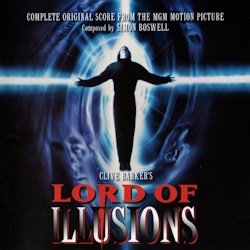 The original Lord of Illusions album contained about half an hour of score mixed with dialogue excerpts and songs, and although I have always liked it, it was never quite enough to satisfy me. In 2011 Perseverence Records and producer Robin Esterhammer released in an expanded 2-CD release of the score containing the complete underscore in film order, sourced from the composer’s own DAT tapes, and then a second disc of bonus tracks and Boswell’s original demos, composed and recorded for the director to use as temp tracks during post-production while there was still no finished score to be used. There are a few sound quality issues with the album, but the music itself is outstanding, and offers a number of excellent additional highlights.
Simon Boswell would go on to write several outstanding scores for major films – I am personally very fond of Photographing Fairies (1997), Cousin Bette (1998), American Perfekt (1998), A Midsummer Night’s Dream (1999), and Jason and the Argonauts (2000) – but I have always felt like Lord of Illusions provided a mouthwatering glimpse of the kind of rich, interesting, sophisticated orchestral horror music he was clearly capable of writing, but which for some reason Hollywood never asked for with enough regularity. Honestly, Boswell should still be a major name in film music, and this score is a superb example of why. Fans of bold, uncompromising orchestral horror scores should seek this out, and use it as a gateway to re-discover his entire filmography.
Buy the Lord of Illusions soundtrack from the Movie Music UK Store
Track Listing:
- ORIGINAL RELEASE
- Lord of Illusions (3:45)
- The Detective (3:11)
- God’s Eyes (3:42)
- Flesh is a Trap (2:27)
- Magic Moments (written by Burt Bacharach and Hal David, performed by Erasure) (2:40)
- Swann’s Last Act (2:58)
- Dorothea and D’Amour (2:31)
- While The Blood Runs Warm In Your Veins (traditional, performed by Joshua White) (3:05)
- Resurrection (4:19)
- Origami Man (4:49)
- What Are You Looking At? (1:24)
- Born to Murder the World (2:39)
- Magic Sets Us Free (2:22)
- Laura (written by Bubba Hernandez, performed by Brave Combo) (2:49)
- Dancing in the Dark (written by Arthur Schwartz and Rick Dietz, performed by Diamanda Galás) (3:13)
- EXPANDED RELEASE
- Titles/Fire Said to Me (3:47)
- About the House/Thumb Slicing (4:13)
- Fingers in the Head (3:41)
- You’ll Like LA/Discovering Quaid (1:38)
- Miller’s Exit (3:05)
- The Graveyard (2:30)
- Dorothea and the Show (4:14)
- Falling Swords (2:11)
- Perforated Swann (1:00)
- Harry Kills Miller (1:25)
- Harry and the Doves (1:24)
- Harry Back at Quaid’s (1:39)
- Jennifer Decorates Car (1:14)
- Homecoming Time (0:53)
- Repository Break In (2:07)
- Brainhead Projected (1:43)
- Harry and Dorothea Rutt (2:09)
- Origami Man (2:37)
- Harry Follows Swann (1:51)
- You’ll Do More Than That (1:29)
- The Maid’s Dead (0:31)
- Butterfield’s Tools/Digging Up Nix (3:27)
- Finding Valentin (1:48)
- Resurrection Part 1 (5:31)
- Resurrection Part 2 (2:00)
- I Do Know You Child (1:10)
- My Wisdom/Nix Stomps His Foot (8:22)
- Nix Fingers Harry/Nix Undresses/Nix Up His Own Hole (6:19)
- Harry’s Theme (Alternate End Titles) (2:18)
- Opening Titles/Fire Said to Me (Demo) (3:39) BONUS
- About the House/Thumb Slicing (Demo) (4:13) BONUS
- Fingers in the Head (Demo) (3:13) BONUS
- You’ll Like LA/Discovering Quaid (Demo) (1:38) BONUS
- Miller’s Exit (Demo) (3:03) BONUS
- Dorothea and the Show (Demo) (4:13) BONUS
- Falling Swords (Demo) (2:11) BONUS
- Perforated Swann (Demo) (2:00) BONUS
- Harry Kills Miller (Demo) (1:07) BONUS
- Harry and the Doves (Demo) (1:23) BONUS
- Harry and Dorothea Rutt (Demo) (2:27) BONUS
- Butterfield’s Tools/Digging Up Nix (Demo) (2:16) BONUS
- Finding Valentin (Demo) (1:47) BONUS
- Resurrection (Demo) (8:42) BONUS
- I Do Know You Child (Demo) (1:09) BONUS
- My Wisdom/Nix Stomps Foot (Demo) (4:48) BONUS
- Nix Undresses/Nix Up His Own Hole (Demo) (5:17) BONUS
- Harry’s Theme (Demo) (2:07) BONUS
- Recording to Click Track (Bonus Track) (7:23)
- Transforming 2M3 (Bonus Track) (0:38)
- Mixing 2M3 (Bonus Track) (2:08)
- Mixing 13M5 (Bonus Track) (6:01)
Running Time: 45 minutes 54 seconds — Original
Running Time: 143 minutes 09 seconds — Expanded
Ionic/Mute Records 13CD (1995) — Original
Perseverance Records PRD 041 (1995/2011) — Expanded
Music composed by Simon Boswell. Conducted by Simon James. Performed by The Northwest Sinfonia Orchestra. Orchestrations by Simon Boswell and William Kidd. Special vocal performances by Diamanda Galás. Recorded and mixed by Rick Winguest. Edited by Paul Rabjohns. Album produced by Simon Boswell. Expanded album produced by Robin Esterhammer.

Shop at the Movie Music UK Store

Member of the

 MOVIE MUSIC UK