JURASSIC WORLD: REBIRTH – Alexandre Desplat
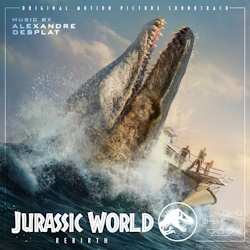 Original Review by Jonathan Broxton
It’s amazing to think that it has now been more than 30 years since the first Jurassic Park movie, and that we are now on our seventh film in the franchise that originated from Michael Crichton’s classic sci-fi adventure novel. The latest film, Jurassic World: Rebirth, takes place five years after the events of the last film, Jurassic World: Dominion, and is set in a near-future time where the descendants of the original cloned dinosaurs continue to co-exist with humans. However, due to a warming planet, the dinosaurs have been forced to reside in areas around the equator, and are beginning to dwindle in number. The plot involves a pharmaceutical company who sends a team into one of these equatorial areas to obtain bio-samples from three different dinosaur specimens, which may hold the key to creating a groundbreaking new heart disease treatment. Of course, things go wrong as they always do, when the team encounters a previously unknown and incredibly violent dinosaur clone mutation. The film stars Scarlett Johansson, Jonathan Bailey, Mahershala Ali, and Rupert Friend, is written by David Koepp (who wrote the original Jurassic Park and its first sequel The Lost World), and is directed by Gareth Edwards.
Director Edwards has a great track record when it comes to monster movies, having directed Monsters in 2010 and Godzilla in 2014, and it is this experience, combined with his work on Rogue One in 2016 and The Creator in 2023, which makes Jurassic World: Rebirth such a fun, crowd-pleasing summer blockbuster movie. It does suffer from a number of logical fallacies and head-scratching moments of oddness – titanosauruses hiding in five feet of grass? The great disappearing-reappearing T-Rex? – and the story suffers by being a bit too clichéd and predictable, and for essentially re-staging scenes from the original Jurassic Park movie, but as a popcorn flick it ticks all the boxes, and I had a good enough time with it.
The score for Jurassic World: Rebirth is by French composer Alexandre Desplat, who previously scored Godzilla for Edwards, and was attached to Rogue One for a significant period of time before production delays led to him being replaced by Michael Giacchino. Here, it is Desplat doing the replacing; Giacchino scored the last three films in the franchise – Jurassic World in 2015, Jurassic World: Fallen Kingdom in 2018, and Jurassic World: Dominion in 2022 – and although I liked those scores a great deal I am personally delighted that Desplat has been given the chance to stretch his compositional muscles here.
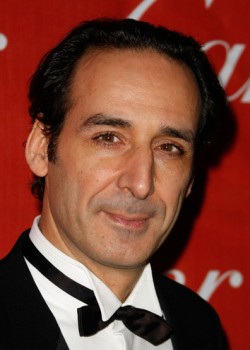 As anyone who reads this website knows, I have been an admirer of Desplat’s music for more than 20 years, stretching all the way back to the first score of his I ever heard, The Luzhin Defence, in the year 2000. Over the course of the subsequent quarter-century he has scored every type of film imaginable, but personally I have always been drawn the most towards his large-scale action/fantasy/sci-fi scores. I adore Rise of the Guardians, Harry Potter and the Deathly Hallows, Godzilla, Valerian and the City of a Thousand Planets, The Shape of Water, and scores of that type. I still think The Golden Compass is one of the best fantasy scores written since the turn of the millennium. Jurassic World: Rebirth is a score cut very much from the same cloth as those standouts, and so from just that standpoint alone, it is perfectly tailored to my taste.
What appeals to the most about his writing for this genre is, ironically, one of the things that other people seem to find frustrating, and that is the intricacy and crispness of the orchestration, and the clarity of the recording. People have called Desplat’s music ‘cold’ and ‘emotionless’ and ‘clinical’ for the entirety of his career, and for the life of me I don’t understand why. I love the way these scores sound; you can hear every detail, every embellishment, every flourish, every little reference to the different themes. I have never really been a fan of the ‘wall of sound’ approach that other composers use to bombard listeners with aural overload and frustratingly little nuance, and so the fact that Desplat does not do that, and has never done that, for me makes him stand apart. James Horner never really did that either. Neither does John Williams.
Speaking of John Williams, Jurassic World: Rebirth also gave Desplat the opportunity to truly follow in the footsteps of his hero for the first time in his career. Desplat has often been effusive in his praise and admiration for Williams, admitting that it was his love for that music that inspired him to become a film composer in the first place. You can hear that love and respect throughout this score; although Desplat has always been a composer with a strong personal voice, here he seemingly takes great pains to emulate the style and sound of John Williams as often as he can, often employing instrumental combinations and chord progressions from Williams’s musical playbook within his own familiar framework. It is enormously satisfying to hear him do this, and Desplat clearly had a blast doing it.
The score was recorded in the UK with the London Symphony Orchestra and the London Voices choir, and it is enormously impressive from start to finish. Thematically, the score is built around two primary ‘adventure’ themes, both of which are intentionally cut from the same cloth as Williams’s main Jurassic Park themes. Like Williams’s classics, they are intended to evoke a sense of grandeur and possibility, but are also tempered with a sense of underlying danger; however, one of the things I like the most about Desplat’s themes is that they appear to be actual offshoots and progressions from Williams’s, often starting with the same opening notes, but then heading off somewhere different.
In addition to these two main themes there is a more ethereal and engaging ‘family theme’ for the vacationing Delgado family who become unwittingly embroiled in the action, a couple of secondary themes that I’ll discuss later, and then a series of primal ‘monster motifs,’ one each for the different dinosaurs from which the protagonists must obtain the various samples. Then, as an acknowledgement of the franchise history and lore, Desplat directly quotes several of Williams’s famous themes from the original film. Interestingly, Desplat does not quote any of Michael Giacchino’s thematic ideas, but I can see why he did that, as none of them have embedded themselves into public consciousness the way Williams’s themes did. Nostalgia is a hell of a drug.
I’m not going to go into immense detail pointing out all the thematic references cue-by-cue, but instead I’ll pick out some things that stood out to me as notable highlights. The “Opening Lab” is the first one, which sets the scene with a flashback to an event that occurred seventeen years previously, when yet another team of dinosaur scientists find themselves becoming dinner for their own creations. The music is darkly ominous, full of low brass, fluttering jungle woodwinds, low choral tones, and shrill violins that gradually rise to a frenzy, and it is here that Desplat first introduces each of his monster motifs, one after the other.
Back in the present day, “Natural History Museum” sees Desplat exploring his main adventure theme in a variety of different ways, underscoring a scene where Rupert Friend’s pharma bro Krebs and Scarlett Johansson’s mercenary Zora visit Jonathan Bailey’s academic paleontologist Loomis at his workplace to convince him to join their expedition. Desplat runs the theme through a variety of emotional tones and a variety of instrumental ideas – sometimes it is warm and engaging, sometimes suspenseful, sometimes quirkily comedic, and sometimes it even approaches light horror, especially when the choir comes in. I love the little sequence at 3:34 where Desplat counterpoints his theme on horns against the first three notes of Williams’s main theme on glockenspiel, and then the piece concludes with an unexpectedly rousing statement of Williams’s ‘Journey to the Island’ fanfare as the team arrives in Suriname to start their adventure.
The way that Desplat deconstructs and reimagines Williams’s main Jurassic Park theme as a playful piece full of pizzicato textures in “Team Gathered” is charming, but this soon gives way to the first sweeping rendition of Desplat’s adventure theme in “Voyage,” as the team heads out to their destination on board a boat chartered from and captained by Mahershala Ali’s character Duncan Kincaid. However, things become more anxious very quickly, and yet again Desplat impresses with the way he counterpoints his own theme with Williams’s main theme arranged for harps and pianos.
There’s an unexpectedly tender, almost romantic piano theme in “Zora and Kincaid,” underscoring the scene where the two guns-for-hire take a moment to discuss the toll their jobs take on their personal lives. However, this quickly gives way to the score’s second main action sequence, “Mosasaur Attacks Yacht,” where we are introduced to Reuben Delgado (Manuel Garcia-Rulfo), who is on a sailing vacation with his daughters Teresa (Luna Blaise) and Isabella (Audrina Miranda), and Teresa’s dumb-ass boyfriend Xavier (David Iacono) in the same area as the main characters. Their yacht is attacked and capsized by a giant aquatic dinosaur called a mosasaur, and Desplat underscores the scene with a dark, deadly, intricately orchestrated action and horror cue that combines the thunderous stylistics of Desplat’s Godzilla scores with some Williams-style rhythmic ideas that come, naturally, from Jaws, but also from the ‘here they come’ TIE fighter attack sequence from Star Wars. It’s just brilliant, so richly textured, so perfectly arranged, but also propulsive and exciting.
The three-cue sequence comprising “Boat Chase,” “Fins Attack Part 1,” and “Fins Attack Part 2” is the score’s third main action sequence, and underscores the scene where the team – having rescued the Delgado family – successfully chase and obtain a sample from the mosasaur, but are then attacked by a pod of amphibious hybridized spinosaurs, which causes their boat to crash and run aground. The “Boat Chase” cue is just sensational; it’s chock full of all Desplat’s best action characteristics from scores like The Golden Compass and Valerian, including the use of light metallic percussion and flutter-tongued muted brass underneath the energetic string runs, all of which is in support of a series of bright, heroic statement of the main adventure theme, which he then combines with growling statements of the mosasaur-specific monster motif. This feels like Desplat’s emulation of the barrel chase sequence from Jaws, and it’s magnificent. And things don’t let up through the two “Fins Attack” cues either, which are again replete with dense, complicated, spectacularly orchestrated action motifs, all full of endlessly creative touches of stylishness – listen out for the clattering xylophones throughout the second half of Part 1!
The ethereal “Cave Swim” opens with some beautiful writing for bass flutes in conjunction with the strings and then after a brief sequence of ominous trepidation, introduces the first statement of the lovely Delgado family theme at the 2:31 mark, a wholesome representation of the bond between them and their desire to find safety. The sequence from “Hurry” through to the end of “The Pistol/Scare in the Trees” is mostly tension-filled jungle trek music, a lot of which owes a debt to Williams’s score for The Lost World, especially in the way Desplat uses more prominent tribal percussion to drive the drama along. The subsequent “Do the Job” then introduces one of the score’s most recognizable secondary themes, a pretty piano theme for Dolores, the orphaned baby dinosaur that little Bella Delgado adopts, a melody that almost feels like a refugee from one of Desplat’s elegant European costume dramas.
“Dino Lovers” and “Dino Spectacle” underscore the scene where the team locates and easily extracts a sample from one of the herbivore titanosaurus dinosaurs – easily, because they are distracted by being in the middle of a mating ritual! – and this moment of calmness allows the awe-struck Loomis to live out his childhood fantasies and caress the leg of one of these majestic beasts. Desplat plays a warm, appealing version of his main adventure theme to accompany this moment of tenderness; fun fact: this is the cue where actor Jonathan Bailey, who plays the clarinet in real life, sat in with the orchestra during the recording sessions, and performed the prominent clarinet line heard at 1:45. The sequence ends with a fantastic rendition of Williams’s main theme, which is reminiscent of the moment where we see the dinosaurs for the first time in Jurassic Park, but this time accompanies a herd of titanosaurs migrating through a spectacular jungle valley.
The score’s fourth main action sequence comprises “What’s This Smell?” and the 8-minute “Crossing the River/T-Rex,” which underscores a scene that was actually in the original Jurassic Park novel but never made the film, wherein the Delgado family are attacked by a tyrannosaurus while trying to make their escape down a river in an inflatable raft. Desplat’s action music is, again, absolutely ferocious, thunderous brass and apocalyptic low choral moans surrounding a nightmarish statement of the main adventure theme, plus several of the monster motifs. Desplat’s orchestration choices are, again, impeccable, from his use of Lost World-style jungle drums to the way he constantly moves back and forth between different parts of the brass section to keep the timbres interesting, to the dexterity of the flute lines, to the rapid increase in tempo in the last two minutes of the cue.
After yet more vivid action in “Climbing the Wall” and the fierce “Bird Strike” – the team extracting their third and final sample from the eggs of a quetzalcoatlus dinosaur – and a shimmering, calm-before-the-storm reprise of the Delgado family theme in “Gentle Boat Ride,” the score’s massive 20-minute finale begins, as the surviving members of the team reconnect with the Delgado family at the now deserted lab compound to await the arrival of their rescue helicopter, but instead must do battle with two different escaped hybrid dinos: the half-velociraptor half-pterodactyl mutadons, and the fearsome ‘D-Rex,’ which looks like a terrifying combination of an Alien xenomorph and a Return of the Jedi rancor.
Throughout this final sequence Desplat revisits several of the main themes in bold action settings, notably the main adventure theme and the Delgado family theme, but also leans heavily into endless vicious reprises of the various monster motifs, with the specific D-Rex motif featuring heavily in both “Run to the Gate” and “Bella and the Beast”. There’s a hilarious pseudo-hero moment featuring the theme for Dolores the baby dinosaur at 2:05 in “Mutadons Fly In,” surrounded by some flashy frenetic string writing. “Tunnel/Helicopter” builds up a real head of steam, and has an animatedly exciting and bombastic finale featuring a cool statement of the main adventure theme arranged for bassoon surrounded by choppy, aggressive strings and jungle drums. “Run to the Gate” is tension and exhilaration personified, and then the conclusive “Bella and the Beast” sees Desplat pitting a deeply tragic version of his main theme against a series of vicious, haunting choral outbursts of the D-Rex motif, resulting in a near-operatic atmosphere that perfectly captures the sense of noble self-sacrifice.
The score concludes with “Sailing Away”, an arrangement of Williams’s main theme for solo piano that mirrors the sense of relief from the original film’s finale. Eventually Desplat augments the solo piano with a cooing choir, and then the might of the full orchestra, ending the score on a terrific nostalgic high.
Suffice to say, I thought all this music was absolutely outstanding. In film context, admittedly, the score is occasionally dialed down too much in the sound mix, resulting in a great deal of Desplat’s detail getting lost under screams and roars, but in the moments where the music is allowed to sing – the boat chase sequence, the tyrannosaurus river sequence, the finale with the ‘D-Rex’ – it really impresses. However, it is on the album that the true excellence and intelligence of Desplat’s music is revealed, and all that delicious instrumental intricacy, that thematic interplay, and that creative orchestration comes rushing into focus. One other thing I will say about this is that, despite running for an hour and 40 minutes, this is one of the rare long albums that never runs out of steam or feels padded; every cue has worth, every cue has something interesting to say, and I remained engaged with it throughout.
Some commentators have suggested that Desplat’s new themes are poor and unmemorable, or that the whole thing is emotionally detached, but I could not disagree with those statements more vehemently. As I stated earlier, these same criticisms have been leveled at the Frenchman since… well… since he started working in Hollywood really, and I remain as baffled by them today as I was back then. I can’t recommend this score highly enough to anyone who has ever loved his bold, flamboyant, endlessly creative fantasy sci-fi and action scores; on the strength of this score, and with his score for Guillermo Del Toro’s Frankenstein still to come in November, this could be Desplat’s year.
Buy the Jurassic World: Rebirth soundtrack from the Movie Music UK Store
Track Listing:
- Opening Lab (4:53)
- Bridge of Deal (0:59)
- Natural History Museum (5:04)
- Team Gathered (1:12)
- Voyage (2:51)
- Dart Show (1:18)
- Zora and Kincaid (2:24)
- Mosasaur Attacks Yacht (4:00)
- Zora and Loomis Chat (1:57)
- Mayday (3:32)
- Mosasaur Bumps Boat (1:12)
- Boat Chase (5:15)
- Fins Attack – Part 1 (4:49)
- Fins Attack – Part 2 (1:31)
- Cave Swim (3:48)
- Hurry (1:42)
- Walking the Swamp (3:21)
- The Pistol/Scare in the Trees (1:33)
- Do the Job (2:28)
- Dino Lovers (2:59)
- Dino Spectacle (1:43)
- What’s This Smell? (1:16)
- Crossing the River/T-Rex (8:10)
- Clifftop (0:36)
- Climbing the Wall (3:37)
- Bird Strike (3:40)
- Let’s Go Home (0:31)
- Gentle Boat Ride (4:05)
- Mutadons Fly In (4:55)
- The Old Lab (2:38)
- Tunnel/Helicopter (4:19)
- Run to the Gate (2:44)
- Bella and the Beast (4:50)
- Sailing Away (2:08)
Back Lot Music (2025)
Running Time: 101 minutes 46 seconds
Music composed and conducted by Alexandre Desplat. Performed by the London Symphony Orchestra and London Voices. Orchestrations by Alexandre Desplat, Conrad Pope, Jean-Pascal Beintus, Sylvain Morizet, Bill Newlin, Larry Rench, and Nan Schwartz. Legacy Jurassic Park themes by John Williams. Recorded and mixed by Peter Cobbin. Edited by Gerard McCann. Album produced by Alexandre Desplat and Dominique Lemonnier.
-
February 6, 2026 at 8:00 amMovie Music UK Awards 2025 | MOVIE MUSIC UK

Shop at the Movie Music UK Store

Member of the

 MOVIE MUSIC UK