HOW TO TRAIN YOUR DRAGON – John Powell
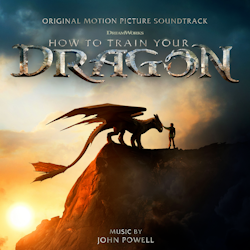 Original Review by Jonathan Broxton
In 2010 Dreamworks Pictures released an animated adventure film based on Cressida Cowell’s popular children’s novel How to Train Your Dragon. Set on the mythical Viking island of Berk, the film follows Hiccup, a skinny and awkward teenager, who is also the son of the village chief, Stoick the Vast. In Berk, dragon attacks are a regular hazard, and slaying them is a mark of honor; Hiccup desperately wants to prove himself to his father and the village but lacks the brute strength of the other Viking youths. Fearing that he will never earn his father’s respect, Hiccup resigns himself to the fact that he will never become a dragon slayer – until the day that Hiccup accidentally shoots down a rare and mysterious dragon known as a Night Fury, and in doing so upends everything he thinks he knows about dragons.
When Hiccup first captures the Night Fury, he’s expected – as a Viking – to kill the dragon and prove himself. But when he finally sees the creature up close, vulnerable and terrified, something in him shifts. He recognizes the creature’s fear and pain as something he shares: they’re both misunderstood outcasts. Instead of killing him, Hiccup spares the dragon’s life, and this act of empathy sets the tone for everything that follows. The subsequent relationship between Hiccup and the Night Fury dragon that he names Toothless is the emotional heart of How to Train Your Dragon, a bond that transforms not only the characters themselves but also their entire world.
The relationship between Hiccup and Toothless is a massive part of what connected with viewers worldwide. The film was a ginormous critical and popular success, grossing almost $500 million at the global box office, and receiving an Academy Award nomination for Best Animated Feature. The success of the film helped launch How to Train Your Dragon into a major franchise, comprising two animated sequels (How to Train Your Dragon 2 in 2014, and The Hidden World in 2019), plus multiple TV series and specials, toys and games, and even theme park attractions. Now, fifteen years after the first film premiered, Dreamworks has followed in the footsteps of Disney by releasing a live-action remake; it is written and directed by Dean DeBlois, who co-wrote and o-directed the animated films, and stars Mason Thames as Hiccup, Nico Parker as Hiccup’s love interest Astrid, as well as Gerard Butler reprising in real life his voice role as Hiccup’s father Stoick.
 When I first heard that they were making this film, my first question was “why”? It’s only six years since the third How to Train Your Dragon animated sequel came out, and as far as I am aware there was no great clamor for them to go back and re-make the original. If one was being uncharitable, this could be seen as little more than a cynical cash-grab by Dreamworks, who likely saw what Disney have been doing with The Little Mermaid, Beauty and the Beast, Aladdin, and others, and wanted their own piece of the pie. I say cynical, because at its core it feels like a ploy to extract more money from fans of the franchise, and it doesn’t sit right with me.
Remaking old films is not a new idea – they have been doing it since the birth of cinema – but each new iteration usually brings something new to the table – a new spin, an updated setting, something that sets it apart from its predecessor. This version of How to Train Your Dragon doesn’t really do any of those things; it is, essentially, a shot-for-shot remake of the first film (not exactly shot for shot, obviously, but close enough), with the same director, the same screenwriter, one returning cast member, and – most importantly from the point of view of this review – the same composer, John Powell.
In my opinion, the 2010 How to Train Your Dragon is the greatest score of John Powell’s career to date. He deservedly received his first Oscar nomination for writing it (and should have won, instead of The Social Network), and in the years since then it has become a popular fan favorite. I adore its thematic beauty, and its deep emotional content. I find the energy of the action scenes tremendously exhilarating. It’s complex and intricate, with a rich variety to its orchestration, and a real intelligence and sophistication to its structure. I have even grown to appreciate the ‘Scottishness’ of it all, when I originally joked that John Powell could have done with brushing up on his Scandinavian geography a little. With all that at stake, what on Earth could Powell bring to the table with his new score for the remake? How do you improve, or even equal, what is essentially film music perfection?
This was a rather unique position for John Powell to find himself in. There are very few examples of a composer being asked to score a remake of his own film using (essentially) the same music. Alan Menken has done it three times on the live-action remakes of The Little Mermaid, Beauty and the Beast, and Aladdin. Hans Zimmer did it with the live-action remake of The Lion King in 2019. And then there are a couple of ‘sort ofs,’ when Elmer Bernstein re-arranged Bernard Herrmann’s original score for the remake of Cape Fear in 1991, and then when Danny Elfman did the same thing for the remake of Psycho in 1998. But beyond these, I’m struggling to think of any other examples of this exact scenario.
Powell confirmed he would compose the score in 2023. In an interview with the Hollywood Reporter director DeBlois recalled, “John saw the same potential I did – he believed that if we approached a live-action version with love and respect for the fanbase, it could be both a nostalgic embrace for longtime fans and a fresh experience for a new generation.” As such, for this new version, Powell says he ‘revisited’ his earlier themes but chose not to simply reuse them. Instead, he says he aimed to honor the spirit of the original while adapting to the new film’s distinct storytelling style and cinematic language, a painstaking process that required significant changes in tempo, key, orchestration, pacing, and musical emphasis. Powell said “It just took an awful lot of massaging and managing and chipping away at it. I feel like I did about three months of sanding.” Unbelievably, Powell had to undertake a significant amount of this work remotely, away from his studio, which was damaged during the January 2025 Palisades Fire. After literally fleeing for his life down the hill to Malibu, Powell relocated multiple times via Airbnb before settling in at Hans Zimmer’s Remote Control Productions studio in Santa Monica to continue work on the score.
So, is How to Train Your Dragon Redux a new score which honors the spirit of the original while adapting to the new film’s distinct storytelling style and cinematic language, or is it essentially a re-tread of the same thing again? The answer, really, is both, and ultimately your appreciation for this album will depend entirely on how many degrees you lean in one way or the other.
One thing I want to be clear about, just going forward, is that I am not going to be pointing out all the little changes Powell made on a track-by-track basis – I’ll leave that to others – mostly because I’m really not musically literate enough to do it, but also because that would be an exercise in futility and, frankly, it would be boring in review form. However, I will point out a few general patterns that I noticed.
Virtually all the original How to Train Your Dragon themes and their variations are back in this score – the spectacular Flying theme for Hiccup and Toothless, the menacing Dragons theme, the three different Viking themes, the more optimistic Fate theme, the love theme for Hiccup and Astrid – but Powell does indeed alter them in a myriad of subtle ways, adding little tweaks to the orchestration, playing around with the tempos, and even adding entire new sections to certain cues to make them fit the varying scene lengths. There are also a number of clear alterations in the way certain cues are mixed, bringing some instruments to the forefront, while placing others toward the back, and this changes the feel of a lot of the music.
One other thing worth mentioning is the fact that, in several key cues, the choir seems to be significantly larger and more prominent, which gives the whole score perhaps a slightly more ‘epic’ feel, but this is counterbalanced by the sometimes almost subliminal use of electronic bass sweeteners, which at times tends to push the score in the direction of contemporary trailer music; your reaction to these developments will depend on your taste.
Perhaps most interestingly of all is the inclusion of a brand new theme, which Powell has called the “Homeward” theme, and which acts in a similar way to the aspirational ‘winds of change’ viking theme (and, in some instances, replaces it in context). The Homeward theme is almost identical to the family theme from Powell’s 2011 score Mars Needs Moms, and is really quite lovely, and it is clearly built from the same building blocks as the rest of the score, sharing musical DNA. You can hear it for the first time on gentle woodwinds and strings in “He’s Not That Boy,” and in several cues thereafter, before it reaches its climax in “You Are My Homeward,” a brand new Viking song that replaces Jonsi’s “Sticks and Stones” and also appears during the end credits.
As for the rest of the score; well, it still packs a huge emotional punch. Despite my misgivings about the validity of the project as a whole, listening to the soundtrack is still a wholly positive, nostalgic delight, with endless highlights. “This Is Real Berk” remains a complete and utter joy, its standout performances of the fun Viking theme and the love theme exploding with power and positivity. The various foreshadowings of the Flying theme and the related ostinato in cues like “Searching the Woods,” “Sketches of a Wounded Dragon,” and “Our Most Valuable Possession” are excellent and intelligent, and the way those all coalesce into the beautiful percussive new-age vibe of “A Really Forbidden Friendship” is superb. This cue retains its unusual tick-tock percussion element highlighting marimbas, xylophones, and a breathy female vocalist, to excellent effect.
The iconic “Test Driving Toothless” is, of course, an utterly spectacular celebration of soaring freedom, the inherent danger but breathless exhilaration of flight, and the beginning of a symbiotic friendship between a boy and his dragon. The the way the theme blends with the love theme for Hiccup and Astrid in “A Romantic Flight” is gorgeous and heartwarming, and then the harp performance of the love theme in “Should We Tell Your Father?” is also especially delightful.
Best of all, the action music is really quite immense. It’s interesting to note that, in terms of style, Powell’s action music has actually altered somewhat over the last 15 years or so, and when you compare the arrangements of How to Train Your Dragon 2010 through its sequels to more recent action scores like Solo, you can hear subtle changes in certain things, notably the way he uses and layers his percussion. Powell appears to have gone back and almost imperceptibly altered the action writing here to bring it closer in tone to these later scores, and to me there is a real dynamic freshness to cues like “First Dragon Training,” “I’m Beginning to Question Your Teaching Methods,” “Carefully Attaching,” “Charming the Zippleback,” “Top Slayer,” “Taken to the Dragons’ Nest,” the apocalyptic “The Trial of Flame,” and many others, all of which feature a slightly new twist to their tone while keeping the thematic interplay, complexity, and emotion intact.
The entire action finale from “Prelude to a Battle” through to the end of “We Have Dragons” is as spectacular as ever. The choral part of “Prelude to a Battle” now has actual lyrics, and has a real sense of impending dramatic destiny. The skirl of warlike bagpipes at the beginning of “Meeting the Queen” is bold and imposing, while the swashbuckling Korngoldian burst of the Viking action theme is tremendously satisfying. The heroic sweep of the flying theme in “Allied Forces” is glorious, the scale of “The Wings of the Beast” is just staggering, and the heartbreaking despair of “Finding Hiccup” is palpable.
The word that I keep returning to in How to Train Your Dragon is ‘joyous’. It made me feel like that the first time I heard it in 2010, and it still makes me feel like that now. This is magnificent music, from start to finish. But your appreciation for this new version of the score will likely depend entirely on your feelings about the existence of the project as a whole, and whether you consider it to be a worthwhile venture aimed at bringing the story to a new generation, or a cynical marketing ploy. It will also depend on whether you appreciate what Powell has done in terms of tweaking the pre-existing music to fit its new circumstances, whether you can appreciate the nuance of the slightly new arrangements, and the inclusion of a new theme, or whether it all feels off, a redundancy not worth investing in. I have heard both arguments, and can understand both points of view.
Personally, I think I lean slightly towards the more positive side of things; it’s not radically different in any meaningful way, but I found it to be fascinating in terms of the ways Powell found to manipulate the round pegs of the old score to fit the square hole of the new film. To answer my own question from earlier about “How do you improve, or even equal, what is essentially film music perfection?” – the answer is, you don’t. You do what you think is right for the film, regardless of your feelings about what the producer’s intentions are, and hope for the best, and that is what John Powell has done here. And, as a lover of this particular style and approach, at the end of the day, it’s another excuse to listen to this wonderful music, and what film score fan would pass up that opportunity?
Buy the How to Train Your Dragon soundtrack from the Movie Music UK Store
Track Listing:
- This Is Real Berk (7:48)
- I Hit a Night Fury (2:03)
- I Want to Be One of You Guys (1:21)
- Conference of the Tribes (2:12)
- He’s Not That Boy (1:19)
- Searching the Woods (3:26)
- Home in the Ring (2:37)
- First Dragon Training (3:57)
- Sketches of a Wounded Dragon (2:43)
- Our Most Valuable Possession (3:01)
- I’m Beginning to Question Your Teaching Methods! (3:47)
- A Really Forbidden Friendship (4:47)
- Carefully Attaching (2:48)
- Charming the Zippleback (1:43)
- He Has a Way with the Beasts (4:28)
- Test Driving Toothless (3:06)
- Top Slayer (2:28)
- Caught Designing Outfits (2:26)
- A Romantic Flight (2:28)
- Taken to the Dragons’ Nest (2:05)
- Should We Tell Your Father? (1:40)
- Waiting to Enter the Ring (2:29)
- The Trial of Flame (4:58)
- You’re Not My Son (3:12)
- What Are You Going to Do About It? (3:36)
- Prelude to a Battle (2:18)
- Meeting the Queen (4:18)
- Allied Forces (4:32)
- The Wings of the Beast (2:56)
- Finding Hiccup (4:11)
- We Have Dragons (2:52)
- You Are My Homeward (1:45)
- ..And Finally, the End Credits Suite (6:28)
Back Lot Music (2025)
Running Time: 106 minutes 02 seconds
Music composed by John Powell. Conducted by Gavin Greenaway. Orchestrations by Jonathan Beard, Edward Trybek, Henri Wilkinson, and Tracie Turnbull, Sean Barrett, Jennifer Dirkes, Benjamin Hoff, Steven Rader, Jacob Shrum, and Jamie Thierman. Additional music by Batu Sener and Markus Siegel. Legacy orchestrations by John Ashton Thomas, Dave Metzger, Daniel Baker, Gavin Greenaway, James K. Lee, Angus O’Sullivan, Germaine Franco, Stefan Schneider, and Jessica Wells. Legacy additional music by Dominic Lewis, Michael Mollo, Paul Mounsey, and James McKee Smith. Recorded and mixed by Nick Wollage. Edited by Bill Bernstein and Simon Changer. Album produced by John Powell.
-
February 6, 2026 at 8:01 amMovie Music UK Awards 2025 | MOVIE MUSIC UK

Shop at the Movie Music UK Store

Member of the

 MOVIE MUSIC UK