VIRGINIA CITY – Max Steiner
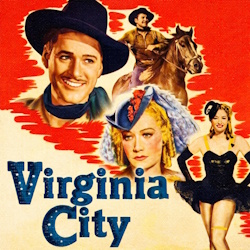 GREATEST SCORES OF THE TWENTIETH CENTURY
Original Review by Craig Lysy
Following the commercial success of Dodge City in 1939, Warner Brothers decided to again showcase their marquee star Errol Flynn in another Western. A story by Robert Bruckner fit the bill, and Robert B. Fellows was placed in charge of production with a $1.179 million budget. Michael Curtiz would direct, with Bruckner writing the screenplay. For the cast Errol Flynn would star as Captain Kerry Bradford, again paired with Olivia de Haviland as Julia Hayne. However, after de Haviland dropped out, as did her replacement Brenda Marshall, Miriam Hopkins won the role. Joining them would be Randolph Scott as Captain Vance Irby, Humphrey Bogart as John Murrell, and Alan Hale as Olaf “Moose” Swenson.
The film is set in the waning months of the American Civil War. Captain Kerry Bradford escapes the Confederate Libby Prison commanded by Captain Vance Irby. Bradford is assigned a mission to Nevada to ferret out the location of $5 million in gold bars the confederacy plans to ship east to fund its tittering war efforts. On the stagecoach west to Virginia City Bradford meets and falls in love with Julia Hayne, a Confederate spy. He also takes fellow passenger John Murrell, the leader of a gang of desperados prisoner. Virginia City intrigue unfolds as Captain Irby arrives to oversee the gold shipment and recruits Murrell’s men to distract the local garrison’s soldiers. Vance escapes with the gold, but is eventually betrayed by Murrell. Bradford joins the fight, Murrell is killed, and he decides to hide the gold to help the south rebuild after the war. The garrison commander Major Drewery and Bradford come into conflict over the disposition of the missing gold and Bradford is arrested, court-martialed, and convicted for high treason. Yet Julia saves the day when she prevails on President Abraham Lincoln to issue a pardon for Bradford on the day General Lee surrenders to General Grant at the Appomattox court house. The film was a commercial success, earning $2.120 million. Critical reception was poor with much of the criticism directed at Flynn and Hopkin’s performances, and Curtiz’s uninspired directing in a film plagued by numerous rewrites during shooting. The film received no Academy Award Nominations.
Max Steiner was Warner Brothers premier composer and this would be the second film he would score of a Warner Brothers Errol Flynn trilogy of Westerns directed by Michael Curtiz; “Dodge City” (1939), “Virginia City” (1940), and “Santa Fe Trail” (1940). Their marquee actor was box office gold and Westerns were blossoming with the public. The film offered stagecoach travels across majestic desert vistas, fierce battles, bar room brawls, romance, and intrigue. Very fertile ground indeed, however, Steiner was decidedly unhappy with the final film, as the constant rewrites during filming, editing, animosity between Flynn and Hopkins, and Curtiz’s out of form directing burdened him with again having to write music ‘to save the film’. He relates;
“Chet North is dubbing this – hence nothing maters! Just a wasted effort! I am writing without any ambition!! HELP! I STINK!! MAX STINKER!! I can’t think’er no more. This picture is horrible!! Curtiz must have been drunk!”
 Never the less, I believe Steiner’s self-assessment was rather harsh as in my judgement he once again composed a score, which in every way enhanced the film, mitigating many of its flaws. Six primary themes were used, three of which were original. The bold Pioneer Theme serves as the film’s Main Theme. It offers a grand a sweeping horn empowered Americana confidence long associated with the genre. It is pervasive in the score and the unifying thread of its narrative tapestry. The Stagecoach Theme exudes Americana bravado, which supports stagecoach travel, offering an exuberant and galloping energy, that propels the coach across spectacular vistas. Americana Julia’s Theme, serves as her identity as well as a Love Theme; first for Vance, and later for Kerry. As the score’s only feminine identity, it juxtaposes the more martial and aggressive masculine identities, by offering an elegant cantabile minuet. I believe it one of the prettiest themes in Steiner’s canon. Since the film is set during the civil war, three military anthems were used as emblems of the opposing sides. The Union was empowered by “The Battle Hymn of the Republic” (1861) by William Steffe and Julia Ward Howe, “The Battle Cry of Freedom” (1862) by George Frederick Root, and the Army’s Bugling Cavalry Charge, while the Confederacy was empowered by “Dixie’s Land” (1860) by Daniel Decatur Emmett. For our villain Murrel we also have an anthem, but one of malevolence, empowered with howling trombones bellicoso of menace, which propel him and his desperados. Lastly, a number of folk songs and hymns, and were woven into the fabric of the score to provide the requisite cultural sensibilities of the time.
“Main Title” opens grandly with Max Steiner’s Warner Brothers fanfare, brief quotes of “Dixie” and the “Battle Hymn of the Republic” launch the flow of the opening credits and usher in at 0:15 a forthright, proud and sweeping Pioneer Theme, which abounds with the confidence, optimism and determination that empowered America’s expansion westward to realize its Manifest Destiny. At 0:54 we segue into the confederate anthem “Dixie”, which supports narrative script that dedicates the picture to the gallant party of 73 men, women and children who in 1864 undertook a daring adventure. At 1:12 the “Battle Cry of Freedom” erupts to support a civil war battle, from which arises at 1:27 the “Battle Hymn of the Republic” as Union troops overwhelm Confederate lines. At 1:36 we enter the film proper atop a dispirited “Dixie”, which supports the retreating Confederate troops entering the town of Morgantown Kentucky. Steiner, true to form, masterfully sets the tone of the film. (*) “Checkpoint” reveals a Confederate Sergeant checking the papers of people at a checkpoint. The galloping Stagecoach Theme carries the arrival of a stagecoach bearing three men and Miss Julia Hayne of Virginia City Nevada, who is bound for Richmond Virginia to visit her friend, Colonel Vance Irby, the Commandant of Libby Prison. They are granted passage and a dire statement of “Dixie” supports narrative script; “Libby Prison – The Devil’s Warehouse and dreaded black hole of captive Union soldiers.
(*) “The Tunnel” reveals prisoners sliding a stove across the floor to reveal a tunnel they are digging to escape, as scouts standby at the door to alert any approaching guard. Steiner sow tension and unease using his Tunnel Motif, a repeating four-note phrase, which empowers Captain Kerry Bradford and Moose, who lead a group of men through the tunnel. Bradford determines they have five feet left to dig and we switch to Captain Vance Irby’s office. Dire horns sound and usher in a foreboding march as he loads his pistol, arms himself, and departs. The prisoner scouts alert the men of his approach, and they scurry to their beds and feign being asleep. He audaciously orders the guard over his objections, to open the cell, and then lock the door behind him. A foreboding musical narrative unfolds with dire fragments of “Dixie” embedded as he scans the room and discovers a soldier with mud covered shoes, mud tracks leading to the stove, and the vent pipe revealing a gap. A crescendo dramatico swells as he orders the men to move the stove, which reveals a hole in the floor. Irby descends into the basement, and a misterioso engulfs him as he walks to a tunnel at the far end. The four-note Tunnel Motif resumes as he gazes into the tunnel, slowly swelling with tension that culminates ominously as he yanks the rope. Irby orders them out and a grim quote of the “Battle Hymn of the Republic” supports their exit, ending harshly as Bradford and Irby lock eyes. In (*) “Irby Confronts Bradford” Irby reveals that he has known about his tunnel for three and a half months, and allowed them to dig and toil as punishment for Bradford’s repeated attempts to escape. Bradford is angry, yet Irby says he will allow them to continue as escape will bring certain death. Bradford promises that one day he will avenge this, with Irby singularly unimpressed. A dire musical narrative carries Irby’s departure as Bradford fumes.
(*) “Julia’s Proposition” reveals Captain Irby returning to his office and discovering Julia waiting for him. After they happily reacquaint, she discloses a plan to save the confederacy with a plan to steal $5 million in gold, which is housed near Virginia City, and ready for the taking. She proposes that since he is familiar with Virginia City and the terrain, that he take on the mission. Steiner supports with warmth and gentility, from which arises her theme, a gorgeous minuet as she relates her efforts to establish herself as a singer. She has used this as a cover to covertly bring information of the North to the Confederacy, which was why she was sent to recruit him. She pleads with him to save the Confederacy and meet with President Davis. (*) “Irby Accepts The Mission” opens with a proud declaration of “Dixie”, which supports a camera zoom in on a gold door plaque, which reads; “Jefferson Davis – First President of the Confederate States of America”. Inside Jefferson’s military staff confirm that the confederacy is broke, that they cannot fund the army, and that defeat is inevitable unless money is found. Irby declares that he is confident that he can steal the gold and safely transport it southwest via Texas to a Gulf of Mexico port where a blockade runner can bring it to Wilmington Harbor. Julia, the architect of this plan is brought in and is thanked personally by President Davis.
“The Trench/Bradford’s Folly” reveals Bradford and his men again in the tunnel preparing to detonate a bomb to open up a hole to the surface. Steiner employs the four-note Tunnel Motif in a stepped ascent of hope to support their efforts, which concludes with trepidation as they place the bomb. At 0:35 French horns declare “The Battle Cry of Freedom” as Bradford orders them to hold detonating the device until the scheduled sentry change at 10 pm. Vance and Julia are traveling by carriage and at 0:40 a dramatic, repeating five-note motif supports him disclosing that Union soldiers are only 70 miles away and his men are digging trenches as the city’s last line of defense. At 1:08 “Dixie” joins as he declares to her that they’ll never take Richmond as she has brought them hope. The music becomes wistful as she reminisces in front of her family’s house. She becomes tearful that they may soon lose their way of life, and her graceful minuet joins at 1:41 when Vance says to her, that she will not lose him. The music becomes foreboding and is joined by martial auras as she asks to return to Richmond and then asks what time it is. As he says 10 pm, a series of explosions erupt across the river at the prison. An accelerando dramatico propels their carriage ride to investigate. (*) “The Escape” reveals Bradford, Moose and Marble escaping through a swamp carried by a trudging iteration of “The Battle Cry of Freedom”. Strains of “Dixie” interplay to support the Confederate soldiers in pursuit. They manage to elude the Confederates and we segue atop trumpets militare fanfare into (*) “General Meade Headquarters” where Bradford reports to General Meade and his staff. He was investigating rebel gold shipments when he was captured, and believes they intend to obtain millions from Confederate sympathizers in Virginia City. General Meade agrees to dispatch him to foil this plot and sends them to the pay master to fund the expedition.
“The Coach” reveals a stagecoach traveling across spectacular Nevada vistas. It is propelled by the vibrant galloping energy of the Stagecoach Theme borne with Americana bravado. The music downshifts into gentility as we move inside to see Bradford, Moose and Marble sitting across from Julia, Jon Murrell and Mr. Upjohn. After initial pleasantries they discuss their businesses. Murrell says he is a seller of hardware and passes around a Dillinger pocket pistol. When it finally returns to him, he announces at gun point that they are to turn over all their money and valuables. Bradford refuses and Murrell calls his bluff, coaxing him to look out the window. At 1:02 we segue into “Murrell” atop howling trombones of menace, which support twenty of Murrell’s guerilla’s riding towards the coach. Inside Bradford turns the tables revealing the pistols two bullets in his hand as he pulls out his revolver. A crescendo bellicoso erupts as Murrell’s men charge and force the coach to stop. Music stops for the dialogue at this point. At gun point Bradford forces Murrell to dispatch his men with orders not to follow, which he does, telling them if they do not obey, Bradford will kill him. Music resumes at 1:26 as they holster their guns, and the Stagecoach Theme launches the coach back on its journey. They stop, and Murrell and Moose move topside next to the driver and the coach continues. At this point there is a film-album variance. In the film, an interior scene features dialogue between Kerry and Julia that is supported by interplay of a gentler rendering of the Stagecoach Theme and Julia’s Theme. The album omits this. Film and album resynchronize at 1:38 in “Chase”, an astounding score action highlight. Murrell pushes Moose off balance, stealing his pistol, and shoots the driver. Ferocious interplay between the howling saxophones of Murrell’s Theme and the driving Stagecoach Theme supports Murrell and Moose fighting. Moose is knocked onto stagecoach tongue as gunfire erupts between Murrell, Bradford and Marble. As they cross a bridge over a river, Murrell jumps off and uses a pine branch to slow his fall into the water. The Stagecoach Theme continues as a furioso as Bradford struggles to stop the coach. With the reins lost, he jumps sequentially on three horses to reach the lead horse and at 2:53 a decelerando commences as he pulls back on its rein while Marble pushes the foot brake. At 3:09 aquatic harp glissandi support Murrell swimming to shore and we conclude with a refrain of “The Battle Cry of Freedom” as the coach continues its journey.
“On a Limb” offers a romantic score highlight. It reveals the coach becoming stuck in a stream. The men come out to push with Kerry carrying Julia over the water and depositing her on a fallen tree limb laying over the water. He says he will come back if she behaves. They free the wagon and music enters with a harp glissando and her minuet rendered by woodwinds tenero as a smiling Kerry returns to retrieve her. Her theme shifts to a romantic iteration that blossoms atop warm French horns d’amore after she says please do not let me fall, and he replies, that he fell for her ten days ago. At 0:35 the buoyant exuberance of the Stagecoach Theme once again carries the coach across stunning Nevada vistas. A diminuendo supports their arrival and stop at a supply depot, joined by a subtle comedy as Mr. Upjohn, Moose and Marble walk into the saloon for a drink. Kerry and Julia go on a stroll and at 1:21 we flow into “Love Beginning”. They talk and Steiner supports with her minuet transformed into a beautiful romanza for one of the score’s finest moments. He is clearly enamored; however, she is evasive, unwilling to divulge her love for Vance. He declares that much lies ahead for them, and she asks that they not cross bridges together until they know what is on the other side. We close with tenderness as he agrees and leans in to kiss her, which she accepts.
(*) “Virginia City” opens with narrative script; “Virginia City Nevada – Home of the fabulous Comstock mines. The Richest, roughest town on the face of the earth”. Steiner supports with a raucous musical narrative as we look upon a chaotic main street. In the saloon, a small band supports patrons singing “The Battle Hymn of the Republic” as the camera focuses a message drawn on the wall; “Death to Rebels with a hanged man portrayal”. On the street people cheer news that Vicksburg has fallen, giving the Union complete control of the Mississippi River, that Sherman has destroyed Atlanta, and thst Union victory is close at hand. The stagecoach trots down main street rift with celebratory gunfire. Union troops and northern sympathizers begin singing the Union war song “We Will Hang Jeff Davis to a Sour Apple Tree” to the tune of “Battle Hymn of the Republic”. Julia asks the boy Cobby to get her luggage from the rack, and repeatedly deflects Kerry’s efforts to obtain her address. She asks him to get her third luggage and as he does, she sneaks away with Cobby. When he returns and finds her missing, we see he is perplexed. (*) “Union Garrison” reveals Union cavalry entering an army garrison outside Virginia City empowered by “The Battle Cry of Freedom” rendered with patriotic fervor. The melody shifts to lyrical strings as we move inside where Captain Bradford presents his orders to the fort commander Major Drewery, who dismisses his concerns, saying he has control of the situation. Strains of “Dixie” join as Bradford asks where southern sympathizers congregate and is told the Crystal Bar and Sazerac Saloon. Julia’s Minuet joins when he inquires as to where the Haynes family resides, but the commander says he is unfamiliar with them, which comes as a surprise. As Bradford departs, a non-militant “Battle Hymn of the Republic” supports.
In an unscored scene Cobby informs Vance in the blacksmith barn that Miss Julia wants to meet him at the Sazerac Saloon tonight. The barn is smelting gold bars made from large sacks of gold dust. Vance’s plan is for the bars to be loaded in a hidden compartment of several wagons, which will be laden with bags of flour. The final gold bar count is $5 million and Vance announces they will depart in two days for a 1,200-mile trek, under the guise of an immigrant wagon train headed for California. (*) “Sazerac Saloon” reveals a saloon barker coaxing men to come in and drink, gamble in the casino, and see the best dancing girls west of the Mississippi River. The folk song “Oh! Susanna” wafts out from the saloon to support. Kerry, Moose and Marble go in to reconnoiter and as they enter Julia leads a song and dance troupe of women singing with patriotic exuberance “The Battle Cry of Freedom”. As Kerry orders a drink, he is dumbstruck as he locks his eyes on Julia performing on stage. He startles Julia as she walks by and their reacquaintance is clearly awkward. She dances around her deception, and agrees to his offer of a drink. The band switches to a festive rendering of the negro spiritual “Kingdom Coming” as Marble and Moose drink shots at the bar. Vance enters, bumps into Marble and Moose who feign recognizing him, and then orders a drink at the bar. Bradford reacquaints and Julia is clearly uncomfortable as the tension is simmering. Bradford introduces Julia and she feigns that she knows Vance. Some drunk and rowdy union men swager in singing “The Battle Cry of Freedom”. Marble and Moose call Bradford over for a drink, and he politely excuses himself. Now alone, Vance advises Julia to stay clear of Bradford, as he escaped from his prison and a Union spy. Vance then departs and we see Julia is clearly conflicted in love. The band starts playing the festive folk song “The Captain with His Whiskers”, and Julia begins singing as she works her way to the stage.
In (*) “Bradford Confronts Vance” Vance returns to the blacksmith shop and is trailed by Bradford and his men. Vance alerts his crew of Bradford’s presence and the danger he poses to their plan. They seal the gold in the false compartment as Bradford enters the shop. The blacksmith signals Vance with a repeating three hammer strikes, which makes Bradford suspicious. Vance circles round to make it appear he is only now visiting the shop. Bradford returns to the shop, and sees light coming from behind a false door. He asks the blacksmith about Vance and is surprised when Vance answers, empowered by an ominous chord, as he walks in from the front door. Bradford drops all pretenses and orders Vance to surrender the gold, When Vance feigns ignorance, Bradford walks to open the false door and we flow into (*) “Blacksmith Battle” atop a ferocious militant rendering of “Dixie” as the blacksmith initiates a shootout. During the fire fight, the gold laden wagons ride out. At 0:09 the “The Battle Cry of Freedom” contests with “Dixie” in a maelstrom, eventually becoming ascendent as Vance and his men flee. At 0:45 a diminuendo supports Bradford and his men entering the room behind the false door. A misterioso unfolds as they explore the room, with Bradford finding a few gold beads on an anvil, which confirms his suspicions. He dispatches Moose to advise the commander to block all streets leaving the city.
In (*) “Vance Recruits Murrell” Vance alerts the town’s confederate leader Doctor Cameron, that fifteen of his men have been captured, that all the roads out of town have checkpoints, and that Union troops are searching the entire town building by building. They decide to burn the maps and strains of an aggrieved “Dixie” support. A knock on the door raises tension as Vance hides. The doctor opens the door to discover Murrell, who has come to have him set his broken arm. Back at the blacksmith, Bradford dispatches his men to Doc Cameron’s house, as he is the last southerner to be arrested. In the doctor’s office Doc removes a bullet and is fixing the wound when they hear knocks on the door. Doc goes to answer, and is able to intimidate Moose and Marble who depart. Back inside, Vance offers Murrell $10,000 to attack the Union garrison as a diversion that will allow him to escape. (*) “Bradford and Julia” returns to the Sazerac Saloon as Julia and her chorus girls perform a sassy “Can-Can”. After the performance he apologizes and she gently caresses his head. Soldiers intrude and alert him of seeing Vance. Bradford declares his love for Julia, kisses her and then sets off in pursuit of Vance. When she enters her room, she finds Vance who discloses recruiting Murrell, as well as their escape plan, with the caveat that she lures Bradford to him so he can end his threat to their plans. She is visibly conflicted, but Vance appeals to her patriotism.
(*) “Bradford and Cobby” reveals Bradford rescuing Cobby from a mob and escorting him away. The boy relates that Julie dispatched him to bring him to her. As they walk outside the Sezarac Saloon, the song “Little Brown Jug wafts out to support. (*) “Julia and Kerry” reveals Kerry visiting her supported by a tender romanza, which plays under their dialogue. She tries to convince him of the danger he is in and to abandon his search to no avail. He says he cannot as it means too much, to which she asks; “More than you and me?” He declines, and she expresses her love by offering to lead him to Vance who is prepared to give himself up. They join in a kissing embrace, empowered by a romantic rendering of her Minuet. (*) “Murrell Attacks” reveals Murrell’s attack on the garrison, which has only a skeletal crew defending. Major Drewery dispatches a soldier to town to bring back reinforcements. Steiner sow a musical narrative of urgency and tension to support. (*) “The Ambush” reveals Cobby leading Bradford to Doc Cameron’s house. Bradford orders Marble and Moose to wait across the street and enters a dark room. A rolling drum and foreboding auras create unease as Vance lights a candle. Bradford informs him of his arrest with Vance countering with a counter offer as three armed men join. A dour march supports Bradford’s arrest, with the caveat that he is being taken back to Libby Prison to serve out his term. As Bradford says every street is blocked with no chance of escape, a bugle declared reveille sounds as Union troops ride out to reinforce the besieged garrison. They tie Bradford up and a resurgent “Dixie” empowers a departure on horseback with over a dozen men. As he mounts his horse he locks eyes, now full of betrayal, with Julia and Cobby. A charging variant of “The Battle Hymn of the Republic” propels the ride of Union soldiers out of town. Steiner sow urgency as Marble and Moose are concerned, batter down the door of Doc Cameron and find Bradford has disappeared.
“Vance Escapes” offers an aggressive galloping motif, which carries Vance and his men to a wagon train waiting outside of town. As they set off on a trek, a confident Main Theme empowers their progress. At 0:46 a sad rendering of “Dixie” full of regret supports Julia ride alongside. She apologizes, to which Kerry replies that she should be happy, as she got everything she wanted. Visibly wounded, she rides off to join Vance at the head of the column. Marble and Moose pursue, and trumpet declarations usher in a menacing Murrell’s Theme as he and his guerilla’s join Vance. Vance pays him off, and Murrell offers a route to bypass Union garrisons, as well as where to cross the Colorado River. He notices Bradford, offers to escort them, but Vance declines and they ride off. As Vance and the wagon train resume a proud Main Theme empowers. They approach a Union checkpoint and Vance orders Bradford kept out of sight. Vance’s calm demeanor and friendliness disarm the Sergeant who grants them passage. Yet as they resume, a toiling musical narrative supports the Sergeant noticing how deeply the wagons sink in the sand with the horses struggling to pull them. He orders them to stop and a foreboding statement of “The Battle Hymn of the Republic” supports the Sergeant ordering a search.
“Shoot-out” offers perhaps the score’s finest action cues. It reveals Vance’s men opening fire on the Union troops, which unleashes a fire fight. Steiner supports with one of his finest action cues, which unleashes a tempest with fierce contesting interplay of “Dixie” with the of Union anthems; “The Battle Hymn of the Republic” and “The Battle Cry of Freedom”. At 0:35 we segue into “For Freedom” atop “The Battle Hymn of the Republic”, which resounds and supports Bradford’s escape on horseback. At 0:47 a diminuendo tragico supports Cobby falling off the wagon and being run over by it. At 0:56 we surge into “Chase/Chase (continued)” atop a charging “Dixie” as Vance leads a party in pursuit of the fleeing Bradford. Steiner unleashes a ferocious, charging musical narrative of pursuit propelled by strings furioso with interplay of “Dixie” and “The Battle Hymn of the Republic”. Bradford rides up to a hill crest with a very steep decline. At 2:57, rather than be captured he rides over the edge and a tumbling descent motif carries he and his horse tumbling over midway with a horrific cascade descent, crowned at 3:13 by horns of doom as Vance looks down to see an apparently dead Bradford. Vance assumes he is dead and returns to the wagons. At 3:24 a beleaguered “The Battle Hymn of the Republic” supports the injured Bradford waking. At 3:33 the proud Main Theme resumes as we see the wagon train traveling at nightfall. A beleaguered “The Battle Hymn of the Republic” resumes as the bruised and bloodied Bradford puts on his boots, and heads off. We close with trumpets of hope as he reaches Mormon Station and telegraphs the Commander of the Virginia City Garrison to send troops to intercept the stolen gold.
In (*) “The Boys Reunite” Steiner sow tension as Bradford stops his transmission when he hears someone approaching. He recognizes the voice, fires a warning shot, which causes Moose and Marble to tumble to the floor in shock. The three then happily reunite and Bradford completes his transmission, saying they will wait and join the column when they arrive. Major Drewery orders general assembly and we shift to the gold laden wagon train empowered by “Dixie”. (*) “Vance’s Deception” reveals him ordering that the column split-up at the river hoping that the decoy wagons will lure the Union cavalry from the gold laden wagons. “Dixie” becomes plaintive as Julia’s pleads with Vance to give Cobby time to rest. Vance apologizes to her and Cobby, but says they have to move out. The Main Theme resounds for a grand exposition, as Vance leads the gold wagons downstream in the Colorado River to obscure their wheel tracks as the other decoy wagons cross to the opposite bank. A beleaguered “Dixie” joins as the horses struggle to pull the heavy loads. The music for the next intervening scenes are not on the album. (*) “Wild Goose Chase” features a trumpeting marcia militare as the Major Drewery reaches the Colorado River. They cross empowered by the “The Battle Hymn of the Republic” buttressed by the marcia militare. Bradford suggests that this is all too obvious and believes the wheel tracks are a deception. Drewery rebuffs him saying it is obvious they went this way and they push on. A shift to the gold wagon train is supported by the proud Main Theme, which becomes beleaguered as we shift into the wagon carrying Cobby as an anxious Julia tends to him. A galloping marcia militare supports the Union cavalry sighting the decoy wagons, which are carried by the Main Theme. They see four wagons, and Drewery tells Bradford he said there were ten. Bradford replies that there are still ten, making the point that he was right, and that they split-up at the river. The trumpeting marcia militare propels their ride to intercept the wagon train below, joined by a triumphant “The Battle Cry of Freedom”. They stop them and a forced search reveals no gold. Drewery accepts Bradford’s suggestion that the column split into three search parties to cover as much land as possible and then rendezvous at Sloan’s Crossing.
“Storm” offers a beleaguered Main Theme joined by wind-like swirling strings as we see Vance’s wagon train buffeted by a sand storm. Vance orders that they make camp and at 0:46 we segue into “Boy’s Death” as Vance, Julia and the Doc tend to Cobby whose life is ebbing. An anguished “Dixie” is rendered as a lament as the boy passes. At 1:09 bugle declared Taps joins when we see a grave marker; “Cobby Gill Age 11” as the wagon train pushes on. As Vance and the wagon train cross desert vistas, a serene iteration of the Main Theme supports. The wagon train is suffering from dehydration and heat exhaustion, and at 1:48 an accelerando disperato carry several men galloping to what they believe is a river, only to be crushed to discover it has dried up. A despondent musical narrative unfolds borne by the Main Theme as families follow with buckets only to be told it was a mistake and that they have to push on. At 2:34 the music softens, and warms with Julia’s Minuet emerging as she tries to comfort Vance. Vance says that she has changed, but continues to dance around the issue – that Julia has fallen in love with Bradford. Instead, he says with resolve that the fate of the Confederacy depends on their mission, and so orders the wagon train forward, again empowered by the Main Theme. They trudge through the muddy river bed and loose a wagon, forcing them to transfer its gold to the other five wagons. At 3:47 an energetic galloping motif brings Bradford and his men to a broken wagon with Cobby’s grave marker nearby. A diminuendo supports the dialogue as the men commend Bradford on his judgement. At 4:21 a confident statement of “The Battle Hymn of the Republic” joins as Bradford dispatches two men to request Major Drewery join him as quickly as possible that they have found the gold wagon train trail. At 4:34 the Main Theme resumes as we shift to the Confederate wagon train, which forms a circle to camp for the night. At 4:51 Murrell’s Anthem resounds as we segue into “Secret Agent”. A Murrell scout has observed the wagons from a cliff and gallops back to alert Murrell, who arrives with fifty guerillas. Murrell covets the gold and is pleased that there are only four of the ten wagons left. Steiner sow suspense as they move closer and prepare to attack. At 5:52 the Main Theme supports the arrival of Bradford, Marble, Moose, and four Union cavalry men. Tension resumes as Bradford see Murrell’s men on an adjacent cliff. They dismount, he orders the horses moved out of sight, and they lay down and observe. Interplay of Murrell’s Theme and the Main Theme support his arrival with two men to parlay. He states that he deserves more gold for his services, but is refused, saying he named his price and got it. He insists that he meet with Irby, and as Vance’s men ride back, one is gunned down. Vance sounds the alarm as he sees the arrival of Murrell’s men, which greatly outnumber him.
“The Battle” features a stunning score action piece in which Steiner unleashes a tempest, masterfully ratcheting up its energy in dramatic steeped ascents buttressed by strings furioso and battling thematic interplay. Murrell’s launches an attack and Bradford decides to join the fight. He charges headlong propelled by “The Battle Hymn of the Republic”. Murrell also charges, and Bradford and his men plow through as Vance orders his men to hold their fire so Bradford and his men can join. Vance and Bradford now fight side by side with Julia feeding them ammo. Murrell’s Anthem dominates with the “The Battle Hymn of the Republic” struggling to challenge as the outnumbered defenders take on mounting casualties. A 1:39 the tempest subsides on a diminuendo tragico as Vance is mortally wounded and falls. At 1:46 the tempest resumes atop a crescendo furioso as we segue into “Battle Continued”. Bradford takes command and orders the men to form lines and fire on his command in volleys. Three successive volleys pummel Murrell’s men who ride off to safety carried by Murrell’s Anthem. (*) “Bradford and Vance” reveals Murrell sitting with his men around a campfire, and boasting that they will take the gold in a second attack in the morning. At the wagon camp the Main Theme plays as a lament as Bradford walks past graves of the fallen, while Doc tends to Vance. Bradford visits Vance, who expresses his thanks. They both know Murrell will attack in the morning and Vance says he hopes the gold will get through to do some good. When Bradford says it will, a solemn “The Battle Hymn of the Republic” joins, informing us that it will be used to support the Union, not the Confederacy. A resigned “Dixie” joins as Vance admits that the war is lost. He pleads with Bradford to divert it to the south as it has been devastated and will be needed to help it rebuild, but Bradford says the disposition of the gold will be decided by his superiors. He promises that Murrell will not get it and asks Vance where it is hidden. He says, under the wagon false floor boards. A warm rendering of “The Battle Hymn of the Republic” supports Bradford’s saying he regrets they fought on opposite sides as he believed that in different circumstances, they could have been good friends.
(*) “Bradford’s Plan” low register bass grave support Bradford disclosing the location of the gold to Moose and Marble. He orders all the gold quickly moved to one wagon as there is only two hours to dawn. He orders Doc to link two barrels of gun powder with a fuse and says he is departing with the gold. A sad musical narrative of regret and betrayal supports Julia rebuking Bradford for betraying Vance and taking their gold. Later Steiner sow tension as they unload the gunpowder at the entrance of a narrow ravine above the wagon. They light the fuse and an ascending crescendo di suspense carries the fire up to the barrels. They explode and a tumbling musical avalanche buries the wagon under tons of rock. (*) “Murrell Attacks” reveals Murrell leading a second attack on the circled wagons empowered by his anthem. Steiner again unleashes a tempest to support the ferocious gun fight. Following the death of a little girl’s father, aching strings affannato arise from a diminuendo as she grabs his rifle and joins the fight. All looks lost until the U.S. bugling calvary charge resounds as Major Dewery arrives and charges against Murrell’s men. A grim “Dixie” joins as Julia tends to a delirious Vance who passes. The calvary anthem is now ascendant, and buttressed by surging strings bellicoso. Murrell turns tail and orders a retreat to no avail as the “The Battle Hymn of the Republic” resounds as he his shot and falls to the ground. Later Major Drewery asks where the gold is, and Bradford says there is no gold. Drewery is outraged and orders Bradford arrested. A proud Main Theme supports as they ride back to Virginia City against cloud swept desert vistas.
The following tertiary cue offers stirring patriotic score highlights. “Abraham Lincoln” opens with Bradford’s court martial trial. He declares his job was to deny the Confederacy the gold, which he did. When challenged why he did not also turn it over to the Union as required, he stated that as a man he felt obligated to help the defeated south rebuild and regain its pride. He is judged guilt of high treason and ordered executed in the morning. Grim strings support his escort by guards past Julia, but the strings ascend and gain hope as we see Julia seated in President Lincoln’s office pleading for Bradford’s life. A solemn “The Battle Hymn of the Republic” supports with fleeting phrases of “Dixie” as President Lincoln commutes Bradford’s death sentence and says the killing must stop, and will stop tomorrow when General Lee surrenders to General Grant at the Appomattox court house. He says the south will rejoin the union and that there must be no bitterness or hatred as we are once again one people united by blood and fire. At 1:27 we segue into “Finale” atop Julia’s Minuet as we see her and Kerry lovingly holding hands as a parade marches by. At 2:16 a solemn instrumental rendering of the patriotic song “My Country, Tis of Thee” joins and we close the film with a stirring crescendo patriottico. “End Cast” offers a proud declaration of the Main Theme, which closes with a coda of “Dixie”.
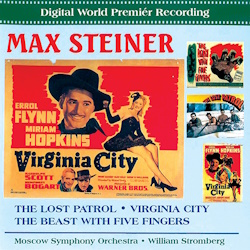 I commend Betta International for the world premiere digital recording of a trio of Max Steiner scores; “Virginia City”, “The Beast With Five Fingers” and “The Lost Patrol”. The score reconstruction, arrangement and restoration by the late John Morgan is excellent, as is the performance of the Moscow Symphony Orchestra under William Stromberg. Max Steiner throughout his career was often tasked with writing music “to save the film”. “Virginia City” was one of those films. As part of his rescue efforts, he composed a grand, sweeping, Americana theme, whose nobility, pride and confidence served to both empower and elevate the film’s storytelling. Given the backdrop of the American Civil War, the employment of its instantly identifiable and relatable Union and Confederate anthems to empower the opposing sides, and contest in battle was well-conceived and executed. For Julia, who is conflicted in love between Vance and Kerry, an elegant minuet cantabile theme offers one of the prettiest in Steiner’s canon. Lastly, Steiner compositions for the battle scenes are really exceptional for their impact, ferocity, and kinetic power. Interplay of the Union, Confederate, and Murrell anthems buttressed by swirling strings furioso, and use of ascending, stepped crescendos, amplified the scene’s drama and dynamics. Folks, Steiner took a sow’s ear and made a silk purse, once again writing a score that enhanced and elevated its film in every way. I highly recommend you purchase this quality compilation album, and take in the film to see how a composer’s music can save a film.
For those of you unfamiliar with the score, I have embedded a YouTube link to the Main Title; https://www.youtube.com/watch?v=MVfGBYobLeE
Buy the Virginia City soundtrack from the Movie Music UK Store
Track Listing:
- Main Title (2:01)
- The Trench/Bradford’s Folly (2:57)
- The Coach/Murrel/Chase (3:39)
- On a Limb/Love Beginning (3:44)
- Shoot-out/For Freedom/Chase/Chase Continued (4:25)
- Storm/Boy’s Death/Secret Agent (6:34)
- The Battle/Battle Continued (2:33)
- Abraham Lincoln/Finale (2:53)
- End Cast (0:31)
Marco Polo Film Music Classics 8.223870 (1940/1996)
Running Time: 29 minutes 17 seconds
Music composed by Max Steiner. Conducted by William Stromberg. Performed by the Moscow Symphony Orchestra. Original orchestrations by Bernhard Kaun and Emil Gerstenberger. Recorded and mixed by Edvard Shakhnazarian and Vitaly Ivanov. Score produced by Max Steiner. Album produced by Betta International.

Shop at the Movie Music UK Store

Member of the

 MOVIE MUSIC UK