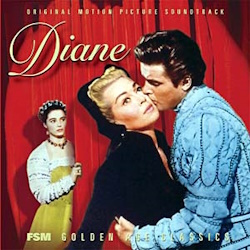
DIANE – Miklós Rózsa
 GREATEST SCORES OF THE TWENTIETH CENTURY
Original Review by Craig Lysy
Samuel Goldwyn of MGM was given a fifty-page manuscript titled “Diane de Poitiers” by John Erskine, which producer Edwin H. Knopft purchased in 1939. The project was given the green light to proceed, however financing delayed production until 1953 when Knopft renewed his effort and received the blessing of studio executive Don Schary to proceed. A $3.892 million budget was provided. Christopher Isherwood was hired to adapt Erskine’s story, and David Miller was tasked with directing. An impressive cast was assembled, which included Lana Turner as Dian de Poitiers, Pedro Armendáriz as King Francis I, Roger Moore as Prince Henri/King Henri II, Marisa Pavan as Catherine dé Medici, Sir Cedric Hardwick as Ruggieri, Torin Hatcher as Count de Brézé, Taina Elg as Alys, John Lupton as Regnault, and Henry Danelli as Gondi.
The story is set in France during the reign of King Francis I circa 1547. The beautiful Diane de Poitiers becomes mistress to Prince Henri despite being twenty years his senior. The very public affair continues despite Henri’s political marriage to Catherine dé Medici. After the death of his father Francis I, Henri becomes King Henri II and he rules with Diane continuing to be his lover, confidant and most trusted advisory, which earns the enmity of Catherine and House de Medici. The feud between the two women escalates and leads to the death of King Henri II. Catherine then asserts her royal prerogatives, assumes the regency for her three sons, and graciously banishes Diane from court rather than behead her. The film was a catastrophic failure for MGM, losing a staggering $2.66 million. Critics praised the film for offering a well-directed, finely acted, lavish story. It earned two Academy Award nominations for Best Art Direction and Best Costume Design.
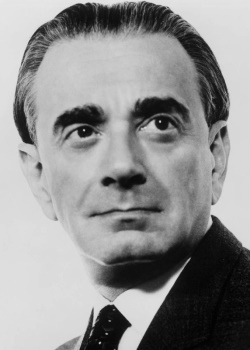
Miklós Rózsa related that Diane de Poitiers was one of the historical characters that he counted among his favorites. As such he was quite happy to take on the assignment. He understood that his music would have to embody sensibilities of 16th century France, and so chose to infuse his score with a number of traditional French source cues. He would also need to speak to the pomp, regality and formality of the King, Royal Court and palace. Yet the film’s core narrative involved Diane, along with her relationship with King Francis I, romance with Prince/King Henri II, and conflict with Queen Catherine and House de Medici. As the star and prime character, Diane would require a theme for the ages, and in a masterstroke Rózsa captures with his music her grace, beauty and nobility, finding a sublime cinematic confluence.
 Rózsa’s soundscape is empowered by eight themes; Diane’s Theme supports our protagonist who is forced to navigate the tidal forces created by the powerful men who draw her into their orbits. Rózsa’s renown lyricism and romanticism is on full display with a classic romanza, which is elegant, noble, graceful, hopeful and ever striving. Unabashed strings romantico empower its articulation buttressed by French horns nobile, yet within the notes we discern sadness as her love for her husband is unrequited, while she must endure court whispers in her role of mistress for Henri. Count de Brézé’s Theme offers a perfect embodiment of the man; austere, and whose heart is emotionally inaccessible. He treats Diane like a goddess on a pedestal, never loving her as she desperately desires as a woman. It is minor modal, and expressed by forlorn strings, which emote with a descending contour, which evoke sadness, and loneliness. The King’s (Francis I) Theme is major modal, proud, imperious, and expressed with an ascending contour. Horns regale declarations express it often as fanfare for this larger-than-life man. The Palace Theme supports the ambiance of the royal court. It is also major modal and borne by horns and strings maestoso with elegant auras and a strolling cadence.
We have three antagonists; Catherine’s Theme mirrors her plight as an aggrieved wife bearing the pain of unrequited love, as well as the humiliation of having to suffer Henri’s shameless and very public affair with Diane. It’s repeating seven note phrases are string borne, minor modal, with an ascending contour full of yearning, which never culminates or is satisfied, for Henri’s heart lay captured by Diane. Count Gondi’s Theme empowers our villain whose malevolence and diabolical nature is supported by lurking woodwinds sinistri, grim bass and tremolo strings. Ruggieri’s Theme supports the manipulative and amoral court astrologer. His serpentine music empowered by an eerie harpsichord embodies his sinister, and menacing nature. Associated with Ruggieri is the mystical Prophecy Theme, which I believe draws inspiration from the “Neptune” piece from Gustav Holst’s “The Planets”. It supports the fateful “Golden Cage” prophecy, which portends the death of Henri. Ethereal wordless women’s voices evoke an otherworldly ambiance that is nebulous, intangible and mysterious.
“Pre-Prelude” offers a score highlight where Rózsa masterfully establishes a sumptuous and regal tone for the film. We open with the MGM Pictures logo empowered by regal fanfare grandioso. The King’s Fanfare regale reprises as narrative script displays against red drapes with the French royal family emblem, the fleur de lis. It relates the tale of one of France’s most romantic figures – Diane du Poitiers. At 0:27 a breath-taking string ascent launches “Prelude” where the film title displays empowered at 0:32 by a sumptuous exposition of Diane’s Theme, which supports the flow of the opening credits. Her theme is carried by strings romantico with elegance and grace, and buttressed by horns nobile, yet its articulation is draped with a pervasive sadness. The opening credits close with her theme expressing a passionate yearning, which is unrealized. At 1:49 we enter the film proper in “Post-Prelude” carried by a jaunty, horn propelled riding motif as a royal courier is escorted across the countryside by a contingent of cavalry.
“Decision” reveals the courier, a captain of the King’s guard, arriving at Castle de Brézé, which disquiets countess Diane de Brézé as her husband’s friendship with an adversary of the king, his boyhood friend the Duke of Bourbon, places him in danger. She seeks to support, but the count is guarded, defensive and suggest it might be safer for her to visit her kin in England. She resists and offers her love and support, which he accepts thankfully with a kiss to her forehead. He expresses his relief that they never had any children, and departs supported by his sad and forlorn theme, which descends with a sense of futility, and finality. At 0:34 fanfare maestoso declare the King’s Theme in support of her decision to make a personal plea with the king. At 0:41 we segue into “Change of Mind” where Diane makes a personal appeal for the sake of her husband to the king. He is unreceptive, offended by her personal criticism, and orders her to leave at once. Yet we see in his eyes, that he is captured by her beauty, and so he changes his mind and orders her to remain here, in the palace during her husband’s trial. A soft, and thankful rendering of her theme carries her curtsy and departure. The music is sustained as she sojourns in the royal garden. The music after 1:16 was dialed out of the film. It offers a gentile, harp draped rendering of Diane’s Theme, which was intended to support her conversation counselling the king.
“Royal Chambers” reveals a dance at court, Rózsa supports by interpolating “Belle Qui Tiens Ma Vie,” written in 1589 by Toinot Arbeau. It offers a slow, and elegant danza maestoso. Only the first twelve seconds are used in the film, with it ending as Diane is summoned for a private audience with the king. In this unscored scene the king declares that her husband is guilty of treason and will be executed. She pleads for his life, is rebuffed, and angers the king with pointed personal criticism. He threatens her with death, yet she reaches him with a personal plea for mercy and magnanimity, which moves him. He realizes his leverage, and says he will grant her wish, but that she must provide recompense at a date and time of his choosing – his intent made crystal clear. She agrees, and departs. In “Home again” Diane arrives at castle de Brézé empowered by horns regale of the Palace Theme. At 0:19 we flow into “Dejected” atop an impassioned string ascent, yet at 0:41 a dire Count’s Theme greets her. He is aggrieved and believes his honor has been impugned as rumors swarm that his stay of execution was bought by her infidelity. She protests her innocence to no avail and he declares that she is to remain in the castle, obscured from the public until this imbroglio is forgotten by the public.
“Royal Command” reveals Diane summoned to Louis’ presence. She continues to dress daily in a black dress of mourning, and again refuses his invitation to dine with him. He remains bitter, and she seeks reconciliation. A musical narrative of melancholia unfolds as their two themes interplay. At 1:27 her theme swells with yearning as she desires a resumption of their marriage based on love. Louis begins to reconsider, but at 2:16 muted fanfare regale declarations of the King’s Theme support the arrival of a courier who submits a royal summons for Diane to return to court and ‘fulfill her promise’. The music darkens with a grim rendering of his theme as this is the final straw for Louis who dismisses her with contempt. We close with despair upon Diane’s Theme. At 3:03 we segue into “Royal Palace” atop resounding declarations of the King’s Fanfare as Diane’s coach arrives at the palace. The theme carries her to the King’s bed chamber and we close with a diminuendo as he dismisses his servants and welcomes her back. Once alone, the music ceases and he commends her for her suggestion of having Catherine de Medici marry his second son Henri. He then tasks her with turning his lout of a son into a refined prince of France, saying only a clever woman could manage him. She accepts reluctantly as Henri arrives. Henri is surprised that a woman is to be his mentor, but accepts his father’s orders.
“Pastorale” offers a sublime scorer highlight. It reveals Diane and Henri acquainting. He is resistant to being forced into adopting the formalities of a gentleman, but she manages to calm and guide him. Under a tree they discuss the nature of love and we begin to see a nascent stirring in Henri’s heart. Rózsa transforms Diane’s Theme into a beautiful romanza for one of its finest expositions. Diane begins instructing Henri in court dancing and at 1:25 we segue into “Gaillarde”, an Italian Renaissance dance borne by harpsichord and a small ensemble. In “Consternation” they dance well together and as they draw near Henri moves forward, intent on kissing her, yet he pulls back when his father arrives and reminds him that three weeks remain before his wedding. Henri clearly wants to consummate his love with Diane, yet her theme is rendered sadly with heartache as his father’s reminder portends an ending of their relationship. At 0:12 we segue into “Wedding Rehearsal” where the King, Henri, his brother Francis, and Diane rehearse the wedding, with her assuming the role of Catherine. Both Henri and Diane are uncomfortable with this enactment and Rózsa supports subtly with an organ solenne. At 1:19 we segue into “Reality” where Henri drops all pretenses and professes his love for Diane, and his unwillingness to proceed with a fraud of a marriage. Diane resists, and counsels his obligation and duty to serve France. He grudgingly agrees, but advises that he will still pursue her when he returns. This causes her distress and she says that this is impossible, and departs. Rózsa supports the scene with a distraught musical narrative empowered by low register strings grave, from which arises at 2:09 a grieving Diane’s Theme, as she does have feelings for him, yet cannot allow herself to yield.
“Cortege” reveals Diane packing to depart. The king issues a command as her sovereign, to remain in the palace for the sake of his son, her pleas notwithstanding. We shift to the main city street and witness an extravagant procession, which brings the arrival of Henri’s fiancé, Princess Catherine de Medici. The de Medici family, the king and dauphin, and Henri and Catherine arrive to cheering crowds. Rózsa supports the pageantry with a trumpet propelled processione maestoso. A forlorn Diane watches from the palace balcony, and when her and Henri’s eyes lock, he loses his jovial demeanor. Later at the royal reception ceremony, Diane is formally introduced to Catherine with glowing praise by the king. She side-steps a query from Catherine as to why her husband is not at court, and departs. But suspicions are raised with her relative Count Gondi and the court astrologer Ruggieri by how she and Henri look at each other.
“Warning” reveals that Henri and Catherine have married and he is restless. He misses her and Rózsa drapes his pacing with melancholia. At 0:18 a yearning Diane’s Theme carries his late-night walk to her quarters, joined at 0:36 by the sinister Gondi Theme as he peers at Henri’s passage through his cracked open door. Her theme resumes and carries Henri to her door where her servant refuses his visit asserting that Diane had retired for the evening. At 0:48 woodwinds sinistri resume Count Gondi’s Theme as he closes his door as Henri returns to his quarters. At 1:07 a thankful Diane’s Theme swells with relief as she accepts a consoling hug by her servant. At 1:16 we shift to Catherine’s quarters supported by her aggrieved theme, which entwines with foreboding phrases of Diane’s Theme as he visits. A crescendo slowly builds on her repeating seven-note phrase as her anger swells with Gondi’s accusations about Diane. We crest in distress, followed by a diminuendo of sadness when he informs her that Diane is Henri’s mistress. At 2:43 Catherine summons Diane to her quarters the next day. The gentility of the Palace Theme carried Diane’s arrival. Catherine probes, yet Diane adeptly disarms her with her poise, and genuine responses. Count Gondi arrives with an urgent matter, Diane departs, and Catherine expresses her belief in Diane’s innocence. Gondi persists, and Catherine demands proof, adding there will be repercussions if he fails.
In “Diana” Gondi sets his plan into motion by providing Diane with new, more spacious, and ornate living quarters. His sinister theme permeates as he reveals a large portrait of the goddess Diana of the hunt, her patron. Diane is overwhelmed and does not perceive his duplicity. At 1:11 we segue into “Peephole” atop dire, muted horns as Gondi brings Catherine to the exterior wall on which the Diana portrait is painted, revealing to her a peephole from which she can surreptitiously observe. Henri visits and expresses his dissatisfaction that she has been avoiding him. The malevolence of Gondi’s Theme dominates, but yields to a musical narrative of heartache as Diane resists his advances. At 2:17 her theme swells when she reveals her love for him, with the caveat that he must be true to his wife. At 2:49 Catherine’s string borne theme joins with a repeating, ascending contour full of yearning, which never culminates or is satisfied for she sees that Henri’s heart has indeed been captured by Diane. At 3:32 Diane’s Theme joins and blossoms with romantic sadness as he pulls her into his arms, kisses her, and declares that from now on, you belong to me. At 4:24 we segue darkly into “Hate” carried by the malevolence of Gondi’s Theme. She is devastated, and this is reflected at 4:55 with an anguished rendering of her theme, which entwines with Gondi’s as they conspire to exact revenge.
“Crystal Ball” reveals a desperate Catherine consulting with Ruggieri for a means to win back the heart of Henri. He summons his pupil Piero to gaze into a crystal ball and speak of its prophecy. Rózsa supports with an ethereal wordless woman’s chorus, much in the vein of Holst’s Neptune piece from “The Planets”. Piero says that he sees three young men riding in fine clothes and each wearing a crown. Ruggieri advises Catherine that they are the sons you will bear, each in turn, will be king. Piero adds that they all bow to her, with Ruggieri adding that you will rule France as reagent. At 2:01 a crescendo terrore supports Piero becoming frightened as he perceives a terrible fate for Prince Henri, who is riding with Count Montgomery, but then ends up in a cage of gold. Afterwards, Ruggieri advises that in the prince’s horoscope he sees but one danger – a wild boar. Catherine then departs, unsatisfied, and with many unanswered questions.
“Prophecy” reveals Ruggieri revealing to his aide Gian-Carlo that Count Montgomery is fated to slay the king. Ruggieri’s menacing harpsichord theme supports his revelations. At 1:26 we segue into “Bugle” atop hunting call declarations by French horn as we see the Diane joining Prince Henri preparing for a royal hunt. At 0:38 Catherine’s Theme joins as she advises Count Montgomery that she will not be joining the hunt, and that he must dutifully stay at Henri’s side. At 0:48 we segue into “Royal Hunt” as the hunting party rides off carried by the King’s Theme rendered is rousing and bravado fashion as a galloping iteration. A diminuendo at 1:42 supports Henri’s arrow strike that wounds a stag, which swims out of reach across a river. Henri dispatches the hunting party to a bridge miles away, while he and Montgomery remain behind. After they have leave, the two take off their boots and armed with only daggers, prepare to swim across to secure the stag first. The theme shifts to sumptuous strings as they swim across. At 2:21 eerie tremolo strings carry a segue into “Wild Boar” as they reach the other bank. The unsettling ethereal music of the Prophecy cue reprises as they walk into a gold leafed Birch tree grove – a cage of gold. Slowly, dark and ominous horn declarations rise up, leading to an explosive accelerando terrore as a wild boar appears, charges Henri, and gores him. Montgomery kills the beast, and we close on the eerie Prophecy Motif as he carries Henri away.
“Desperate Ride” reveals a carriage racing with Catherine to the royal hunting lodge where she finds Diane at bedside tending to Henri. She harshly orders Diane to return to the palace at once, which she dutifully obeys. She refuses an escort from Count Montgomery and rides alone carried by her theme rendered as a galloping travel motif. It swells on a stepped crescendo magnifico as she finds the palace bustling with soldiers. She is advised that the Duke of Bourbon has raised an army, and leading a rebellion. At 0:51 we segue into “Fanfare to Forgiveness” as the crowd hails the arrival of King Francis in full battle gear supported by the King’s Fanfare regale. The king asks Diane to show some gratitude to the loyal man who alerted him to the rebellion. She enters the room, and is shocked to find her husband. The king is thankful and will allow the count the honor of riding by his side. At 0:59 we segue into “Forgiveness” an exquisite score highlight. Husband and wife at long last reconcile and we hear for the first time a romanticized rendering of the Count’s Theme with interplay of Diane’s Theme. At 2:31 we segue into “For King and Country” atop grand trumpeting fanfare regale, the finest of the score, as the count bids Diane farewell and departs, saying he hopes he is worthy of her in battle. We close on a coda nobile of the Count’s Theme as Diane goes to the window to witness the king’s and Louis’ departure. At 3:00 we segue into “Viva la Guerra March”, a trumpet and drum militare propelled marcia orgogliosa as the king leads his army out of the palace. The piece is truncated with only the first 21 seconds used. At 3:41 we segue into “Love Letter” where a contemplative Henri holds a ring Diane gifted to him in her letter. In the letter she discloses that she returns home to her husband for good, and asks that he always wear this ring as a token of her affection. Rózsa supports with an exquisite rendering of Diane’s Theme by strings romantico.
Six months later in “King’s Return”, Henri has healed and frets to Catherine that he should be fighting with his father. She discloses her sorrow that she was unable as his wife, to make him happy. Music enters atop declarations of the King’s Fanfare by trumpets regale as the victorious king returns home with his army in tatters. The theme loses vital energy and a weary exposition carries the king in. Henri greets him with affection, but the king sits and demands wine. He tells of a horrific battle where fifty of his greatest knights were slaughtered. At 0:40 we segue into “Souvenirs” carried by the Count’s Theme, which is rendered as a poignant lamentation while the king relates that de Brézé killed Bourbon, but was himself mortally wounded and died. The king then lifts his tunic to reveal a mortal wound to his abdomen and collapses at 2:18 with a dire chord. At 2:23 we segue into “Death of Francis I” where family and ministers stand vigil as Francis lay on his death bed. He informs his eldest son the Dauphin, that he will be king by the morning. Rózsa supports the death scene with a lamentation empowered by the “Dies Irae” (Day Of Wrath) Theme, taken from the Roman Catholic requiem Mass.
“Suspicion” offers a poignant score highlight where Rózsa masterfully weaves a grim musical narrative with interplay of the Palace, Catherine’s, Gondi’s and Diane’s themes. It reveals that Diane has been summoned to the palace by the king’s command. She arrives to discover that Henri is king. He relates that his brother was poisoned by an Italian servant who was captured and confessed to the crime, but will not reveal who was his handler. Henri suspects Catherine and the de Medici, but Diane cautions Henri to stand back and let the court manage the case. Henri, Catherine and the court convene in the torture room. The prisoner again admits his crime, that he came to France as a servant to Catherine, and that she assigned him to the king. When asked his motive for killing the king, he remains silent. When asked who tasked him with the murder, he looks at Catherine, and refuses to answer. Henri orders the rack to loosen his tongue. In “Confession” the assassin cracks under the pain, and says, “I confess!” Dire, surging chords of pain resound as the Queen faints and Henri orders her taken to her quarters. Gondi joins her and reveals that her family, the de Medici arranged the murder, thus ensuring their control of France through her and her sons. Rózsa entwines both their themes in dark purpose with abyssal iterations. Gondi advises that the plot was withheld from her to ensure plausible deniability. At this point Henri enters and harshly orders Gondi to leave. Henri advises that the assassin’s confession clears her name, and she reinforces this by asserting her innocence. At 0:45 we segue into “Revelation” atop dire horn declarations when she makes a stunning revelation – that she is pregnant. He shows no joy, turns his back, and departs with cold indifference. We conclude on a molto tragico rendering of Catherine’s Theme as she contemplates an uncertain future. At 1:10 narrative script appears, supported by the ethereal Prophecy Motif; “Seven years have passed and the first of Ruggieri’s prophecies have come true. Catherine had become the mother of princes.” We close at 1:26 atop Catherine’s Theme which blossoms atop sumptuous strings felice as Henri, she, and their three sons sit for a family portrait.
“Jealousy” reveals that Diane has assumed the role of counselor to the King, earning his affection of his sons who call her Auntie Diane. Henri, followed by his two eldest sons rush out to greet her as she arrives, causing palpable consternation from Catherine. Gondi’s Theme dominates as he counsels restraint to Catherine, urging her to not harm Diane. At 0:20 the music brightens on Diane’s Theme as the boys and Henri greet her. At 0:43 we shift back carried by Gondi’s sinister theme to the balcony where Catherine is consumed by rage, dreaming of the day Diane dies at her feet. Gondi counsels’ restraint to Catherine, urging her to not harm Diane. Instead, he offers a diabolical riddle; “If you cannot cage the bird (Diane), cut down the tree (the king) in which it nests. That evening in “Banquet Music” Henri hosts the Duke of Savoy, an enemy to House de Medici, at a banquet, which Rózsa supports with traditional French tune, which flows with unobtrusive gentility. He provokes Catherine by naming Diane Lady of the Lists for the jousting tournament the next day. Catherine’s countryman Count Ridolfi agrees to carry her scarf colors of red and gold – the sun at sunrise, while Henri will carry Diane’s scarf colors of black and silver, the moon at night. At 1:04 we segue into “Forbidden Fruit” where Diane admonishes Henri for yet again publicly humiliating Catherine. A somber Palace Theme plays under the dialogue. At 1:39 we flow into a romantic rendering of her theme as she again expresses her undying love for Henri. In an unscored scene Ridolfi reveals to Gondi, House de Medici’s plan to assassinate the king – a fake and brittle jousting safety cap that will shatter on impact, thus allowing his blade to pierce Henri’s armor and kill him.
“Lists” opens with trumpeting fanfare as Catherine defers to Diane as Queen of the Lists and allows her to sit on the higher, central throne. At 0:19 we flow into “Knights and Horses” as the trumpeting fanfare regale resumes for a more robust rendering as the knights led by Henri approach and then bow their heads to Diane. At 0:54 we segue atop the trumpeting fanfare regale into “First Jousting Fanfare” as the first joust commences. This fanfare is reprised at 1:05 “Second Jousting Fanfare”, at 1:12 for “Third Jousting Fanfare” and 1:22 for “Fourth Jousting Fanfare”. Montgomery defeats Ridolfi and so earns the right to the final challenge with King Henri. In “Lance” Sir Montgomery unknowingly picks up the tampered lance, which is supported by a musical narrative of impending doom. At 0:45 we flow into “Cage of Gold” carried by the mystical and ethereal Prophecy Motif. Piero senses something is wrong, discerning that the cage of gold is in reality Henri’s resplendent gold armor. He yells out for Henri to not ride, however, Ruggieri silences him, saying, what will be, must be. A crescendo di orrore by the motif commences, cresting with devastation at 1:29 as Montgomery’s lance pierces Henri helmet delivering a mortal wound. We segue seamlessly at 1:32 into “Revenge” as Rózsa unleashes a frantic tempest as people rush to the fallen king. At 2:01 a diminuendo usher in a malignant synergy of Gondi’s, Theme, Catherine’s Theme and the tremolo strings of the Prophecy Motif, which supports her using the accident as a pretext to arrest Diane. Diane accepts her arrest with grace and is led away. At 2:48 the Palace Theme is rendered as a dirge as Henri is carried to his bed chamber. Catherine slips Diane’s ring off his finger, which wakes him. He countermands her order to take him to his chamber and commands to be taken to Diane’s room. We close on a devastated Catherine’s Theme, joined with Gondi’s Theme, which supports her acquiescence and humiliation.
“Last Journey” reveals a loving Diane holding Henri’s hand as his life ebbs. He is sad that their love ends this way and counsels her to flee lest Catherine kill her. Diane’s tender and loving theme eases his passing, which occurs at 0:45. Immediately the unholy synergy of Catherine and Gondi’s Themes resume and suppress an anguished Diane’s Theme as court ministers order Henri’s body removed on the queen’s command and taken to his bed chamber. We end darkly, with menace as Catherine accepts Henri’s body and closes his chamber door with a terrible resolve. “Requiem” was Rózsa’s original conception for Henri’s death scene, which was not used. He interpolated “Missa Pro Defuntis” (1580) by Orlando di Lasso, which features a choir of twelve boys and organ solenne. IN an unscored scene Sir Montgomery tries to convince Diane to flee to safety with him and six men as a horrible retribution from Catherine awaits. Diane refuses to have him and his men become outlaws and says she will willingly accept her fate.
“Retribution” reveals Catherine is enraged that Gondi and her uncles conspired to killed the only man she ever loved. She sentences him to the rack until he agrees to write a public confession that admits his and her uncle’s conspiracy to assassinate King Henri. As guards take him away, he draws his dagger and thrusts it into his heart. Music enters with the suicide, rendering a molto tragico Gondi’s Theme, which slowly dissipates as he passes unto death with his dying words; “I am paid in full and suffer the fate of all who serve the de Medici”. At 0:41 we segue into “Private Audience” as Catherine commands that Diane be brought to her. At 1:10 she enters the queen’ chambers and finds her facing the window. As she turns a dire statement of her theme supports. In “Finale” we open with a tender statement of Diane’s Theme draped with harp adornment. Interplay with a menacing Catherine’s Theme and Gondi’s Theme unfolds as a calm, poised, and deferential Diane, uses finesse and quiet dignity to diffuse Catherine’s rage, and intent to kill her. At 1:11 Catherine’s Theme shifts from anger to aggrievement, ultimately blossoming with yearning. At 2:57 it softens and becomes tender as her eldest son, the dauphin, joins and hugs Diane. This serves to extinguishe the last ember of hate in Catherine’s heart as she orders her guards to escort the Countess de Brézé to her estate with her liberty restored. As a thankful Diane departs Catherine adds a caveat – “Madame, I never wish to see your face again.” After Diane has left, Catherine goes to her safe, retrieves the ring Diane gave to Henri, and dispatches her son to return it to her. At 3:22 and a crescendo appassinato commences on Diane’s Theme as Diane receives the ring. In her carriage she cherishes it and we close the film gloriously as only Rózsa can with grandiose magnificence with refulgent, ever soaring declarations of Diane’s Theme, which culminates with a flourish. At 4:25 we conclude with “End Cast” with an ornate and sumptuous rendering of Diane’s Theme.
The technical team remixed and remastered the score from the original 35 mm master source tapes. Choral cues were recorded on 17.5 mm magnetic film units running as a fourth track. I believe the restoration was successful and the album offers a wonderful listening experience. Miklós Rózsa had earned praise for his scores in the period piece genre, including; Madame Bovary (1949), Ivanhoe (1952), Young Bess (1953), and Knights of the Round Table (1953). Diane would be yet another feather in his cap. The film, Lana Turner’s last under contract for MGM, was a role that actresses long for in an industry where men usually had the dominant role. This was her story, and Rózsa in a masterstroke captured Diane’s very essence musically with one of the most romantic character themes in his canon. Diane yearns for love but finds none with her much older and austere husband, while her adulterous relationship with Henri brings notoriety and scandal. Her qualities of dignity, nobility, grace, and humility are woven into a yearning string borne romanza buttressed by warm contrapuntal French horns. It’s yearning phrasing is unabashed and passionate, yet ultimately unfulfilled, and finding no resolution. Juxtaposed are a trio of antagonist theme, Catherine, Count Gondi and Ruggieri that Rózsa animates with sinister, menacing and diabolical malevolence. The tension and musical interplay masterfully supported the palace intrigue and conflict, while also elevating the film’s narrative. In the Finale, we have one of the most moving film endings in cinematic history. Diane receives from Catherine the ring she had gifted Henri as a token of her love. It is all that is left of him and their love, and as her carriage departs the palace, she clutches it to her chest with tears and cherishes it dearly. Rózsa supports with a crescendo appassinato that closes the film gloriously as only Rózsa can, with grandiose magnificence borne by repeating, refulgent, ever soaring declarations of Diane’s Theme, which culminates with a magnificent flourish. Folks, if you like period piece scores with regal fanfares, marches, royal processions, a love theme for the ages, a trio of sinister antagonist themes, and masterful thematic interplay, then do purchase this fine album, which includes many bonus and source cues. I also counsel to take in the film and bear witness to how a composer can elevate a film.
For those of you unfamiliar with the score, I have embedded a YouTube link to a wonderful ten-minute suite: https://www.youtube.com/watch?v=GTza5TE0zCU
Buy the Diane soundtrack from the Movie Music UK Store
Track Listing:
- Pre-Prelude/Prelude/Post-Prelude (2:38)
- Decision/Change of Mind (1:32)
- Royal Chambers (based on “Belle Qui Tiens Ma Vie” by Toinot Arbeau) (3:18)
- Home Again/Dejected (0:49)
- Royal Command/Royal Palace (4:04)
- Pastorale/Gaillarde (2:00)
- Consternation/Wedding Rehearsal/Reality (2:37)
- Cortege (3:23)
- Warning (3:03)
- Diana/Peephole/Hate (5:40)
- Crystal Ball (2:32)
- Prophecy/Bugle/Royal Hunt/Wild Boar (3:24)
- Desperate Ride/Fanfare to Forgiveness/Forgiveness/For King and Country/Viva la Guerra March/Love Letter (4:37)
- King’s Return/Souvenirs/Death of Francis I (4:36)
- Suspicion (2:27)
- Confession/Revelation (1:54)
- Jealousy (1:04)
- Banquet Music/Forbidden Fruit (2:01)
- Lists/Knights and Horses/First Jousting Fanfare/Second Jousting Fanfare/Third Jousting Fanfare/Fourth Jousting Fanfare (1:31)
- Lance/Cage of Gold/Revenge (4:13)
- Last Journey (2:16)
- Requiem (1:47)
- Retribution/Private Audience (1:27)
- Finale/End Cast (5:07)
- Diane (Piano and Violin) (2:40)
- Prelude/King’s Messenger/Riding (4:45) – Alternate Score
- Royal Command/Royal Palace (4:13) – Alternate Score
- Reality (1:19) – Alternate Score
- Warning (2:09) – Alternate Score
- Diana/Peephole/Hate (5:39) – Alternate Score
- Bugle/Royal Hunt/Wild Boar (3:46) – Alternate Score
- For King and Country/Viva La Guerra March (0:58) – Alternate Score
- Death of Francis I (2:25) – Alternate Score
- Suspicion (2:18) – Alternate Score
- Revelation (Alternate #1) (1:10) – Alternate Score
- Revelation (Alternate #2) (1:09) – Alternate Score
- Lists/Fifth Jousting Fanfare/Revenge (2:59) – Alternate Score
- Last Journey (2:05) – Alternate Score
- Retribution/Private Audience (1:32) – Alternate Score
- Finale/End Cast (5:07) – Alternate Score
- Royal Gardens [Source Cue] (2:35)
- Royal Gardens (Alternate) [Source Cue] (2:09)
- Love Song [Source Cue] (2:21)
- Pavane du Rois [Source Cue] (0:16)
- Gaillarde (Pre-Record Version) (1:28)
- Pavane (Pre-Record Version) [Source Cue] (2:13)
- Chanson Populaire [Source Cue] (0:19)
- Banquet Music (Pre-Record Version) [Source Cue] (1:35)
- Requiem (Film Version) [Source Cue] (0:45)
- Fanfare for Cortege (Pre-Record Version) [Source Cue] (1:27)
Film Score Monthly FSMCD Vol. 7, No. 3 (1956/2004)
Running Time: 147 minutes 13 seconds
Music composed and conducted by Miklós Rózsa. Orchestrations by Eugene Zador. Recorded and mixed by XXXX. Score produced by Miklós Rózsa. Album produced by Lukas Kendall.

Shop at the Movie Music UK Store

Member of the

 MOVIE MUSIC UK