Archive
SINNERS – Ludwig Göransson
 Original Review by Jonathan Broxton
There’s a moment in Sinners, director Ryan Coogler’s outstanding new horror-drama, where the lead characters in the ‘juke joint’ are listening to live blues music, rich and authentic. As the crowd becomes entranced by the performances, overcome by the songs, something magical happens: slowly, almost imperceptibly, avatars representing the entire history of black American music emerge from within the massed dancers, ghosts of the past and foreshadowings of the future of what this music would eventually become over the span of multiple subsequent generations. There are tribal drummers and Zaouli dancers from Côte d’Ivoire, who brought their music and their traditions with them when they were forcibly removed from Africa as slaves, and which eventually became the work songs and ‘Negro spirituals’ of the plantations and the cotton fields. There is 1940s jazz, and 1950s rock and roll. There are 1980s breakdancers, 1990s DJs and rappers, and references to contemporary hip-hop and R&B. It’s a brilliant distillation of one of the major things that Coogler is trying to say with his film – that African music and Black music is at the core of so much of modern American culture, and that that history remains very much overlooked and under-appreciated by too much of the mainstream. Read more…
TRIBUTE TO A BAD MAN – Miklós Rózsa
 GREATEST SCORES OF THE TWENTIETH CENTURY
Original Review by Craig Lysy
MGM Studios has suffered a string of loses and sought to recoup them with a film in a popular, money-making genre – Westerns. They came across the short story “Hangings for the Lucky” by Jack Schaefer, and purchased the film rights, which ultimately became this film: Tribute to a Bad Man. Sam Zimbalist was assigned production with a $2.8 million budget. Schaefer and Michael Blankfort would write the screenplay, and Robert Wise was tasked with directing. Casting was not smooth sailing as the star Spencer Tracy was fired by Wise for disrupting filming and Grace Kelly left her career to marry Prince Ranier III of Monaco. James Cagney was brought in for the starring role of Jeremy Rodock, and joining him would be Don Dubbins as Steve Millar, Stephen McNally as McNulty, and Irene Papas as Jocasta Constantine. Read more…
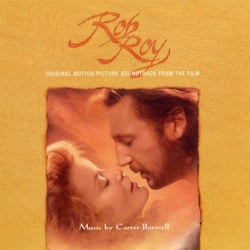
ROB ROY – Carter Burwell
 THROWBACK THIRTY
Original Review by Jonathan Broxton
One of two ‘historical Scottish epics’ released in 1995 – the other, of course, being Braveheart – Rob Roy is a historical drama set in the early 18th-century Scottish Highlands. The film follows Rob Roy MacGregor (Liam Neeson), a clan leader who strives to maintain honor and dignity while navigating the brutal social and political landscape dominated by aristocratic landowners and English influence. Rob borrows money from the Marquis of Montrose (John Hurt) to improve his clan’s welfare but is betrayed when the money is stolen by the cunning and sadistic Archibald Cunningham (Tim Roth), an associate of Montrose. Rob refuses to falsely implicate himself in a political scheme in order to regain the funds, choosing instead to uphold his principles. This decision makes him an outlaw and sets him on a dangerous path of vengeance, survival, and moral conflict. The film was directed by Michael Caton-Jones, and co-stars Jessica Lange as Rob’s devoted wife Mary, plus Eric Stoltz and Brian Cox in other supporting roles. Read more…
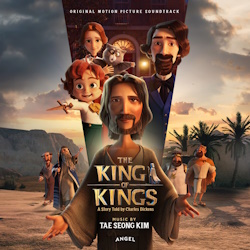
THE KING OF KINGS – Tae-Seong Kim
 Original Review by Jonathan Broxton
For many years during Hollywood’s golden age one of the studio staples was the ‘biblical picture,’ big-budget star-studded epics adapting stories from the Christian bible. Ben-Hur, The Ten Commandments, The Greatest Story Ever Told, The Robe, Quo Vadis, and so on and on; films like these won Oscars, broke box office records, and are today remembered as some of the best and most important films in history. However, over the last couple of decades, the popularity of these biblical epics has decreased significantly, and now very few of them are made. The last one to achieve any sort of commercial success was Mel Gibson’s The Passion of the Christ in 2004, and efforts to revitalize the genre have mostly failed – Darren Aronofsky’s Noah, and Ridley Scott’s Exodus among them. Read more…
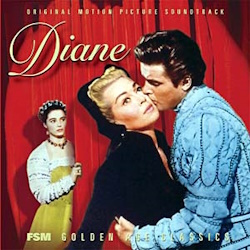
DIANE – Miklós Rózsa
 GREATEST SCORES OF THE TWENTIETH CENTURY
Original Review by Craig Lysy
Samuel Goldwyn of MGM was given a fifty-page manuscript titled “Diane de Poitiers” by John Erskine, which producer Edwin H. Knopft purchased in 1939. The project was given the green light to proceed, however financing delayed production until 1953 when Knopft renewed his effort and received the blessing of studio executive Don Schary to proceed. A $3.892 million budget was provided. Christopher Isherwood was hired to adapt Erskine’s story, and David Miller was tasked with directing. An impressive cast was assembled, which included Lana Turner as Dian de Poitiers, Pedro Armendáriz as King Francis I, Roger Moore as Prince Henri/King Henri II, Marisa Pavan as Catherine dé Medici, Sir Cedric Hardwick as Ruggieri, Torin Hatcher as Count de Brézé, Taina Elg as Alys, John Lupton as Regnault, and Henry Danelli as Gondi. Read more…

Shop at the Movie Music UK Store

Member of the

 MOVIE MUSIC UK