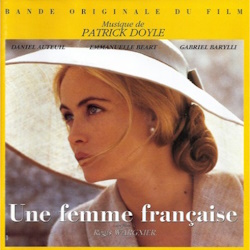
UNE FEMME FRANÇAISE – Patrick Doyle
 THROWBACK THIRTY
Original Review by Jonathan Broxton
Une Femme Française is a French romantic drama film co-written and directed by Régis Wargnier, starring Emmanuelle Béart and Daniel Auteuil. The story follows Jeanne (Béart), a passionate and free-spirited woman, who marries Louis (Auteuil), a devoted but rigid French army officer, in the early 1940s. Soon after their marriage, Louis is sent off to fight in World War II, leaving Jeanne alone for several years; she struggles with loneliness and eventually engages in various torrid romantic and sexual affairs, seeking love and companionship in his absence. When Louis finally returns, he discovers Jeanne’s infidelities but remains deeply in love with her, and they attempt to rebuild their marriage, but the emotional wounds and social constraints of the time make it difficult. Over the course of several decades their relationship is tested by Louis’ military deployments, societal expectations, and Jeanne’s unrelenting desire for independence and passion – including an extensive affair a wealthy industrialist in post-war Berlin – all of which combined to offer a deeply emotional portrayal of a woman torn between personal fulfillment and societal norms.
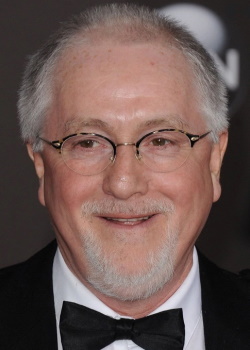
The score for Une Femme Française is by Scottish composer Patrick Doyle and marked the second collaboration between the two men following Indochine in 1992. It’s always been interesting to me that Doyle was one of the only major British and American composers of the 1990s who also worked semi-regularly on non-English language films; of course this should not be especially unusual, considering that French composers and Italian composers and German composers worked on English-language films all the time, but he was nevertheless an anomaly, and it speaks highly to his relationship with Wargnier that the director came back to him over and over again to give him the music he wanted. Invariably the music that Wargnier wanted was an enormous, lush, thematic, classically orchestral sound, and that’s what Doyle provided again here.
 The score is anchored mostly by a main theme for Jeanne, which first appears in the third cue, “Les 2 Frères”. It’s an endlessly pretty piece, softly enchanting but perhaps slightly melancholic, as Doyle attempts to find the right balance between Jeanne’s love for her husband, her loneliness when he is gone, and relationships she has with her various lovers over the years; these people fill her void, emotionally and sexually, but also leave her feeling emotions of guilt and shame, knowing she had betrayed Louis’s love for her. The theme is usually arranged for a wash of strings backed by lovely bucolic woodwind textures, and is has many of the hallmarks of Doyle at his most romantic: there are echoes of earlier scores like Henry V, Indochine, Much Ado About Nothing, and the love theme from Mary Shelley’s Frankenstein.
The theme is prominent in numerous subsequent cues, and receives especially notable performances in “La Rencontre,” “Les Amants” where it is arranged for notably delicious romantic strings, “Le Retour,” “La Robe Écarlate,” “and Jeanne s’en Va,” the latter of which is delicate and pastoral in all the best ways. Cleverly, Doyle is also able to take elements of the theme and break them down so that just their chord progressions remain, and then use them to inform other cues. For example, “La Tentation” is more dramatic, with lots of Dead Again-style moving textures for strings and woodwinds that combine to create a new atmosphere of underlying tension, but these are all anchored by the chord patterns of Jeanne’s Theme, representing the temptation that Jeanne feels when she is first drawn to a man who is not her husband. Similarly, in the subsequent “Les Ruines,” Doyle introduces a series of expressive woodwind flutters around the chord progressions of Jeanne’s Theme, creating a sense of withdrawn melancholy, bitterness, and effective poignancy
Thankfully, though, this is not simple a one-theme score, and Doyle is able to expand his music into other directions that are equally captivating. The first cue, “Le Mariage,” is full of florid, whimsical, lively string performances, all redolent of young and carefree love, and which speak to the optimism in inherent in Jeanne and Louis’s relationship at the beginning of it all. The second cue, “J’ai Rêvé de Vous,” explored the profundity of their relationship in those first years with music that is deeper and more elegant, still slightly melancholic tone, but extraordinarily beautiful, with those lush cascades of strings which Doyle is rightly famous.
Elsewhere, “Le Bal Russe” is a highly classical waltz piece, and stereotypically Russian-sounding in terms of its orchestrations, which include a balalaika, accordion, and a sparkling violin solo by Mark Berrow alongside the standard symphony. “La Séparation,” which accompanies the first scene of Louis heading off for war and leaving Jeanne on her own, contains an appropriately bitter-sounding but highly classical theme for fragile string quartet. “Le Rapt” is ebullient and energetic, and features some lithe and delicate interplay between strings and woodwinds. This energy returns later in “Vertige,” which is the closest thing the score has to an action cue, and features the score’s most prominent use of brass, pianos, and actual percussion, as well as adopting some unusual jazzy textures in terms of the way some of the strings are phrased. There’s also a delicious and intoxicating source music cue, “Mambo,” which is as fun as it sounds.
The finale of the score, the title track “Une Femme Française,” is a Doyle career highlight, and is gorgeous vocalize version of Jeanne’s theme performed by the Anglo-Guyanese classical soprano Jill Gomez, the Countess of Northesk. Gomez’s wordless vocal stylings are deeply evocative, and hauntingly beautiful, and are of course thematically appropriate in terms of the film itself: in many ways Gomez’s voice is Jeanne’s voice, capturing different facets of her personality, and revealing the depths of the romantic emotion that inform and guide many of the decisions she makes throughout the story. It’s just stunningly beautiful, quintessential Doyle. The conclusive cue, “Jeanne et Louis,” is a soft jazz-club version of Jeanne’s theme for saxophone, piano, and a light jazz combo, which again offers a different facet to the score and highlights Doyle’s versatility.
As I mentioned earlier, Une Femme Française was the second collaboration between Doyle and director Wargnier after Indochine, and they would later go on to work together on Est-Ouest in 1999, Man to Man in 2005, Pars Vite et Reviens Tard in 2007, and La Ligne Droite in 2011. Theirs is a truly exceptional collaboration, and anyone who has ever wallowed in the sumptuous romance of any of these scores – or, indeed, any other similar Patrick Doyle scores, will find Une Femme Française to be of a similar outstanding quality. The physical CD is scarce these days, but well worth the effort to track down.
Buy the Une Femme Française soundtrack from the Movie Music UK Store.
Track Listing:
- Le Mariage (2:18)
- J’ai Rêvé de Vous (1:20)
- Les 2 Frères (1:14)
- La Tentation (1:15)
- Le Bal Russe (2:08)
- La Rencontre (1:30)
- La Séparation (4:04)
- Les Amants (2:13)
- Le Rapt (2:16)
- Le Retour (1:40)
- Vertige (1:47)
- Les Ruines (2:22)
- L’Irréparable (2:01)
- Mambo (2:08)
- La Robe Écarlate (0:57)
- Jeanne s’en Va (1:09)
- Une Femme Française (5:04)
- Jeanne et Louis (2:42)
WEA Music 0630-10675-2 (1995)
Running Time: 38 minutes 08 seconds
Music composed by Patrick Doyle. Conducted by David Snell. Orchestrations by Laurence Ashmore. Special vocal performances by Jill Gomez. Recorded and mixed by Paul Hulme and Geoff Foster. Edited by Roy Prendergast. Album produced by Patrick Doyle.

Shop at the Movie Music UK Store

Member of the

 MOVIE MUSIC UK