DODGE CITY – Max Steiner
 GREATEST SCORES OF THE TWENTIETH CENTURY
Original Review by Craig Lysy
In 1937 Studio executive Jack Warner decided to join the Western genre bandwagon following Paramount Pictures commercial success with “The Texas Rangers” (1936) and “The Plainsman (1936). In 1938 they believe that they had struck gold when they came across a story “Dodge City” by screen writer Robert Buckner. They purchased the film rights, Hal B. Wallis was assigned production with a $1.06 million budget, Michael Curtiz was tasked with directing, and Buckner would write the screenplay. Wallis struggled to find a leading man for the role of Wade Hutton, and decided to roll the dice with thirty-year-old Errol Flynn. Joining Flynn would be a fine cast, which included Olivia de Haviland as Abbie Irving, Ann Sheridan as Ruby Gilman, Alan Hale as Rusty, Henry O’Neill as Colonel Greenville M. Dodge, Bruce Cabot as Jeff Surrett, Victor Jory as Yancy, and Frank McHugh as Joe Clemens.
The story is set in post-civil war Dodge City Kansas, which has emerged from an army fort into a bustling commercial center used as a railway depot from which Texas longhorn cattle are shipped east for meat processing. Civil order has broken down and lawlessness threatens the city’s very existence. Hatton, who is leading a wagon train of settlers west, arrives and finds the city in anarchy. Abbie’s uncle Dr. Irving, city merchants and important citizens solicit Hatton to become sheriff and clean up the town. He refuses as he does not believe he is suited for the job, but changes his mind when a young boy is killed. After a series of battles with lawless renegades, and a confrontation with an angry mob that demands non-judicial executions, Hatton wins the day, pacifying Dodge City as well as earning the hand of Abbie. The film was a huge commercial success, and Warner Brothers most popular film of 1939, earning $2.53 million. Critical reception was poor, with most believing it’s script weak, and just another B film popcorn thriller. As such, the film failed to receive any Academy Award Nominations.
Max Steiner had just finished scoring the Western “Oklahoma City” (1939) and Jack Warner assigned him to the project. His response was; “Goody-goody! Cant’s we Dodge it!” The studio was determined to pre-empt the release date of the upcoming film “Stagecoach” (1939) by competitor United Artists. Upon viewing the completed film, he was singularly uninspired and his notes indicate that he realized that he had only three weeks to write nearly start to end music for the 104-minute film, music, which was sorely needed to enhance it. He relates in notes written to his orchestrators regarding the film opening where he unleashes his Pioneer March; “MAESTOSO! Strong melody – an epic picture promise! Which they don’t get! A ‘Nebich’ (Yiddish for ‘poor thing’), not an EPICH!”
 Time constraints were again severe and made worse by a last-minute decision by studio executives. The director and he had previously agreed to not score the climatic burning train fight scene, believing that the sound effects and gun fire would overwhelm the music. Well, they were overruled and Steiner, who had just completed the score at 12 pm and had not slept for fifty hours was ordered to write additional music. He moved the final recording session later that day from 6 pm to 1030 pm and again performed a miracle, completing the composition at 6 pm, orchestrating it by 10:30 pm and then recording the score until 6 am the next day. As was his life-long practice, Steiner infuses his musical narrative with source songs, hymns, and anthems to provide the requisite cultural sensibilities, including; “Columbia, the Gem of the Ocean” (1843) by David T. Shaw, arranged by Thomas A. Beckett, “I’m Goin’ Back to Dixie” (1874) by Charles A. White, “Little Brown Jug” (1869) by Joseph Winner, “Life Is Like a Mighty River”, Traditional, “Dixie’s Land” (1860) by Daniel Decatur Emmett, “Nelly Was a Lady” (1849) by Stephen Foster, “Marching Through Georgia” (1865) by Henry Clay Work, and “Oh! Susanna” (1848) by Stephen Foster.
For his soundscape, four primary themes and a motif are provided. The Pioneer March serves as the score’s Main Theme. Steiner uses the unusual B major scale, which is bright, majestic, forthright, and bold, attributes of the pioneer spirit and empire building he sought to infuse into the foundation to his soundscape. The Pioneer March is rendered in ABA form with the A Phrase expressed as a slow and forthright marcia orgogliosa, while the B Phrase is more yearning and aspirational. The Wagon Train Theme offers quintessential Americana. It is also composed with an ABA construct with a forthright, declarative A Phrase, and a more lyrical, dance-like B Phrase. Confident strings buttressed by warm French horns carry the wagon train with simple harmonies and a rolling cadence, which perfectly capture America’s optimistic pioneering spirit. Abbie’s Theme supports her identity, but later evolves into Love Theme for her and Wade. Steiner graces us a beautiful cantabile borne by stings tenero. It is rendered in ABA form with an expressive A Phrase, and a yearning more lyrical B Phrase. For our villain Jeff Surrett, and by extension his henchmen Yancy, Munger and Taylor we have a heavy, oppressive and ominous repeating seven-note construct with a descending contour borne by strings sinistri, which fully capture his amoral menace and malevolence. We have the minor modal Buffalo Motif, which emotes with pentatonic orientalism that would seem to align with American Indians, who are absent in the picture. Instead, he uses it to support massive herds of buffalo, which graze upon the vast prairie land. Lastly, there are three set pieces composed to support poignant deaths in the film; Matt, his son Harry, and Abbie’s brother Lee, where he uses a dirge or lamentation to score the pathos of the aftermath.
“Main Title” opens with Steiner’s dramatic Warner Brothers fanfare, but he shifts it articulation to the unusual B major scale to support a seamless transition to his Main Theme, the Pioneer March. The B major scale is bright, majestic, forthright, and bold, attributes of the pioneer spirit and empire building Steiner sought to infuse into the foundation to his soundscape. The flow of the opening credits unfolds against painted scenes showing the great migration of pioneers heading west in search of land, opportunity, and a new life. Steiner empowers the opening credits with an extended exposition of his Main Theme, the Pioneer March rendered in ABA form, as a slow and forthright marcia orgogliosa, which perfectly establishes the tone of the film. At 1:20 narrative script appears; “The Civil War has ended. Armies disband – the nation turns to the building of the west”. The music ends and we enter the film proper with narrative script; “Kansas – 1866”. A train is churning westward with a group of business men, including the train owner who boasts about the speed of his train. They encounter a stage coach taking the daily mail and the coachmen decide to out run the train and so begin whipping their team of four horses to gain more speed. The train owner orders his engineer to ensure they arrive first and a race ensues. Eventually the train pulls ahead to the coachmen’s ire.
“Buffalo Herd” reveals cowboys Wade Hutton and side-kicks Rusty and Tex riding towards a buffalo herd. They are hired hands tasked with killing buffalo and bringing their meet to feed the crews laying railroad track. Rusty sings the folk song “The Old Chisholm Trail” as Steiner imposes with pentatonic grandness the minor modal Buffalo Theme as we gaze upon their vast numbers. At 0:44 a crescendo of anticipation takes them up to a hilltop, where the see the train approaching. We flow with vigor at 1:13 into “The Iron Horse” with the men propelled by a bright and spritely galloping motif. Wayne exchanges pleasantries through the open train window with his boss Colonel Dodge, and agree to meet in town. At 2:08 we segue into “Rendezvous” atop the sinister Surrett’s Theme as he prepares to depart with hundreds of cured buffalo pelts obtained illegally without permit from Indian lands. Wayne has setup an ambush and arrives with a dozen federal marshals propelled by a crescendo dramatico. A diminuendo of tension follows and plays under the dialogue as the Kansas Indian Commissioner and federal Marshalls arrest Surrett and his men. Wade discloses his part in setting up the arrest, and thanks Surrett for all the pelts, which earns his enmity and threat of revenge.
(*) “End Of The Line” reveals Colonel Dodge hammering a gold spike that marks the terminus of his rail line. An army band plays the festive “Columbia, the Gem of the Ocean”, which supports the cheering throngs celebrating this momentous moment. “Dodge City It Is!” reveals Colonel Dodge giving a visionary speech of his hope that this city will be become a great metropolis, the flower of the prairie. He struggles on what to name this city, until Wade yells out a suggestion to name it Dodge City, after the man who created it! They all shout, “Dodge City It Is!” and music enters atop the Pioneer March rendered as a marcia maestoso to support narrative script; “Dodge City Kansas – 1872. Longhorn cattle center of the world, and wide-open Babylon of the American frontier, packed with settlers, thieves and gunmen.” The music slowly sours as we shift to a montage of a bustling city verging on chaos, beset by too many saloons, and too many guns. At 0:32 swirling strings mimic a spinning roulette wheel, joined at 0:40 by the march, which regains its pride as we peruse “The Gay Lady Saloon”. At 1:00 we flow into a pastorale as we see hundreds of corralled longhorn cattle being loaded into train cars for transport to slaughter houses in the east. At 1:16 we close darkly with Surrett’s sinister theme as Matt Cole, a cattle broker demands the agreed fee of $15,000 to ship Surrett’s cattle. Surrett is short of cash as he had to buy himself out of jail and tries to hedge to no avail. Cole advises that he will come to Surrett’s saloon, the Gay Lady tonight to collect his money and departs.
(*) “Matt Cole is Murdered” reveals Matt entering the saloon in search of Surrettt. An instrumental prelude of the folk song “I’m Gowin’ Back to Dixie” plays and then is joined by singer-performer Ruby Gilman’s vocal and dancing girls stage show. Matt finds Surrett, demands payment, and he takes Mat to the bar for a drink on the house while he fetches the money. As Surrett walks away he signals his henchman Yancy to provoke a fight. He tries, but Matt does not take the bait, however as he fetches his tobacco pouch, Yancey yells out “He’s drawing a gun!”, and kills him. “Matt Cole’s Funeral” reveals Matt’s burial service, which Steiner supports with a dirge borne by strings lamentosi replete with tolling bells. At 1:09 the music darkens as the several town elders exhort the sheriff to do his duty and issue Yancey an arrest warrant. He does so, Surrett tells him to comply, but then gives him a wink. At 1:22 Steiner unleashes a tempest violenta as Surrett’s henchmen throw the sheriff into the hearse and ride off shooting their guns. In an unscored scene Dr. Irving and his wife fret at the violence overtaking their city, and worry that perhaps they should not have arranged to have their nephew Lee and niece Abbie join them.
“The Covered Wagons” offers a wonderful score highlight where Steiner introduces his Wagon Train Theme. Wade, Tex and Rusty are leading a cattle drive and settlers, which include Lee and Abbie, northward from Texas to Dodge City. He supports with quintessential Americana atop his warm and confident Wagon Train Theme, whose simple harmonies and rolling cadence perfectly capture America’s optimistic and pioneering spirit. Lee is an undisciplined lout and drunkard who embarrasses Abbie. He repeatedly fires his pistol in the air while shouting, which brings Wade and his men to the wagon. He suggests Abbie better manage her brother as they will be held account if he causes the cattle to stampede. She does not like his tone, yet we see that there is some attraction between the two. We conclude grandly as Wade issues orders to camp at riverside for the night. At 3:00 we energetically segue into the folk song “Oh, Susannah” expressed by banjo and guitar. At 3:14 we flow into “Sunrise” carried by a more sedate Wagon Train Theme borne by languorous strings and muted trumpets.
At 3:44 we segue into “Abbie’s Theme”, where Abbie and Wade finally acquaint. We see that she is attracted by his charisma and poised confidence, and Steiner graces us with her theme rendered in full ABA form as a cantabile borne by stings tenero with warm horns. Their intimate moment is shattered and we segue into “Stampede!” because her drunk brother is stupidly tossing tin cups up in the air and shooting each with his pistol. Wade confronts Lee about his problematic drunken behavior, but he is combative and defiant until Wade threatens to tie him up and bring him in to Dodge City riding backwards on a mule. Wade then departs, but Rusty’s mocking laughter enrages Lee who begins shooting at him. Steiner rachets up tension, as Wade is forced to shoot Lee in the leg. Yet the gunfire causes the cattle to become agitated and then stampede. Steiner unleashes a tempest as the cattle stampede. Abbie stands over Lee who lays helpless on the ground and Wade swoops her up into his arms and takes her to safety, shielded by a wagon as Lee is trampled to death. At 0:47 a diminuendo of grief borne by strings affanato unfolds as Abbie finds that Lee has died. We flow into the Wagon Train Theme rendered as a dirge by elegiac trumpets as we see the wagon train departing past Lee’s burial mound. Wade dispatches Tex with a letter of condolences for Dr. Irving, where he explains the circumstances that led to Lee’s death. At 1:34 a transitory brightening of the theme supports Wade’s efforts to console and voice his regrets, but she asks him to leave her alone, which he does. We resume the Wagon Train Theme as a dirge as the traverse a vast prairie land. At 2:29 a spritely tune carried Wade and Rusty’s ride through Dodge City’s bustling Main Street. We end with comic auras as Wade advises that Rusty is sorely in need of a bath.
(*) “Rusty Takes a Bath” reveals Rusty taking a bath as he sings the folk song “Nelly Was a Lady”. In three unscored scenes, Surrett and Yancy reacquaint with Wade and Rusty at the barbershop. The animus is palpable and once again Surrett offers veiled threats should Wade choose to remain in town. Later, Wade meets with Dr. Irving, who accepts his explanation of Lee’s death. His wife and Abbie however bear a grudge and spurn him. That afternoon buyers bid for Wade’s cattle with Surrett offering the highest bid, however since he can only pay 50% up front with the balance paid in thirty days, Wade awards the cattle to the second highest bidder Mr. Orth, who will pay cash in full. This further angers Surrett and Yancy. In “The Murder”, Orth arrives at the Drovers hotel to pay Wade with Matt Cole’s son Harry earning a quarter to watch his horse. Wade and Rusty arrive and also pay Harry to watch their horses. Inside a shot is heard and a patron yells that Orth has been shot. Munger, one of Surrett’s henchmen walks down the stairs propelled by the malevolent chords of Surrett’s theme, informing us of his hand in yet another murder. Wade and Rusty follow and are greeted by Surrett empowered by his sinister theme. He says it is too bad what happened to Orth, and offers Wade $30 a head for his cattle. A crescendo irato erupts as Wade says he will never sell his cattle to him. He returns to the hotel, as does Rusty who spits his contempt, enraging Surrett who draws a gun but is foiled by the newspaper editor Joe Clemens who walks into his pistol. In the newspaper window a poster declares Orth’s killing for bidding against Surrett. At 0:54 we segue into “Surrett’s Theme” atop an ominous Surrett’s Theme as Yancy walks into the Dodge City Star Newspaper office. He confronts Joe and orders him to stop running stories about Surrett. Clemens refuses and Yancy bludgeons Joe with the handle of his horse whip. Rusty informs Wade that he is going to the Gay Lady Saloon for a good time, and the two split up. Outside the saloon he comes to the aid of a lady seeking to avoid stepping in mud to exit her carriage. He lifts her up and deposits her on the wooden deck. The folk song melody for “Little Brown Jug” wafts out from the saloon, and as they enter Ruby starts singing the lyrics. The cowboys from the cattle drive try to drag Rusty in for some drinking, but he declines, saying he is giving up these evil ways.
In an intervening scene (*) “The Pure Prairie League” Rusty comes by this establishment, which is hosting a lady’s social. A woman’s choir sings the traditional hymn “Life Is Like a Mighty River” supported by an organ solenne. He is curious, walks in and the women welcome and fawn over him. We shift back to the Gay Lady Saloon where Ruby and her women’s dancing troupe sing the confederate anthem “I Wish I Was in Dixie’s Land”. The patrons from northern states counter by singing a patriotic Union anthem “Marching Through Georgia”. This leads to a huge brawl as Union and Confederate veterans begin fighting. Surrett joins the fray, which spills out to the street with men flying out windows and the front door. Men crash through the wall and into “The Pure Prairie League” social and Rusty joins the fray. I believe Steiner made the correct choice to leave unscored, what may be the greatest saloon brawl in cinematic history. At 1:45 we resume cue 7 with a dire declaration of Surrett’s Theme when he discovers Rusty has been left behind. At 1:58 we segue into “Necktie Party” as Surrett’s Theme erupts with vengeful menace, which launches a crescendo dramatico as he orders his men to take Rusty to the plaza for a public hanging. Joe informs Wade and Tex of Rusty’s situation, and at 2:07 an accelerando propels their run to his defense while a crescendo violento supports the placing of a noose around Rusty’s neck. At 2:47 a sequence of ominous chords supports the arrival of Wade, and his slow, purposing walk to Surrett. His request to release Rusty is rebuffed with an order to hang him. A diminuendo of tension follows as Wade draws his pistol, and orders Rusty’s release. Rusty then takes Surrett’s pistol and at 3:45 a tense walking quaternary cadence supports Wade and Rusty taking Surrett at gun point to the Sheriff’s office. At 4:12 a crescendo dramatico supports their arrival at the Sheriff’s office where a plank labeled “Closed”. Is nailed across the door. A diminuendo of tension follows as town elders advise that Surrett has again driven the sheriff out of town, and Dodge City is his town. Wade returns Surrett’s pistol, and suggest he become sheriff. He says he will consider it and he then strut away empowered by his menacing theme.
In an unscored scene town elders assemble at Dr. Irving’s residence and proposition Wade to become sheriff. He declines, saying he is in the cattle business and not suited for the job. Abbie takes the moment to excoriate Wade with a very personal rebuke as she still harbors great resentment over her brother’s death. Wade is gracious, thanks the elders, and departs as a gentleman. The next day in “The Children” a poster announces the “3rd Annual Sunday School Picnic” in which town children are taken on an outing into the country for a picnic. Steiner offers a delightful spritely tune abounding with joie de vivre. The children board the wagon and with Abbie holding he reins we segue at 0:31 into “Abbie’s Theme” as they set-off on an adventure carried by her theme rendered as a trotting motif of happiness with child-like delight. At 1:19 we segue into “The Fight” where a cross street gun battle erupts, which Steiner supports with a maelstrom. The wagon is tapped in the crossfire, the horses rear up, and little Harry takes the reins from Abbie. At 1:34 the main wagon strut snaps and the horses bolt dragging Harry along on the ground. Steiner propels with a charging galloping motif, joined at 1:57 by a galloping accelerando energico, which propels Wade who grabs a horse and rides furiously to save Harry. At 2:25 we segue into “Little Harry” where we see that Wade has succeeded in stopping the stampeding horses, but finds that Harry has died from the brutal dragging. Steiner supports the pathos of Harry’s death and ensuing anguish of his mother and Abbie with a string borne lament. Wade has had enough, and at 3:04 we segue boldly and with resolve atop the Main Theme into “Dodge City” where we see him well armed and wearing the sheriff’s badge. A montage empowered by bold Main Theme follows revealing Wade, and his deputy Rusty ending Dodge City’s gun violence and lawlessness through arrests, new laws, and fines.
In three unscored scenes Wade and Surrett meet. Surrett offers a bribe for Wade to turn a blind eye to his control of the cattle business and the Gay Lady Saloon, which make him $100,000 a year. Wade declines and reminds him that no guns are permitted north of front street and that he needs to check it or join the ranks in jail. He departs and Yancy and Munger are spoiling for a fight, with Yancy firing a parting shot just missing Wade and Rusty. Surrett restrains them, and says for now they bide their time and wait for an opportunity to kill Wade. Wade ends up arresting best friend Tex for gun and curfew violations, revealing that no one is exempt from the law. A newspaper headline displays Dodge City’s law and order restored and dozens of families are arriving to set up roots in the now thriving and safe city. Wade levy’s taxes to support the growing town infrastructure needs and flirts with a now receptive Abbie at the newspaper office. Days later Tex comes by and tells Wade he is turning down his offer to become a deputy and is returning to Texas as Dodge City has become too civilized and sissified. Wade and Rusty give him back his gun, bid him goodbye, and then arrest him for carrying a gun! He joins as a deputy and the next day, Slaps Yancy with a barber shop leather strap when he pulls a gun on him. He then throws him out the window and orders Tex to lock him up.
The next day in “Wade and Abbie Go Riding” reveals the two out riding in the countryside carried by a spritely riding motif brimming with joie de vivre. At 0:14 the Buffalo Theme joins as he points to a large herd of grazing buffalo in the distance. They dismount, sit in the grass, and he relates a story from his childhood in Ireland. Steiner supports with pleasant gentility with Irish accents. She has taken a liking of him, he notices, and at 1:06 the music shifts to a more romantic iteration as he becomes amorous. She becomes uncomfortable, and returns to her horse, with him lifting her up into her saddle. At 2:07 he also mounts and the Buffalo Theme reprises as he discusses their single-mindedness, and again suggests that she most likely would be open to his kiss. This time she is receptive and at we blossom of strings romantico as he leans over and gently kisses her on the lips. We close tenderly as they depart together.
In “Joe Clemens Murdered” Mrs. Cole visits the newspaper to submit an add to sell her house as she cannot afford it anymore. She says that Mr. Surrett never paid her husband the $15,000 for the cattle, and that her efforts to collect have been brushed off. Joe agrees to investigate and he, Abbie and Wade meet with Surrett who denies he did not pay. Wade relates the Cole, Orth and several others have all been murdered on your orders and after recruiting additional witnesses, he will return with an arrest warrant and will have ample evidence to present at his trial to secure a conviction. They depart and that night Joe and Abbie complete the journal, which has all the evidence and witness information. It’s past midnight and Wade arrives to escort Abbie home, and then he will return to do the same for Joe. Wade and Abbie depart and ominous music enters with slow building tension as we see a key being inserted in the locked front door. A shot is heard and a crescendo of urgency carries Wade and Abbie’s run back to the Star office. A decrescendo of death supports the discovery of Joe’s dead body, shifting to an grieving lament as the doctor says he was shot in the heart, and that all the evidence has been taken from the safe. At 1:15 a lurking Surrett’s Theme supports Wade’s suspicion that he was behind the murder. He leans on the safe door and his hand is stained by printer ink, which he is told cannot be cleaned off, but must wear off. A fleeting Abie’s Theme joins as he instructs her to go home for her own safety, while he visits the Gay Lady Saloon.
In unscored scenes Ruby and Munger provide an alibi to Wade saying Surrett left town at 4:30. Wade heads to a card table observes Yancy playing and discovers printing press ink on his hand, which gives him a pretext to arrest him. He is disarmed and Rusty takes him to the jail, while Wade joins the card game. He begins to pressure Surrett henchman Taylor who becomes nervous. Wade then takes him to the jail for a formal interrogation and he cracks when threatened by a charge of an accessory to murder, which means he will hang. He relates that Yancy left at 12:30 and Wade locks up Taylor for his own safety. The next day he visits the Irvings and informs them and Abbie that she has to leave town at once for her own safety. They agree, and go upstairs to retrieve a valise while she refuses to go. Wade tries to reason with her, yet she remains defiant. He then takes her into his arms an confesses, don’t you realize that I am doing this because I love you and kisses her. She resists, yet acquiesces after a second kiss.
“Transferring the Prisoner” reveals an angry mob has surrounded the Sheriff office and jail. They are demanding that Yancy be handed over for a public hanging. Tex and Rusty board up the windows and get their rifles. Surrett’s lawyer joins Yancy in his cell saying that Surrett is not returning until the town settles down. Yancy grabs him, says he will implicate Surrett and they will hang together if he hangs him out to dry. Wade arrives and tells the mob that Yancy is going to get a fair trial under law, and that there will be no mob violence as long as he is sheriff. Inside Wade realizes that with a battering ram’s arrival, that they cannot hold the mob back. He promises the lawyer a fair trial and they sneak Yancy out the back door and into a hearse, which will take him to a train heading to Witchita. Music enters as an angry tempest as the mob rams down the door and storm into the jail. A trumpet propelled travel motif supports the hearse’s journey and arrival at the train station. At 0:50 a diminuendo supports their disembarking and escort of Yancy onto the train, joined by Abbie’s Theme as she watches from her train window. A churning train motif supports departure, joined by a sinister and Lurking Surrett’s Theme as he, Munger and another henchman sneak aboard the caboose. Another henchman seated in the car joins as they walk forward. In the Mail car Wade and Rusy stand guard as Yancy is cuffed to a metal rail. Steiner sow a rising tension over the churning train motif as Surrett walks past Abbie without noticing and then seizes control of the train from the engineer at gun point. We close with tension as Surrett enters the mail car, demands Yancy’s release, and a shoot-out commences.
In “Fire Aboard the Train” Steiner offers a tour de force, which is remarkable as Stiener had not slept in 50 hours when he was ordered at the last minute to score the scene. The postmaster is shot trying to retrieve his rifle, and as he falls a lantern also falls and ignites a wastebasket of paper starting a fire. A descent motif carries the lantern fall, and piano, harp and woodwind figures join to create flames musically as the fire grows. Steiner unleashes the score’s most ferocious action writing with sterling interplay of the Main, Surrett’s, Wagon Train and Stampede themes as the fire spreads and threatens to consume both sides. At 1:00 a diminuendo usher in Abbie’s Theme as she enters the car and is taken hostage by Surrett who issues a dire threat to Wade. He orders them to toss them their guns, and free Yancy. They comply, Yancy runs to Surrett, and they exit the car, leaving Abbie, and then bolting the door closed on the outside. With their escape cut off, Wade carries Abbie to the other end of the car through the flames with strings furioso fueling a tempest. At 2:17 trumpets of hope resound as Wade points out an axe to Rusty who begins chopping out the wall. At 2:29 Surrett’s Theme sounds as the roof of the adjoining car collapses, forcing them back. The train churns past the rendezvous point, and more of Surrett’s men ride with empty horses towards him, Yancy and Munger to escape on. Yet as each mount their horse, they are picked off by Wade and Rusty. “Finale” offers a magnificent score highlight. Colonel Dodge asks Wade and his new wife Abbie to repeat his Dodge City miracle by assuming the post of Sheriff in Virginia City. In a classic movie ending sunset scene, our hero and wife ride forth to a new and happy life together. Steiner weaves together a magnificent musical narrative with interplay of Abbie’s Theme, the Wagon Train Theme, and finally the Main Theme which concludes with a grand flourish. At 1:53 we flow into “End Cast” with a proud reprise of the Mai Theme.
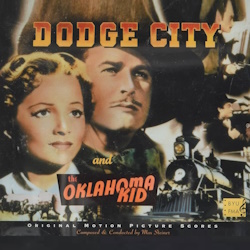
The technical team used the original 16-inch, 331/3 rpm acetate disks and good monaural audio is achieved, but given the beautiful themes Max Steiner composed, I really long for a rerecording with 21st century audio quality. Dodge City offers one of Hollywood’s finest Western scores that really helped to establish the “Western Genre” sound. Westerns were generally expressed narratives as morality plays where the good guys and bad guy roles were clearly defined. Additionally, Steiner understood, as did many that followed, that woven into the very sinews of American culture were two defining cultural drivers; first, Manifest Destiny, which asserted that America was ordained by God to stretch from the Atlantic to the Pacific oceans. Two, pioneering spirit, which elicited thousands to leave their homes in the east to seek land, opportunity and a better life in the west. Steiner taped into this Americana with his main theme, the Pioneer March, a bold, confident and forthright marcia orgogliosa, as well as his Wagon Train Theme, which he imbued with the optimistic pioneering spirit of families seeking a new life. These timeless and forthright melodies, with simple harmonies enhanced this film, elevated its narrative, and was warmly embraced by the viewing public. The thematic interplay of the villain and hero themes also served to musically express in simple terms good and evil, with Surrett’s Theme particularly malevolent and malignant. Folks, this is an early Golden Age Western score, which contributed to establishment and development of the genre. For collectors this compilation album, which includes another western by Steiner (“The Oklahoma Kid”) is invaluable. Do take in the film on a streaming service to truly experience how a composer can elevate a film.
For those of you unfamiliar with the score, I have embedded a YouTube link to a wonderful 15-minute suite; https://www.youtube.com/watch?v=e930p6A7Roo
Buy the Dodge City soundtrack from the Movie Music UK Store
Track Listing:
- Main Title (1:52)
- Buffalo Herd/The Iron Horse/Rendevous (2:57)
- Dodge City It Is! (1:30)
- Matt Cole’s Funeral (2:24)
- The Covered Wagons/Oh, Susannah/Sunrise/Abbie’s Theme (5:18)
- Stampede! (3:03)
- The Murder/Surrett’s Theme/Necktie Party (4:56)
- The Children/Abbie’s Theme/The Fight/Little Harry/Dodge City (4:34)
- Wade and Abbie Go Riding (2:43)
- Joe Clemens Murdered (2:02)
- Transferring the Prisoner (3:08)
- Fire Aboard the Train (4:07)
- Finale/End Cast (2:17)
Brigham Young University Film Music Archives FMA-MS108 (1939/2001)
Running Time: 40 minutes 51 seconds
Music composed and conducted by Max Steiner. Original orchestrations by Hugh Friedhofer. Recorded and mixed by XXXX. Score produced by Max Steiner. Album produced by James d’Arc.

Shop at the Movie Music UK Store

Member of the

 MOVIE MUSIC UK