OUTBREAK – James Newton Howard
 THROWBACK THIRTY
Original Review by Jonathan Broxton
Outbreak is a medical disaster thriller directed by Wolfgang Petersen, inspired by Richard Preston’s 1994 nonfiction book The Hot Zone. The story begins when a highly contagious and lethal virus, named Motaba, is discovered in Zaire in 1967. The U.S. military secretly destroys the infected village to prevent its spread but keeps the virus as a potential bioweapon. Years later, the virus resurfaces when an illegally smuggled monkey carrying Motaba is brought into the United States. The monkey ends up in a small California town, where the virus mutates into an airborne strain, making it even deadlier; the disease spreads rapidly, causing severe hemorrhagic fever and killing its victims within days. U.S. Army virologist Colonel Sam Daniels (Dustin Hoffman) and his team, including his ex-wife Dr. Roberta Keough (Rene Russo), race against time to find a cure. However, their efforts are hindered by General Donald McClintock (Donald Sutherland), who wants to suppress the outbreak to protect the military’s bioweapons program. As the town is placed under martial law and the military considers firebombing it, Daniels and his team try to track down the host monkey and develop a cure just in time to prevent mass destruction.
The film was a huge hit in the spring of 1995, as it tapped into the pervasive public fears of the time when emerging diseases, especially Ebola outbreaks, were making headlines. Furthermore, its portrayal of viral containment measures reflected concerns about how governments and health organizations might handle a pandemic, and now seem incredibly prescient considering what happened during the COVID-19 pandemic in 2020. It’s starry cast, which included not only Hoffman, Russo, and Sutherland, but also Morgan Freeman, Kevin Spacey, Cuba Gooding Jr., and Patrick Dempsey, did an excellent job at conveying all the different elements of the story, and Petersen’s assured direction gave it an appropriately high level of intensity and action which drew audiences in.
 The score for Outbreak was by composer James Newton Howard, and was the second high profile score of his to come out in the early months of 1995, hot on the heels of Just Cause. Outbreak is an interesting score because, like Just Cause, it can be seen as another work that bridges the gap between earlier action/suspense scores like The Fugitive and Wyatt Earp, and later scores like Waterworld, The Postman, and several others on into the new millennium. It is awash in so many of the familiar orchestration and compositional touches that have adorned Howard scores like this for decades, although by listening to the original album one might be forgiven for thinking otherwise. In its original presentation, Outbreak is unexpectedly low-key for a lot if its running time; a lot of the score is given over to suspenseful orchestral rumblings interspersed with a few moments of percussive African flavor, and only occasionally does it erupt into the meaty, muscular sound for which Howard is most famous.
Thematically the score is light; it’s a score built on texture, ambiance, and orchestration rather than melody, but on the occasions when it does raise its voice, the effect is excellent. The African aspect of the score is highlighted by the sadly infrequent contributions of vocalist and composer Lebo M., hot from his success with The Lion King. The orchestra is augmented by synths arranged by Howard’s old Toto bandmate Steve Porcaro, and the vocals of the L.A. Master Chorale enhance a few moments of the powerful drama. A few little scattered textures do offer some recurring identities – there is a woodwind motif associated with the Motaba-carrying monkey, and a sort of elevated, eerie tone for combined electronics and strings works its way into the score as a motif for the virus itself, and is best heard in “Jimbo Gets Sick” where it seemingly coalesces to mimic the screaming of primates – but beyond this, Howard is content to essentially through-score the film, reacting to it moment by moment without much apparent regard for narrative structure.
Normally I would criticize scores like this for having no focus, but for some reason this approach on Outbreak doesn’t bother me, mainly because there are so many JNH musical calling cards all over the score, to the extent that experiencing it becomes an enjoyable and welcoming game of ‘spot the influence’. In addition to the aforementioned The Fugitive and Wyatt Earp, and his foreshadowing of things like Waterworld, The Postman, and even Lady in the Water, Howard draws from his familiar bag of tricks liberally; I heard ideas and flavors from scores as diverse as The Package, Flatliners, and Falling Down, among others. The upshot of all this is that it makes Outbreak a ‘quintessential’ James Newton Howard score, but it also means that it’s not especially original, and as such anyone not in tune with that sound may find the whole thing redundant.
The highlights for me, by far, are the action sequences, beginning with the latter part of the second cue “Motoba River Valley,” which underscores the flashback scene where a small African village is firebombed to stop the virus from escaping, and which Howard greatly enhances with imposing brass writing and vivid African percussion. Later, “Casey Rips His Suit” explodes into a huge scream of orchestral dissonance and choral anguish as Kevin Spacey’s character realizes, to his horror, that he has been exposed to the virus, and is thus doomed to a lingering and painful death. Elsewhere, “Finding The Ship” and “Casey Goes Down” are at times brutally powerful, full of thundering brass clusters – Robert Elhai’s presence as an orchestrator is noted.
“Robbie’s Bedside” is one of the score’s few concessions to traditional melodic writing, representing the relationship between Dustin Hoffman and Rene Russo’s characters, and is quite lovely, featuring some tender writing for piano and guitar backed by strings.
The score’s 10-minute finale, comprising “A Little Resistance” and “They’re Coming,” is outstanding, adding a palpable level of excitement and tension to the final showdown between Hoffman’s ethical doctor Daniels and Sutherland’s unscrupulous and ruthless military man McClintock. There is a sense of muted heroism in the brass writing of the former, and then in the latter Howard increases the volume, drives up the pace, and unleashes some rip-snorting action passages that feature some almost Goldsmith-style writing for complicated layered brass, as well as some of the wonderful ‘action xylophone’ percussive patterns that were becoming a Howard mainstay by this point in his career. The vicious flourish of howling brass around the 6:00 minute mark – accompanying a helter-skelter helicopter chase – is a score highlight, and the whole thing ends on a more positive note as Daniels finds a cure, and stops the virus from spreading.
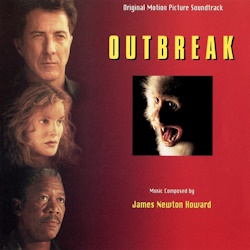
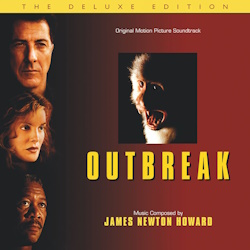 Unfortunately, as I mentioned earlier, the original 1995 Varèse Sarabande album was a 30-minute special that didn’t fully capture the scope of what Howard actually wrote for the film, and in fact makes it seem like a much less engaging and involving work than it actually is. Thankfully, in 2015, Varèse released a 2-CD expanded edition of the score that rectified many of these issues, and offers a vastly superior listening experience. There are several action standouts heard on the expanded album that do not feature on the original release, including the opening “The Bomb,” “Military Arrives,” “Sam Through Mob/Isolating Town/Pet Store,” the terrific “Trying to Escape,” “You Knew All Along/Go on as Soldiers/Sam Phones/Troops Move Out/We Better Leave,” and the fabulous “Sam Escapes”. In addition there are lots of extended sequences of suspenseful dissonance that build on the ’virus motif,’ and several more cues that highlight more of Lebo M.’s African vocal contributions to the score.
Fans of James Newton Howard’s 1990s action thriller style will find plenty to appreciate in Outbreak; despite its lack of prominent themes, the score succeeds as a result of its outstanding orchestrations, its lineage in Howard’s filmography, and for several sequences of terrific action. However, if you can, make sure you listen to it on the 2015 expanded release, because it showcases the score in a whole new light and really brings out much of the depth that was missing from the original album.
Buy the Outbreak soundtrack from the Movie Music UK Store
Track Listing:
- 1995 ORIGINAL RELEASE
- Main Titles (3:19)
- Motaba River Valley (1:00)
- Final Authorization (2:34)
- White Flags (1:44)
- Casey Rips His Suit (2:20)
- Finding The Ship (1:42)
- Casey Goes Down (2:04)
- Robbie’s Bedside (2:38)
- Jimbo Gets Sick (1:43)
- Cedar Creek Exodus (1:07)
- A Little Resistance (2:48)
- They’re Coming (7:14)
- 2015 EXPANDED RELEASE
- The Bomb/Main Title (4:00)
- Motaba River Valley/Walk Through Village (3:11)
- Jujuman (1:32)
- Monkey on Boat (0:39)
- Keep the Dogs (1:20)
- Examining the Virus/Old Friend (3:25)
- Ship to San Francisco (1:18)
- Jimbo Frees Monkey/Jimbo Gets Sick/Blood Splatters (2:43)
- Jimbo Dies/Autopsy (2:35)
- Movie Theater/Monkey in Woods (1:19)
- Tech in Hospital (1:33)
- Sam on Runway/Ford Gets Antibody/Good Luck (1:51)
- Military Arrives (2:34)
- Ward (1:15)
- Sam Through Mob/Isolating Town/Pet Store (2:24)
- Trying to Escape (1:54)
- Nobody Leaves Town/E-1101/Quiet Streets (3:15)
- White Flags (1:44)
- Cedar Creek Exodus (1:07)
- Casey Rips His Suit (2:20)
- Monkey Lives/Casey Goes Down/Needle Prick (3:00)
- You Knew All Along/Go on as Soldiers/Sam Phones/Troops Move Out/We Better Leave (3:49)
- Sam Escapes (2:38)
- Tae Kuk/Affirmative (1:04)
- Robbie’s Symptoms (2:37)
- Finding the Ship (1:42)
- Dead Sailor/Robbie Comforts Casey (2:54)
- TV Station/Sam on TV (1:49)
- Cops Arrive/McClintock Takes Off (1:24)
- Final Authorization (Extended Version) (2:47)
- A Little Resistance/Helicopter Chase (6:11)
- Robbie’s Bedside (Film Version) (2:38)
- Plane Takes Off/They’re Coming (7:42)
- McClintock Arrested (1:18)
- Robbie’s Cured/End Credits (7:12)
- Keep the Dogs (Alternate) (1:24)
- A Little Resistance (Album Version) (2:48)
- Robbie’s Bedside (Album Version) (2:38)
- Robbie’s Cured (Alternate/End Title [Alternate Segment]) (2:14)
Varese Sarabande VSD-5599 (1995) – Original
Varese Sarabande CD Club VCL 0615 1157 (1995/2015) – Expanded
Running Time: 30 minutes 13 seconds – Original
Running Time: 99 minutes 48 seconds – Expanded
Music composed by James Newton Howard. Conducted by Artie Kane. Orchestrations by James Newton Howard, Chris Boardman, Brad Dechter, and Robert Elhai. Recorded and mixed by Shawn Murphy. Edited by Jim Wiedman. Score produced by James Newton Howard and Michael Mason. Expanded album produced by Robert Townson.

Shop at the Movie Music UK Store

Member of the

 MOVIE MUSIC UK