THE ROSE TATTOO – Alex North
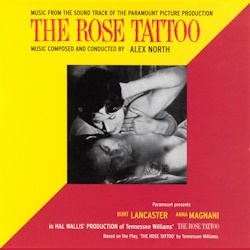 GREATEST SCORES OF THE TWENTIETH CENTURY
Original Review by Craig Lysy
Renowned director Hal Wallis saw opportunity with the Broadway production of “The Rose Tattoo” by Tennessee Williams, which opened at the Martin Beck Theater in New York on February 3, 1951, ran for 306 performances, and won four Tony Awards. He stated in his memoirs that he saw its premiere and “knew at once that I had to buy it. It was sure to be a great success. Audiences would identify with its earthiness, its sexuality, its deeply felt emotions and naturalistic dialogue.” He purchased the film rights, and sold his vision to Paramount Pictures, who placed him in charge of production. Daniel Mann was hired to direct, and author Tennessee Williams would write the screenplay. For the cast, Williams was insistent on Italian actress Anna Magnani playing Serafina Delle Rose, and this would be her first English speaking role. Joining her would be Burt Lancaster as Alvaro Mangiacavallo, Marissa Pava as Rosa Delle Rose, and Ben Cooper as Jack Hunter.
The film explores the life of Serafina Delle Rose, a Sicilian seamstress who lives in a Gulf of Mexico community. She is a devoted wife, but is devastated by her husband Rosario’s death, which causes her to suffer a miscarriage. She withdraws from life, and becomes a recluse. Three years later she learns from two prostitutes for which she was sowing bandanas, that Rosario was a frequent customer. She is outraged and decides to verify Rosario’s infidelity, but when the parish priest refuses to disclose what he heard in the confessional, she attacks him, only to be pulled off by a truck driver named Alvaro. The two slowly bond and it comes to pass after much drama and many obstacles, that she rediscovers love. The film was huge commercial success earning $4.2 million. Critical reception was also very favorable, and the film received eight Academy Award Nominations, including Best Picture, Best Film Editing, Best Costume Design, Best Musical Score for a Dramatic Picture, and Best Supporting Actress, and winning three for Best Actress, Best Cinematography, and Best Art Direction.
Alex North had made a notable impression in Hollywood with his breakout scores to A Streetcar Named Desire (1951), Death of a Salesman (1951) Viva Zapata! (1952) and Unchained (1955). Producer Hal Wallis decided to offer him the project, given his success scoring the aforementioned drama films. Upon viewing the film, I believe North realized that his approach would be, eclectic, mixing into his soundscape the requisite traditional Italian themes, Jazz, player piano fun, edgy modernism, his trademark dissonance, madcap silliness for the goat scenes, and brooding auras of isolation and despair after Serafina withdraws from the world.
 For his soundscape, North supports with three primary themes and several motifs. The Main Theme is the song melody for “Come le Rose”, which serves as an idée fixe that anchors the film. It speaks of a woman coming to the sad realization that her best days are behind her, and that love has past and will not return. The melody is aching, wistful, and burdened with regrets. It serves as Serafina’s Theme who struggles to accept Rosario’s infidelity and move on with her life. Rosa’s Theme speaks to her estrangement from her mother who following Rosario’s death refuses to dress, lives as a recluse. She feels repressed as Serafina tries to keep her in seclusion, denying her efforts to enjoy life and find love. The theme shifts among solo woodwinds tristi, draped with aching strings, and at time surges with anger and bitterness. There is a Love Theme for Jack and Rosa, which emotes as a classic string borne romanza often join by, and embellished by woodwinds with harp adornment.
Serafina, Rosa, Alvaro and most of her neighbors are Sicilian and North drapes the film from start to finish with exquisite Italian lyricism often led by a mandolin. My maternal ancestors were Sicilian and I believe North wrote as though Sicilian blood ran in his veins. Also included are a number of source tunes including “The Sheik of Araby” by Ted Snyder, Francis Wheeler and Harry B. Smith, “Come le Rose” by Adolfo Genise, lyrics by Gaetano Lama, and “Out of Nowhere” by Johnny Green. Lastly, there are a number scenes of of madcap and slapstick silliness related the frequent breakouts of the family goat, and the corralling efforts to put him back in his pen. North propels these scenes with carnivalesque buffoonery, which creates delicious musical comedy. The family player piano is in many ways a character in the story and its loud and festive tunes support comedic interludes, as well as offering in the finale, a protective sonic shield for Serafina and Alvaro from her neighbor’s prying ears.
(*) “Logo” opens with Nathan Van Cleve’s logo music of swirling strings brillante and fanfare bravura, which support the display of the Paramount Pictures, and then VistaVision logos. We flow atop a tenor voice vocalizing feelings of sadness and fast strummed mandolin into “Serafina”, which supports the flow of the opening credits against a fabric bearing a rose. At 0:46 children’s choir joins and continue the sad musical narrative. The music from 1:23 – 3:55 is dialed out of the film and features Maria Pavan singing in Italian the wistful love song “Come le Rose” (Like Roses), which speaks of a woman coming to the realization that her best days, and love have past and will not return.
(*) “Papa is Sleeping) reveals Serafina shopping at the local grocery store, where she brags about her “A” type husband. She returns home and her Rosa daughter informs her that a lady is waiting at the front door, and that Papa is sleeping as he has another night run. Music enters as she enters the bedroom, lays next to him, smells the rose oil in his hair. She lovingly caresses and kisses him as she expresses her undying love. She then says she has a feast planned as she has a new life in her body. She begs him not to make another night run, as she does not understand or like it. North supports gently with strummed mandolin and strings d’amore emoting the melody of “Come le Rose”. She comes out and meets Estelle who asks her to make a silk shirt for her lover, as tomorrow is the one-year anniversary of the day they first met. Rosario peers through the door as Estelle, is his lover. She accepts twenty dollars and Estelle departs in a taxi to the Mardi Gras Club as Serafina runs out to manage the capture off the family goat which again escaped. “Arrivederci” opens with a mandarin driven molto triste rendering of the Main Theme, which supports Rosario driving off in his truck. Serafina is perplexed and saddened as he drives off. That night a police car stakes out next to a road block as they prepare to stop a smuggler’s truck, which they are informed left the Mardi Gras Club ten minutes ago. Soft strains of the Main Theme support. Rosario smashes through the barrier and the police begin a pursuit. Machine gun fire causes Rosario to lose control, and his truck rolls down an embankment and explodes in a fireball killing him, which North supports with an anguished Main Theme.
(*) “Serafina’s Devastation” reveals Father De Leo arriving with four women to give Serafina the bad news, carried by a soft musical narrative draped in Italian auras. As the camera shifts inside revealing Serafina sowing the silk shirt, dissonance moves to the forefront as she hears whispering outside the door. The five enter, and she quickly realizes what has happened. She backs up with an out-stretched hand and repeatedly says “Don’t Speak!”. She is overcome, and collapses sobbing in anguish. North supports her devastation with a molto tragico rendering of the Main Theme. (*) “Serafina’s Torment” reveals that the next day, the doctor informs Father and her friends that Serafina has lost the baby. Father informs him that she wants Rosario’s ashes to keep in a pot in the house. Then Estelle shows up with flowers and insists on seeing Rosaio’s body, but is stopped by father and then violently assaulted by the women who scream expletives at her. Inside the housekeeper turns on the player piano, which plays the festive “The Sheik of Araby” to drown out the screaming outside. The doctor rescues Estelle as Serafina stumbles out of the bedroom, stops the piano, and collapses. Music enters with a mandolin triste playing the Main Theme as they carry Serafina back to bed, and Rosa sobs on the front stairs.
In (*) “Rosa Meets Jack”, it is three years later, Rosa, now a high schooler, frets to her girlfriend that she has to goes to the dance in a plain dress as her mother refused to sow her a gown. The girlfriend points out Jack Hunter, a handsome blonde guy, in a sailor uniform. When she tries to introduce her to Jack, Rosa runs away as she is embarrassed that she is not wearing a formal. Jack follows her and finds her in the auditorium playing and singing the second stanza of “Come le Rose”. He calls her Rose, which surprises her and we shift to the dance floor where they slow dance intimately to the song melody to “Out of Nowhere”. She is smitten and contented in his arms. Later as they sit on the stairs, she offers him a kiss, but the moment is lost with the lights being turned off and the sound of the doors being locked. They run to a side door and she promises that on tomorrow’s date she will allow him to kiss her supported by Italian strings tenero. At home a sad Main Theme supports as Rosa is slapped by Serafina when she lies that she is home late because she was studying civics. “Lament” reveals a huge mother-daughter fight as Serafina, who has become a recluse tries to prevent Rosa from going to graduation, believing high school has made her a wild woman. The fight spills out onto the street where Rosa shouts that Serafina looks disgusting and that she is ashamed to be her daughter. Serafina relents and music enters with an anguished Rosa’s Theme as Serafina confides to a friend that her daughter called her, disgusting. At 0:31 the melody shifts to strings as we see that she is devastated by what Rosa said as she returns to the house, which has become a tomb.
(*) “Graduation” reveals that she hears the high school band playing, and decides to dress up and go to Rosa’s graduation. She struggles to get into a number of dresses as she has gained weight. We flow into “Floozie”, which reveals two prostitutes arriving and paying Serafina to mend their bandanas for a political convention they are to attend. The banter of the two women offends Serafina’s who reprimands one, only to have her divulge Rosario’s frequent infidelity. North chooses to support the scene with a free-form meandering jazz narrative, which I believe is rendered from Serafina’s perspective of the two puttanas (whores). At 2:48 we shift to a more festive iteration, however from here on, the music was dialed out of the film after the women begin fighting and shouting. (*) “Tell Me It’s Not True” reveals a devastated Serafina repeatedly beseeching a statue of the Virgin Mary to give her a sign and tell her it is not true. A small ensemble of strings and woodwinds support, and bathe us in sadness. (*) “Bacio” reveals Rosa bringing Jack home to introduce him to mama. She is not home, and inside she decides to teach Jack an Italian word, Bacio. When he asks what it means, she demonstrates, by kissing him. She becomes very amorous, but he shows restraint. North supports tenderly with the Love Theme softly rendered as a romanza. The music ends when they hear Serafina in the next room.
(*) “Rosa Apologizes” reveals Rosa fixing a disheveled Serafina up so she can introduce her to Jack. Serafina is listless as Jack brings her flowers and introduces himself. After he goes out to find Rosa’s diploma, Rosa apologizes for her hurtful words and after repeated efforts, daughter and mother reconcile. North supports with an anguished musical narrative with mandolin and strings offering Rosa’s Theme, that swells on a painful crescendo, which crests at 1:18, and slowly dissipates on a diminuendo as Mama finally relents and directs Rosa to leave while she interrogates Jack. In “Amami, Caro” we have a molto romantico score highlight. Jack wins Serafina over after convincing her that not only is Rosa still innocent, but so is he. She says that Rosa is in love, and then asks, if he is in love, and he says yes. When she confirms he is Catholic she makes him kneel before the Virgin Mary and promise the ensure the innocence of Rosa. A tender romanza with exquisite writing for strings, woodwinds and harp unfolds and blossoms as Serafina accepts Jack as worthy of Rosa and in becoming a member of the family. Rosa is joyous and Serafina declines his offer of a kiss on her cheek, offering her hand instead. Serafina pours some wine to celebrate, but a horn blows and Rosa and Jack run out to join their friends. We close with Serafina again asking the statue of Mary to say it is not true, and give her a sign.
“Thorn Of The Rose” offers the score’s most powerful and dramatic composition. It reveals that Serafina is plagued by the stories of Rosario’s infidelity, and so travels to the church to speak to Father de Leo. The church is holding a bazar and one of her friends tries to introduce her to her bachelor brother Alvaro, but Serafina is obsessed with locating Father and declines. She sees him, runs to him, and insists on speaking to him in private, so he takes her to his office. As they enter the church an angelic women’s choir sings a hymn (not on the album). She reminisces about her arranged marriage and becomes distraught. He decides to offer his counsel, expressing that her isolation and excessive grieving was unhealthy. When women arrive, drawn by her raving, Serafina explodes with vitriole. He asks her to go home, and she grabs him and demands that he tell her if Rosario confessed to him about another woman. A musical narrative of anguish unfolds as he says he cannot violate the seal of the confessional. She presses and forcibly begins shaking him, screaming for him to tell her and a crescendo di dilore swells and crests at 1:18 as Alvaro pulls her off of Father, who flees, as she tears Alvaro’s shirt. We dissipate on a diminuendo of anguish as she pounds on the church doors and sobs.
(*) “Alvaro Drive Serafina Home” reveals the good hearted and chivalrous Alvaro driving Serafina home in his truck. He escorts her to the door; she goes in, sits down at the sowing table, and begins to sob. He decides to enter and then he starts crying, saying he always cries when someone else does. He convinces her to stop, so he can stop, and she calms down. She sees his torn shirt and tells him to take it off so she may fix it, which he does. She asks for more light and as he opens the shutter, we flow into “Com É Strano”, which offers a trumpet led spritely musical narrative draped with Italian auras. She discovers he is Sicilian and he asks if he can wash up as he smells like a goat. After he goes to the bathroom, she mutters to herself that that he has the body of her husband, but the head of a clown. She asks the Lady if this is a sign, and he begins singing Figaro. He returns and finds her on a chair, having fetched a bottle of wine. She cannot get down so he lifts her down and we see her swoon in his muscular arms. We shift at 0:58 to pathos, with a wistful passage as he relates that his sister encouraged him to meet her, and she counters that she does not need anyone as her husband is always with her. She then shows him the urn which holds Rosario’s ashes. She says she broke the churches rules, but he counters, that God has forgiven her. At 1:21 we resume the music which opened the cue as we see her warming to him as she tells her story of Rosario’s rose tattoo on his chest. She asks him to open the Spumante and the cork pops with a gush of sparkling wine as they both laugh. She then learns that he, like Rosario transports bananas, and then permits him to call his boss saying he will be late. She then learns that he supports his old maid sister, a feeble-minded grandmother and his papa. We again see her scanning his muscular body, and she is clearly smitten. He calls his boss who is angry and demands he deliver the bananas at once as he is fired.
“Gioconda” reveals that she likes Alvaro’s good nature and so gifts him the silk shirt she made for Estelle. North supports with a tender reprise of the mandolin led romanza with angelic voices and Italian auras. He is thankful, and we see her falling for him, but the moment is lost when a boy arrives shouting that her goat had escaped again. He puts the shirt down, and races out at 1:34 propelled by a truly frenetic, and silly musical narrative, which embraces both comedy and slap stick goofiness. Afterwards, the romanza returns as she cleans her hero off, and helps him don the silk shirt. His sweetness, and good heart brings her out of her shell of isolation, and she accepts his proposal to return tonight after he has delivered the bananas. Musical playfulness joins as he coaxes a young boy off his truck and departs with a smile. We close with sad strings of regret as Serafina asks Rosario to forgive her for believing the terrible lie. (*) “Jack and Rosa Quarrel” reveals them on a sail boat where she complains that he has been cold since he spoke with her mother. He says he has to be careful as she is still a young girl. She clearly wants him to stop treating her like a little girl saying that she is old enough to marry and have children. When he declines to kiss her with people around, she becomes angry and jumps off, causing him in frustration to strike the cabin roof. North supports the scene quietly under the dialogue with a source tune.
(*) “Jack Gets a Tattoo” reveals him dressed up and entering a tattoo parlor in town. He asks Mama Shigura to give him a big beautiful rose on his chest and they barter for the price. A festive source tune plays in the background under the dialogue. We flow into “Caprice”, which offers a happy and sunny Italian composition, which supports his arrival at Serafina’s house. He takes a swig of whiskey, and brings out a heart-shaped box of chocolates as we see her in her room dressing. He has signs “Truck For Hire” on his truck, suggesting that his boss fired him. Inside Serafina exits her bedroom in a black lace dress. He enters the house bubbling with happiness and compliments her on her beauty. She smells the rose oil in his hair, and has a fleeting moment of discomfort. In the parlor, the opening melody reprises (not on the album). He returns her the purse she left at Father De Leo’s office. He gifts her chocolate and moves his chair close, and we see her become uneasy. He turns on the player piano, a festive Italian dance plays, and he grabs her and begins dancing with her. It is too much, and she gets angry, turns off the piano and orders him to sit.
In “Rosario” we have a powerful and dramatic composition of great pathos. She says for the animated Alvaro to calm down, and smells the same scent of rose oil in his hair that Rosario had. She expresses uneasiness regarding Rosa’s innocence with her sailor boyfriend. He asks if he has a tattoo, and she becomes flustered, laughs, and asks, how would she know. He then tells her that he has a tattoo, opens his shirt, and stuns her with the sight of a rose on his chest. She is overcome, and music enters as she says she is dizzy, needs fresh air and goes out on the porch. He becomes amorous, kisses her, which she rejects with fury. She slams the door telling him to go home, yet he follows her in and pleads, say his feelings are genuine, and that she has been a widow too long. She asks for the shirt back, then refuses it, and demands he disclose the name of the woman who gifted it. When he says Estelle Hohengarten who works at the Mardi Gras, she relates the story told her by two women of Rosario’s infidelity. North supports with a molto tragico rendering of the Main Theme borne by weeping strings affanato. As the realization that Rosario love was tainted and untrue, the music drapes itself in dissonance as woodwinds take up the melody. She demands he take her to the Mardi Gras so she can confront Estelle. (*) “I Have Proof!” reveals their arrival at the club supported by an edgy and seductive dance tune (not on the album). Alvaro tries to dissuade her, but she will not relent. They enter she shouts for Estelle causing a scene, and then storms into the game room where she finds her. She angrily confronts her and when she admits to it, Serafina slaps her with her purse saying she is a liar. Estelle then declares she has proof, and tears open her blouse to reveal a rose on her chest, which she said she had done to match his. A crescendo of anger erupts with another purse slap, which empowers a tempest of violence as Alvaro escorts Serafina out of the club.
(*) “The End of Rosario” reveals their arrival home with Alvaro unable to pay the cab fee. Serafina runs in ahead, they hear a loud smash, and both men run in to find Rosario’s urn of ashes smashed on the floor as Serafina sobs. Alvaro convinces the driver to go as she has just lost her husband. As Alvaro takes her to the window and consoles her, North supports rendering the Main Theme as a Pathetique. He tells her the pain will pass, and to lean on him, which she does, but then pulls away saying she does not want that. She tells him to go, and park the truck down another street, and then come back. They put on an act for the neighbors that he is leaving. Afterwards the music sours as she says goodbye, and gives everybody her love as she puts a rose in her hair. “Lothario” reveals Alvaro parking his truck and proceeding on foot back to the house carried by an Italian Motif led by mandolin. He avoids the street and stumbles in the dark through people’s property, upending a chicken coop, which elicits gun shots by the owner. Plaintive woodwinds bear the Main heme as he arrives, downs the last of the whisky, and enters Serafina’s house. He collapses on the floor drunk, and bloodied, and she cannot rouse him. At 1:11 she is flustered at her clown, and a comedic passage supports as she covers him with a blanket and closes the curtain. (*) “Rosa Proposes” reveals Jack bringing Rosa home, supported tenderly by their romanza. She is sad that he ships out tomorrow at five, and asks before he goes, if he would give her a gold ring, and marry her as she wants to give him her heart to keep forever and ever. He is overjoyed, takes her into his arms, but then says he has to go and runs off as he is clearly aroused. She goes inside, and the music descends into sadness as she lays down on the couch and weeps.
(*) “Alvaro Surprises Rosa” reveals Alvaro waking up as Rosa sleeps on the sofa. North sow tension with a free form modernism as he does a double look, and then crawls towards her, in the dark thinking she is Serafina. He utters “Che Bella”, wakes her, and she screams and runs away. A passage of dissonant, dissociated modernism supports Serafina repeatedly slapping him as Rosa watches. She chases him out and mother and daughter have a terrible argument, which North supports with a molto tragico rendering of the Rosa’s Theme as Rosa calls her mother a liar and hypocrite, choosing not to believe her story of how he got in the house. As she smashes the piggy bank to get money to leave, Jack arrives. Serafina motions him to go in, and the two confess their love. North supports with their Love Theme, which blossoms when Serafina asks if he is going to marry Rosa, and he nods yes. She says that her white wedding clothes are prepared and to go marry Rosa. Rosa then says that the man never touched, her, but only sad Che Bella. Jack kisses Serafina’s hand, and then he and Rosa run off. (*) “Finale” reveals Serafina and all the women on the block discovering a shirtless Alvaro sitting atop the mast of a parked ship singing he is happy as a bird. Serafina retrieves the silk shirt and the women toss it up to him. He dons it, descends, and the women support his walk to Serafina. He calls to her twice through the door, with no answer. But the player piano begins playing its festive tune as Serafina says, now we can continue our conversation. As the women all walk away, we end the film a crescendo festivamente, which ends in a triumphant flourish
The CDs – both of which are straight re-issues of the original Columbia soundtrack LP from 1955 – offer only 30 minutes of score, presented in archival monaural audio. I would hope that one day we may get a re-recording of the complete score. North was presented with a film narrative, which required a multiplicity of different musical styles; ethnic Italian, Jazz, pop, melodrama, romanticism, and carnivalesque buffoonery. Upon viewing the film, I clearly appreciate North’s efforts, and understand why he was rewarded with an Academy Award nomination. To begin with, this was Serafina’s story and the decision to use the song melody “Come le Rose”, which is aching with wistfulness, sadness and regret was brilliantly conceived, and executed. She was the song and the confluence of its melody and Anna Magnani’s peerless acting, was profound. Equally compelling was Rosa’s sad and pathetic theme, which spoke to her feelings of shame for her mother’s descent and dissolution following her father’s death, as well as her anger from Serafina’s suffocating repression, which prevented her from joy of living, and the pursuit of her romantic yearning. The Sicilian ethnic auras, are gorgeous and permeate the film, woven into its very sinews. And of course, the frenetic carnivalesque buffoonery of the goat adventures offered a respite of comedy from the film’s melodrama. Folks, North’s score fit the film’s narrative perfectly, and I believe that it, along with Magnani performance, which won her the Best Actress award, allowed Hal B. Wallis to realize his vision. I highly recommend that you take in this outstanding film and experience North’s mastery of his craft.
For those of you unfamiliar with the score, I have embedded a YouTube link to its Main Title: https://www.youtube.com/watch?v=mXgbAzbedbM
Buy the Rose Tattoo soundtrack from the Movie Music UK Store
Track Listing:
- Serafina (3:56)
- Floozie (4:40)
- Lament (2:39)
- Com É Strano (How Strange He Is) (2:43)
- Thorn of the Rose (1:47)
- Arrivederci (2:22)
- Amami, Caro (Love Me Darling) (3:14)
- Caprice (1:13)
- Rosario (2:31)
- Lothario (2:01)
- Gioconda (3:15)
Varese Sarabande VCL-9001-5 (1955/1990)
PEG Recordings 030 (1955/1998)
Running Time: 30 minutes 21 seconds
Music composed and conducted by Alex North. Orchestrations by Maurice De Packh. Recorded and mixed by XXXX. Score produced by Alex North. Varese Sarabande album produced by Robert Townson and Tom Null.

Shop at the Movie Music UK Store

Member of the

 MOVIE MUSIC UK