JUST CAUSE – James Newton Howard
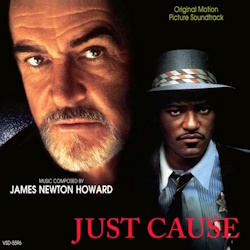 THROWBACK THIRTY
Original Review by Jonathan Broxton
Just Cause is a psychological thriller based on the 1992 novel of the same name by John Katzenbach, directed by Arne Glimcher, starring Sean Connery, Laurence Fishburne, Blair Underwood, and Ed Harris. The film follows Paul Armstrong (Connery), a Harvard professor and former lawyer, who is drawn back into the legal world when an elderly woman pleads with him to help her grandson, Bobby Earl Ferguson (Underwood), a black man convicted of the brutal murder of a young girl in a small Florida town. Initially reluctant, Armstrong is convinced of Bobby Earl’s innocence after the accused claims that he was coerced into confessing by a ruthless sheriff, Tanny Brown (Fishburne). As Armstrong investigates, he uncovers more inconsistencies in the case and follows leads that point to another suspect, serial killer Blair Sullivan (Harris), who is incarcerated for another crime. However, as the case unravels, Armstrong slowly realizes that not everything is as it seems.
The score for Just Cause was by James Newton Howard, and came right in the middle of an outstanding period in the composer’s career, following on from serious accomplished dramatic orchestral scores like Alive, The Fugitive, and Wyatt Earp, and immediately preceding career highlights like Restoration and Waterworld. In many ways, Just Cause is a sort of ‘greatest hits’ score, as it features numerous interesting variations on elements heard in many of those scores, from the dark elegance of the main thematic writing to the powerful intensity of the action and suspense cues. It’s also a good illustration of how Howard’s own personal stylistics were really starting to establish themselves across multiple scores; composers tend to be quite eclectic in their early careers as they find their feet, and that certainly was the case with Howard, but by 1995 he had really developed a strong sense of who he was as a composer, and Just Cause is a great example of that.
 The “Main Title” is full of that dark elegance I mentioned earlier, and contains a moody main theme written mainly for strings, backed by subtle orchestral textures and tastefully understated electronic enhancements. The theme acts both as a representation of the mystery at the heart of the story – Bobby Earl’s guilt or innocence – and as a theme for Armstrong himself, his respect for the law, and his sense of right and wrong. “Searching for Clues” builds on this same central thematic idea, but is perhaps more forceful, underscoring both the seriousness and sense of intrigue that accompanies Armstrong’s investigations into Bobby Earl’s case. Later, “Ida Remembers” revisits some of the same ideas with more emphasis on gentle woodwind textures – intimate, warm – but it all becomes dramatic and revelatory towards the end, as the apparent truth about Bobby Earl starts to emerge.
Also dramatic are the score’s multiple action cues, which are at times unexpectedly bold and intense. “Bobby Earl In the Elevator” erupts in an explosion of noise, a rash of thrilling strings and shrill brass explosions, and then “That’s Laurie’s Car” is a knockout, full of more bombastic brass and vibrant string runs. This music is very typical of Howard’s 1990s action music; as well as being very much in the same ballpark as the scores already mentioned, it foreshadows much of the action material heard in later scores like Outbreak, The Postman, Dinosaur, and others. It is all very strongly rooted in Howard’s familiar style and contains many of his trademarks, from the punchy brass pitched in combination with staccato drum hits, the prominent use of action xylophones, and the frequent interpolation of percussive ‘slap’ sounds that really make an impact. It’s excellent.
After a few cues of low key, moody, understated string suspense music –“ Finding the Scimitar,” “Bobby’s Confession,” the more menacing “Read the Signs” – the thrills return in “Sullivan Phones,” which features a sinister brass motif for Ed Harris’s character, a convicted serial killer condemned to the electric chair, who has a mysterious connection to Bobby Earl and the crime he is accused of committing. The subsequent “The Execution” underscores Sullivan’s trip to the aforementioned electric chair with a sense of brooding melodrama, and ultimately features a searching brass idea that is underpinned with an appropriate touch of tragedy.
The finale of the score, where everything turns on its head and the actual truth about Bobby Earl emerges, begins with “Conviction Overturned,” which is full of melodic strings, warmly noble horns, and harp glissandi, and feels like musical justice – but it is all a ruse, and in the subsequent “Phony Message” the truth comes out: somehow, Bobby Earl and Sullivan were working together to get his conviction overturned, and Bobby Earl was guilty all along. Howard’s music becomes purposeful and forthright here, full of chugging strings, frantic percussion licks, and throbbing brass clusters, driving the protagonists on to their ultimate confrontation in a remote Florida swamp.
The use of the elegant main theme in “Case Closed” gives the brutal end to the story a sense of grim catharsis as Armstrong and Sheriff Brown – having finally put their issues aside – team up to stop the duplicitous Bobby Earl once and for all, with the help of a well-placed alligator. As the end credits roll Howard gives a lush sweep to the proceedings by introducing a notably lovely horn countermelody under the strings, and then reprises some of the excellent action music, bringing the score to a satisfying close.
Despite being a Varese Sarabande ‘thirty minute special,’ Just Cause is an enjoyable little score that fans of James Newton Howard’s 1990s action and thriller sound will appreciate greatly. It doesn’t do anything especially groundbreaking, but it does what it does very well, and it acts as a nice reminder of a time when studios making mid-budget legal thrillers regularly hired A-List composers to write top-notch orchestral scores, full of interesting melodic ideas and creative action music. Those were the days.
Buy the Just Cause soundtrack from the Movie Music UK Store
Track Listing:
- Main Titles (1:36)
- Searching for Clues (1:54)
- Bobby Earl In the Elevator (1:19)
- That’s Laurie’s Car (2:22)
- Finding the Scimitar (2:25)
- Bobby’s Confession (3:02)
- Ida Remembers (3:04)
- Read the Signs (2:49)
- Sullivan Phones (2:09)
- The Execution (3:43)
- Conviction Overturned (1:39)
- Phony Message (1:58)
- Case Closed (2:47)
Varese Sarabande VSD-5596 (1995)
Running Time: 30 minutes 47 seconds
Music composed by James Newton Howard. Conducted by Artie Kane. Orchestrations by James Newton Howard, Jeff Atmajian, Chris Boardman, and Brad Dechter. Recorded and mixed by Shawn Murphy. Edited by Thomas Drescher. Album produced by James Newton Howard and Michael Mason.

Shop at the Movie Music UK Store

Member of the

 MOVIE MUSIC UK