THE LEFT HAND OF GOD – Victor Young
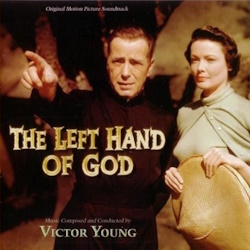 GREATEST SCORES OF THE TWENTIETH CENTURY
Original Review by Craig Lysy
Renowned 20th Century Fox producer Buddy Adler had a penchant for making films full of conflict, forbidden love, that were often set in exotic Asian locales. He saw opportunity after reading the 1951 novel “The Left Hand of God” by William Edmund Barrett and decided its story would translate well to the big screen. He sold his vision to CEO Darryl F. Zanuck and secured his blessing. Adler would oversee production with a $1.785 million budget, Edward Dmytryk was tasked with directing, and Alfred Hayes would adapt the novel and write the screenplay. A fine cast was assembled, with Humphrey Bogart as James Carmody, Gene Tierney as Anne Scott, Lee J. Cobb as Mieh Yang, Agnes Moorehead as Beryl Sigman, and E. G. Marshall as Dr. David Sigman.
The story is set in 1947 in post-WWII China during the tumult of its civil war. John Carmody, an American pilot who was shot down, serves a local Chinese warlord Yang. Yet he is discontent, escapes, assumes the identity of a slain Catholic priest Father O’Shea, and hides at a local mission. A fellow westerner Anne Scott, a widow who works as a nurse at the mission hospital, becomes unsettled when she finds herself falling in love with O’Shea. Eventually Carmody’s deception is discovered and Yang leads his soldiers to reacquire him. Yang accepts Carmody’s offer to settle his fate the Chinese way with dice and proceeds to win his freedom. Yang demands a rematch, loses again and accepts his fate, granting Carmody his freedom. As Carmody prepares to leave the mission, he finally discloses the truth of who he is to Anne. The film was a commercial success earning a profit of $2.215 million. It was however a critical failure, criticized for an implausible script with Bogart miscast. It failed to secure any Academy Award nominations.
Veteran composer Victor Young was hired for the project and realized he was being provided a broad canvass for which to compose. The story was set in China during the tumult of its civil war, and had woven within its narrative, a tale of deception and unrequited love. He resolved early that he would have to incorporate both occidental and oriental sensibilities so as to speak to the film’s setting in China as well as the religiosity of the Catholic and Methodist missions run by westerners. Foremost was the need to compose two love themes, which would speak to the two women who loved James; Anne and Mary.
 For his soundscape, Young blended oriental and occidental musical sensibilities, and anchored the film with three primary themes. There are four Chinese identities, which are pervasive throughout the film. They are pentatonic in construct and emoted by an array of Chinese lutes, woodwinds, drums, cymbals and western strings. Their textures and rhythms fully embrace Orientalism, and in my judgment, masterfully expressed the Chinese setting, bringing its history, countryside vistas, architecture, and people to life. The Might of China Theme offers proud declarations by horns orientali, which speak to the grandeur, power, and magnificence of Chinese civilization. Young employs it in heraldic, dramatic and martial iterations throughout the film. The Travel Theme speaks to scenes where people are traveling across the Chinese countryside. Strings orientali and woodwinds animato, vibrant with life, provide the impetus for these journeys often against the beauty of China as reflected in its forests, countryside, and imposing mountain vistas. Young employs it for panoramas and settings where the natural wonders of China manifest in the cinematography. The Serenity Theme speaks to the simple life of the Chinese people, who are bound to the land, working hard to irrigate and cultivate their fields. Young infuses the theme’s repeating sting borne seven-note phrases with soft percussive rhythms and woodwind adornment, which evoke an idyllic life. The Village Theme expresses the bustling life of Chinese villages. It offers vibrancy and energy with strings animato, nativist percussive rhythms and a chirping woodwind ostinato.
There are two love themes; the primary Love Theme offers a string borne romanza, which speaks to the love between James and Anne. It is stirring in its beauty, and full of yearning, yet it lacks passion or ardent romanticism. Notable is that the theme never achieves resolution as their love is forbidden by an insurmountable cultural impediment – a priest’s vow of celibacy. We find late in the film when James at last confesses that he is not a priest, and that he loves Anne, that the heartache of unrequited love we have felt in the notes, is shared by both. A secondary Love Theme is used to support the love between James and his concubine Mary Yin during his indentured captivity by General Yang. This delicate theme, which is in reality also her theme, is also unrequited, as Mary’s love for James, whom she worships, is never reciprocated. Its expression, sensibilities and instrumentality are quintessentially Chinese as it is emoted solely from her perspective. The Faith Theme supports the Catholic Mission, chapel, the faith of the people, and also operates as an emblem of Father O’Shea when James is dressed in his priestly robes. Young drapes us with divine auras using aspirational strings solenne, and warm horns nobile buttressed by chords religioso. Lastly, two American source songs, both sung by the children in Chinese were also infused into the score; “A Loaf of Bread”, written by Ken Darby and based on traditional “The Old Gray Goose”, and “My Old Kentucky Home”, traditional.
(*) “Logo” opens with the extended CinemaScope version of Alfred Newman 20th Century Fox fanfare. “Prelude” opens with fanfare dramatico of the Might of China Theme draped in refulgent strings as the opening credits unfold against the towering Himalaya Mountains. At 0:12 strings religioso emote the Faith Theme, which supports the film title, crowned with a reprise of the Might of China fanfare. At 0:23 we shift to orientalism with the pentatonic, vibrant, bubbling woodwind rich China Travel Theme. At 0:41 the Serenity Theme unfolds on sumptuous strings buttressed by horns nobile, crowned with a final fanfare declaration of The Might of China Theme to close the credits. At 1:17 we flow into the film proper atop a diminuendo of the Travel Theme, which supports script; “A Remote Province in China – 1947”. “Countryside” opens with The Might of China fanfare, which reveals James leading a pack mule across beautiful vistas of the Chinese countryside. The China Travel Theme joins and carries his progress. At 0:31 we see James, who has assumed the identity of Catholic priest Father O’Shea, dressed in black clerical garments. He pauses and the Faith Theme borne by strings solenne support. At 0:38 the Might of China Theme resounds atop trumpet declarations as we see him holding a pistol. He mounts the mule and continues his trek carried by the theme in traveling form. At 1:02 trumpets resound with the Might of China Theme as the music gains dramatic intensity as we see James engulfed in a rainstorm. He comes to a gap in the trees, and at 1:15 horns religioso declare the Faith Theme as we see the Mission. Horns orientale support him resuming his ride. At 1:49 Young sow tension as we see him deciding to ride across a wood plank suspended bridge over a raging stream. The bridge collapses and he and the mule are toppled and swept away in the current. The remainder of the cue was dialed out of the film as we see him struggle to reach the shore. He resumes his trek on foot and arrives at the monastery. In the opening cues Young masterfully establishes two of his primary themes and the story’s setting.
As James is served hot tea, he meets Dr. Sigman, his wife Beryl and nurse Anne Scott. News is brought that a man Li Kwan is dying and is asking for the Last Rites. O’Shea tries to defer but is cornered and taken to the dying man. We see his anxiety as he fears his deception will be revealed. “Man Praying” reveals O’Shea sitting on the bedside as the old man asks for absolution. As Kwan begins praying in Chinese, we are draped in solemn oriental auras with the Serenity Theme is rendered as a soft hymn. At 0:27 the hymn assumes the form of a danza tenero as we see the man relieved of his burdens. At 0:48 the music becomes solemn as Kwan passes unto death and Anne joins at bedside to thank him. She then asks that he led her, the other patients in the ward, and staff in prayer, which he does by reciting the Lord’s Prayer, and Hail Mary. 13:29 (*) “Children Singing” reveals Father O’Shea entering the courtyard following a disagreeable discussion with Dr. Sigman, who believes the mission should be closed. Beryl leads children in a circle dancing with locked hands as they sing a folk song in Chinese. Father sees Anne and decides to accompany her to the village.
We flow into “Coolie Workers”, which offers a wonderfully conceived and executed score highlight where we see workers working to bring river water into their irrigation channels. Young offers a churning orientalism with the Might of China Theme to support their work as men foot pedal irrigation wheels. At 0:09 the music softens and becomes tender as he assists Anne cross a small stream. Their bodies come into contact, which she ends with some embarrassment. The tranquil gentility of the musical narrative continues, draped with orientalism as they stroll and he learns of her background. The music at 1:13 becomes more vibrant and energetic atop the Village Theme as we see them entering the bustling village. The music retreats behind the dialogue as Shen-fu (priest) is welcomed into the village by its elders. At 1:47 horns maestoso sound the Might of China and Travel Themes and the eldest man in the village, and father of uncounted sons is brought by palanquin seeking Shen-fu’s blessing. After blessing the man, Father O’Shea wins the admiration of the town folk when he honors Chinese tradition by kneeling to an elder and asking for his blessing. As they walk back to the mission the Faith and Serenity Themes entwine as Anne commends Father for winning the hearts of the people. At 3:22 the music becomes disquieting as he returns to his room and places his pistol under his pillow. His servant John Wong joins and he is again cornered and forced to agree to a Sunday sermon so as to maintain his deception. He receives the blessing of serendipity when he discovers a book of classic sermons while hiding his pistol behind some books.
19:28 “Shalimar” opens with a solemn Faith Theme as we see John ringing the church bell. As the villagers file into the church, they are supported by a reverential rendering of the Serenity Theme. At 0:34 we shift to Anne’s quarters where we see her dressed in her finest blue dress and dabbing some Shalimar perfume on her neck. She joins Beryl for coffee who brings up Father O’Shea’s handsomeness and masculine charm, which flusters Anne who asserts that she notices it too, but cannot think of him as a man. She departs for mass, clearly unsettled with her feelings in conflict with her faith. Young supports with the yearning Love Theme borne by strings tenero. There is no passion, or romanticism in the notes, instead its melody voiced with yearning. We segue into “The Church” where Father O’Shea delivers a classic sermon by St. Peter. Music enters atop the Chinese Theme with a sense of wonderment when he continues his sermon speaking Chinese, for which the people are gracious and thankful. The theme shifts to a buoyant strolling iteration as the people depart the church. At 0:46 the music darkens and becomes foreboding as a soldier on horseback arrives. The Faith theme, rendered con forza supports Father O’Shea walking towards the man, whom he recognizes. Tension rises as Father O’Shea challenges Pao Ching, a Lieutenant of Warlord Yang whom he despises, as to why he is here. The soldier spits in contempt and Father O’Shea uses a karate chop at 1:14 to his neck to drive him to the ground supported by dire music. Although armed with a rifle, Pao Ching returns to his horse and departs without uttering a word. We close with a grim musical narrative with an undercurrent of tension as Father realizes that his use of violence in front of the villagers cannot be reconciled with his role of a priest.
Father returns to his quarters, spurns a cup of tea from John, and receives a visit from Anne who asks if he is all right. “Father O’Shea” offers a poignant score highlight. Father voices his desire to close the mission, saying he agrees with Dr. Sigman that it is too dangerous to continue as the civil war closes it. She protests, saying that he has won the people’s heart and that they are making a difference. He counters that she should return to safety in America, get married and raise a family. She then drops a bombshell saying that she was married, to an American pilot who died flying supplies from India over the Himalayas. She closes saying that they are making a difference and that even if he leaves, she intends to stay. Young supports by gracing us with an extended rendering of the Love Theme. I discern yearning and sadness in the notes as we now see feeling stirring in James, yet due to circumstances their feeling for each other, are unrequited. Masterful is how Young’s music expresses what each character feels, yet does not voice. 30:14 (*) “Shen-fu’s Ministry” reveals Father visiting Mi Lu and advising that his boy will recover soon. A soft Chinese Theme plays under the dialogue. Dan, a young boy, comes and says that he is needed urgently. He arrives at the house of Chun Tien who is grieving the death of his stillborn son. He visits the mother, who is dying. She asks that he tell her a story and he begins to tell the story of the Nativity, as she passes unto death. Young offers a softly stated musical narrative of sadness and regret. Later, as he exits, ethnic Chinese musical accents support the family advising that Chun Tien has gone to the Yellow House, a seedy saloon to drown his grief. Against their advice, Father with Dan serving as guide, goes to retrieve him.
“Yellow House” reveals the two walking a country road carried by a spritely strolling rendering of the Chinese Theme. At 0:22 musical trepidation supports their arrival as Father sends Dan home. A tender, yet sad rendering of the China Theme supports as he advises Tien that his wife has died. Tien is grief stricken, declares that he loved her dearly, and begins pounding his head into the table. Father pulls him up, slaps him and then comforts him, reassuring him that God loves her just as much and she is now in a better place. Tien’s grief is assuaged and they depart for home. At 1:36 the Chinese theme borne by pizzicato strings, strumming strings and ethnic Chinese adornment support Father and Dr. Sigman departing Tien’s home. The scene appears to have been edited as music from 2:10 – 5:11 is not found in the finished film, which is a shame as it features shifting variations of the Chinese Theme, which are beautiful. 37:58 (*) “My Old Kentucky Home” reveals Father on piano, leading children singing the Stephen Foster ballad in Chinese. Anne arrives and he accepts her request to join. They begin singing the “A Loaf Of Bread” by Ken Darby, which was based on the traditional “The Old Gray Goose”. It speaks of a woman unsure of who to choose of three suitors, which triggers Anne’s conflicted feelings for Father as she stops singing, feigning that she forgot the rest of the lyrics. She then sends the children away and he tries to elicit her to join him in singing another song, but she declines and departs, carried by a sad, aching rendering of the Love Theme. The musical narrative is sustained as he follows and finds her gazing at the mountains. The attraction is palatable and she asks that she sing solo at his next mass, to which he agrees. But then she apologizes for not offering confession, as she is not yet ready. He suggests that perhaps they could discuss this outside the confessional, and she departs to turn in for the night as he ponders the future.
Later Beryl visits father and after beating around the bush, she advises that he has a problem, as Anne has a crush on him. He tries to deflect, but she persists and suggests he seek the counsel of Reverend Marvin, who runs a Methodist Mission on the other side of the mountain. 45:07 (*) “The Journey” reveals Father riding to visit Reverend Marvin carried by breezy lightness of the Chinese Serenity Theme. As they meet, Father pulls off his collar, and says he has something to reveal – that his real name is James Carmody, an American pilot. We flashback in “Retrospect” and are carried by strings doloroso as James relates that he crashed and was badly injured flying supplies over the hump to support Chinese resistance against the Japanese. He says that he was rescued by a warlord named Mieh Yang, a graduate of an American college. After healing, he became indentured to his service, with the quasi role of second in command. A musical narrative of regret supports his storytelling. At 0:26 tension surges with a gun shot and kinetic drama unfolds as he orders his regimen to ride to the village. At 0:47 a solemn, funereal rendering of the Faith Theme carries his walk to the body of a mortally wounded priest. Tension bubbles as he demands to know who shot him and Pao Ching says he does not know. James sniffs the rifle barrels of Pao’s lieutenants and then Pao’s, which reveals he murdered the priest. At 1:41 a retributive surge supports his slap of Ching, and reminder to all that his orders are to be followed. At 1:51 the solemn Faith Theme supports James picking up the priest’s bible and seeing on the inner cover “To Father Peter John O’Shea”. He orders Ching to put the Shen-fu on a liter and we flow atop the Chinese Travel Theme to support their journey to Yang’s headquarters, an old Buddhist lamasery with a commanding view of the surrounding countryside. At 2:22 the music becomes celebratory atop the Might of China Theme as they enter the castle courtyard. At 2:33 the music surges with bliss as Mary Yin, the concubine Yang brought for James, runs along the castle wall with joy. Grave horns orientale resound as James orders that Teng attend to the priest’s wounds. At 3:00 Young introduces his second Love Theme in a beautiful passage as James and Mary join in a kissing embrace. She is clearly in love with him, worships him, and the music is rendered from her perspective, unrequited as he frets about his captivity and desire to regain his former life. We close darkly atop a dire chord as James enters the office of General Mieh Yang.
“Yang” reveals Yang Mieh, who is American college educated and very articulate in English, again rewarding James for his service. He again beats James with dice over whether to double his pay. A quarrel ensues over his decision to bring the wounded priest here, and the impropriety of him, a white man striking Pao Ching. He decides to fine Ching 600 yen, that the priest must die, and that he is to apologize to Pao Ching. This is the straw that breaks the camel’s back as James rages that he has paid his debt in full, and is leaving. As he storms out the Buddhist monk Teng enters and says the priest has died. Music enters grimly and with finality with the news as James departs and visits the dead priest. An undercurrent of anger supports James’ bitterness, but the Faith Theme, which bears a kernel of hope joins as Teng advises that his soul lives on, and that the priest’s mission lies on the other side of the mountain. He then suggests that Yang’s men are now reticent to kill another priest and that perhaps he could find temporary refuge there until the next caravan arrives. As Teng departs, we close with the Faith Theme rendered maestoso swelling with hope. Music ends as the flashback returns us to Reverend Marvin’s office, with James explaining that he took the chance and escaped. Marvin advises to notify the bishop by letter, James insist accompanying the courier in person and reporting directly to the bishop. A courier arrives and advises that Yang is marching on the catholic mission. With urgency James departs, saying he refuses to go back and be recaptured. He adds that no harm will come to the mission as Yang is only looking for him.
“Yang In The March” reveals Yang’s army on the march supported by an aggressive Might of China Theme rendered as a marcia militare. In the village people are fleeing in panic as troops enter and begin mercilessly whipping them. In an unscored scene Dr. Sigman frets to Anne over the number of whipping victims, and why Father O’Shea has abandoned them. He asserts that something smells fishy regarding him, at which point Father enters the clinic. In a private meeting in Sigman’s office Father is confronted and rejects their desire to fight back. He asserts they would be slaughtered and that he alone will deal with Yang.1:02:40 (*) “James Contrition” reveals him in church conversing to God in his thoughts, admitting his failure, but also his desire to make things right. Young supports softly with the Faith Theme rendered as a hymn. At 1:04:17 Young sows a dire musical narrative with a beleaguered Might of China Theme as we shift to villagers fleeing in the countryside and arriving en masse to the Mission as Father watches from the window. Yang’s men arrive, he hands his pistol to Dr. Sigman, and says he is going out to turn himself in to Yang so no one is harmed. At 1:04:34 a grim Chinese Village Theme full of trepidation and buttressed by horns nobile supports Father exiting the clinic and the people standing with respect. The music shifts to a crescendo dramatico, and a processione maestoso supports as he walks to the soldiers. He walks stoically past the soldiers and they follow him to town where Yang sits and waits in the town square.
In an unscored scene with riveting dialogue, Yang rages against the village elders saying their village is of no worth to him and that it should be burnt to the ground to purify the air. He then poses; “Do you not agree Shen-fu?” When James does not answer, he orders the square cleared and a chair brought for ‘Father’. They proceed to barter and we see Yang both impressed and fond of James’ wit and audacity. Yang accepts James’ proposal to spare the Mission and Villages on condition he returns and serves him loyally for three years. He says take or leave his final offer. James counters with a Chinese tradition; “All or nothing, bring out the dice”, which elicits a wry smile from Yang as he has never lost with dice to James. Yang accepts with the caveat that if he wins, James will be indentured for five years. James agrees and Yang throws three sixes. James throws four threes and wins; however, Yang alters the deal, saying he must roll again to save the Methodist mission, with the term reduced to three years if he loses. James rolls a pair of threes, Yang laughs derisively and then throws two, twos to again lose. He is angry and makes a desperate offer for James to join him at twice the pay or he will expose him as a fraud to the catholic hierarchy. However, James counters by saying he already informed them by letter. Yang grudgingly accepts his fate, agrees to be benevolent, and asserts that James will now become the most famous ‘priest’ in China.
In 1:15:30 (*) “Goodbye”, Yang and James part ways with Yang offering the caveat; “You gave up a good woman in Mary Yin, Jimmy”, which is crowned with a dark chord. Three chords orientali follow and usher in a paean of joy atop the Chinese Village Theme as we shift to the village where firecrackers support villagers celebrating. “Anne” offers a poignant and romantic score highlight. It reveals a contemplative Father sitting in the garden. Chinese ornamental accents carry Anne from her quarters as she comes and sits by him. She thanks him for saving the Mission and the Love Theme unfolds with warmth and tenderness as he attributes his success to luck. He first surprises her by saying that he departs the Mission tomorrow, and then stuns her with the revelation that he is not a priest. He informs her that two priests will arrive tomorrow to take over the Mission. He then discloses that he was a pilot like her husband, and offers contrition saying he will be exposed as a fraud tomorrow and will submit to whatever punishment the church imposes. She then admits that she too must atone, for falling in love with a priest, to which he counters, I too fell in love with you. Overwhelmed and shattered, she runs back into her quarters. The next day a large caravan bearing the new missionaries arrives at the Mission and at 2:59 horns maestoso resound with a grim declaration of the Faith Theme to support their arrival. A strolling passage adorned with Chinese textures joins with the Chinese Village Theme to supports the two priests being greeted by James, dressed as a priest. A 3:37 a diminuendo tenero supports a woman bringing her sick baby for a blessing as Father escorts Fathers Cornelius and Joseph to the rectory. James defers and Father Cornelius blesses the child, but she persists and James also blesses them, and then counsels her to go to hospital. As they walk, he is admonished with sarcasm by Father Cornelius for limiting his number of miracles.
The cue stops at 3:55 as an intervening unscored scene unfolds. Father Cornelius is disposed to believing James’ story and motives. He decides that the charade of him being a priest will be sustained for the sake of the people, the church, and James’ sake, given the good works he accomplished. He is ordered to join the caravan, travel in priest robes, and that judgment by the Bishop at Sianking will be rendered upon his arrival. He is also directed to cease all interaction with Mrs. Scott. At 3:56 cue 11 resumes with the gentle textures of the Chinese Theme draped with sadness as Father says a fond goodbye to John. The theme carries him into the chapel buttressed with chords religioso. He sits in a pew and the scene ends with him contemplating his future. 1:25:00 (*) “Anne’s Confession” offers a heart-warming score highlight, where Young graces us with the Love Theme rendered warmly with sentimentality. It reveals her confiding to Father Cornelius that she fell in love with a priest, but could not confess her sin as Father O’Shea was the only priest. She asserts that he was a force of good, and earned the love and admiration of all. She beseeches Father Cornelius to please intercede on his behalf with the bishop. At 1:25:45 their conversation is interrupted as the children of the village begin singing “My Old Kentucky Home” as a song of love and farewell to their beloved Father. As he walks to his horse to depart, we see love, admiration, and thankfulness in the eyes of the villagers as the music blossoms with love. A sobbing John rings the church bell and we flow into “Finale” with a refulgent Chinese Village Theme, which supports his departure. The villagers run after him as he rides out of the Mission, and at 0:34 we close the film with the Might of China Theme swelling on a crescendo glorioso, which ends in refulgent magnificence to end the film as Father rides off with the caravan.
I offer my gratitude to the late Nick Redman for resurrecting Victor Young’s inspired and beautiful score to “The Left Hand Of God”. I also commend the technical team for restoring the score, which offers a wonderful and fulfilling listening experience. Young embraced orientalism with this pentatonic score that offers four Chinese themes in a manner, which makes one believe that he was Chinese in a former life time. For this lover of scores, which blend oriental and occidental sensibilities, the use of ethnic lyricism, indigenous instruments, textures, auras, and rhythms are masterful, and offer sublimity. In the story, James Carmody is an American, trapped by circumstances beyond his control in China. He desperately desires to return to America only to escape one captivity, to land in another. Young surrounds James with the beauty, wonder and grandeur of China, which I believe evokes their culture more than the sets, architecture and sweeping vistas. Juxtaposed is the Faith Theme, which comes into being when James assumes the identity of the slain Father O’Shea. The occidental construct of the theme not only outwardly juxtaposes his Chinese surroundings, but also inwardly serves as a catalyst for his spiritual awakening, gaining strength as he is transformed. Two love themes are provided, with Anne’s being occidental in construct and Mary’s being oriental. Sadly, both are unrequited and tragic to the two women involved. Anne’s Theme aches with yearning for forbidden love, and so never blossoms to find resolution, While Mary’s Theme, despite its pure joy and vibrancy, ultimately withers like a flower denied water, as James is not interested in a lover to share his cage, but a means to escape. Folks, Young is renowned for his melodic lyricism, which is again offered here, joined with beautiful orientalism. I highly recommend you purchase this quality album for your collection and take in the film as well on one of the streaming services.
For those of you unfamiliar with the score, I have embedded a YouTube link to a suite of the Main Title and Finale: https://www.youtube.com/watch?v=slSdZDMUoI0
Track Listing:
- Prelude (1:28)
- Countryside (3:16)
- Man Praying (1:59)
- Coolie Workers (3:42)
- The Church (2:27)
- Father O’Shea (3:09)
- Yellow House (5:10)
- Retrospect (4:33)
- Yang (2:17)
- Yang In The March (0:47)
- Anne (4:35)
- Finale (1:07)
- Prelude (Mono) (1:28) BONUS
- Countryside (Mono) (3:17) BONUS
- Coolie Workers (Mono) (3:42) BONUS
- Shalimar (Mono) (2:14) BONUS
- The Church (Mono) (2:22) BONUS
- Father O’Shea (3:08) BONUS
- Yellow House (Mono) (5:11) BONUS
- Finale (Alternate) (1:05) BONUS
Varèse Sarabande VCL-11051044 (1955/2005)
Running Time: 56 minutes 57 seconds
Music composed and conducted by Victor Young. Orchestrations by Edward B. Powell. Recorded and mixed by XXX. Score produced by Victor Young. Album produced by Nick Redman.

Shop at the Movie Music UK Store

Member of the

 MOVIE MUSIC UK