NELL – Mark Isham
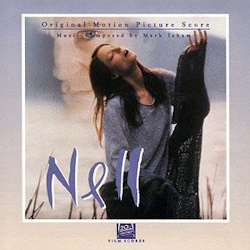 THROWBACK THIRTY
Original Review by Jonathan Broxton
Nell is a fascinating film that explores themes of human connection, individuality, and the boundaries between nature and civilization, which challenges viewers to think about how society treats those who are different and the ethical implications of trying to “help” them. Based on Mark Handley’s 1985 play ‘Idioglossia,’ and directed by Michael Apted, the film stars Jodie Foster in the title role as a young woman who has grown up in isolation in a remote cabin in the Smoky Mountains of North Carolina. When her mother dies, Nell is ‘discovered’ by local doctor Jerome Lovell (Liam Neeson), who finds that Nell apparently speaks her own unique language and has a different way of interacting with the world, which has been shaped by her solitude and her limited human contact. Lovell calls Paula Olsen (Natasha Richardson), a psychologist, for help, and they begin studying Nell to understand her behavior and language. As they spend time with her, they discover that Nell is highly intelligent, emotionally insightful, and capable of connecting with others despite her differences. However, Nell’s presence also raises questions about the ethics of interfering with someone’s life and the societal need to label and categorize people who are different.
I thought Nell was an excellent film, thought provoking and moving; it features a nuanced and sensitive central performance by Jodie Foster, who received a Best Actress Oscar nomination for her work, but unfortunately the idiosyncratic nature of how Foster made Nell move and speak resulted in it becoming prone to parodies and even mockery, which undermined the thoughtful message the film was trying to convey. The film is also notable for being the only time that the then-married couple Liam Neeson and Natasha Richardson worked opposite each other on screen; Richardson sadly died in 2009 of an epidural hematoma, after suffering a head injury while skiing.
 The score for Nell is by composer Mark Isham, who in 1994 was right in the middle of his ‘warm folksy Americana’ period; Nell was preceded by scores like A River Runs Through It and Of Mice and Man, and would be followed by scores like Fly Away Home, The Education of Little Tree, and October Sky. Although of course he wrote other scores in other styles during this period, I have always found that his ‘warm folksy Americana’ oeuvre appealed to me the most, and Nell is one of my favorites from that sub-genre within his filmography.
The main theme for the film is present right from the get-go, and is arranged in the opening cue “Welcome to Robbinsville (Theme from Nell)” as a toe-tapping hoe-down with a catchy beat that perfectly captures the sound of small-town Appalachia and its traditional folk music, with its Irish and Scottish roots. Isham augments his modest orchestra with a small band that includes guitars, fiddles, light percussion, keyboards, and a mountain dulcimer, but interestingly the melody is carried most often by virtuoso Jim Walker’s flutes and pennywhistles, whose lithe sound pierces through everything else. Walker’s flute is the cornerstone of the entire score but, rather than having him perform jaunty melodies, Isham makes his sound part of Nell’s soul; he often makes haunting, ethereal sounds, and sometimes comes across less like a musical instrument and more like someone channeling the wind. His tones perfectly illustrate what an unsettling, mysterious, but oddly beautiful presence Nell herself is when she comes down off the mountain and affects the lives of the townsfolk of Robbinsville.
This moody, mysterious tone continues throughout several subsequent cues, beginning with “The Woman in Gray,” which uses subtle electronic tones and enigmatic plucked strings to create its atmosphere, and continuing on through cues like the soothing and intimate “God Has Led You Here,” the similarly peaceful “A Wild Woman,” and later tracks such as the almost otherworldly “A Trick of Light” and “Twins”. Occasionally, in some of these more ghostly cues, Isham seems to be channeling – or, perhaps in some way, inspiring – the sound that James Horner used in his evocations of nature in scores like The Spitfire Grill
In all of these cues the theme for Nell is ever-present, either directly in obvious statements, or more subtly in Isham’s chord progressions, which follow the structure of the main Nell/Robbinsville theme without fully quoting the melody. “Nell” contains a very slow, thoughtful, deconstructed rendition of the main theme on pipes backed by calming piano textures and soft strings. In “Milly” Isham finally bends to the demand for more poignant emotion and allows a trio of violins to accompany his gorgeously textured writing for flutes and guitars, bringing an extra dimension and depth to the understated orchestrations. “Robbinsville (Reprise)” sees Isham bringing back his excellent country-folk arrangement of the main theme, and then the beautiful “Trees in the Wind” contains elements of the main theme under the flutes, and is suggestive of the magical way Nell communes and is one with her environment.
“Eva’durs” is one of the more intense and dramatic pieces in the score, and sees Isham using a larger brass and percussion sound under his sprightly dulcimers and glassy textures to capture the threat of the increasingly aggressive news media, whose fascination with Nell makes her respond in increasingly agitated and violent ways. A similar sound is present later in “A Glass Wall,” which is a dramatically heightened piece featuring a prominent drumbeat and a stark woodwind take on the underlying ‘Robbinsville’ theme that adds a sense of urgency to the scene of Nell being forcibly institutionalized in a mental hospital by doctors who refuse to understand who she really is.
This is counterbalanced by the sequence from “Thou Art Beautiful O My Love” through to the end of “Makin’ Love,” which sees Isham adopting a more traditionally romantic sound, and again bolstering his Appalachian folk music combo and Walker’s delicate flutes with serene strings playing lush, dreamlike melodies. This is Mark Isham at his loveliest, most appealing best, and although the tone of the music remains slow and poignant, the effect of the music is thoroughly beguiling.
The conclusive pair, comprising “Into Eachother’s Eyes” and “Don’t Weep For Nell,” underscore two key moments in the film’s finale: Lovell and Paula finally confessing their love for each other, and Nell making an impassioned speech – translated by Lovell – in a courtroom hearing intended to determine her competency, and at which she convinces the court to let her return to her mountain home. Isham’s music here is romantic and moving, and again is anchored by Walker’s effortlessly tender flute performances, but the whole thing is also underpinned with a touch of melancholy, especially when Nell is fondly recalling her mother and her late twin sister. It’s wholly compelling, and really lovely, some of the prettiest music Isham had written to date at that point in his career.
Mark Isham was nominated for a Golden Globe Award for Nell in 1995, and it’s not difficult to see why. Nell is a beautiful score, a gorgeous trip through rural Appalachia to meet a unique, unusual, unconventional woman whose deep affection for the place – its trees and woods and mountains – comes out in a series of tender, moving, naturalistic pieces.
Buy the Nell soundtrack from the Movie Music UK Store
Track Listing:
- Welcome to Robbinsville (Theme from Nell) (3:52)
- The Woman in Gray (3:34)
- God Has Led You Here (2:41)
- A Wild Woman (1:57)
- Nell (2:21)
- Milly (1:54)
- Robbinsville (Reprise) (4:22)
- A Trick of Light (4:23)
- Eva’durs (3:03)
- Twins (1:02)
- Trees in the Wind (2:08)
- Thou Art Beautiful O My Love (1:41)
- Swimming and Popcorn (1:38)
- Doana Kee (1:13)
- Hungry for Quietness (1:29)
- Makin’ Love (1:01)
- A Glass Wall (1:59)
- Into Eachother’s Eyes (4:32)
- Don’t Weep For Nell (3:22)
London/Decca 444-818-4 (1994)
Running Time: 48 minutes 12 seconds
Music composed by Mark Isham. Conducted and orchestrated by Ken Kugler. Flute solos performed by Jim Walker. Recorded and mixed by Stephen Krause. Edited by Tom Carlson. Album produced by Mark Isham.

Shop at the Movie Music UK Store

Member of the

 MOVIE MUSIC UK