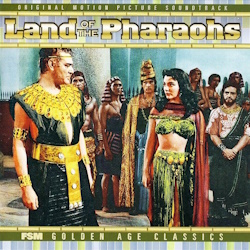
LAND OF THE PHARAOHS – Dimitri Tiomkin
 GREATEST SCORES OF THE TWENTIETH CENTURY
Original Review by Craig Lysy
Director Howard Hawks had long been fascinated by the magnitude of one of the architectural wonders of the world, the Great Pyramid of Giza, as well as its mastermind, the great Pharaoh Khufu. He pitched his idea of filming a grand, and lavish epic that explored this great feat of engineering and secured support from MGM. For Hawks this was a passion project and he decided to personally manage production with a massive $3.15 million budget, which included on site filming in Egypt using Cinemascope and Warner Color. Novelist William Faulkner, Harold Jack Bloom and Harry Kurnitz were hired to write the screenplay, and Hawks would also personally direct. Hawks made the audacious decision to not utilize a top tier star for the film, a decision which most critics believe contributed to the film’s poor reception. The cast would include; Jack Hawkins as Pharaoh Khufu, Joan Collins as Princess Nellifer, Dewey Martin as Senta, and Alex Minotis as Hamar.
The film is set in ancient Egypt during the reign of Pharaoh Khnum Khufu, circa 2589 B.C.E. The pharaoh as a testament of his power, commissions a tomb from architect Vashtar for his passage to the afterlife. This edifice to his power will take the form of an enormous pyramid. As architect with knowledge of the tomb Vashtar is told he will forfeit his life, but in return pharaoh agrees to free his enslaved people. Soon a beautiful Cypriot woman Nellifer arrives, charms pharaoh, offers herself in lieu of tribute, and becomes his second wife. She immediately begins scheming to gain control of Khufu’s treasure and then assume power as regent until she can also eliminate his son and heir Prince Xenon. Hamar, the Lord High Priest foils Nellifer’s treachery by tricking her into presiding over the Pharaoh’s burial service in the pyramid, which ends to her horror with the tomb being sealed and trapping her for eternity. The film was a commercial failure, losing $450,000. Critics panned the film for offering grandiose and lavish pageantry, as a backdrop for a banal screenplay. The film failed to earn any Academy Award nominations.
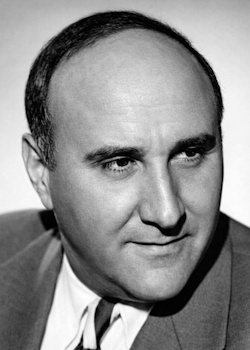
Director Howard Hawks greatly appreciated his three previous collaborations with Dimitri Tiomkin on “Only Angels Have Wings” (1938), “Red River” (1948), and “The Big Sky” (1952), and offered him the scoring assignment. After taking in the film Tiomkin realized with delight that he had an enormous tapestry on which to compose. The pageantry, and ceremony of the royal court, called for fanfares, marches, and processions, while chants and chorale were needed for funereal and religious reasons. There were action scenes and duels, which required kinetic music to animate and propel them, while the enormity, and magnificence of the great pyramid needed its own musical language to convey its grand purpose and legacy. Lastly, Tiomkin understood that it would not be possible to use an authentic ancient Egyptian musical idiom, and so he chose instead to drape his soundscape with exotic orientalism. In terms of the language used in choral and chanting pieces, Tiomkin eschewed established languages, instead creating his own language to evoke a sound one envisioned for ancient Egypt.
 For his soundscape, Tiomkin composed five themes; Pharaoh’s Theme serves as the score’s Main Theme expressed with a classic ABA construct, with the horn orgogliose declared A Phrase offering an emblem of Pharaoh, the living god’s supremacy, power, and divinity, while the B Phrase offers a more lyrical and intimate string borne passage. The theme supports Khufu in both his capacities offering a proud and regal horn declared rendering in formal royal court scenes, processions, and military settings as supreme ruler of Egypt. Yet it also offers a softer, more loving, and tender string and woodwind borne rendering of Khufu in his more intimate capacities of husband to Nailla, father to his son Xenon, and friend of his trusted and dear boyhood companion Hamar. Our beautiful villainess Nellifer is supported by a saxophone seducente, which speaks to her malevolence, covetousness, and alluring seductive sexual power as she brings ruin to both Khufu and her lover Treneh. It is expressed as a string borne romanza, yet expresses a love that is impure, selfish and corrupting. The Melody of Death Theme serves as a secondary motif for Nellifer which supports her heinous assassination of Nailla. It offers a repeating wood flute borne melody expressed like a soft desert breeze, which has a mesmerizing effect on the player and listener, and an alluring effect on cobras. Vashtar, the architect and leader of the indentured Kashites has a paternal quality borne with nobility by a joining of lyrical woodwinds and strings tenero. Kyra, the slave woman saved by Senta is supported by a spritely yet tender narrative born by playful strings and woodwinds animato.
Tiomkin masterfully utilizes chorus to voice several recuring themes; the Song of the Builders supports the workers building the great pyramid. Instructive is how the song over the years has its patriotic fervor and jubilation transformed into an oppressive and aggrieved song of unrelenting toil, woe and despair. The “Funeral Song of Joy” supports the scene where the fallen Egyptian soldiers, are venerated, housed in sarcophaguses, and taken to the Nile River port where ships await to transport them to the City of the Dead. A paean of celebration voiced by mixed chorus supports the procession. “Hymn to the Hero” offers a mixed chorus song of praise on the shore as the ships bearing our heroes set sail. “Funeral Song to a Traitor” offers a grim and grotesque musical narrative of damnation as cowards and deserters are cast into a pit filled with ravenous crocodiles. For the Pharaoh’s funeral scenes there is the “Song of Joy” expressed with jubilation as the people say a last goodbye to Pharaoh. However, once inside the pyramid, the procession of priests with the sarcophagus is supported by a more solemn iteration.
“Main Title” reveals the Warner Brothers studio logo empowered by declarations of Pharaoh’s Theme by horns reale. At 0:11 the display of the opening credits unfolds, draped with exotic desert auras, and supported with reverence by a contralto woman’s vocal with cimbalom adornment. At 0:37 we shift to an impassioned male tenor voice buttressed at 1:01 by strings solenne. At 1:37 we flow into the film proper with the melody taken up by orchestra as Hamar, Lord High Priest of Egypt offers narration of his latest entry in a chronical of Khufu, Pharaoh of Egypt, who has achieved another victory over the latest adversary who would dare challenge the might of Egypt. At 2:11 we segue into “Pharaoh’s Procession”, a magnificent score highlight as we see a massive procession of Egyptian hosts led by the victorious Khufu. The 6:26 minute cue was trimmed to 3:15 minutes due to editing, which shortened the scene. Tiomkin empowers the victorious Pharaoh with both phrases of his theme rendered as a rousing marcia trionfale with ornate and exotic orchestrations. The instrument arrays is varied with each facet of Pharaoh’s army; infantry sword men, spear men, cavalry, generals, and finally Pharaoh himself. At 8:37 we segue into “Pharaoh Walks” with trumpets reale resounding as Pharaoh descends from his palanquin and walks aloof and austerely atop a path of flower petals past people kneeling in adoration. At 9:03 the B Phrase melody shifts to a chorale of sopranos who sing with celebratory adoration as he walks to the royal court. We conclude at 9:15 with the melody shifting and now led by solo flute gentile as Pharaoh is greeted by Hamar, and Queen Nailla.
“Pharaoh and Hamar” reveals Khufu in private quarters, warmly expressing his friendship with his trusted advisor Hamar. They revel in a friendship forged when they were boys. Tiomkin renders the Main Theme without the pomp and regality, transforming its melody into a more tender and warm iteration. After bathing, he summons his wife and Hamar makes a discreet exit. With her entry at 1:11 strings romantico transform the Main Theme into romanza as they embrace in love and Nailla pledges to bear Khufu a son. At 2:17 we segue into “Looking for Vashtar”. He is the leader of the Kashite prisoners and the Egyptian captain offers him food and wine, which he graciously shares with his people. He then accepts Pharaoh’s offer to attend a requiem ceremony for Egyptian soldiers who fell in battle. Tiomkin introduces Vashtar’s Theme borne with warmth, gentility, and humility by a solo English horn tenero and kindred woodwinds. The synergy between the melody and James Robertson Justice’s portrayal of Vashtar is superb. At 3:24 we segue dramatically into “People of Egypt” atop declarations by horns austere as Hamar arrives and praises the fallen. At 3:34 we segue into “Recitative” where Hamar declares to the crowd, “Let the gods of Egypt speak!” From deep within the temple voices offer praise by Osiris, Isis, Anubis, Horus, answered by the crowd’s affirmation of “Amen”. At 4:02 trumpets reale resound in “Pharaoh’s Decree” as Hamar announces the arrival of “The Living god”. Khufu offers praise to the fallen, and bestows burials for all with gold, silver, ivory, alabaster, food and wine so that they may thrive in the afterlife. Tiomkin offers a solemn exposition of Pharaoh’s Theme to support his eulogy.
Following Pharaoh’s departure, we flow into “Funeral Song of Joy” where the fallen, housed in sarcophaguses are taken to the Nile River port where ships await to transport them to the City of the Dead. A paean of celebration voiced by mixed chorus supports the procession. At 0:50 we segue into “Hymn to the Hero” as mixed chorus sing praise on the shore as the ships set sail. At 1:37 the music darkens and a grim and grotesque musical narrative unfolds as we segue into “Funeral Song to a Traitor” where we bear witness to cowards and deserters being cast into a pit filled with ravenous crocodiles. At 2:44 we segue into “Pharaoh’s Spoils” where Khufu revels in the spoils of his victory and declares to Hamar his desire to build an impregnable tomb. Tiomkin supports with an austere rendering of the A Phrase of Pharaoh’s Theme, which plays under the dialogue, some of which was dialed out. Khufu is vexed that each architectural design offered is flawed and he angrily dismisses his architects. Khufu is however pleased when Hamar declares that the architect who cleverly fortified the Kashite city with a design that nearly defeated the Egyptians awaits. At 4:57 Vashtar’s Theme supports his arrival. Khufu commends him on his skills as an architect and reveals his desire for an impregnable tomb, dismissing the flawed models of his architects. A grim musical narrative unfolds as a defiant Vashtar is irreverent and arouses Khufu’s anger. Hamar however intercedes and finds leverage to persuade Vashtar by disclosing that if he does not cooperate, all the Kashite prisoners will be cast into the crocodile pit. Vashtar consents on condition that his people are freed when the pyramid is complete, a condition to which Khufu agrees. At 9:28 we segue into “Breaking Pottery” atop horn declarations of Pharaoh’s Theme by French horns bravura as he and Hamar arrive at the Kashite encampment. Vashtar pitches his idea of using sand to lower massive stones sealing the pathways. Pharaoh is initially dubious and dismissive. Tiomkin chose to support the dialogue driven scene with interplay of Vashtar and Pharaoh’s Themes, but most of the music was dialed out. At 11:29 the score resumes with a stepped descent motif crowned by celebratory horns, which support a demonstration of how sand drainage could lower massive stones to seal the pyramid. Khufu and Hamar are impressed and Vashtar is rewarded and ordered to immediately begin building the pyramid. At 14:00 we segue into “Song of the Builders”, a magnificent score highlight. Pharaoh sends out heralds throughout Egypt calling on the people to join in building Pharaoh’s tomb. They come from all corners of the kingdom and Tiomkin supports with interplay of two chants buttressed by orchestral grandeur that joins religious fervor, patriotism and celebratory joy in an astounding musical passage. The confluence of music, chorus and cinematography is sublime.
In “Song of the Builders” Tiomkin masterfully continues the contrapuntal choral work by purposely using nativist, untrained voices to support the imagery of thousands of peasants and craftsmen working tirelessly on Egypt’s grandest endeavor. The percussive sounds of chisels and hammers are masterfully woven into the joyous musical narrative. Narration supports scenes of massive, 5,000-pound stones being quarried and transported across the desert in humanity’s greatest construction project. At 5:38 we segue into “The Crane” atop dire horns, which support the collapse of a port crane with the massive stone crushing several workers. A grim and frantic musical narrative unfolds as the injured are rescued. At 5:58 the jubilant choral empowered “Song of the Builders” resumes to support a montage of the early years of the pyramid’s construction. We shift forward fifteen years in time at 9:18 to “Slave Hits Drum”. In the intervening years the joy, zeal and patriotism has dissipated, replaced by toil, and oppressive working conditions. Tiomkin supports the scourge of the whip with an oppressive drum empowered musical narrative of woe. At 10:45 we segue into “Treasure”, a cue of ever shifting emotional dynamics as the mercurial Khufu first discusses with his son Xenon his love of gold and desire for these riches to accompany him in the afterlife. Khufu’s Theme is rendered tenderly with paternal affection, and some child-like playfulness. At 11:33 a string borne romanza supports the arrival of Nailla who reminds Khufu that it is past Xenon’s bedtime. The music is tinged with sadness as we see her distraught with Khufu’s obsession with his legacy and place in the after-life. At 12:25 the musical narrative shifts to one of an anger and frustration as Pharaoh lambasts his builders, and even Harman for daring to voice that his expectations are not reasonable. He will not accept their excuses that they lack sufficient workers, that the stones with each new level must be raised ever higher, and that local quarries are depleted, forcing them to transport stones from distant quarries.
“Nellifer” offers a score highlight where Tiomkin masterfully emotes Pharaoh’s conflicted emotions. Pharaoh holds court accepting ambassadors from tributary states bringing him their annual tribute. Nellifer, princess of Cyprus informs Pharaoh that his tribute is excessive, and as such offers herself in lieu of payment. She is irreverent, willful and defiant, which forces Pharaoh to save face by ordering that both she and her man-servant be lashed for their insolence. We see Khufu is conflicted, outraged at her affront and defiance, while sexually attracted to her beauty and irrepressible spirit. We open with heraldic fanfare as Nellifer is announced. Tiomkin offers a musical narrative, which speaks to the conflicted emotions surging in Khufu, entwining an alluring romanza with a solo violin seducente, with fury and anger as he is unaccustomed to anyone, especially a woman, speaking to him in such a manner. Summoned to his chambers, she is unrepentant and remains defiant, saying he must choose her or the tribute. He chooses her by offering a cup of wine, which she drinks with obvious satisfaction. In “Fighting the Bull” narration informs us that Nellifer has become Khufu’s second, and favorite wife. He honors and seeks to impress her by fighting a bull. The cue’s warm, opening with Khufu’s Theme was dialed out of the film. At 0:20 martial drums and fanfare unleash a furious musical narrative as the bull charges and Pharoah, with aid of his servants breaks the bull’s neck. His triumph is declared by celebratory trumpets trionfale. We segue at 1:52 into “Sudanese Dance” as Sudanese dancers entertain Pharaoh and Nellifer with a danza esotica, empowered by a small nativist ensemble.
In “The Vault” the opening 0:00 – 0:42 was edited out of the film with the scene to which it was attached – narration by Hamar expressing his suspicions regarding Nellifer. There is a pervasive sadness in the notes as well as apprehension. Later, at 0:43 Nellifer uses her feminine wiles to induce Khufu to allow her to visit his treasury. Tiomkin supports with an alluring romanza with exquisite orchestral embellishment, including a passage by solo violin d’amore as she marvels at the bountiful amount of gold and jewelry. At 2:17 the music darkens as she requests to see the treasury’s inner sanctum, Khufu’s exclusive domain. He refuses but hen relents, again unable to resist her alluring feminine wiles, promising her a piece of jewelry of her choice. As they enter at 2:32 harp arpeggios and shimmering, ethereal effervescence drapes us in wonderment as Nellifer marvels at glistening treasure that far surpasses that of the outer chamber. At 3:22 the music sours as she dons a magnificent sapphire necklace. Khufu orders her to remove it, but she resists, reminding him of his promise. Khufu is resolute, saying all that is in this room joins him in the afterlife, and again orders her to remove it, which she does grudgingly. Khufu is asked to return to his party and allows Nellifer additional time in his domain. She again dons the necklace and at 3:52 entices Captain Trenah, who is more than captivated by her beauty, to personally remove the necklace. Strings and woodwinds express a musical narrative of seduction as he removes the necklace, and states that he wishes it was his to give. As she departs, she states well it is not yours to give, but her body language reveals she is open to his advances. At 5:05 we segue into “The Quarry” where we behold the ceaseless toiling of weary workers extracting the remaining stones from the soon to be depleted quarry. We shift to the Nile River where ships carry the pyramid’s ornamental stones. Tiomkin transforms the formerly jubilant “Song of the Builders” into an oppressive, unrelenting musical narrative of woe as thousands suffer the scourge building an edifice for Pharaoh’s vanity and ego. At 6:31 we segue into “Secret Meeting” where we see that Nellifer has summoned Trenah in the dark of night to her quarters. Tiomkin supports with a lustful romanza replete with a saxophone seducente as she expresses her loneliness and offers him wine. At 7:47 we segue into “Vashtar’s Home” where Senta, Vashtar’s dutiful son requests that he should rely on him more given his failing eyesight. He resists, but is finally persuaded when Mikka adds his voice in support. Tiomkin supports with a musical narrative, which joins filial love with references to the pyramid emoted by the Main Theme.
“The Priests” reveals Khufu assigning priests, who have had their tongues cut out, to observe and assist Vashtar with the final phase of the tomb’s construction. Tiomkin supports with a grim musical narrative with allusions to the Main Theme. At 1:15 we segue into “Blindfolded”, which reveals Senta being blindfolded as Vashtar guides him into the bowels of the tomb to assist him. Along the way, he has Senta lift his blindfold to remember key junction points in the labyrinth. Tiomkin sow unease, supporting with a foreboding musical narrative with a pervasive Main Theme. At 3:57 we segue into “Toiling” as we see the oppression of thousands of laborers toiling outside the pyramid. Flutter-tongue horns bellicoso empower an oppressive musical narrative of woe. At 4:12 trumpets reale resound to support the arrival of Pharaoh to inspect his tomb. As he descends into the pyramid the music recedes into the background. At 5:03 we segue into “Senta” where Senta oversees the movement of a massive stone that will eventually be used to seal the burial chamber. A lyrical Vashtar’s Theme supports the scene as Vashtar departs to the upper chamber. At 5:32 a slow building tension commences as we see the massive stone being drawn up into a shaft, cresting horrifically at 6:07 as the rope snaps. Tiomkin unleashes a frightful musical passage as the stone smashes down, dislodging a support timber, which falls upon and injures Pharaoh. At 6:26 we shift to a caring, string borne musical narrative, which supports Senta dutifully setting a tourniquet to stop the bleeding from Pharaoh’s leg wound. There is sadness in the notes since to save Pharaoh, Senta must reveal knowledge of the pyramid’s passageways, needed to bring Pharaoh to safety.
“Kyra” reveals Pharaoh expressing his thanks to Senta for saving his life, and granting him anything he desires, with the caveat that when he dies, so too must Senta, like his father so as to safeguard the tomb. They are interrupted by a fight between Nellifer and her servant Kyra, who defies her. Senta saves her from the lash by requested that Pharaoh gift Kyra to him, which outrages Nellifer. Yet Pharaoh is resolute and his will prevails. Music enters and flows as a romanza seducente in the aftermath as the scene shifts to Nellifer’s chambers where she entreats Treneh to conspire with her to murder Nailla so she may solidify her standing as queen. Treneh is wary of embarking on such treachery, yet once again he succumbs to her alluring seduction and embraces her in a lustful kissing embrace. At 1:50 we segue into “Senta and Kyra” where we see her sulking. Yet after Mikka and Senta convince her that she is not their slave, but a member of their house, she comes alive and takes control of the kitchen, requesting several herbs and spices. Tiomkin introduces her spritely theme born by playful strings and woodwinds animato. At 3:14 we segue into “Kyra’s Song”, which ended up on the editing room floor with its scene. It features her vocal of Vashtar’s Theme as a song supported by strings romantico, intended to inform us of Senta and her falling in love. At 5:03 we segue into “Council Chamber” where Treneh sets a trap using a ruse for a tomb laden with treasure. As planned, Pharaoh’s insatiable greed for treasure causes him to go on a five-day trip away from the capital. Fanfare reale supports Treneh arrival at the throne room. A lyrical, yet alluring rendering of the Main Theme supports Treneh’s storytelling and ruse. At 6:26 a martial and pompous declaration of Pharaoh’s Theme resounds and empowers his expedition’s departure.
“Melody of Death” reveals Nellifer presenting Xenon with a ‘magic flute’, which delights him. She plays the melody twice with Xenon watching intently. A scene shift at 0:30 reveals Nabuna and Treneh witnessing a reprise of the flute melody being used by a snake charmer to arouse a cobra. Later that night Xenon reprises the flute melody with Nabuna releasing the cobra, which enters through the balcony. Naila sees the cobra and flings herself upon it to save Xenon. We flow into “Melody of Death” as Treneh departs Nellifer’s quarters to respond to the queen’s scream. The flute’s melody is rendered in lurking form as Hamar’s suspicions are aroused when he is informed of the queen’s death, and the fact that it was Nellifer who gifted the prince the flute. At 2:13 we segue into “Pharaoh’s Tent in the Desert” where Nellifer implements the diabolical phase two of her plan, ordering Nabuna to ride to Pharaoh’s encampment and assassinate him, which will pave the way for her to ascend to the throne. Tiomkin offers great pathos by supporting the Pharaoh’s grief with the Melody of Death Theme borne by strings affanato when he receives the devastating news of Nailla’s death. At 3:02 an textural agitato unfolds as Nabuna makes a stealth approach to Pharaoh’s tent. He sneaks in and the music surges with savagery as he stabs him superficially, but then succumbs to Pharaoh’s mortal dagger thrust. Anguish follows as Pharaoh alerts the guards and is stunned to discover that the assassin is Nabuna, Nellifer’s servant. He now suspects her and orders his wound bound, and an immediate nighttime departure to Luxor. At 4:19 we shift to Nellifer’s quarters where she and Treneh join in a celebratory kissing embrace, confident that they have succeeded as he gifts her the sapphire necklace she has always coveted. A seductive, yet perverse rendering of the Melody of Death Theme empowers a malignant musical narrative. At 5:51 we segue into “Camel Caravan”, which supports Pharaoh as his brigade rides into Luxor. A strident and martial march swells on a crescendo irato to support Pharaoh’s fury and walk to Nellifer’s chamber. He enters without their knowledge and hears her ordering Treneh to leave as he must not be found here. At 6:46 a diminuendo of fear supports Nellifer discovering blood droplets on the floor as Pharaoh hides behind a column. To save herself, she berates Treneh for daring to come to her quarters, calling for Pharaoh’s wrath to be visited upon him. Pharaoh falls for her ruse and his anger cannot be assuaged. At 7:48 we segue into “The Duel” with Tiomkin supporting with a violent musical narrative. Treneh mortally wounds Pharaoh but as he moves in for the kill he is impaled by Pharaoh’s spear-like throw of his sword. At 9:14 we segue into “Treneh’s Death” as Pharaoh commands Nellifer to summon Hamar immediately. A beleaguered Pharaoh’s Theme, which is steadily weakening as life drains from him joins with interplay of Nellifer’s malignant Theme as she walks toward him gloating. At 11:45 a horrific crescendo furioso erupts when he sees the necklace around her neck, which confirms her complicity. She now admits with contempt her role, and as he summons his last strength to reach her, he succumbs at 12:37 to blood loss and falls dead. A funereal gong marks Pharaoh’s passing (not on the album).
“Kyra” reveals Mikka informing Vashtar, Senta and Kyra of Pharaoh’s death. Vashtar says that their lives will continue for a short time as the tomb is nearly finished. Tiomkin offers sad interplay of Vashtar’s and the Main Theme to support the scene. At 1:23 we segue into “Land of the Pharaohs” where Harmar consoles the young prince. The Main Theme is rendered solemnly a capella as a threnody. At 2:02 the melody is buttressed orchestrally to support Nellifer’s arrival. At 2:12 we segue into “Nellifer’s Wish” where she commands that she be taken to Pharaoh’s treasure room, which Hamar accommodates empowered by a grand statement of the Main Theme. As they travel there a textural, otherworldly musical narrative borne by vibraphone with harp adornment unfolds. She finds the room empty and is outraged. Hamar informs her that Pharaoh’s treasure has been moved to his tomb. He then adds that she must preside over the burial ceremony before she can rule Egypt as queen.
“Chess Game” reveals Vashtar informing Senta, Kyra and Mikka that he and Senta will most likely be sealed in the tomb with Hamar as Pharaoh decreed. Kyra is distraught and runs out carried by an anguished Vashtar’s Theme, followed by Senta, who comforts her. At 0:29 we segue into “Hamar’s Gift”, which was dialed out of the film. It was intended to support Hamar thanking Vashtar for his efforts and agreeing to free Vashtar, Senta and the Kashites from captivity, believing the tomb impregnable. Tiomkin supported the scene with a wistful rendering of the Main Theme, crowned by a triumphant Vashtar Theme. At 2:17 we segue into “Nellifer the Queen” atop horns malevole as Hamar bids farewell to Pharaoh to the crowd. Hamar sets his trap supported by a dire and portentous musical narrative by eliciting Nellifer to publicly agree to oversee Pharaoh’s burial according to Egyptian religious traditions and law. At 3:22 a film-album variance occurs. The album presents a solemn choral rendering of the Main Theme to support the travel of Pharaoh’s sarcophagus to the pyramid. In the film version we open with a jubilant choral version of the funereal “Song of Joy”, which then shifts midway to the more solemn choral version as we see the procession traveling through the tomb’s passageways. The sarcophagus is placed in its granite enclosure and Hamar advises that burial can only proceed on her order. At 4:59 we segue into Sealing the Tomb”, an astounding score highlight where music, acting and cinematography achieve a confluence for the ages. An imperious “Nellifer commands Hamar to initiate the burial and two sand valves are struck which drain out sand allowing a massive stone lid to descend and seal Pharaoh’s sarcophagus. What Hamar did not disclose to Nellifer was that these two valves trigger a cascade of valves throughout the pyramid that cause every passageway to be sealed by massive stones, which trap all of them in a now sealed tomb for eternity. Anvil strikes, swirling strings, and resounding horns of alarm empower a last dramatic statement of Pharaoh’s Theme. At 5:54 chorus transforms Pharaoh’s Theme into a dirge as sand flows into the chamber, which elicits Nellifer to ask Hamar what is happening. He rebukes her for her scheming and murder, declaring that she will be sealed with them, her new kingdom to rule for eternity. She panics, tries to flee, but it is too late. Tiomkin unleashes the retributive fury of his orchestra, a strident, blaring, and dissonant tempest as Nellifer begs Hamar to save her as she does not want to die. The musical synchrony with the cascading descent and locking of the massive stones is outstanding, crowned with a final choral empowered declaration of Pharaoh’s Theme, which dissipates into nothingness as a distraught Nellifer collapses. At 8:01 we segue into “End Title” where we see Vashtar and Senta leading the Kashites back home, taking one last look of a massive tomb built for a single man’s vanity. A solemn choral empowered and thankful rendering of the Main Theme brings the film to closure.
I would like to thank Lukas Kendall for this wonderful premiere two CD album release of Dimitri Tiomkin’s score “Land of the Pharaohs”. Although the score was recorded in stereo, the masters were lost and the technical team needed to use the monaural dub-downs stored in Warner Brothers vault. Since Tiomkin used several instrumental overlays, the technical team was able with mixing and mastering to provide a rudimentary stereo effect. Although 21st century audio quality was not achieved, I believe the magnificence of Tiomkin’s score shines through. Tiomkin was presented with a massive tapestry, which told the story of the oldest of the Seven Wonders of the Ancient world, and perhaps the greatest architectural feat in human history. Against this backdrop was the personal narrative of Pharaoh Khufu who commissioned a grand edifice to satisfy his ego and vanity, as well as the narrative of Nellifer whose beauty, covetousness and malevolence brought ruin to all. Pharaoh’s Theme, offers a proud, regal and imperious anthem for Khufu in his capacity of living god, ruler of Egypt and supreme commander of the Egyptian army. It was brilliantly conceived, and wonderfully malleable, allowing a multiplicity of iterations; regal, martial, loving and choral. Our villainess Nellifer perfectly embodied her alluring beauty, covetousness, evil, and seductive sexual power. Several songs, chants and hymns masterfully enriched and empowered the film’s musical narrative. Folks, I believe Tiomkin composed a classic Hollywood ancient epic score, which brought ancient Egypt alive. In my judgement his music in every way enhanced its film, providing grandeur and inspiring storytelling, which I believe allowed director Howard Hawks to achieve his vision. I highly recommend you purchase this quality album, which I believe to be a gem of the Golden Age.
For those of you unfamiliar with the score, I have embedded a YouTube link to a wonderful fifteen-minute suite; https://www.youtube.com/watch?v=yJVpIZOHiNQ
Buy the Land of the Pharaohs soundtrack from the Movie Music UK Store
Track Listing:
- Main Title/Pharaoh’s Procession/Pharaoh Walks (10:38)
- Pharaoh and Hamar/Looking for Vashtar/People of Egypt/Recitative/Pharaoh’s Decree (5:51)
- Funeral Song of Joy/Hymn to the Hero/Funeral Song to a Traitor/Pharaoh’s Spoils/Breaking Pottery/Song of the Builders (16:39)
- Song of the Builders/The Crane/Song of the Builders/Slave Hits Drum/Treasure (13:44)
- Nellifer (5:13)
- Fighting the Bull/Sudanese Dance (3:42)
- The Vault/The Quarry/Secret Meeting/Vashtar’s Home (9:57)
- The Priests/Blindfolded/Toiling/Senta (8:10)
- Kyra/Senta and Kyra/Kyra’s Song/Council Chamber (7:05)
- Melody of Death (1:25)
- Melody of Death/Pharaoh’s Tent in the Desert/Camel Caravan/The Duel/Treneh’s Death (12:54)
- Kyra/Land of the Pharaohs/Nellifer’s Wish (4:18)
- Chess Game/Nellifer the Queen/Sealing the Tomb/End Title (8:59)
6-10 bonus tracks: - Land of the Pharaohs (Instrumental) (2:33) BONUS
- Land of the Pharaohs (Vocal) (2:16) BONUS
- Council Chamber (Alternate) (2:01) BONUS
- Melody of Death (Continuation) (1:12) BONUS
- 15M2 Alternate (1:00) BONUS
Film Score Monthly FSM Vol. 10 No. 17 (1955/2008)
Running Time: 117 minutes 37 seconds
Music composed and conducted by Dimitri Tiomkin. Orchestrations by Manuel Emmanuel, P.A. Marquardt, George Parrish, Herb Taylor, Lucien Cailliet, Leonard Raab and Frank Comstock . Recorded and mixed by XXXX. Score produced by Dimitri Tiomkin. Album produced by Lukas Kendall.
Leave a comment

Shop at the Movie Music UK Store

Member of the

 MOVIE MUSIC UK
ROSE BY ANY OTHER NAME