HERE – Alan Silvestri
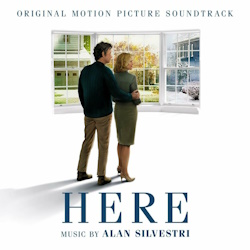 Original Review by Jonathan Broxton
Here is a cinematic experiment film directed by Robert Zemeckis, adapted from a graphic novel by Richard McGuire, which uses the ‘static camera’ conceit to tell the story of a specific place throughout time – from the era of the dinosaurs through the ice age, to the dawn of humanity, pre-Columbian native Americans, and then after a house is built on that spot, the different families who live there, from the Colonial era to the present day. The main story follows the Young family – WWII veteran Al and his wife Rose, who buy the house and raise their children there, one of whom, Richard, marries his childhood sweetheart Margaret, and lives there too. It’s an intimate, sensitive portrayal, a snapshot of vignettes that chart the passage of time in non-linear fashion, and which touches on all that comes with it – birth, death, and all the ups and downs of life in between. Some critics have decried at as being overly-sentimental and mawkish, and while I admit that it does go for the emotional jugular with unashamed regularity, I nevertheless thought it was lovely, a welcome escape from depressing reality. I also thought the main technical idea, where the camera never moves but the world moves around it, worked really well; the way Zemeckis uses overlapping boxes to delineate the shifts in time were especially effective.
Here marks the cinematic reunion of director Zemeckis, screenwriter Eric Roth, cinematographer Don Burgess, and lead actors Tom Hanks and Robin Wright, working together the first time since Forrest Gump thirty years ago. Hanks and Wright play Richard and Margaret from their teenage years in the 1950s right up until modern day, and Zemeckis’s use of de-ageing technology is excellent and wholly convincing. Richard’s parents are played by Paul Bettany and Kelly Reilly, and both are impressive as a WWII veteran driven to alcoholism by his experiences, and his long-suffering wife, respectively. Other cast members include Michelle Dockery and Gwilym Lee as a Victorian-era couple experiencing the dawn of aviation, David Fynn and Ophelia Lovibond as the inventor of the La-Z-Boy recliner and his former pin-up model wife, and Daniel Betts as the illegitimate son of American founding father Benjamin Franklin. Although it never comes close to recapturing his late-80s/early 90s heyday, for me Here is probably Zemeckis’s best film since The Polar Express back in 2004.
 One other member of the Forrest Gump team to return is composer Alan Silvestri, who has scored every one of Zemeckis’s films since Romancing the Stone in 1984; this is their 20th collaboration overall. Silvestri has been taking a well-earned career break over the last few years, specifically since his part of the Avengers saga ended, only emerging from his vineyard to work on Zemeckis’s films The Witches in 2020 and Pinocchio in 2022. As such, every new Silvestri score is a major event, and Here is no exception. It’s a classic Silvestri score in every sense of the word; stylistically, it is a throwback to his mid-1990s Golden period, and offers a combination of the beautiful intimate themes from scores like Forrest Gump, alongside some of the bold and exciting action sequences from scores like Judge Dredd. I also noted a slight hint of Rachel Portman in the way Silvestri uses pianos and oboes, which led me to wonder whether something like The Cider House Rules might have been used in the temp track, but either way it’s brilliant. All tolled, this is easily my favorite Silvestri score since Ready Player One and the Avengers in 2018-19.
It is a score of two halves. Initially, the score focuses on the emotional lives of the Young family and the various other families who live in the home, and to accentuate their stories Silvestri has crafted several themes, all of which use a similar sound palette comprising a traditional symphony orchestra, augmented by prominent piano solos and acoustic guitars. There are different melodies that run through the score, but other than an identifiable main theme for the Young family, Silvestri never really differentiates musically between the different families: as far as I can tell the Franklins don’t have a specific theme, the Harters don’t have a specific theme, and the Beekmans don’t have a specific theme. Instead, Silvestri seems to have taken a ‘whole score’ approach, assigning different thematic ideas and instrumental textures to specific overarching emotions and concepts – romance, humor, anger, birth, death, and so on, and building them up until they create a musical collage of the entire human experience.
The beautiful main Young Family theme is first heard in the “Opening,” a gorgeous long-lined melody based around a piano, backed by gentle strings, plucked harps, and soft oboe accents. The score’s second major theme – which I’m calling the Home Theme, because it tends to accompany moments of significant emotional weight related to something that has happened in the house – kicks in for the first time with a swell of the strings at 0:46, before quickly switching back to the Young Family theme to end the piece. This is really the prototype for the rest of the score; almost every cue thereafter features one or more performances of either the Young Family theme, the Home theme, or both, with subtle changes to the orchestration and the emotional resonance as the scene demands.
There is a sense of curiousness to the pretty piano chords that open “Why Am I Here,” which then grow to encompass some gorgeous magical textures for harp and oboe. “This is Here” contains an especially warm and sweeping statement of the Home Theme with a notably lovely horn countermelody under the strings, and later some soft choral accents. There is a sense of mournful darkness and helplessness in “God Help Me,” and then throughout both “I Think She’s Going To Leave Me” and “Sell the House” Silvestri offers a series of baleful deconstructed variations on the Young Family theme to musically illustrate the sad breakdown of Richard and Margaret’s marriage. There is some notably expressive writing for solo oboe, solo violin, and solo cello here that is just heartbreaking, and when he allows his music to reprise the main theme more fully in “I’m Going to Sell the House” the effect is outstanding.
One of the few moments of specificity comes during “Necklace of Shells,” which underscores the lovely romance between two members of the Lenni Lenape tribe who lived in the spot where the house was built several hundred years previously, and which Silvestri highlights through some exquisite, slightly melancholy textures which pass between different parts of the woodwind section, backed by light strings and metallic percussion. In addition, Silvestri uses a set of specific period textures – fiddles, pennywhistles, and guitars, alongside the regular orchestra – in cues like “This is Here” to add a touch of authenticity to the scenes involving William Franklin and his exploits in the earliest parts of the Revolutionary War.
At the other end of the scale, Silvestri wrote a trio of outstanding action sequences that draw on the enormous sound he used in scores like Judge Dredd, as well as later works like The Mummy Returns, Van Helsing, the action parts of The Polar Express, and some of his Marvel/Avengers work. The cues “Extinction,” “Mammoth,” and “The Great Flood” (the latter of which does not appear in the film, and was likely written for a deleted scene) all accompany scenes set during different prehistoric eras, and see dinosaurs contending with a meteorite-driven extinction event, and then primitive humans on a mammoth hunt. This music is very different from everything else in the rest of the score, but it’s also wholly Silvestri; the rambunctious string runs, the powerful explosions of brass, the driving percussion rhythms, the soaring choral accents, the unexpected moments of dissonance in “The Great Flood,” are all just magnificent. Even here, Silvestri still finds ways to bring in chord progressions and little thematic nuggets from his main themes, such as the big brass performance of the Home Theme at the beginning of “Mammoth.” It’s so impressive, and I never get tired of hearing Silvestri in this epic mode.
The score ends with a magnificent 11-minute finale comprising “I Love It Here” and the “End Credits”. The former cue underscores the film’s last scene of an elderly Richard and Margaret – the latter of whom is suffering from dementia – visiting their former home at an open house. Margaret has a rare moment of lucidity and remembers that Vanessa, their daughter, lost a ribbon from school down the back of the sofa, and this triggers a flood of good memories of their life there together. Here, finally, Zemeckis’s camera moves from its fixed spot and explores the space around Richard and Margaret, revealing hitherto-unseen parts of the house, before exiting through the window and panning up to show the whole building, and then the town in which they live. Silvestri responds to this with several staggeringly beautiful reprises of both main themes for the fullest orchestra, wringing every drop of possible emotion from it all. I don’t mind admitting that I burst into tears at the 2:00 mark, with that cymbal clash and that spectacular trumpet countermelody – film music at its absolute finest. The “End Credits” then offers a stunning 8½ minute reprise of all the score’s main ideas for the full orchestra and various soloists, including both main themes, the ‘Revolutionary War’ variant, the Native American variant, and even a brief burst of the ‘Extinction’ action music.
Some listeners may be dismayed at the fact that the score for Here is only around 40 minutes long, but in truth that’s pretty much everything in the film – as he did with Forrest Gump, Zemeckis also makes judicious use of numerous period rock and pop songs at key moments to underline the different time periods, and there are also long sequences of film where there is actually very little music. I actually appreciated this in context – Zemeckis and Silvestri clearly spotted the film carefully, which resulted in the score having a great deal of impact when it does raise its voice.
I really cannot recommend Here strongly enough, especially to anyone who has ever been drawn to Alan Silvestri’s most overtly warm and emotional writing. It’s so refreshing, and so pleasing, to hear film music in a current movie which isn’t afraid to accentuate and enhance a film’s drama and emotion with music that is equally dramatic and emotional – so much so that I wanted to stand up and cheer at the end of the film. There used to be a time, thirty years or more ago, when this type of scoring was the norm, and I long for it to be so again. Certain sections of the entertainment media – and, I’m sure, some audiences too – will rip into this score for being maudlin, saccharine, overly-manipulative, whatever else, but I don’t care. Scores like Here are perfect examples of the type of film music I love the most, and I will celebrate them here for as long as I can, as loudly as I can.
Buy the Here soundtrack from the Movie Music UK Store
Track Listing:
- Opening (1:44)
- Why Am I Here? (2:32)
- Extinction (2:09)
- This is Here (3:45)
- Necklace of Shells (1:32)
- Mammoth (1:41)
- Circle of Life (2:13)
- God Help Me (1:55)
- The Necklace (1:30)
- I Think She’s Going To Leave Me (1:28)
- Sell the House (2:51)
- The Great Flood (3:17)
- I’m Going to Sell the House (2:12)
- I Love It Here (2:43)
- End Credits (8:31)
Sony Music (2024)
Running Time: 39 minutes 54 seconds
Music composed and conducted by Alan Silvestri. Orchestrations by Stephen Graham. Recorded and mixed by Peter Cobbin and Dennis Sands. Edited by Jeff Carson, Charles Martin Inoue and Stephen Durkee. Album produced by Alan Silvestri.
Leave a comment

Shop at the Movie Music UK Store

Member of the

 MOVIE MUSIC UK
Can anyone tell me why there is no cd release HERE?
Because virtually no soundtracks get CD releases any more. The market has changed, and there’s not enough demand for it, so financially it makes no sense to do that.
Better sound, booklet, physical copy and still not enough demand. Where are the filmmusic collectors?