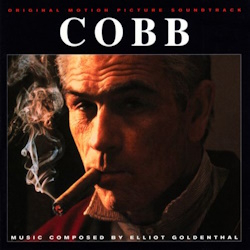
COBB – Elliot Goldenthal
 THROWBACK THIRTY
Original Review by Jonathan Broxton
Growing up in the United Kingdom, baseball was never a sport that was ever on my radar, but even with my limited knowledge of its history there were still some names which transcended and were familiar as icons of the game: Babe Ruth. Lou Gehrig. Joe Di Maggio. One of the most controversial players of that era was another familiar name: Ty Cobb, who played for the Detroit Tigers between 1906 and 1926 and was one of the first people inducted into the Baseball Hall of Fame when it was first established in 1936. By all accounts he was a mercurial player, with especially incredible batting ability, aggressiveness, and mental toughness; such was his prodigiousness he held the record for the highest career batting average for almost 100 years until 2024, when MLB decided to include players from the Negro League in official statistics, and he was overtaken by Josh Gibson.
Ron Shelton’s film Cobb tells the great man’s life story via a narrative device which explores the relationship between Cobb and sportswriter Al Stump, who ghostwrote Cobb’s autobiography over several months prior to Cobb’s death in 1961. In it, Cobb is portrayed not as a typical sports hero but as a deeply flawed and complex figure – volatile, often cruel, and troubled by his own demons – and shows how Stump struggles with the difficult task of capturing Cobb’s legacy, grappling with the question of how much of Cobb’s dark side to reveal to the public. The film starred Tommy Lee Jones and Robert Wuhl as Cobb and Stump, and while many critics lauded Jones’s performance especially, it was something of a box office flop, grossing a little over $1 million.
The score for Cobb was by composer Elliot Goldenthal, who by the end of 1994 had firmly established himself as a leading member of film music’s best young composers of the decade. He had written for box office successes like Alien 3 and Demolition Man in the previous couple of years, and would earn his first Oscar nomination, for Interview With the Vampire, the following spring. Ron Shelton’s unusual dramatic approach to his depiction of Cobb allowed Goldenthal to draw on several different musical styles, some of which were completely new aspects to his oeuvre at that time.
 To capture Cobb’s difficult and challenging personality Goldenthal wrote some incredibly aggressive scherzos, but then tempered those with some warmer and more nostalgic evocations of baseball, Cobb’s love for the sport, and the pastoral Americana sound that one often associates with the game’s glory days. In addition, Goldenthal drew on several music styles specific to the time period and to particular aspects of geography, including vintage jazz, and some hymns from America’s Deep South that acknowledge Cobb’s Georgia roots.
As is always the case, Goldenthal’s music is intensely intellectual and boldly dramatic, offering a captivating commentary on the personalities of both Cobb and Stump, but it is also compositionally fascinating and challenging, as he often allows the different aspects of the score to combine in ways that could seem abrasive to anyone not used to his wholly individual approaches to film music. These seemingly schizophrenic collisions of sound are intentional in that they seek to convey the contradictions at the heart of who Ty Cobb was, both as an athlete, and as a person.
The first main theme is the Baseball Theme, a warm and wholesome trumpet theme layered over a bank of appealing strings, which seeks to capture the nostalgic appeal of America’s pastime. The theme is clearly inspired by Aaron Copland’s approach to the sound, but even here Goldenthal finds ways to turn the whole thing on its head and offer a touch of darkness via occasional shifts to minor keys, and unusual instrumental phrasing that occasionally recalls the more tonal moments of Alien 3. The first appearance of the theme comes in the opening “Variations on an Old Baptist Hymn,” which starts out with Goldenthal himself growling the lyrics of the hymn in question with a fire-and-brimstone energy, before the whole thing melts into the first proper performance of the theme. The theme continues to assert its influence in the subsequent “Stump Meets Cobb,” where Goldenthal offsets the warmth of the brass theme with a bank of scampering classical string figures that foreshadow the nervous, confrontational relationship between the two men, and which again have a touch of Alien 3 about them.
Related to the Baseball theme are what I’m calling the ‘Americana Strings,’ which here specifically relate to the Baseball Hall of Fame in Cooperstown, New York, and Cobb’s personal obsession with being inducted into it. In the two “Cooperstown Aria” cues Goldenthal lays heavily into a tragic and deeply melancholy string-based sound that speaks to that side of Cobb’s personality; it’s some of the most gorgeously moving music of Goldenthal’s career to that point, and it is made all the more affective by the way he adds a twist of torturedness – is that a word? – to the phrasing of them.
However, for me, the best parts of the score come when Goldenthal unleashes his main theme for Cobb himself which, rather than celebrating his baseball career and his excellence as an athlete, examines the volatility and dangerousness of the man himself. The two “Reno Ho” cues are simply sensational, unrestrained explosions of power and energy, full of enormous banks of thrusting strings, propulsive percussion, and his trademark howling brass section with special emphasis on screaming trombones. It’s utterly fantastic – it builds on the sound he first explored in the action parts of Alien 3 and Demolition Man, while foreshadowing some of the best parts of later scores like Interview With the Vampire, Final Fantasy, Titus, and others. These moments where Goldenthal just lets rip with all the orchestral forces at his disposal never cease to thrill me. This theme portrays Cobb as an intimidating and unstoppable force of nature, prone to violence and anger, and as a musical depiction of that side of his personality it’s utterly compelling.
A subsequent variation on this sound can be heard later in the “Sour Mash Scherzo,” which is a little bit more understated and has a little more focus on strings over brass, but it’s still intensely captivating – sour mash whiskey was Cobb’s drink of choice, and woe betide anyone who got in his way when he was under its influence. Those throaty growls in “The Baptism” are brilliant too.
The final piece of the Cobb puzzle are the authentic pieces of period jazz that Goldenthal wrote to capture the time and atmosphere of Cobb’s heyday. Two of them – “Nevada Nightlight” and “Meant Monk” – are outstanding, straightforward pastiches of classic nightclub jazz, smoky and romantic and just a little bit sleazy, which is just perfect. Goldenthal uses saxophones, pianos, plucked bass, and brushed percussion to conjure up the atmosphere, and the latter cue especially has some stylistic hat tips to the great Theolonious Monk that are excellent. Goldenthal is underrated as a jazz composer, and I might have liked to have seen him be given the opportunity to write more music like this over the years. Meanwhile, “Newsreel Mirror” and “Georgia Peach Rag” are stylistic collisions which blend the jazz sound with an intentionally grating and dissonant orchestral palette which recalls some of the more abstract horror writing on scores like Pet Sematary and Alien 3. They are harsh and difficult, but fascinating, yet another delve into the darker corners of Ty Cobb’s psyche.
The finale of the score – which underscore the scenes of Cobb achieving his lifelong dream of being inducted into the Hall of Fame in 1939, and then his death from diabetes in 1961 aged 74 – see Goldenthal returning to both the Baseball Theme and the Americana Strings for one final exploration of the style. Goldenthal isn’t usually one to give into sentimentality, but he comes close to doing just that during “The Homecoming”. You can feel the emotion in the music here, which swoons and sighs for over six minutes, a beautiful series of gorgeous harmonic textures and rich, luxurious chords which effortlessly alternate between major and minor keys, and even feature some vaguely Horner-esque passages for high woodwinds. Similarly, “Cobb Dies” reprises the Baseball theme with a sense of nostalgic warmth twinged with pathos, and has an unexpected militaristic sound to the phrasing of the brass, a last call for an old warrior of the ballpark.
Also included on the soundtrack album is a direct lift from the Alien 3 score via the “Beast Within” cue, which was tracked into the final cut by director Shelton, and then a performance of “The Ball Game” by the pioneering Gospel and early R&B singer Sister Wynona Carr, whose sensual, husky vocals and double-entendre laden lyrics give the song an unexpectedly alluring sound.
Cobb is a brilliant score, the sound of which is wholly unexpected considering the nature of the film and the type of music that often accompanies sports-related biopics. With this score Elliot Goldenthal picks at the layers of who Ty Cobb was: an undisputed genius on the baseball diamond, a legendary slugger whose records stood for a century, a man who loved the sport deeply, but was also a violent, self-obsessed, belligerent racist who alienated many of the people who tried to help him and – as this movie claims – was difficult to work with during the writing of his autobiography. All these aspects come together in a piece of music which is simultaneously celebratory and critical, warm and nostalgic, but also at times viciously aggressive. Coming to terms with all this in the context of Goldenthal’s own challenging musical style is necessary to appreciate Cobb, but those who do will find it to be endlessly rewarding, even if you’re not a fan of the sport.
Buy the Cobb soundtrack from the Movie Music UK Store
Track Listing:
- Variations on an Old Baptist Hymn (3:05)
- Stump Meets Cobb (1:50)
- Cooperstown Aria Part I (1:43)
- Nevada Nightlife (2:28)
- Reno Ho! Part I (2:37)
- Newsreel Mirror (3:26)
- Meant Monk (2:17)
- Cooperstown Aria Part II (2:00)
- Winter Walk (1:11)
- Hart and Hunter (1:16)
- Georgia Peach Rag (2:29)
- The Baptism (1:30)
- Reno Ho! Part II (2:35)
- The Homecoming (6:18)
- Sour Mash Scherzo (1:09)
- Cobb Dies (1:49)
- The Beast Within (from Alien 3) (2:24)
- The Ball Game (written and performed by Sister Wynona Carr) (3:05)
Sony Classical SK 66923 (1994)
Running Time: 43 minutes 12 seconds
Music composed by Elliot Goldenthal. Conducted by Jonathan Sheffer. Orchestrations by Elliot Goldenthal and Robert Elhai. Recorded and mixed by Joel Iwataki. Edited by Daniel Carlin and Todd Kasow. Album produced by Elliot Goldenthal, Matthias Gohl and Richard Martines.

Shop at the Movie Music UK Store

Member of the

 MOVIE MUSIC UK