MONSTER SUMMER – Frederik Wiedmann
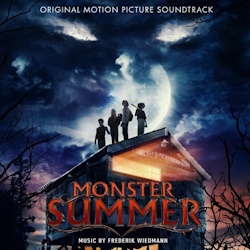 Original Review by Jonathan Broxton
Monster Summer is a lighthearted yet spooky Halloween movie for kids, written by Cornelius Uliano and Bryan Schulz, and directed by former child actor David Henrie from Wizards of Waverly Place. The story is set in the 1990s on the island of Martha’s Vineyard, and stars Mason Thames as Noah, a local teen with dreams of becoming an investigative journalist. Noah’s chance at a big story comes when he notices that local children are mysteriously vanishing, only for them to reappear the next day in a catatonic state. His main suspect is Miss Halverson (Lorraine Bracco), a mysterious elderly woman who recently moved into his mother’s boarding house and shows all the classic signs of being a witch; with the help of his friends and a retired, reclusive police detective (Mel Gibson), Noah embarks on a quest to uncover the truth.
The score for Monster Summer is by the Los Angeles-based German composer Frederik Wiedmann, who has been enjoying an outstanding couple of years through his scores for TV shows like The Dragon Prince, Star Trek: Picard, and Batman: Caped Crusader, as well as several films in the DC Animated Movie Universe. His purple patch continues here with this score; it’s a classic children’s adventure score with horror undertones, thematic and melodic, a superbly evocative throwback to several classic orchestral scores from decades past. 1980s and 90s nostalgia is having a boom right now, driven mostly by TV shows like Stranger Things, as the children of that era are becoming filmmakers in their own right and want to recapture the films they loved as a child, but whereas the score for Stranger Things is evoking the synth tones of a John Carpenter or a Tangerine Dream, Wiedmann’s work here is more in world of an Alan Silvestri, or a John Debney, with a splash of Bruce Broughton, and a nugget of early James Horner.
 The score was recorded with two orchestras – one in Glasgow, Scotland, and one in Bratislava, Slovakia – and is built around four main recurring themes: one for the young protagonist Noah, one for the mystery at the heart of the story, a ‘friendship theme’ representing Noah and his comrades, and one for the Witch whose nefarious presence lurks over the whole story.
Noah’s Theme is unexpectedly emotional and melancholic, a gorgeous and haunting solo cello motif backed by moody strings and a tender piano part. It gets its fullest statement in the eponymous “Noah’s Theme,” enjoys a brief reprise in “All Alone,” and forms a major part of the finale through cues like “Strange Things,” the pensive and determined “Treehouse Meeting,” “The Haunting,” and “Goodbyes,” before appearing in a more optimistic variation in the conclusive “Redemption”. Despite it being absent for most of the first part of the album, to me this theme is the emotional heart of the score, and it really showcases Wiedmann’s under-appreciated talent for crafting moments of real, deep, effective beauty.
Instead, most of the first half of the score is dominated by the Witch Theme and the Mystery Theme, both of which quickly establish themselves as the drivers for the film’s narrative from the get go, as they both appear in the “Main Title”. The Witch Theme is the very first thing you hear, and it actually contains two elements which can be played consecutively or independently of each other: there is a short bassy Jaws-like motif which represents the overarching ‘lurking presence’ of the witch, and then a longer and more full-bodied string-led melody full of darkness and malevolence. Meanwhile, the Mystery Theme (which first appears at 0:53 in the “Main Title”) drips with moody Gothic romance, but is underpinned with a sense of curiosity, perfect for Noah and his band of inquisitive young detectives.
There are numerous excellent reprises of both these themes throughout the score, but what I really like is how Wiedmann has embedded them into the fabric of some really quite impressive moments of suspenseful orchestral horror and action. Cues like “Deep in the Forest,” “Dark Encounters,” “The Monster Returns,” “Strange Things” and “The Haunting” really raise the stakes in terms of horror music with some aggressive string rhythms, including extended sequences of pizzicato and col legno slaps, as well as eerily abstract textures that perfectly capture the atmosphere of the piece. Some of these cues briefly incorporate some electronic percussion and synth textures to beef up the bass, but it’s not to the detriment of the score as a whole.
Elsewhere, the second half of “Night Swim” is tremendously exciting with some notably powerful brass. The back and forth between the two themes in “Following the Clues” is wonderfully moody and ominous, but is also underpinned with a determination and sense of purpose. Later, the Mystery Theme appears in a darkly romantic variation in “The Trace of a Monster”.
A minor motif representing Mel Gibson’s character Mr. Carruthers can be heard on ominous tremolo strings during the second half of “Trespassing,” and then in later cues like “Spying on Mrs Halverson,” “Did I Scare You,” the ghoulish “Mrs. Halverson’s Room,” and the energetic “Following Mrs. Halverson,” there is an equally ominous piano motif representing Lorraine Bracco’s character, the creepy old woman whose presence may be the catalyst for all the spooky goings-on in town. One additional side note is some fun orchestral Americana music for the full orchestra which addresses the film’s baseball sub-plot and which can be heard in cues like “Home Run” and later as part of the finale in “Redemption”.
As I mentioned, the Friendship Theme doesn’t really establish itself until the last three or four cues (although it is present much more in the film), but once it comes in it really makes a positive impact. It comes across as a sort of heroic combination of Noah’s Theme and the Mystery Theme, with an aspirational major-key tone, and prominently features a lilting mixed-voice choir. It enters in the aftermath of the outstanding and bombastic action sequence “Fight Against Evil,” and then is present all throughout the tremendous “Monsters,” and the warmly sentimental and moving “Goodbyes,” before swelling to superb heights in the stunningly beautiful finale “Redemption”. As I mentioned earlier, for all his skill at action and horror, Wiedmann’s talent for genuine heartfelt emotional beauty is often overlooked, but these two final cues especially confirm his talent for it.
Monster Summer is a fun and enjoyable score, full of excellent themes, intense moments of horror and action, and a lot of heart. Fans of the composers I namechecked earlier, or of more recent scores like the Douglas Pipes pair comprising Monster House and Trick ‘r’ Treat, will find Frederik Wiedmann’s score for Monster Summer to be of a similar high quality, a spooky thrill ride perfect for the Halloween season.
Buy the Monster Summer soundtrack from the Movie Music UK Store
Track Listing:
- Main Title (2:25)
- Deep In The Forest (2:59)
- Home Run (1:28)
- Trespassing (2:40)
- Night Swim (2:18)
- He’s Changed (1:50)
- Following The Clues (2:13)
- Spying On Mrs Halverson (1:15)
- Noah’s Theme (2:21)
- Did I Scare You? (1:54)
- The Trace Of A Monster (1:21)
- Dark Encounters (2:06)
- Mrs. Halverson’s Room (2:11)
- Following Mrs. Halverson (1:16)
- All Alone (0:52)
- Sympathy For Mr. Caruthers (1:37)
- The Monster Returns (1:49)
- Strange Things (3:41)
- Treehouse Meeting (2:27)
- The Haunting (3:29)
- Silver Bullets (4:02)
- Let’s Do This! (2:13)
- Fight Against Evil (2:53)
- Monsters (4:33)
- Goodbyes (2:27)
- Redemption (4:18)
Filmtrax (2024)
Running Time: 62 minutes 27 seconds
Music composed by Frederik Wiedmann. Conducted by Johannes Vogel. Orchestrations by Gemma Hyesu Wiedmann, Ryan Humphrey, and David Gregory Byrne. Recorded and mixed by Peter Fuchs and Casey Stone. Edited by Red Bennett. Album produced by Frederik Wiedmann.
-
February 7, 2025 at 7:02 amMovie Music UK Awards 2024 | MOVIE MUSIC UK

Shop at the Movie Music UK Store

Member of the

 MOVIE MUSIC UK