ONLY YOU – Rachel Portman
 THROWBACK THIRTY
Original Review by Jonathan Broxton
Only You is a romantic comedy about destiny, love, and chance encounters, directed by Norman Jewison and starring Marisa Tomei and Robert Downey Jr. The story follows Faith Corvatch (Tomei), a woman who has always believed in fate and soulmates; as a young girl, Faith was told by a Ouija board and a fortune teller that she was destined to marry a man named “Damon Bradley,” and over the years, she becomes fixated on this name, believing that her perfect match is out there somewhere. Years later, Faith is engaged to a practical but unromantic podiatrist not named Damon Bradley, but she still feels something is missing from her life. Just before her wedding, she receives a phone call from one of her fiancé’s old classmates – a man named Damon Bradley – who is about to fly to Italy. Spurred by this coincidence and her lifelong belief in fate, Faith impulsively decides to pursue him, convinced he is the love of her life. She travels to Italy with her best friend Kate (Bonnie Hunt) in search of Damon, but instead meets Peter Wright (Downey). Peter is immediately smitten with Faith, and pretends to be Damon Bradley in order to get close to her, a lie which complicates their budding relationship…
The score for Only You was by British composer Rachel Portman, who by the end of 1994 was well on her way to becoming the queen of mainstream Hollywood romantic dramas and comedies. It was her second score of the year, after Sirens, and marked another example of the lush, lyrical, melodic sound that would come to dominate her filmography for the next decade and beyond. As is the case with almost all of her work in the period, Only You is a score dominated by lush strings, elegant pianos, and flighty woodwinds, all underpinned with either a deep sense of poignant longing, or a high-spirited jauntiness that here captures the sense of fun and adventure and light comedy inherent in Faith’s sojourn through Tuscany and down the Amalfi coast.
 The score is built around two primary ideas. The first is the score’s central romance theme, which receives several resounding full statements, beginning with the gorgeous “Venice,” which just drips with passion, but is imbued with a touch of melancholic yearning. This main thematic idea, which is usually rendered on flutes, is more often than not backed by a rich and deep bed of strings, but then in some of the moments of notably intense emotion Portman brings out her brass section to offer a lush whole-note horn counterpoint that is reminiscent of the deeply romantic sound composers like John Barry and Georges Delerue often gave to films of this nature.
The second recurring theme is a sort of ‘caper motif’ which tends to underscore the cute chase sequences of Faith running after Damon/Peter in her relentless pursuit of her destiny. Cues like “I’m Coming With You,” “Running After Damon,” and the middle section of “Do You Love Him” are prime examples of this, bouncy and effervescent rhythmic cues that expertly combine light percussion runs and sparkling violins with a jaunty motif that moves around between oboes and clarinets. A lot of this music foreshadows the caper-like music Portman would write for Alan Parker’s The Road to Wellville later in 1994, as well as some of the flamboyant and pretty scherzos heard later in scores like Chocolat. It’s lovely – quintessential Portman, all across the board.
One other prominent idea in the score is a brief motif related to the fantasy element of the film, the so-called ‘gypsy blessing’ that Faith receives as a girl, and which sets her entire life on the path of seeking out Damon Bradley. This idea dominates the opening cue, “Written in the Stars,” a magical and whimsical piece anchored by a gorgeous violin performance from soloist Christopher Warren Green, dancing elegantly atop a delicate piano. Later, in the appropriately named “Gypsy Blessing,” Portman blends the motif with a tender-hearted version of the main theme carried by the solo violin, to excellent effect.
The film’s few moments of bittersweet contemplation see Portman slowing her main themes down and offering alternate orchestrations, such as the lovely writing for accordion and acoustic guitar in “Lost in Tuscany”. As a nod to the film’s Italian setting (and the musical clichés inherent therein) Portman provides an engaging bit of folk music pastiche in “Arriving at Damon’s Restaurant,” and also incorporates an extended saxophone refrain of Rodgers & Hammerstein’s classic song “Some Enchanted Evening” from the musical South Pacific into the second half of the aforementioned “Gypsy Blessing”.
The final three cues, “Positano, “Do You Love Him,” and “Theme from Only You,” focus almost solely on the main romance theme, and in these cues Portman pulls back from any pretense of restraint and performs the theme at its grandest and fullest. The contrapuntal performance of the love theme and the caper motif together during “Do You Love Him” is especially outstanding, and the searching, agonizingly beautiful arrangement of the main theme during “Theme from Only You” has a powerful emotional depth similar to some of James Horner’s best romantic scores from the 1980s.
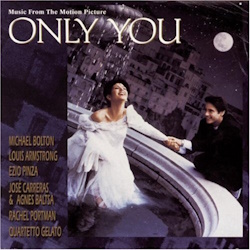
The soundtrack album for Only You features around 22 minutes of Portman’s score, and is bolstered by a series of Italian and Italian-adjacent romantic songs, including the aforementioned “Some Enchanted Evening” performed with sonorous seductiveness by opera singer Ezio Pinza, as well as the famous song “Only You (And You Alone)” from which the film derives its title, performed by the great Louis Armstrong. There are several classical pieces from Verdi and Bach, and original song called “Once in a Lifetime” written by Diane Warren and Walter Afanasieff and performed by Michael Bolton that drips with dates 1990s production values, but which I actually quite like.
Only You was perhaps the first score that really cemented Rachel Portman’s reputation as the go-to composer for Hollywood romances. Looking back with the hindsight of thirty years it’s now easy to see how influential it was in terms of her own career; many of the mannerisms, compositional stylistics, and touches in the orchestration would inform many of her later scores, including the Oscar-winning Emma, and such beloved works as The Cider House Rules and Chocolat. With that in mind it’s perhaps a little frustrating that this score isn’t as well known and well liked as they are; in many ways, Only You is their emotional equal, and as this score came earlier in her career, it could be seen as being a more original work. Either way, anyone who has ever felt the aching pang of unrequited love, or who has harbored a desire to fulfill some romantic fantasies amid the gorgeous Italian countryside, this is the score for you. I adore it.
Buy the Only You soundtrack from the Movie Music UK Store
Track Listing:
- Only You (And You Alone) (written by Buck Ram, performed by Louis Armstrong) (3:12)
- Written in the Stars (1:15)
- Some Enchanted Evening (written by Richard Rodgers and Oscar Hammerstein II, performed by Ezio Pinza) (3:01)
- I’m Coming With You (2:20)
- Venice (1:51)
- O Sole Mio (written by Eduardo Di Capua, Giovanni Capurro and Alfredo Mazzucchi, performed by Peter de Sotto and Quartetto Gelato) (3:09)
- Libiamo Ne’ Lieti Calici from La Traviata (written by Giuseppe Verdi, performed by Agens Baltsa and José Carreras) (2:57)
- Lost in Tuscany (2:29)
- Arriving at Damon’s Restaurant (1:39)
- Running after Damon (0:57)
- Gypsy Blessing (3:21)
- Positano (1:45)
- Quartet in B Flat Major (written by Johann Sebastian Bach, performed by Quartetto Gelato) (4:54)
- Do You Love Him? (3:15)
- Theme from Only You (3:34)
- Once in a Lifetime (written by Michael Bolton, Diane Warren and Walter Afanasieff, performed by Michael Bolton) (5:55)
Columbia CK 66182-2 (1994)
Running Time: 45 minutes 40 seconds
Music composed by Rachel Portman. Conducted by David Snell. Orchestrations by Rachel Portman. Recorded and mixed by Dick Lewzey. Edited by Bill Abbott. Album produced by Rachel Portman.

Shop at the Movie Music UK Store

Member of the

 MOVIE MUSIC UK