ED WOOD – Howard Shore
 THROWBACK THIRTY
Original Review by Jonathan Broxton
Edward D. Wood Jr. was an American filmmaker, actor, and writer, best known for his low-budget, unconventional films, often cited as some of the worst ever made. Despite lacking technical skill and often facing financial constraints, Wood had a passionate drive for filmmaking, and he eventually became known for two B-movies released in the 1950s: Glen or Glenda (1953), and Plan 9 from Outer Space (1959). Wood was also known for his eccentricities, including his love of angora and cross-dressing, which he incorporated into his films. Though ridiculed in his lifetime, he later gained a cult following and is now mostly celebrated for his unique, optimistic vision.
The screenplay for Ed Wood was written by Scott Alexander and Larry Karaszewski, who had developed a positive reputation for writing family comedies, but wanted to break away from that genre and explore more personal, offbeat projects. Their initial interest in Ed Wood came from their own fascination with Hollywood outsiders, and they wrote the screenplay as a biopic that celebrated Wood’s optimism, despite the critical view that he was the “worst director of all time.” The project was originally developed at Columbia Pictures, and they had considered Michael Lehmann (the director of Heathers) to direct, but when Columbia passed on the film, Disney’s Hollywood Pictures picked it up, and Tim Burton came on board. He was drawn to the material because of its connection to themes he often explored in his own work—outsiders, misunderstood visionaries, and the importance of imagination over convention. Burton found parallels between Ed Wood’s unbridled creativity and his own experiences in Hollywood.
Burton cast his old friend Johnny Depp to play Wood, with support from Martin Landau as troubled actor Bela Lugosi, and Sarah Jessica Parker and Patricia Arquette as Wood’s girlfriends Dolores Fuller and Kathy O’Hara, as well as Jeffrey Jones, Bill Murray, and Lisa Marie. One of the central aspects of the film is the relationship between Wood and Lugosi, which plays a significant emotional role in the movie. This storyline was based on real events, as Wood had befriended Lugosi, whose career had fallen into decline after his heyday playing Dracula, and cast him in several of his low-budget films. Lugosi became one of the key emotional anchors of the story, and Landau’s performance ultimately won him an Academy Award for Best Supporting Actor.
 The score for Ed Wood was by Howard Shore, and marked the first time in Tim Burton’s career that he had worked with any composer other than Danny Elfman on a full-length feature. Their creative relationship had been highly successful up to that point, with Elfman scoring many of Burton’s previous films, including Beetlejuice, Batman, Edward Scissorhands, and The Nightmare Before Christmas. However, during the production of The Nightmare Before Christmas, tensions arose between the two, partly due to creative differences and the intense workload Elfman faced. Fortunately, the Burton-Elfman partnership was only temporarily strained; they reconciled soon after and resumed working together on future projects, starting with Mars Attacks in 1996. Interestingly, Burton had apparently contacted Henry Mancini to score the movie, but when he became gravely ill with pancreatic cancer and could not work on the project, Howard Shore was the next choice. Mancini passed away in June 1994.
If one was being uncharitable, one could describe Ed Wood as Howard Shore doing his best Danny Elfman impression, but to do so would overlook what Shore achieved here. While it’s true that there is a significant Elfman influence in the score, that is almost a side effect of Shore’s decision to be inspired by the same 1950s B-movie sci-fi and horror scores that also often inspired Elfman: I’m thinking of scores by people like Bernard Herrmann, Leith Stevens, Paul Sawtell, Herman Stein, and early works by Henry Mancini and Elmer Bernstein, as well as lesser-known composers like Raoul Kraushaar and Albert Glasser. In addition to that, Shore brought a different dimension to his score by also drawing on the kitsch Latin mambo lounge music exotica style of composers like Les Baxter to represent the off-screen romantic life of Wood. These choices resulted in a final work which is tonally all over the place, but tremendously authentic.
To capture the sci-fi sound Shore employed a full orchestra augmented by electronic tonalities from both a theremin and an ondes martenot, and then to capture the 1950s kitsch sound Shore used lush and fulsome strings underpinned with Latin bongo rhythms. The “Main Title” is a perfect example of both styles combined, opening with a bold orchestral sound full of drama and portent, before switching to a fantastic exotica groove in its second half. The sci-fi sound is prominent mostly in cues which deal with Wood’s own love of those cheesy movies, and of Hollywood production itself; cues like “Bride of the Monster,” “I Have No Home,” and “Lurk Him” perfectly recapture this vibe. Elsewhere, the infectious and upbeat exotica sound returns prominently in cues such as “Elmogambo,” and the more urgent “Grave Robbers Begins,” before the whole thing comes back together for one final flourish in the superb end titles piece “Ed Wood [Video]”.
A love theme for “Ed and Kathy” is introduced in the eponymous track, an unexpectedly tender and romantic piece for warm strings and elegant woodwinds that is clearly the blueprint for the theme he would write for Nobody’s Fool later in 1994. Wood often said that Kathy was the love of his life – she did not have a problem with his transvestism – and they married in 1956, staying together until Wood’s death in 1978. The love theme appears strongly later in “Elysium,” and builds to a glorious, sweeping Hollywood climax in “This Is The One,” which underscores Wood’s reaction to his own film at the premiere of his most famous and notorious work, Plan 9 from Outer Space.
Other cues of note include the busy can-do optimism of “Backlot,” the quirky innocence and sense of wonderment in “Glen or Glenda,” the string-based drama of “Eddie, Help Me,” the playful ‘sneaking around’ music that accompanies Ed’s love of “Angora,” and the celebratory ‘World War II victory march’ theme that features prominently in “Ed Takes Control,” and then underscores much of the rousing “Eddie Takes A Bow,” riffing snare drums and tolling bells underneath a serious, patriotic-sounding theme for militaristic horns and strings.
One other interesting thing to mention about Ed Wood is the fact that Shore uses excerpts from the famous ballet Swan Lake by Pyotr Ilych Tchaikovsky as a recurring leitmotif for Bela Lugosi. Many of the early horror movies in which Lugosi starred used classical cuts in place of original score, and so using that music to represent him is a clever bit of meta-scoring. Not only that, the music itself is imbued with a pathos and an inherent romanticism that perfectly captures the state of Lugosi’s life at that time. Cues like “Mr. Lugosi,” “Eddie, Help Me,” “I Have No Home,” “Sanitarium,” and “Elysium” all feature Tchaikovsky’s music prominently.
The final thing that is noticeable in these cues, again, is just how much of a distinctive style Howard Shore has always had. So many times in the score there are fleeting references, little compositional stylistics, and instrumental phrases that foreshadow so many of the things he would later do in his Lord of the Rings scores, while also recalling things he was doing years earlier on projects like The Fly, Dead Ringers, and The Silence of the Lambs. Having become so much more familiar with his mannerisms over time, especially since Lord of the Rings, it’s always so rewarding to go back and realize just how much of that has always been present in his music.
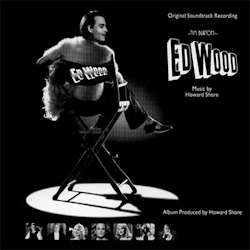
The 1994 soundtrack album for Ed Wood was released by Hollywood Records, and is an excellent representation of the music in the film, although some collectors may be annoyed to find that several cues feature dialogue excerpts performed in-character by Martin Landau as Lugosi and Jeffrey Jones as the psychic Criswell. I have never appreciated albums that do that – if you want to hear the dialogue, watch the film! – so this is something to bear in mind. With that one caveat in mind, everything else about Ed Wood works. It’s quirky, creative, offbeat and upbeat at the same time, and offers a wonderful homage to both 1950s low-budget sci fi scores and lounge music exotica that fans of either genre will appreciate for its authenticity and genuine affection.
Buy the Ed Wood soundtrack from the Movie Music UK Store
Track Listing:
- Main Title (feat. Jeffrey Jones as Criswell) (5:04)
- Backlot (1:06)
- Mr. Lugosi/Hypno Theme (1:56)
- Beware (feat. Martin Landau as Bela Lugosi) (0:56)
- Glen Or Glenda (1:18)
- Eddie, Help Me (1:56)
- Elmogambo (3:20)
- Bride of the Monster (1:17)
- I Have No Home (feat. Martin Landau as Bela Lugosi) (1:20)
- Kuba Mambo (written by Perez Prado) (1:53)
- Nautch Dance (written by Korla Pandit) (1:27)
- Angora (1:23)
- Sanitarium (3:42)
- Ed and Kathy (1:28)
- Elysium (2:16)
- Grave Robbers Begins (1:16)
- Lurk Him (1:04)
- Ed Takes Control (feat. Jeffrey Jones as Criswell) (4:06)
- Eddie Takes A Bow (1:00)
- This Is The One (1:58)
- Ed Wood [Video] (3:22)
Hollywood Records HR-62002-2 (1994)
Running Time: 43 minutes 08 seconds
Music composed and conducted by Howard Shore. Orchestrations by Howard Shore. Featured musical soloist Lidia Kavina. Recorded and mixed by John Kurlander. Edited by Ellen Segal. Album produced by Howard Shore.

Shop at the Movie Music UK Store

Member of the

 MOVIE MUSIC UK